






























Find the Bank That Accepts Your Background First, Then Compare Account Features
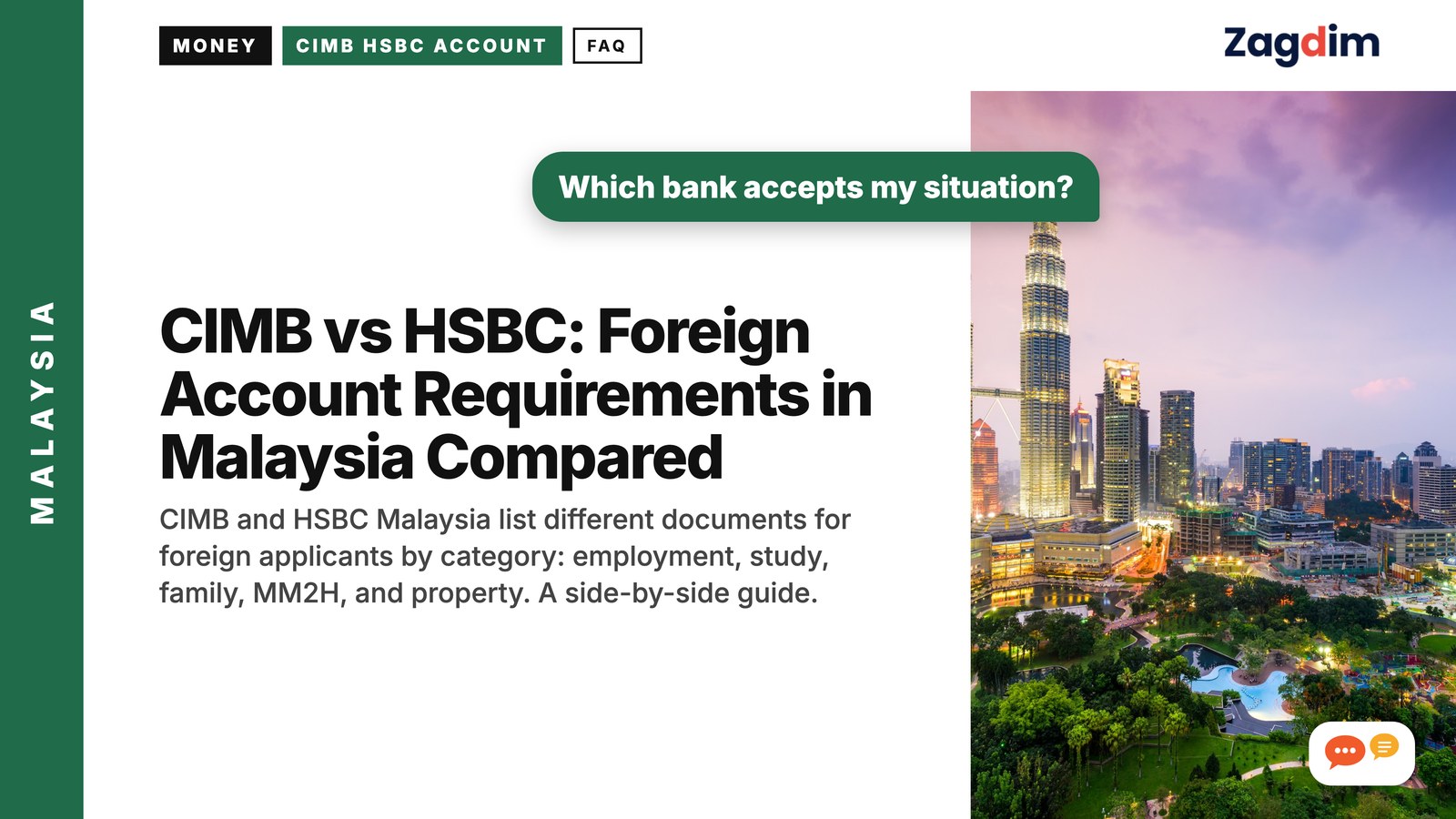
CIMB and HSBC have each published document requirements for foreign applicants, but the two banks categorize applicants differently and accept different kinds of proof. When comparing them, the question isn’t simply which bank is “easier” — start by identifying which category your own situation falls into: employment, study, family, or property.
The following is based on the lists as publicly viewable as of October 9, 2026. Meeting the document requirements does not guarantee account approval; the bank still carries out its own verification.
Working in Malaysia: CIMB’s Income Requirement Has a Named Exception
CIMB’s employed-applicant category lists a valid work permit or Employment Pass, an employer letter, and proof of monthly income of at least RM10,000. The list notes that CIMB@Work payroll customers are exempt from that income threshold. Passports and related permits are also subject to remaining-validity requirements.
HSBC’s employment category requires an employer letter, and depending on the list, asks for a work permit, a Residence Pass–Talent, or specified company financial or banking information as supporting proof. Applicants should let the bank confirm which category applies to them — this should not be read as meaning any employed applicant can skip valid residency and identity verification.
The two banks’ requirements are not interchangeable with each other, and CIMB’s RM10,000 threshold is not a salary requirement set by Malaysian law for all foreigners opening accounts.
Students and Dependents: More Than Just Handing Over a Permit
CIMB’s student category separately lists a student ID and a confirmation letter from the local institution, and notes that foreign students may only open a savings account. HSBC requires a corresponding admission letter and student pass; students at universities in Peninsular Malaysia also go through EMGS verification.
Dependent applications generally require proof of the relationship to the main applicant, plus evidence of financial support or residency arrangements. The specifics differ between the two banks, and a marriage certificate alone is not sufficient grounds for opening an account.
MM2H: Applications in Progress and Already-Approved Cases Are Treated Differently
CIMB’s list distinguishes between MM2H applicants who are arranging their fixed deposit through CIMB while the application is still in progress, and applicants who are already approved with the fixed deposit held elsewhere. The in-progress category lists approval or confirmation documents from the relevant authority submitted through a licensed agent, plus an approved social visit pass. The already-approved category separately lists a valid MM2H pass and address information.
HSBC’s requirements for MM2H, related state programs, and PVIP include an immigration approval letter and a valid social visit pass. General tourist entry documents should not be treated as meeting the requirements for a long-stay program category.
Buying and Renting Out Property: HSBC Lists a Separate Documentation Path
HSBC’s property category requires proof of income source, and offers several property-document options — for example, a recently signed and stamped sale and purchase agreement, an older agreement paired with a property tax bill or utility bill, or an HSBC/HSBC Amanah loan approval letter under specified conditions. For rental-income purposes, the list also accepts a valid, signed, and stamped tenancy agreement.
This shows that property-related use cases have a clear documentation path to ask about. It does not mean owning any property automatically qualifies someone to open an account, nor do all banks take the same approach.
Proof of Address and Product Thresholds: Check Once More at the End
HSBC’s list requires proof of a local address held in the applicant’s own name for Advance accounts, for specified reasons such as employment, having immediate family residing in Malaysia, studying, or marriage to a Malaysian national. This footnote should not be generalized into a blanket requirement for every product and every foreign applicant.
Separately, minimum balance, relationship requirements, and fees are product conditions, and should be compared apart from identity documentation. Holding Premier status overseas also does not mean a foreign applicant can skip Malaysia’s account-opening checks.
Commonly Misunderstood Situations
“If your monthly income is under RM10,000, no bank will let you open an account.”
This is not a market-wide rule. Even within CIMB’s own list, there is a named exception for payroll customers.
“HSBC accepts property documents, so someone on a tourist visa can definitely open an account.”
A documentation path is only one basis for the application; the bank still verifies the applicant’s full background and product eligibility.
What to Check Next
Ask both banks the same questions, confirming point by point which application category applies, how much validity remains on your documents, what address proof is needed, the minimum balance, and overseas banking functions, before deciding which one to approach. Banks may update their lists or ask for additional documents at any time.
Frequently Asked Questions
Q1: Is CIMB or HSBC definitely easier?
There is no universal answer. Compare whether each bank accepts your background and whether you can provide the corresponding proof.
Q2: Does every foreign applicant at CIMB face the RM10,000 monthly income threshold?
No. That is the requirement listed for the employed-applicant category, and CIMB@Work payroll customers have a named exception — it should not be applied to every category.
Q3: If I already hold HSBC Premier status overseas, can I open a Malaysian account directly?
You still need to meet the local product, relationship, and documentation requirements, and complete verification.
Disclaimer
This article is based on official and bank information viewable as of October 9, 2026, for general information purposes only; it does not constitute individual financial, tax, or legal advice. Account-opening, transaction, foreign-exchange, and documentation requirements may change; actual arrangements are subject to the institution, the contract, and applicable regulations.
References
CIMB Malaysia — Documents for Identity Verification; HSBC Malaysia — Supporting Documents to Open an Account
Have a question about this guide? Leave a comment below, or ask Zagdim directly.
Your first stop for international property and global living.
Research and insights. Know what’s changing. Understand what matters.