
































Buying property in Malaysia raises a recurring question for overseas buyers: should the purchase be made in a personal name or through a company? The answer touches rental income tax, what happens when a company wants to pay money out to its shareholder, the tax rate on an eventual sale (Real Property Gains Tax, or RPGT), and the stamp duty due on the purchase itself. This article sets out the rules behind that comparison, based on guidance and legislation from Malaysia’s Inland Revenue Board (LHDN).
Start With the Total Cost From Holding to Exit
Holding a property through a company does not automatically save tax compared with holding it in a personal name. A fair comparison has to add up the purchase costs, the annual costs of renting the property out, the cost of keeping the company running, the cost of a shareholder later taking money out of the company, and the eventual cost of selling.
It also matters which of three distinct statuses applies: “non-Malaysian citizen,” “non-permanent resident,” and “tax non-resident.” Each status can affect different taxes, so a single “foreigner” label cannot be used to set every tax rate at once.
Rental Tax Compares Taxable Income, Not Gross Rent
For an individual who is a tax non-resident, rental income is generally taxed at a flat 30%. An individual who is a tax resident is taxed instead at the applicable progressive rates. Nationality alone does not determine an individual’s tax residency status for income tax purposes.
For a company, the general standard rate is 24%, though preferential rates for micro, small, and medium-sized companies depend separately on conditions such as shareholding, capital, and income. A company that earns only passive investment income cannot automatically apply a lower tiered rate either.
Neither side can simply treat the full year’s gross rental income as the taxable amount. Deductible expenses, whether the rental counts as business income, and investment holding company rules can all change the calculation. In particular, the principal portion of a loan repayment cannot be treated as a deductible rental expense.
Company Profits Are Not Automatically the Shareholder’s Cash
After a company pays its tax, the remaining profit still belongs to the company, not to the shareholder personally. A shareholder can only withdraw funds on a proper legal basis, for example repaying a genuine shareholder loan or receiving a dividend declared according to the law.
From the 2025 assessment year, individual shareholders whose relevant Malaysian dividend income exceeds RM100,000 in total for the year fall under a 2% dividend tax arrangement. The actual taxable dividend income still has to be worked out under the applicable rules; after-tax profit at the company level cannot simply be treated as fully tax-free cash once it reaches the individual.
RPGT Classification Can Differ When You Sell
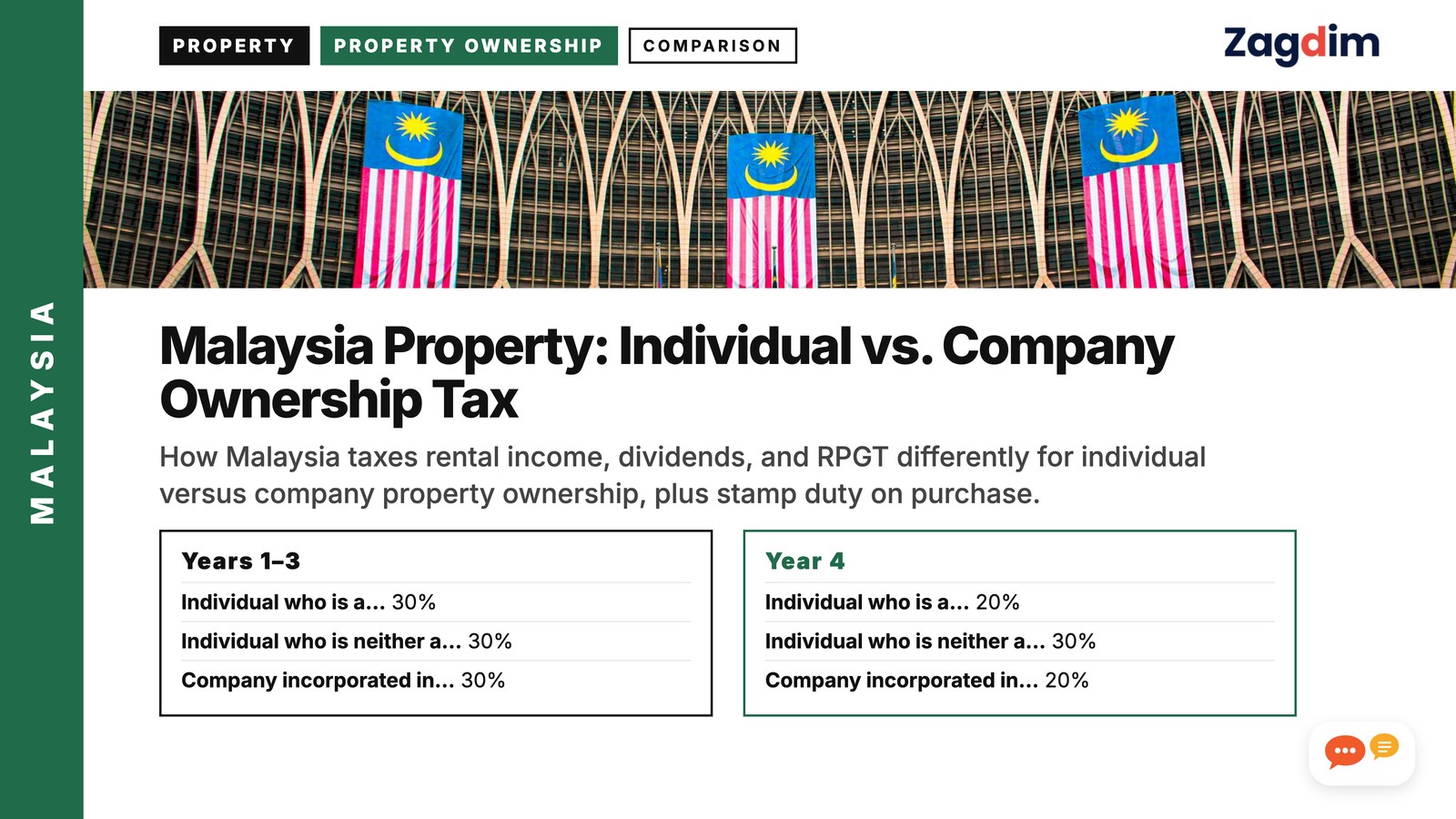
The table below applies to a property disposal that is capital in nature. If the disposal is actually part of a property trading business, the income tax treatment may differ.
| Seller Category | Years 1–3 | Year 4 | Year 5 | Year 6 Onward |
|---|---|---|---|---|
| Individual who is a Malaysian citizen or permanent resident | 30% | 20% | 15% | 0% |
| Individual who is neither a citizen nor a permanent resident | 30% | 30% | 30% | 10% |
| Company incorporated in Malaysia | 30% | 20% | 15% | 10% |
These rates apply to the chargeable gain as calculated under the law, not to the full sale price. A Malaysia-incorporated company with foreign shareholders should not automatically be classified the same way as a company incorporated overseas for RPGT purposes.
Purchase Stamp Duty and Annual Costs Also Belong in the Comparison
From 2026, the relevant residential transfer instrument for an individual who is neither a citizen nor a permanent resident carries an 8% stamp duty. How a company buyer is classified instead depends on the definitions in the stamp duty legislation and on how the transfer instrument itself is confirmed, not on how a state government defines foreign equity for other purposes.
A company also carries ongoing costs: company secretary fees, bookkeeping, statutory filings, and, where applicable, audit fees. Later transferring a company-held property back into one’s own name can itself count as a new transfer for tax purposes, not a free change of name.
Common Misunderstandings
“A Company’s 24% Rate Is Lower Than an Individual’s 30%, So a Company Must Be Better”
This comparison still needs to account for whether the individual is actually a tax resident, what expenses are deductible, the cost of running the company, dividend tax, and the eventual cost of selling.
“If a Foreigner Owns a Local Company, the Company’s Property Sale Is Automatically Taxed as a Foreign Individual”
RPGT seller classification is set by law. A Malaysia-incorporated company and a foreign individual are not the same category.
How to Decide the Next Step
Using the same property, the same rental figure, and the same holding period, prepare a separate after-tax income and expense projection for an individual owner and for a company owner, then factor in the likely exit route. If the property is already held personally, also account for the cost of transferring it into a company.
Frequently Asked Questions
Does a Foreign Individual Always Pay 30% on Rental Income?
Not necessarily. Tax residency status under income tax rules needs to be confirmed first; a tax resident is taxed at the standard progressive rates instead.
Is a Company’s Property Sale RPGT-Free From Year Six?
No. A Malaysia-incorporated company generally still pays 10% RPGT from year six onward; it cannot apply the zero rate available to citizen or permanent-resident individuals.
Is a Dividend a Company Pays to Its Own Shareholder Completely Tax-Free?
An individual shareholder still needs to check the dividend tax threshold, exemptions, and calculation rules that have applied since the 2025 assessment year.
Disclaimer
This article is based on information available as of October 8, 2026, and is provided for general reference only. It does not constitute legal, tax, financial, or investment advice. Actual transactions should be confirmed against the specific property, company structure, applicable law, and formal contracts.
Sources
LHDN — Non-Resident Individuals; LHDN — Public Ruling 8/2025: Tax Treatment for Micro, Small and Medium Companies; LHDN — Public Ruling 12/2018: Income From Letting of Real Property; LHDN — Real Property Gains Tax Rates; LHDN — Finance Act 2025 (Act 874), stamp duty amendment for residential transfers; LHDN — 2025 Budget tax seminar Q&A, individual dividend tax
Have a question about this guide? Leave a comment below, or ask Zagdim directly.
Your first stop for international property and global living.
Research and insights. Know what’s changing. Understand what matters.