
































If you live outside Japan and own property there, a tax break ended on 1 October 2026. The brokerage fee (chukai tesuryo, 仲介手数料) you pay a Japanese agent to sell, buy or let a property used to be free of consumption tax (shohizei, 消費税). It now carries 10%.
Which costs are affected? Can a deal that was signed before the change, but has not yet completed, stay under the old rule? Zagdim asked two Japanese tax accountants (zeirishi, 税理士), Kohei Wataguchi of Suinas Tax Corporation and Cong Wang of BPS International Tax Accountant Corporation, how to work it out in practice and what paperwork to keep now.
In short: from 1 October 2026, if you live overseas and use a Japanese agent to sell, buy or let property, the agent’s brokerage fee is no longer tax-free. It now carries 10% consumption tax. The only exception is a contract signed on or before 31 March 2026, which can stay exempt under a transitional rule (keika sochi, 経過措置). What you should do now is check the dates on your contracts and keep the paperwork.
What Changed, and What Didn’t?
Only one cost is affected: the brokerage fee. From 1 October 2026, when an agent acts for a non-resident in buying, selling, exchanging or leasing property located in Japan, that service is subject to consumption tax wherever the client lives. This covers overseas buyers too: the fee you pay an agent when buying property in Japan is taxed in the same way. Until now, these fees were treated as services supplied abroad and were exempt as “exports”.
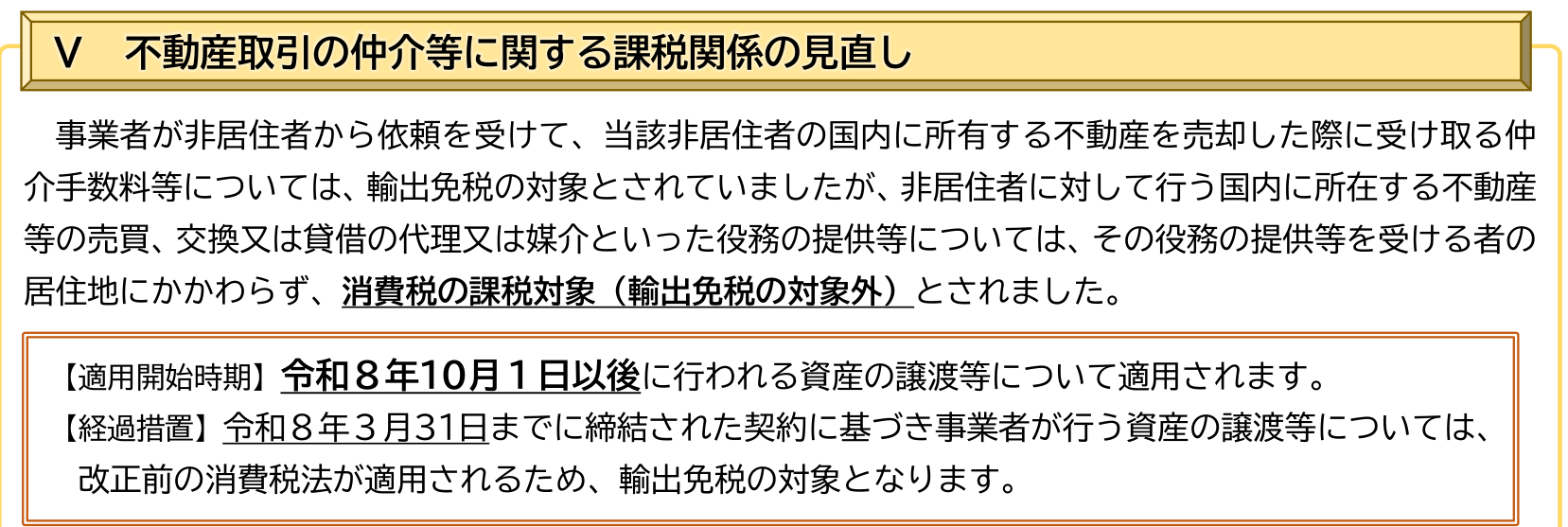
A non-resident (hikyojusha, 非居住者) here means an individual with no domicile or residence in Japan. The standard consumption tax rate is 10% (7.8% national plus 2.2% local).

“The only addition under this change is the brokerage fee, so it is important not to confuse the sale price with the brokerage fee. Services such as property management fees, repairs and cleaning were already taxable before the change, and the treatment of the sale price itself (land non-taxable, buildings taxable) is unchanged.”
Wataguchi summarises what is and isn’t affected:
| Category | Item | Effect of the change |
|---|---|---|
| Newly taxable | Brokerage fee on a sale | Yes (from October) |
| Newly taxable | Brokerage fee on a lease (e.g. finding a tenant) | Yes (from October) |
| Already taxable | Management company fees; repairs, cleaning and similar services | None. Managing or repairing property in Japan was never exempt |
| Outside consumption tax | Fixed asset tax, registration and licence tax, stamp duty | None (these are taxes themselves, so no consumption tax applies) |
Table: summary by Kohei Wataguchi (October 2026)
For owners, your monthly management and repair bills are not affected. What changes is the fee you pay an agent when you sell, or when you need a new tenant. If your property is let, every future tenant search through an agent falls under the new rule.
Does the Old Rule Still Apply to Me? Check Two Dates
It comes down to two dates: when the contract was signed, and when the agent’s service is completed. The new rule applies to transactions on or after 1 October 2026. A contract signed on or before 31 March 2026 stays under the old rule and remains exempt, even if the transaction completes after October.
Cong Wang, Assistant Tax Accountant at BPS International Tax Accountant Corporation, explains the test in terms of the handover date and the contract date: “The treatment depends on the handover date and the contract date. If the handover takes place on or before 30 September 2026, the previous export exemption applies. If the handover takes place on or after 1 October 2026 but under a contract signed on or before 31 March 2026, the transitional rule keeps it export-exempt. If the contract was signed on or after 1 April 2026 and the handover takes place on or after 1 October, the export exemption no longer applies.”
Wataguchi sets out the three scenarios by contract date and service date:
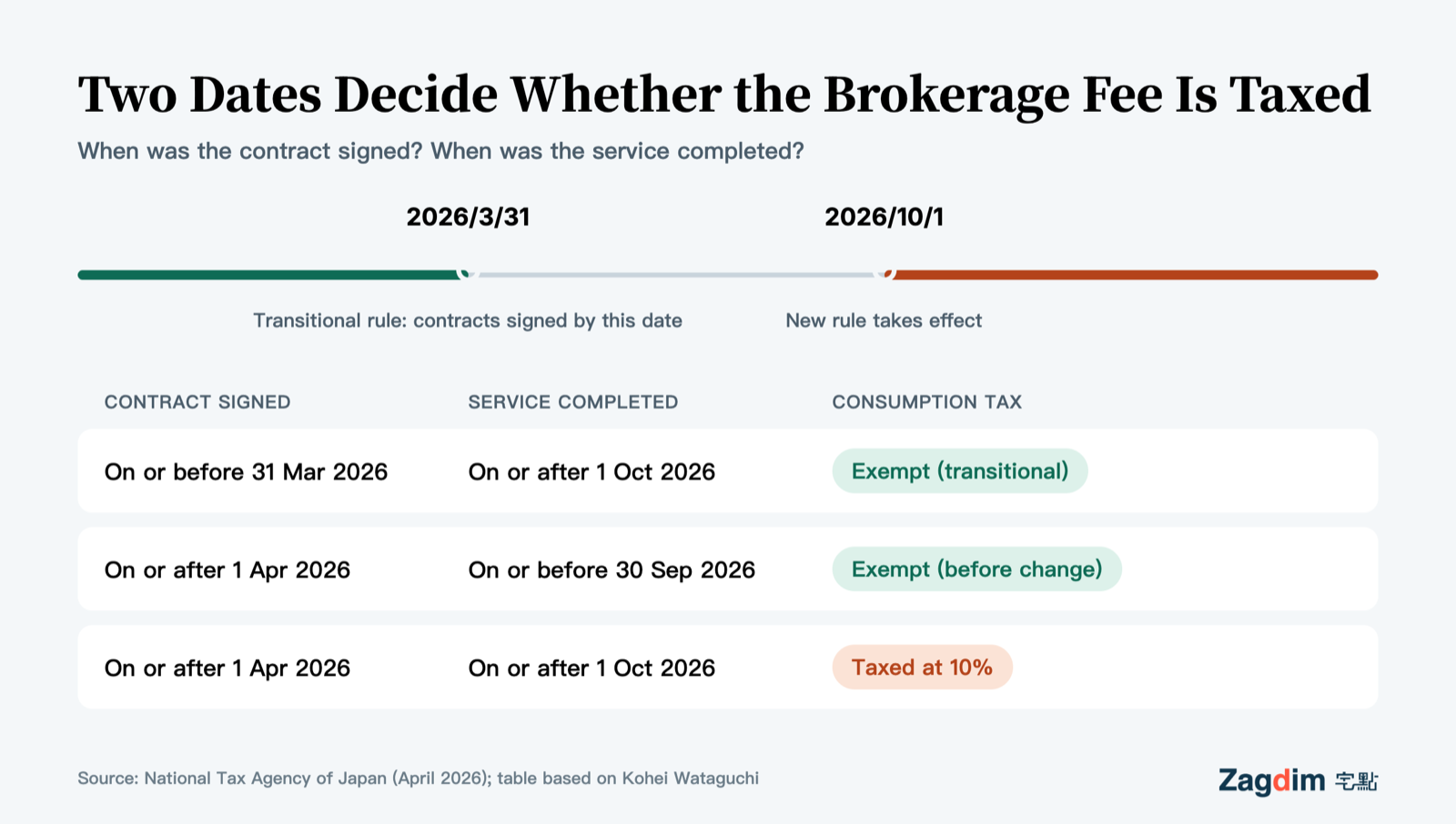
For example, an owner living in Taipei asks a Tokyo agent in May 2026 to sell a flat, and the buyer takes handover in December. The contract was signed after 1 April and the handover is after 1 October, so this is the third scenario: the brokerage fee carries 10% consumption tax.
The harder cases are when a brokerage agreement signed before March is later renewed or its terms change, or when the sale contract and handover fall in different months. Official guidance does not spell out every such case. If your dates sit close to either cut-off, it is worth asking a tax accountant to review the actual documents.
Kohei Wataguchi of Suinas Tax Corporation also warns against adjusting dates to fit the rule: “Contracts signed on or before 31 March 2026 remain exempt even if the transaction takes place after October [2026]. Contracts signed on or after 1 April with services provided on or after 1 October are taxable. Formal adjustments made only to qualify for the transitional rule, such as moving the contract date forward, risk being disallowed.”
What Should I Keep Now?
Anything that proves when a contract was signed matters most. The two accountants’ recommendations, combined:
| Document | What it should show | Recommended by |
|---|---|---|
| Brokerage agreement (your contract with the agent) | Signing date and validity period | Wataguchi, Wang |
| Documents or emails on renewals, re-signing or changed terms | Date and content of each change | Wataguchi |
| Sale agreement | Signing date | Wataguchi, Wang |
| Lease agreement | Signing date | Wataguchi |
| Invoices and receipts for the brokerage fee | Whether consumption tax applies, and the rate | Wataguchi, Wang |
| Proof of non-resident status | That you have no domicile in Japan | Wataguchi |
The table combines both accountants’ advice. Wataguchi’s list is the most complete, running from the brokerage agreement and records of any changes to proof of non-resident status; Wang focuses on “documents that show the contract date, such as the sale agreement, the brokerage agreement, and invoices and receipts for the brokerage fee.”
If your contracts are only on paper, or renewal records are scattered across emails, sorting them out now will make a future sale and tax filing much easier.
What Is the Most Common Filing Mistake?
Assuming “I live overseas, so the tax is 0%.” From October 2026, that reasoning no longer holds for brokerage on property in Japan.

“A likely filing mistake after the change is assuming that consumption tax is export-exempt because the client lives overseas. Brokerage and similar services relating to property in Japan are now subject to consumption tax even when the client is a non-resident, so a transaction should not be treated as 0% simply because it is for a non-resident.”
When an agent’s invoice arrives, check it against your contract dates. If your contract falls within the transitional rule but tax has been added, or the other way round, ask the agent first.
When you sell, the brokerage fee counts as a selling expense that is deducted from the sale price before your capital gain is calculated. How the extra consumption tax is treated on your return is worth confirming with the accountant who files it.
The Bottom Line
The change touches only one fee, but you will meet it every time you sell or find a tenant. Contract dates decide the outcome, and good records are the best preparation.
If your contract dates fall either side of 31 March or 1 October 2026, or you are not sure your documents are enough, tell Zagdim about your situation and we can arrange a suitable specialist for you.
Life abroad? Ask Zagdim.
Your first stop for international property and global living.
Research and insights. Know what’s changing. Understand what matters.
Newsletter for overseas updatesSubscribe →
Key Terms
- Consumption tax (消費税): Japan’s tax on goods and services; the standard rate is 10%.
- Export exemption (輸出免税): the rule that removes consumption tax from exports and services supplied abroad.
- Transitional rule (経過措置): an arrangement that lets existing contracts stay under the old rule when a new one takes effect.
- Non-resident (非居住者): an individual with no domicile or residence in Japan.
- Brokerage agreement (媒介契約): the contract an owner signs with an agent to sell or let a property.
- Selling expenses (譲渡費用): costs paid directly to sell land or buildings, such as the brokerage fee.
About This Article
Information was checked on 13 October 2026. The rules are drawn from the National Tax Agency’s consumption tax amendment notice (April 2026), its Tax Answer pages, and the Ministry of Finance’s FY2026 tax reform outline. Official guidance does not state, case by case, which contract’s date counts or exactly when a brokerage service is treated as completed; the guidance in the second section reflects the two accountants’ practical views.
The experts’ comments are their own professional views. Quotes were confirmed by each expert in Japanese and translated by Zagdim. This article is not individual tax advice; please consult a tax accountant about your own situation.
References
National Tax Agency – 消費税法改正のお知らせ (April 2026), Section V, “Review of taxation on brokerage of real estate transactions” / National Tax Agency – Tax Answer No.6567, Services supplied to non-residents / National Tax Agency – Tax Answer No.6551, Export exemption / National Tax Agency – Tax Answer No.6303, Consumption tax rates / National Tax Agency – Tax Answer No.3255, Selling expenses / Ministry of Finance – FY2026 Tax Reform Outline (Cabinet decision, 26 December 2025)