






























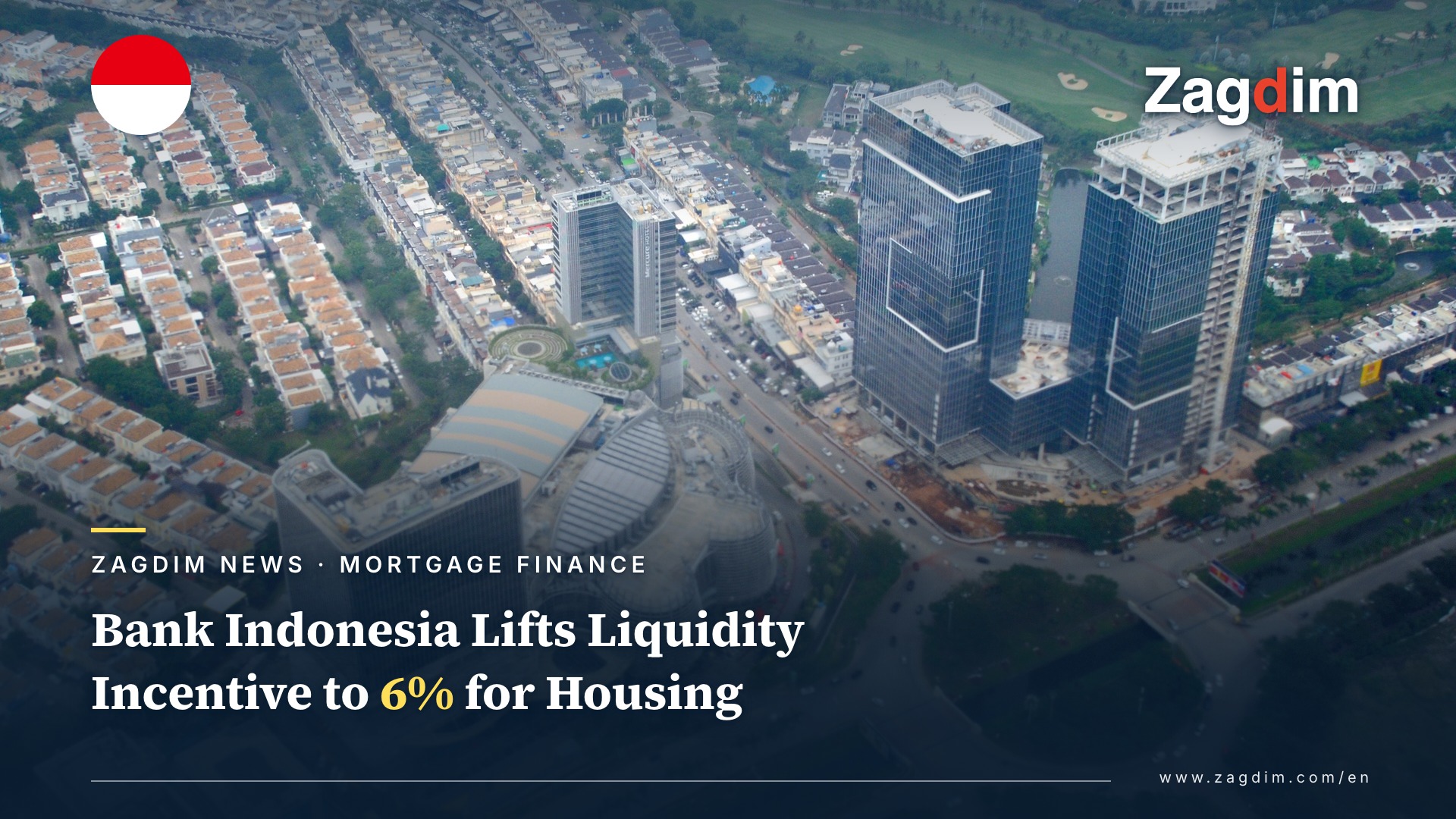
Bank Indonesia has raised the cap on its Macroprudential Liquidity Incentive (KLM) to 6%, split into a maximum 4% for direct sector lending and 2% for money market deepening, effective from September 2026. The move continues a series of step-increases to the tool — the cap stood at 5.5% as recently as August 2026.
KLM is not an interest-rate cut. Under the scheme, Bank Indonesia lets commercial banks hold less in the minimum reserves they must otherwise park at the central bank, in exchange for directing lending toward designated priority sectors, including housing, real estate and construction. That frees up funds a bank would otherwise leave idle, lowering its effective cost of funding loans into those sectors — without Bank Indonesia touching its benchmark policy rate.
The housing, real estate and construction sectors have a dedicated ceiling of 1.4% of banks’ third-party funds under the scheme. Bank Indonesia says realization currently stands at about 1.32%, leaving roughly 0.08 percentage points of unused headroom for banks to draw on. Between April 2025 and July 2026, the incentive framework helped facilitate 115,927 new commercial home mortgages (KPR) worth a combined Rp 68.35 trillion (about US$4.30 billion), according to Bank Indonesia.
Mortgage borrowers and property developers are the main parties affected: banks drawing on the incentive have more room, and more reason, to extend home loans and construction financing on competitive terms. Bank Indonesia also maintains a separate Macroprudential Inclusive Financing Ratio (RPIM) channel encouraging banks to expand low-cost housing credit for lower-income households, and continues to allow loan-to-value and financing-to-value ratios of up to 100% for qualified borrowers, removing the standard down-payment requirement.
Speaking at a coordination meeting with Minister of Housing and Settlement Areas Maruarar Sirait at Bank Indonesia’s headquarters on October 2, 2026, Governor Destry Damayanti said the central bank “will continue to strengthen” its institutional synergy with the government’s housing agenda. Maruarar welcomed the liquidity move, linking it to government housing initiatives including the “Gentengisasi” roof-modernization program, and said “the public must know that Bank Indonesia’s policies carry a tangible, massive impact on the Indonesian economy.”
References
Bank Indonesia – Macroprudential Policy Instrument (Kebijakan Insentif Likuiditas Makroprudensial) / Investortrust.id – Bank Indonesia Boosts Macroprudential Liquidity Incentive to 6% in Fresh Push for Housing Sector