Zagdim Overseas
Subscribe
  • News
    • Thailand
    • Japan
    • UK
    • Germany
    • Global Reports
  • Country Guides
    • Thailand
    • Japan
    • Malaysia
    • Vietnam
    • Philippines
    • Indonesia
  • Property Research
    • Zagdim Insights
  • Ask Zagdim
  • About
    • Zagdim Research
    • Expert Network
    • Contact Us — LINE / WhatsApp
  • 中文 EN
No Result
View All Result
Zagdim
No Result
View All Result

DHS Finalizes Rule Ending Automatic Extensions for H-4, Asylum and Green-Card Work Permits

Home News
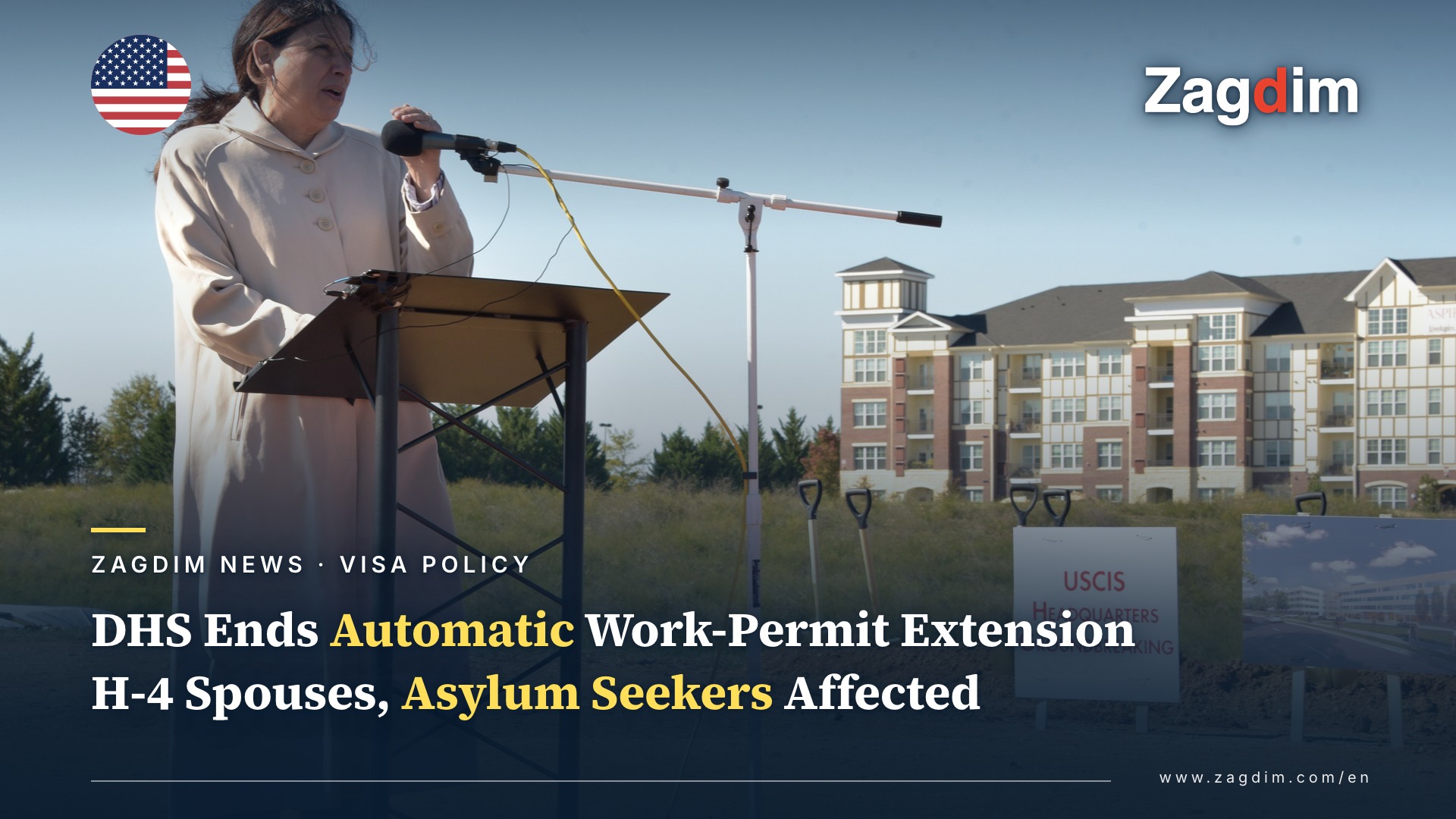
A DHS official speaks at the 2017 USCIS headquarters groundbreaking ceremony in Camp Springs, Maryland, with a 'USCIS HEADQUARTERS Groundbreaking' sign visible, illustrating a story on DHS/USCIS ending automatic work-permit extensions

Photo: U.S. Department of Homeland Security (Public Domain), 2017 USCIS headquarters groundbreaking, cropped

October 15, 2026
in News, Real Estate & Economic News
Reading Time: 3 mins read
Tags: United States

The Department of Homeland Security has finalized a rule that keeps a policy already in effect for nearly a year: work-permit holders in several categories — including H-4 spouses of H-1B workers, pending asylum applicants and green-card (adjustment-of-status) applicants — no longer get an automatic extension of their work authorization while a renewal application is pending.

USCIS published the final rule, “Removal of Automatic Extensions for Certain Employment Authorization Documents,” in the Federal Register on October 14, 2026 (91 FR 65306, Docket No. USCIS-2025-0271). It is effective the same day. The final rule does not change anything substantively — it responds to public comments received on an interim final rule DHS issued on October 30, 2025, and “reaffirms and finalizes” that rule’s provisions “without changes.” The operative cutoff date for affected applicants remains October 30, 2025: that is the date on which the up-to-540-day automatic extension of Employment Authorization Documents (EADs, Form I-766) stopped applying to new renewal filings.

Before the change, aliens who timely filed a renewal Form I-765 could keep working on their facially expired EAD, backed by a USCIS receipt notice, for up to 540 days while the renewal was adjudicated. According to USCIS’s own Handbook for Employers (M-274, Section 5.1), the categories that previously qualified for this automatic extension include C26 (H-4 dependent spouses of H-1B workers), A17 (E treaty-investor/trader dependent spouses), A18 (L-2 intracompany-transferee dependent spouses), C08 (asylum applicants, who may be granted work authorization at USCIS’s discretion once 180 days have passed since filing, under INA section 208(d)(2)), and C09 (adjustment-of-status, i.e. green-card, applicants), along with several narrower humanitarian and parole-related categories. Temporary Protected Status (TPS) extensions are governed separately by their own Federal Register notices and are not affected by this rule. DHS says the change is meant to ensure USCIS completes “proper vetting and screening” and an eligibility determination before extending anyone’s work authorization, rather than extending it automatically on the strength of a timely filing alone.

For someone whose EAD renewal was filed before October 30, 2025, nothing changes: the facially expired card, together with the matching receipt notice, remains valid proof of work authorization for up to 540 days or until the renewal is decided, whichever comes first. For a renewal filed on or after that date, there is no automatic extension — if the current EAD expires before USCIS approves the renewal, the person must stop working until a new physical EAD is issued; a receipt notice alone no longer suffices. One exception applies to H-4, E and L-2 dependent spouses: if their underlying nonimmigrant status (shown on an unexpired Form I-94) has not itself expired, they may remain work-authorized by virtue of that status even after their EAD document lapses, though the expired EAD can no longer be used as proof. USCIS, in its original October 2025 announcement — reaffirmed by this final rule — recommends filing a renewal application up to 180 days before the current EAD expires to reduce the risk of a gap, and Director Joseph Edlow said the change reflects a “renewed emphasis on robust alien screening and vetting.” In its own regulatory impact analysis, DHS estimates that 20,000 to 33,000 EADs will lapse over an 18-month window beginning around May 2027, affecting roughly 1,700 to 2,800 U.S. employers, with an estimated $138.1 million in lost productivity and $312.1 million in labor-turnover costs to employers.

References

Federal Register – Removal of Automatic Extensions for Certain Employment Authorization Documents / USCIS – DHS Ends Automatic Extension of Employment Authorization / USCIS – Handbook for Employers M-274, Section 5.1: Automatic Extensions Based on a Timely Filed Application to Renew Employment Authorization


Zagdim AI
All content is researched, written, or authorized for publication by the @Zagdim Overseas team. Sharing and reposting are welcome, but please make sure to credit the source and include the original article link from this website. Any plagiarism or unauthorized use may result in legal action. For article submissions, please contact us via Facebook. Thank you for your support!

For article submissions, press release publication, or interview notices, please contact [email protected]. 

Zagdim Ask

Have a specific question about overseas living, property, visa, or practical arrangements?

Fill in your situation and key concerns through Zagdim Ask. Our team will review your message and get back to you by email where appropriate.

Submit your enquiry →

Similar Topics

UK Landlords Told to Rethink Property Ownership as October Budget Tax Rise Could Wipe Out Profit for Some
News

UK Landlords Told to Rethink Property Ownership as October Budget Tax Rise Could Wipe Out Profit for Some

November 10, 2026
Greece's 15% Property Transfer Tax for Non-EU Tax Residents Is Now a Government Bill in Parliament
News

Greece’s 15% Property Transfer Tax for Non-EU Tax Residents Is Now a Government Bill in Parliament

November 10, 2026
Taiwan's Financial-Proof Thresholds for Naturalisation: NT$5 Million in Assets or Twice the Minimum Wage
News

Taiwan’s Financial-Proof Thresholds for Naturalisation: NT$5 Million in Assets or Twice the Minimum Wage

November 10, 2026
Next Post
Residential apartment buildings on a street in Barcelona, Spain, illustrating a story on landlords withdrawing homes from the long-term rental market over new housing decrees

Spain's Landlords Withdraw Thousands of Rentals as New Tenancy Decree Takes Hold

Germany's Top Court Hears Challenge to Family-Business Inheritance Tax Breaks

Germany's Top Court Hears Challenge to Inheritance-Tax Breaks for Family Businesses

File photo of New Zealand Prime Minister Christopher Luxon and Labour leader Chris Hipkins together at the 2023 State Opening of the 54th Parliament, illustrating a story on the two men clashing again over capital gains tax in the 2026 election debate

Luxon and Hipkins Clash Again over Capital Gains Tax as New Zealand's Election Nears

Facebook Twitter Youtube

About Us

Zagdim is a global knowledge platform focused on international property, global living, relocation, lifestyle, and location-based decision-making.

We provide insights on overseas real estate, market trends, regional analysis, economic developments, and practical relocation information. Through continuous market observation and on-the-ground research, Zagdim helps readers better understand a place before deciding where to live, invest, buy property, or establish a base abroad.

We currently follow markets including the UK, Japan, Thailand, Malaysia, Germany, Australia, the UAE, Greece, Portugal, and Spain, while continuing to track emerging lifestyle, relocation, and property trends worldwide.

Category

  • Australia
  • Buying & Immigration Guide
  • Cambodia
  • Canada
  • Costa Rica
  • Dubai
  • Encyclopedia
  • Europe
  • Expat Lifestyle Guide
  • Germany
  • Global Reports Analysis
  • Hong Kong
  • Human-Picked
  • Indonesia
  • International Property Buying Guide
  • Japan
  • Japan Market News
  • Kenya
  • Living Abroad
  • Malaysia
  • Mallorca
  • Market Trends Overview
  • News
  • Other Market News
  • Overseas Leasing & Long-Term Stay
  • Partner Content
  • Philippines
  • Policy Interpretation
  • Portugal
  • Property
  • Property Law & Tax
  • Real Estate & Economic News
  • Real Estate Law & Taxation
  • Relocation, Immigration & Visa
  • Singapore
  • South Korea
  • Spain
  • Switzerland
  • Thailand
  • Thailand Market News
  • UK Market News
  • United Kingdom
  • United States
  • Vietnam
  • Vietnam Market News
  • Visa & Immigration
  • Zagdim Insights
  • Zagdim Property Insights

Email:[email protected]


Add Friends


WhatsApp
Contact Us


Wechat:Zagdim

Work with Zagdim

For brand and content partnership enquiries, email [email protected].

©2026 Zagdim Overseas All Rights Reserved · Privacy Policy

No Result
View All Result
  • News
    • Thailand
    • Japan
    • UK
    • Germany
    • Global Reports
  • Country Guides
    • Thailand
    • Japan
    • Malaysia
    • Vietnam
    • Philippines
    • Indonesia
  • Property Research
    • Zagdim Insights
  • Ask Zagdim
  • About
    • Zagdim Research
    • Expert Network
    • Contact Us — LINE / WhatsApp
  • 中文 EN

©2026 Zagdim Overseas All Rights Reserved · Privacy Policy