

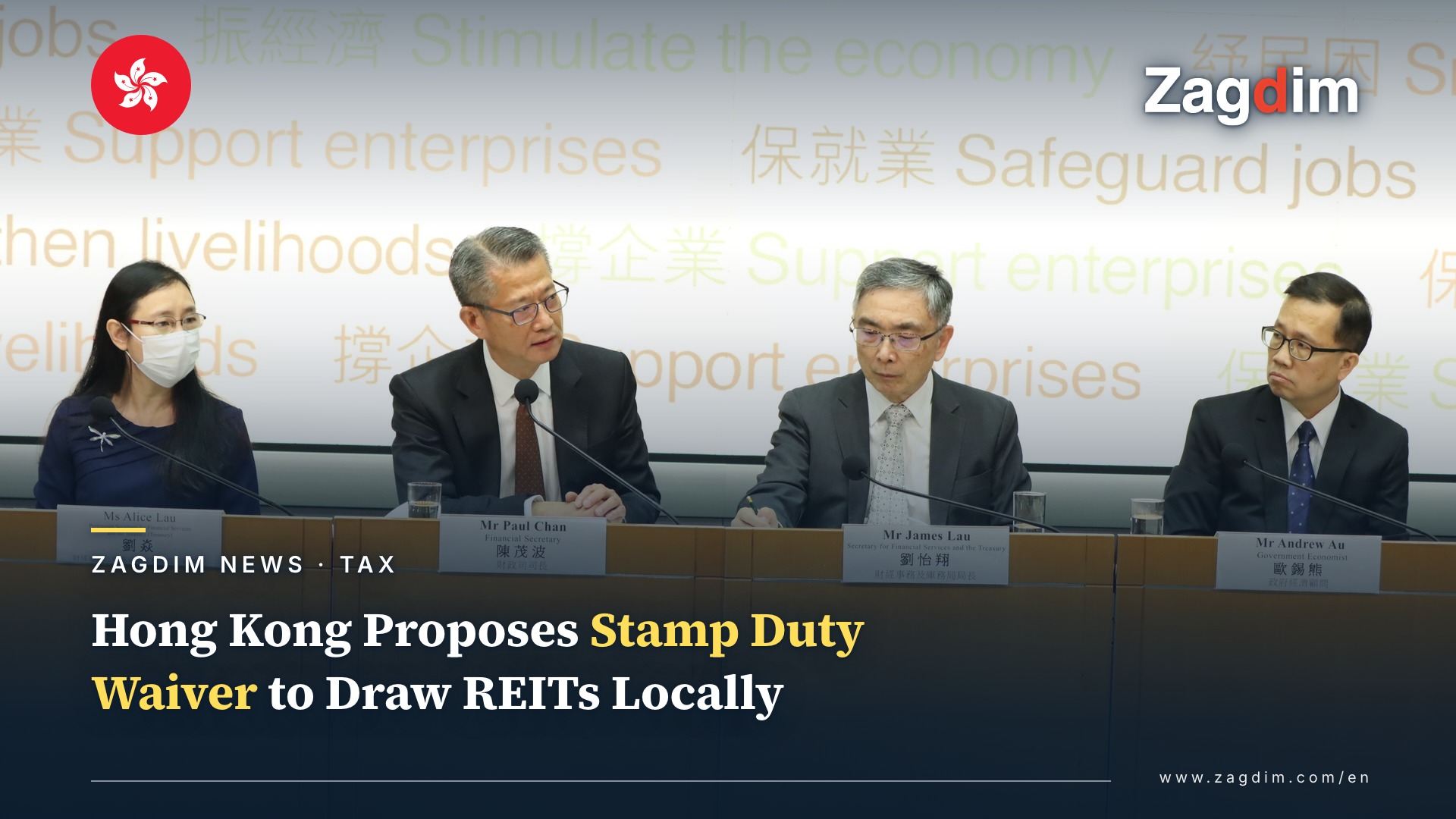
The Hong Kong government has set out a proposal to waive stamp duty on transfers of non-residential property and related company shares into real estate investment trusts (REITs) that are seeking to list in Hong Kong, according to a Legislative Council paper dated November 6, 2026, summarized by KPMG in its latest Hong Kong SAR Tax Alert. The waiver was first flagged in the 2026/27 Budget as a way to promote Hong Kong’s REIT market; the Legislative Council paper now lays out the detailed framework.
The waiver would cover stamp duty on transferring Hong Kong non-residential properties, and on shares in special-purpose vehicles that hold such properties, into a REIT — but only for new REITs seeking their first Hong Kong listing, or REITs already listed elsewhere that are pursuing a dual-primary or secondary listing in Hong Kong. REITs already listed in Hong Kong do not qualify. For a share transfer to qualify, non-residential property must make up at least 95% of the value of the assets held by the special-purpose vehicle. Hong Kong currently charges ad valorem stamp duty of up to 4.25% on non-residential property transfers, and 0.2% total (split between buyer and seller) on transfers of Hong Kong stock, so the waiver removes a real cost for sponsors assembling a REIT’s initial property portfolio.
The proposal comes with conditions designed to stop the waiver being used for a quick in-and-out. The REIT must list on the Hong Kong Stock Exchange within six months of the property or share transfer, though KPMG notes the government may allow flexibility on that deadline “in exceptional cases.” Once listed, the transferred properties or shares must remain part of the REIT’s portfolio for at least two years, and the REIT itself must stay listed in Hong Kong for at least two years. To enforce this, the government will place a statutory charge on transferred properties, or require the REIT to post security for transferred shares, released only once all waiver conditions are met.
The government plans to introduce the formal Amendment Bill into the Legislative Council in the first half of 2027. To avoid discouraging REITs from moving early, stamp duty paid on qualifying transfers between the bill’s introduction and the date the resulting law takes effect will be refunded once the REIT meets the eligibility criteria.
KPMG said the move is “a welcomed” step for Hong Kong’s competitiveness as a REIT listing venue, but flagged several open questions for the government to clarify: what evidence a REIT must show that it is actively progressing toward listing, what factors would justify extending the six-month deadline, and exactly how and when the 95% non-residential-property threshold for special-purpose vehicles will be assessed. The measure remains a government proposal awaiting legislation — it has not yet been enacted.