






























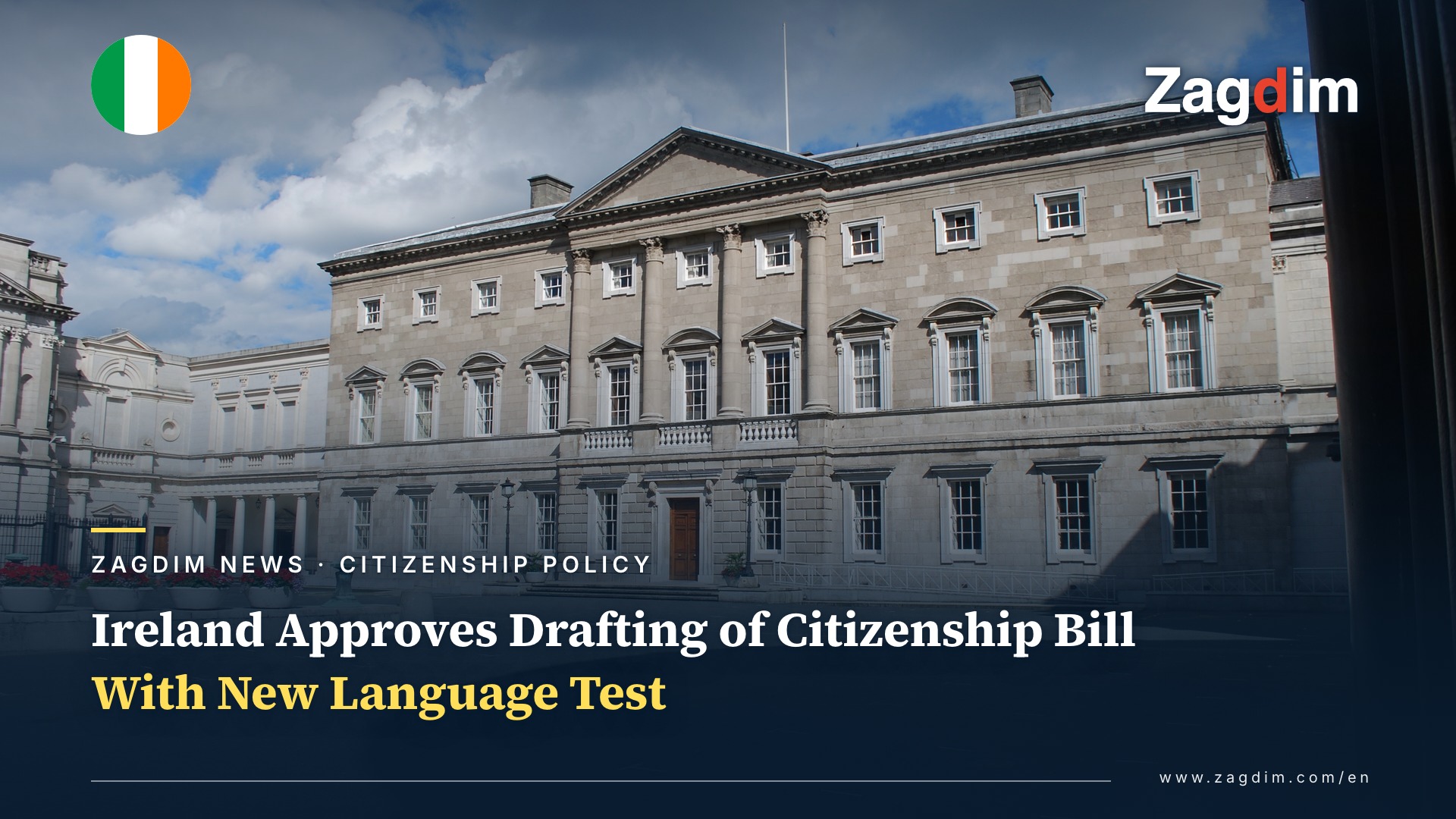
Ireland’s Cabinet has approved the priority drafting of a bill that would, for the first time, require most citizenship applicants to pass a test in English, Irish, or Irish Sign Language, alongside a longer residency period and new civics and self-sufficiency requirements.
What Happened
On September 9, 2026, Minister for Justice, Home Affairs and Migration Jim O’Callaghan and Minister of State for Migration Colm Brophy secured Cabinet approval for the priority drafting of the Irish Nationality and Citizenship (Amendment) Bill 2026, based on a General Scheme outlining the proposed changes, according to O’Callaghan’s own release and Irish Legal News. Under the scheme, most naturalisation applicants would for the first time have to demonstrate proficiency in English, Irish, or Irish Sign Language — Ireland currently has no language requirement for citizenship at all. The scheme reportedly gives the minister discretion to waive the test for vulnerable applicants, though the government has not published the required proficiency level or the test format.
Who It Affects
The language test and the other new conditions would apply to people applying for Irish citizenship through naturalisation, not those who acquire it by birth or descent. The scheme also proposes raising the standard qualifying period of reckonable residence from five years to eight (two years immediately before applying, plus six of the preceding ten), adding a test on Irish civics, society and politics, and requiring applicants to show economic self-sufficiency, Irish Legal News and immigration-law client alerts from Fragomen and Newland Chase reported. None of this affects anyone applying under the current rules while the bill is still being drafted.
Background So Far
Ireland is one of the few European countries that does not currently test naturalisation applicants’ language ability; a study by the Economic and Social Research Institute, prepared for the Department of Justice, found that 24 EU member states plus the UK already require it. Writing in The Conversation, Chelsea Whittaker, an assistant professor in further education and training and inclusion at Trinity College Dublin, said the change would add pressure to Ireland’s English for Speakers of Other Languages (ESOL) system, which had more than 36,900 non-national learners enrolled in 2024 but has faced funding cuts, teacher-retention problems, and calls for a more coordinated national framework dating back to the early 2000s. A coalition of migrant-rights and civil-society groups has argued the proposed changes “lack a strong evidence base and could make citizenship harder to access,” per the same article.
Outlook
O’Callaghan has described the reforms as “balanced, proportionate and necessary,” while Brophy called Irish citizenship “a privilege, not a right,” according to Irish Legal News. The General Scheme is still at an early drafting stage: it has yet to be published in full, and government and legal-sector reporting say it is expected to go to the Oireachtas Joint Committee on Justice for pre-legislative scrutiny before a bill is formally introduced, meaning the final wording — including the required language level — could still change. Whittaker wrote that “without these foundations, a policy intended to support integration risks creating new barriers to belonging,” arguing any new requirement needs “sustained investment, fair access to classes, support for teachers and a national ESOL strategy” to work as intended.
References
Jim O’Callaghan TD – Jim O’Callaghan Secures Approval for the Priority Drafting of the Irish Nationality and Citizenship (Amendment) Bill 2026 / Irish Legal News – Justice Minister Secures Priority Drafting of Irish Nationality and Citizenship (Amendment) Bill 2026 / The Conversation – Ireland Proposes Language Testing for Citizenship: More Demands on Already Stretched English Teaching