
































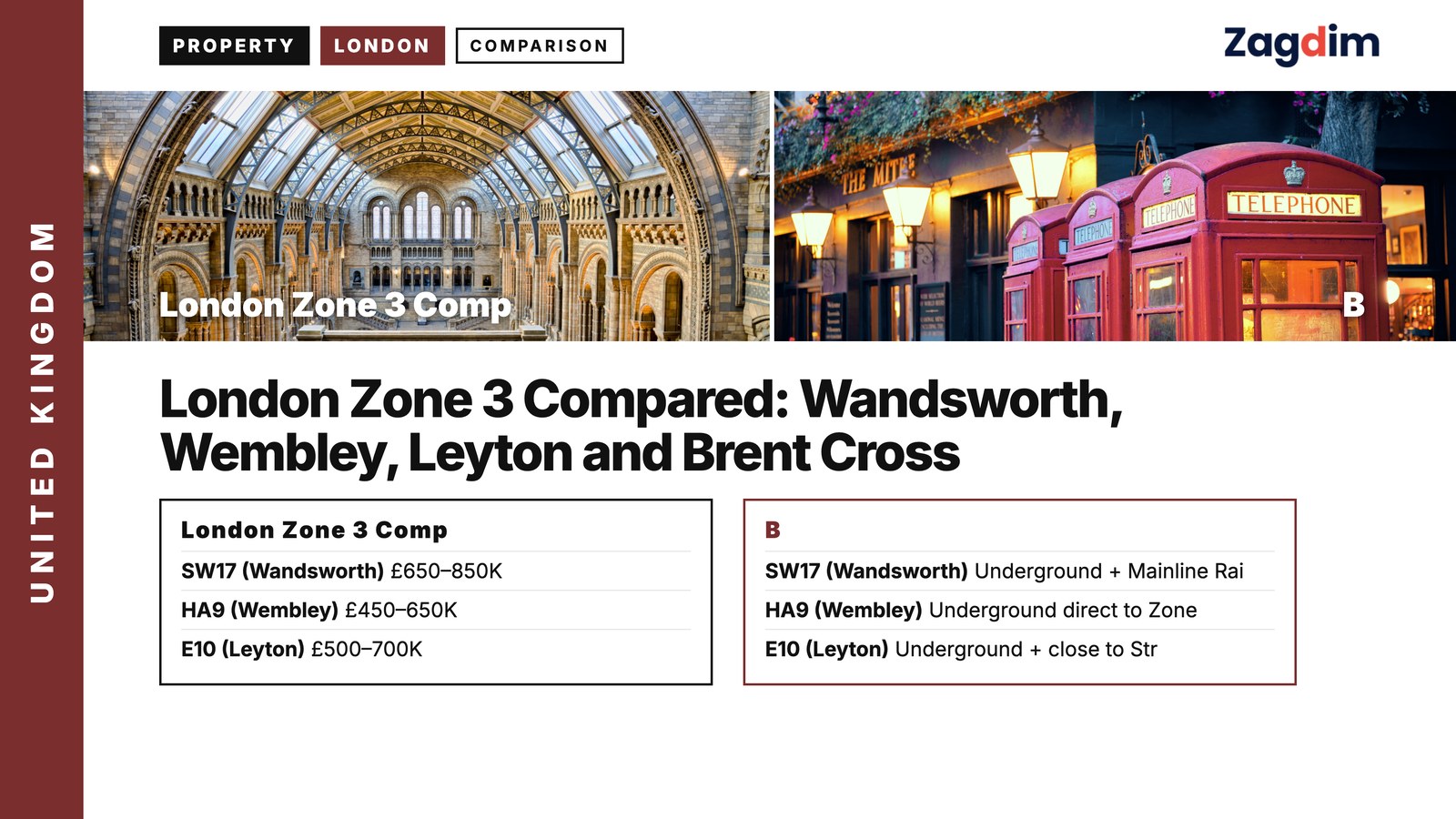
The Real Question About Zone 3: No Longer “Suburban,” but a Second City Core
For many people just starting to consider buying in London, “Zone 3” can still sound a little vague — not quite the city centre, not quite the suburbs either, a kind of in-between zone. But look closely at population movement, price trends, urban-regeneration schemes and transport policy over the past decade, and Zone 3 is quietly becoming London’s real “second core” — no longer simply the fallback choice for first-time buyers “settling for second best.”
Over the past decade, Zone 3 has absorbed large numbers of middle-class households, first-time buyers and young families priced out of Zones 1–2, and has also become the first choice for international buyers and new migrants hoping to find somewhere they can genuinely settle and build a life.
Local amenities here are steadily maturing: from the healthcare-led community regeneration around SW17, to Wembley’s large-scale redevelopment zone, Brent Cross’s tech new-town scheme, and the creative living cluster forming between Leyton and Stratford — each of these hotspots is changing, bringing new character and new possibilities.
But precisely because Zone 3 spans London’s east, west, north and south, each area’s feel, transport pattern and price structure differ sharply. Some lead on education resources, some draw crowds with large shopping centres, and some aim to become the next tech and start-up hub.
So the question becomes: Zone 3 is genuinely worth considering, but which area should you choose?
Below, we compare the four most talked-about, most representative Zone 3 areas — Wandsworth, Wembley, Leyton and Brent Cross — to give you the full picture of just how varied Zone 3 really is.
Wandsworth (SW17): A “Veteran Middle-Class Stronghold” of Mature Transport and Amenities
If Zone 3 is London’s “second core,” then Wandsworth — particularly the SW17 pocket covering Tooting and Earlsfield — is the “seasoned elder” of that core: long before many newer areas even began developing, this was already where middle-class families and professionals competed to settle, and prices were already ahead of first-time-buyer budgets.
Its biggest distinguishing feature is a rare “double stability” — neither transport nor daily life requires compromise.
On transport, Tooting Bec station (Northern Line) gets you to Bank or Leicester Square within 25 minutes; on the other side, Earlsfield mainline rail runs direct to Waterloo in just 14 minutes. Whether commuting, seeing a doctor or picking up children, it’s genuinely efficient day-to-day living.
On amenities, Graveney School ranks in the top 3% of schools in London, and combined with Wandsworth’s long-term investment in early-years education and community activities, the area has become synonymous with being “family-friendly.” Springfield Park, opened in 2024, is London’s largest new municipal park in a decade, paired with the NHS-led Springfield Village healthcare-plus-housing regeneration scheme, reshaping the area’s sense of community and health provision.
That said, maturity comes with a higher entry threshold.
According to Zoopla and HouseMetric data, SW17’s main transaction price range sits at £650,000–£850,000, with a one-bedroom starting price close to £590,000, and three-bedroom terraced houses regularly breaking £1 million. Rents aren’t cheap either, with two-bedroom units averaging £1,950–£2,200/month. This makes it hard for first-time buyers without a dual income and solid savings to get a foothold in this market.
Who is it for?
✔️ Those with childcare considerations, seeking stable schooling and quality of life
✔️ Those who can accept a mid-to-high total price, focused on long-term owner-occupation
✔️ Those who don’t want to take a risk on infrastructure or daily amenities
Next, we head to north London for a contrasting style — Wembley: a “new middle-class centre” built on scale and regeneration.
Wembley (HA9): Major Redevelopment and a Gathering Point for Asian Families
Wembley is one of the most significant and talked-about urban-regeneration areas in London over the past decade, and a case where Brent Council has invested the most resources into a district-wide redevelopment. Since the 2012 Olympics, the skyline and streetscape here have been thoroughly refreshed, gradually attracting large numbers of Indian and Chinese families to become the main buyer group, forming a culturally blended “new middle-class centre.”
On transport, Wembley’s advantages are clear. The Jubilee Line and Metropolitan Line run directly to Baker Street, Bond Street and Canary Wharf, with a journey time of around 20–25 minutes, letting commuters reach central work districts without changing lines. Add in Wembley Central, which connects to mainline rail and the Overground, and this area’s transport convenience even exceeds parts of Zone 2.
Amenities here are largely “development-led.” The Wembley Park regeneration scheme has built numerous modern residential blocks, shopping centres, restaurants and open spaces, with weekend markets and large event spaces keeping the area lively. At the same time, however, quality of life here depends heavily on how well new developments are planned and managed — step away from the main commercial hub, and some streets still carry an air of old-London suburban decline.
Prices are relatively affordable: a one-bedroom new-build starts around £450,000–£500,000, with two-bedroom units mostly in the £550,000–£650,000 range — an appealing option for families with limited capital who still want a new-build home.
That said, mixed school ratings and significant variation between streets are points to weigh carefully before buying. Some schools have only average rankings, and the area’s crime rate remains above the London average, particularly around stations at night, where a sense of safety and community connection need more attention.
Who is it for?
✔️ Families who value direct transport links and have a limited budget
✔️ Those who can accept higher-density living and value a multicultural atmosphere
✔️ Those who see amenities being pulled together by new developments as an advantage
Next, we head east to Leyton (E10), an emerging spot that has transformed itself from an industrial area into a creative cluster.
Leyton (E10): A Young Start-Up Enclave in a Resurgent East London
Amid east London’s transformation from industrial district to creative hub, Leyton (E10) is one of the most representative transitional areas. Just one stop from Stratford, and sandwiched between Hackney and Olympic Park, it’s rapidly becoming a new gathering point for young entrepreneurs, freelancers and migrant families.
On transport, Leyton station (Central Line) reaches Liverpool Street within 15–20 minutes, giving it strong commuter convenience. Nearby, Stratford International also offers potential connections toward Europe via Eurostar, and with the DLR, Elizabeth Line and other lines converging here, it has become one of east London’s important transport hubs.
On amenities, Olympic Park and Hackney Marshes extend green space into the area, offering good outdoor recreation. In recent years it has also drawn a growing number of independent brands and cafés, forming a new kind of “creative living chain” — a growing number of London’s young creative and design professionals are gathering here.
Prices average around £500,000 upward for a one-bedroom, with two-bedroom units mostly in the £600,000–£700,000 range — somewhat cheaper than Stratford, but still with growth potential. Over the past two years, Leyton’s overall prices have maintained annual growth of 5–7%, suggesting the area is still on an upward trend.
However, Leyton’s “uneven development” is also very apparent: some pockets (such as those connecting to Hackney) have a decent sense of safety and street life, but venture further inland and there are still ageing buildings and street-level issues, with a noticeable gap in nighttime safety and commercial amenities still not fully matured.
Who is it for?
✔️ Those interested in creative communities and an east-London atmosphere
✔️ Those who can embrace a newer lifestyle while accepting the risk that comes with a community still in transition
✔️ Those with a medium-term buying horizon, hoping to benefit from future potential
Next, we move to an example that combines large-scale urban planning with industrial restructuring — Brent Cross (NW4): a regeneration scheme dubbed the “future Canary Wharf of north London.”
Brent Cross (NW4): From Shopping Centre to a “New Town” Planning Ambition
Brent Cross (NW4) is the most “future-facing” area within Zone 3. This isn’t an extension of a traditional residential district — it’s a major urban-planning experiment, starting from a shopping centre and being fully reshaped into a “new town.” The core scheme, named Brent Cross Town, is a major transformation project covering 180 acres and costing £8 billion, expected to deliver 6,700 homes and 3 million square feet of commercial space [figures citable to the relevant planning documents].
Transport infrastructure is the backbone supporting the whole project: the new Brent Cross West station (Thameslink line) opened in 2023, reaching King’s Cross in 10 minutes, and has become a symbol of the whole area’s upgrade. In future, the scheme will bring in significant office and tech-sector activity, aiming to become “north London’s Canary Wharf.”
On price, since most of the site is still in the early stages of development, a one-bedroom unit currently starts around £480,000, with two-bedroom units around £650,000–£750,000 — similar to early new-build pricing seen in Stratford or Wembley. It draws forward-looking investors and families hoping to get into a planned community early.
That said, Brent Cross is currently still a “community under construction” — local amenities aren’t yet complete, and schools and healthcare provision still need strengthening; much of the area still consists of temporary facilities and building sites, so daily living experience will take time to settle. For first-time buyers, the risk here is whether future plans will actually be delivered on schedule.
Who is it for?
✔️ Families or investors focused on medium-to-long-term development potential who can wait for construction to complete
✔️ Those with a strong interest in planned communities and tech-sector development
✔️ Those willing to accept early-stage uncertainty in exchange for potential future value gains
Conclusion and Area Recommendations: Which Zone 3 Should You Choose?
Zone 3 is no longer just “the fallback area for those priced out of the city centre” — amid London’s urban regeneration and shifting demographics, it is gradually becoming the starting point of a multi-core living pattern. But precisely because it covers such a wide range, the level of development, community character and growth potential vary noticeably between areas.
Whether you’re considering owner-occupation, investment, or planning ahead for your family’s future, here are a few angles worth thinking through:
- 👨👩👧👦 If you value family education and settled, stable living → Wandsworth (SW17)
- 🧳 If you’re a new migrant, or want to integrate into a familiar community → Wembley (HA9)
- 🎨 If you want to combine entrepreneurship, lifestyle and social life → Leyton (E10)
- 🏗 If you lean toward investment potential and a planned community → Brent Cross (NW4)
Here’s the core comparison across the four areas:
| Area | Average Price (2-bed) | Transport | School Resources | Regeneration Level | Rental Return Potential |
|---|---|---|---|---|---|
| **SW17** (Wandsworth) | £650–850K | Underground + Mainline Rail 🚆 | ⭐⭐⭐⭐⭐ (Graveney) | ✅ Established community + healthcare regeneration | ⭐⭐ (high rent but compressed margins) |
| **HA9** (Wembley) | £450–650K | Underground direct to Zone 1 | ⭐⭐ (inconsistent) | ✅✅ Large-scale scheme in progress | ⭐⭐⭐ (new-build appeal is high) |
| **E10** (Leyton) | £500–700K | Underground + close to Stratford | ⭐⭐⭐ | ✅ Creative industries moving in | ⭐⭐⭐⭐ (students and entrepreneurs) |
| **NW4** (Brent Cross) | £480–750K | Thameslink 🚉 | ⭐⭐ (still developing) | 🔄 Still under construction | ⭐⭐⭐⭐ (medium-to-long-term growth) |
Have a question about this guide? Leave a comment below, or ask Zagdim directly.
Your first stop for international property and global living.
Research and insights. Know what’s changing. Understand what matters.
Sources
- *Galliard Homes — “Zone 3 Property Hotspots Report 2025”
- JLL — “London New Homes Report 2024”
- Savills — “UK Residential Forecast 2024–2028”
- Zoopla — “London Housing Market Overview 2024”
- CBRE — “London Residential Regeneration Tracker 2023”
- TfL — “Journey Time Statistics 2024”
- London.gov — “Housing Strategy Progress Report 2023–2024″*
*Disclaimer: This article is compiled from public reports and market data from 2023–2025, including data from Savills, JLL, CBRE, Zoopla, Galliard Homes, TfL and other official or property-industry bodies. Some area information and development plans are based on observations drawn from 2024 urban-regeneration and transaction trends, and are for reference only; they do not constitute investment advice. Where data has since been updated, the original source should be treated as authoritative.*