




























Introduction
The UK remains one of the most popular destinations for people relocating from Hong Kong, Taiwan and elsewhere in Asia, whether the goal is long-term settlement, starting a business, or giving children a more international upbringing. For most people, the first decision is which of three main routes to take: the BNO visa, the Spouse visa, or the Skilled Worker visa.
Each looks like a ticket to the UK, but the eligibility rules, costs and practical trade-offs are quite different. Common questions at this stage include: “I qualify for both BNO and a spouse visa — can I prepare for both at once?” and “Can I still apply for a Skilled Worker visa without a job offer in hand?”
Government figures and market observation for 2024 show BNO visa applications gradually easing off, suggesting the focus among applicants is shifting from “getting in early” to “settling in and building a stable life.” At the same time, the Spouse visa has become noticeably harder to qualify for: since 2024 the financial threshold has risen sharply and document checks have become stricter, creating real pressure for anyone planning to move as a family.
This article breaks down the eligibility, restrictions and best-fit situations for these three visa routes in one place, to help you work out which path suits your circumstances.
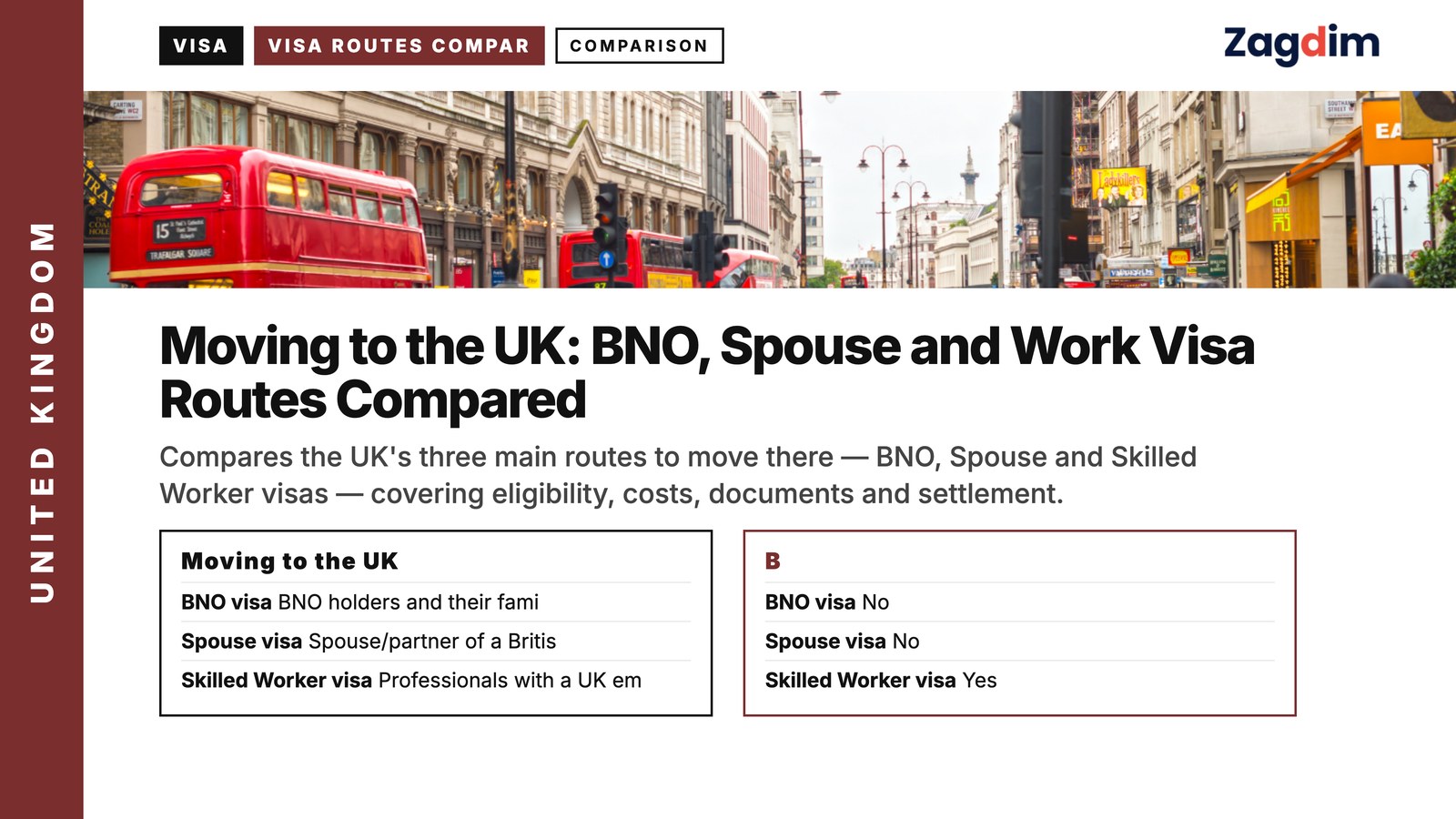
Comparing the Three Routes
Which visa is right for you depends on your starting point and your goal. Are you single or moving as a family? Do you have a professional background that fits UK employment? Do you want to land the whole family at once, or build up through your career? These factors shape the right choice.
BNO visa: if you hold BNO status, or a family member does and the family plans to relocate together, this route is usually the most flexible. It needs no sponsor and no UK-resident spouse or employer — only proof of finances and identity — which suits people who want to arrange their own timeline.
Spouse visa: if your spouse is a British citizen, a UK settled person, or already lawfully resident in the UK (for example via the BNO route), this visa lets you live together in the UK. The income threshold rose substantially on 11 April 2024 (from £18,600 to £29,000), which is a real hurdle for applicants relying on overseas income.
Skilled Worker visa: suited to applicants who already have a professional background and a sponsorship offer from a UK employer — a career-led route into the UK. The process is comparatively fast-moving and requires meeting salary, skill and occupation-list requirements; it particularly favors professionals in technology, healthcare and engineering.
Comparison of the three visa routes:
| Visa Type | Who It Suits | Sponsor Required | Income Threshold | Can Bring Family | Best For |
|---|---|---|---|---|---|
| BNO visa | BNO holders and their families | No | None | Yes | Families who want flexibility to plan their own life |
| Spouse visa | Spouse/partner of a British citizen or UK settled person | No | £29,000 | Yes | Couples who want to live together |
| Skilled Worker visa | Professionals with a UK employer’s sponsorship | Yes | £41,700/yr or the occupation’s “going rate,” whichever is higher (from ~£33,400 for eligible new entrants, health/education roles or Immigration Salary List occupations) | Yes | Career-focused, professionally qualified applicants |
*The £41,700 Skilled Worker threshold applies to certificates of sponsorship issued from 22 July 2025; certificates issued before that date may still carry the previous £38,700 threshold.*
Application Process: The Steps for Each Route
Although the three visa types have different eligibility conditions, the application process broadly follows the same rhythm. Whether you are applying via BNO, Spouse or Skilled Worker, the process runs through the same key steps — understanding each one helps cut down on delays and extra document requests.
Step 1: Confirm your identity and eligibility. The starting conditions differ by route — a BNO application needs the applicant’s and family members’ passport status confirmed; a Spouse visa needs proof the relationship is genuine and confirmation of the UK-based partner’s immigration status; a Skilled Worker application first needs a formal job offer and sponsorship from a Home Office-licensed employer.
Step 2: Prepare documents and proof of funds. This includes identity documents, financial evidence, proof of accommodation, and relationship evidence (for the Spouse route) or a sponsorship letter (for the work route). Plan ahead, especially around the newer income and funds requirements — recent bank statements or tax records are recommended.
Step 3: Submit online and pay the fees. All UK visa applications are currently submitted through an online system; you upload your full set of documents and pay the visa fee plus the Immigration Health Surcharge (IHS). Applicants can choose a priority service to shorten the wait, for an extra fee.
Step 4: Wait for a decision, and respond to any request for more evidence. Processing time varies by visa category and location, typically 4 to 12 weeks. If information is missing, you will receive an official request for further evidence — respond promptly to avoid delays.
Step 5: Receive your visa and complete follow-up steps. Once approved you will receive your visa decision and entry letter. After arriving you will need to collect your Biometric Residence Permit (BRP), register with the NHS, and — depending on the visa — register your address or with the police within a set time limit.
Route-specific detail:
- BNO route: prepare your passport and documents (old BNO passport if held, birth certificate, proof of funds, accommodation arrangements, criminal record certificate), submit online through the UK Visas platform and pay the visa fee and IHS, book biometrics at an application center, then enter the UK — either on a 30-day Entry Permit before collecting a BRP, or with app-based digital verification. After 5 years of continuous lawful residence you can apply for ILR.
- Spouse/partner route: the UK-based partner must meet the income and accommodation requirements (£29,000, rising gradually since 2024); prepare language and relationship evidence (joint accounts, photos, travel records); submit either inside or outside the UK. The first grant is for up to 2 years and 9 months (switching into this visa from inside the UK gives up to 2 years and 6 months); you then extend for up to a further 2 years and 6 months, and after 5 years in total you can apply for ILR (with further language and financial evidence).
- Skilled Worker route: secure a job offer and Certificate of Sponsorship (CoS) number from a Home Office-licensed employer whose role meets the salary and skill thresholds; submit your application with language proof, financial evidence, employment contract and sponsorship letter; after 5 years of lawful work in the same category you can apply for ILR — changing employer requires a fresh application.
Reminder: every family member applying under the BNO route — including minor children or dependent parents — must submit an independent application and their own financial evidence; applications are not automatically bundled under the main applicant.
Documents You Will Need
BNO visa:
- A valid BNO passport (if it has expired you can still apply, but must also provide identity proof)
- Proof of residence (utility bills, tenancy agreement, registered address, etc.)
- Financial proof (bank statements or payslips showing you can support yourself)
- Family relationship proof (a dependency statement if bringing adult children or parents)
- A criminal record certificate (ACRO Police Certificate) if required
Spouse visa:
- Marriage certificate or proof of a long-term partnership (e.g. cohabitation evidence)
- Proof of the UK-based partner’s status (British passport, settled status, or BNO BRP)
- Financial proof: evidence of income meeting the household threshold (from £29,000), such as tax records, employment contract, bank statements
- Evidence of living together (joint bills, address proof, photos)
- English-language proof (in some cases, a pass at CEFR A1 or above, e.g. IELTS Life Skills)
Skilled Worker visa:
- Valid passport and personal identification
- Certificate of Sponsorship (CoS) from the employer
- Employment contract and salary details
- Proof of qualifications matching the relevant occupation, where required
- English-language proof: level B2 or above for new applications from 8 January 2026 (for example, a Secure English Language Test); people who had this visa before 8 January 2026 and are extending need B1
- Tuberculosis test results if you are from a listed country, and a criminal record certificate if you are applying from outside the UK for certain jobs (for example in education, healthcare, therapy or social services)
All documents not in English or Welsh must be accompanied by a certified translation, with the translator’s details and a certification statement clearly noted.
Not sure your paperwork is in order? Preparing documents can look simple but is one of the easiest places to make a mistake, especially language proof and financial structuring — ask Zagdim if you’d like a second look.
Typical Costs
Fees for the BNO route illustrate the scale of costs involved in a UK visa application (figures in GBP; check the current gov.uk fee table before applying, as fees are revised periodically):
| Stage | Typical Fee |
|---|---|
| BNO visa (30-month grant; from 8 April 2026) | £206 |
| BNO visa (5-year grant; from 8 April 2026) | £285 |
| Immigration Health Surcharge (IHS), adult, per year | £1,035 |
| Immigration Health Surcharge (IHS), adult, per 30 months | about £2,588 |
| Immigration Health Surcharge (IHS), adult, per 5 years | £5,175 |
| Immigration Health Surcharge (IHS), students/dependants/Youth Mobility Scheme/under 18, per year | £776 |
| Immigration Health Surcharge (IHS), students/dependants/Youth Mobility Scheme/under 18, per 30 months | about £1,940 |
| Immigration Health Surcharge (IHS), students/dependants/Youth Mobility Scheme/under 18, per 5 years | £3,880 |
| ILR application fee (from 8 April 2026; biometric enrolment included, no separate charge) | £3,226 |
| Naturalisation (citizenship) application fee | £1,709 |
| Citizenship ceremony fee | £130 |
| Life in the UK Test fee | £50 |
TB test certificate costs are additional and vary by clinic (a certificate from an approved test centre is required for the BNO route if you have been living in Hong Kong for the past 6 months). The Spouse and Skilled Worker routes carry their own separate visa fees and the same IHS structure; check the current fee for the specific visa length and category before applying.
Frequently Asked Questions
Q1: Can the BNO visa lead to settlement?
A1: Yes. After 5 years of residence you can apply for UK Indefinite Leave to Remain (ILR), and after a further year of residence you can apply for citizenship. Before applying for ILR you must also meet the residence-day and Life in the UK Test requirements.
Q2: Does the income threshold affect the Spouse visa?
A2: Yes. The Spouse visa income threshold rose from £18,600 to £29,000 on 11 April 2024 (people who already held or had applied for a spouse/partner visa before that date keep the £18,600 threshold on further applications). £29,000 remains the current threshold as of September 2026, though the government is still considering the Migration Advisory Committee’s recommendation to lower it. The applicant must show that their UK-based partner meets this threshold, or make up any shortfall with savings, or apply under an exception (such as a disability-related carer situation).
Q3: Can you switch between visa types?
A3: In some cases, yes. For example, a BNO visa holder who marries a British citizen can switch to a Spouse visa; a Skilled Worker who reaches settlement can also switch to a family-category visa. However, the qualifying period does not necessarily carry over between different visa types — each case needs individual assessment.
Q4: Can a Skilled Worker visa holder bring a spouse and children?
A4: Yes. Skilled Worker visa holders can apply for a Dependant visa for a spouse and minor children. The spouse can work lawfully, and children can attend UK state schools. A dependant’s visa length runs in step with the main applicant’s.
Q5: Which of the three routes leads to citizenship fastest?
A5: In principle, all three require 5 years of continuous residence before applying for ILR, then a further year before applying for citizenship. If an applicant already holds UK settlement, or has switched routes smoothly, the actual timeline may be somewhat shorter.
Q6: If you don’t qualify for BNO, are there other routes?
A6: Yes. Besides the Spouse and Skilled Worker routes, there is also the Student visa, entrepreneur-type routes (such as Innovator Founder), and the Global Talent visa, depending on individual circumstances and goals. Note that the older Tier 1 Investor visa closed to new applicants in 2022.
Q7: Does renting or buying property help a visa application?
A7: Not directly — it is not itself a scoring factor. But when submitting a Spouse or BNO application, providing a stable UK address and tenancy or purchase documents can support your case as evidence of settled living arrangements, helping the caseworker understand your plans.
Common Mistakes to Avoid
1. A Spouse visa needs more than a marriage certificate. The UK’s financial checks for the Spouse visa are strict, with the income threshold risen from £18,600 to £29,000, and possibly higher in future. Beyond the marriage certificate, you also need joint bills, shared address records, tax documents or savings evidence to support a genuine, stable relationship.
2. A BNO grant for one person does not automatically cover the whole family. Every family member — spouse, children and dependent parents — must submit an independent application with their own financial evidence. The BNO route does not include housing or employment benefits, so applicants need to arrange their own accommodation and work plans in the UK.
3. A Skilled Worker visa cannot be built around just any job offer. The Skilled Worker visa requires a formal offer from an employer holding a Home Office Sponsor Licence. Even with a signed offer letter, if the employer is not a licensed sponsor, the application will not be valid.
4. BNO and Spouse visa holders do not receive full public benefits immediately. Holders can work and study, but do not automatically qualify for benefits such as Universal Credit or means-tested healthcare support. Full access, along with eligibility for citizenship, comes only after 5 years of lawful residence plus a further year holding ILR.
5. Underestimating the English-language and financial evidence requirements causes refusals. Most UK visas require compliant language test results and income evidence; expired language certificates or income structures that do not match the requirements are common causes of refusal.
Before submitting, it is worth checking your situation against the requirements in full, and getting professional input where needed, to avoid a refusal or delay caused by an avoidable error.
Summary
Whichever of these three routes you are weighing, what matters most is not the entry route on its own but a pathway that can be extended — from lawful residence, to a stable footing, to eventual settlement and citizenship. Working out your eligibility, your budget and your living arrangements early reduces friction at each transition and lets you move through each stage with more confidence.
If you are mapping out your own plan to move to the UK, ask Zagdim and we can help you think through the route that fits your situation.
Have a question about this guide? Leave a comment below, or ask Zagdim directly.
Your first stop for international property and global living.
Research and insights. Know what’s changing. Understand what matters.
Sources
- UK Home Office – BNO Visa Route: Policy Guidance
- Immigration Barrister – UK Spouse Visa Income Threshold Update
- GOV.UK – Skilled Worker Visa Eligibility Overview
- Migration Observatory – UK Partner Visa Income Requirements Explained
- Migration Advisory Committee – Annual Report 2024
- DavidsonMorris – UK Visa Comparison and ILR Pathways
- IAS Services – Spouse Visa Requirements
- NHS Employers – Visa Types and Work Rights in the UK
- Fragomen – Continuous Residence and ILR Rules
- UKCISA – Graduate Route and Student Visa Rights
- PwC – UK Personal Tax Insights
- Sable International – Comparing UK Visa Routes for Overseas Applicants
*This overview is compiled from UK government sources and professional immigration advisers, covering 2021 to 2025. Fees, thresholds and processing times change periodically — confirm current figures on gov.uk before applying.*