
































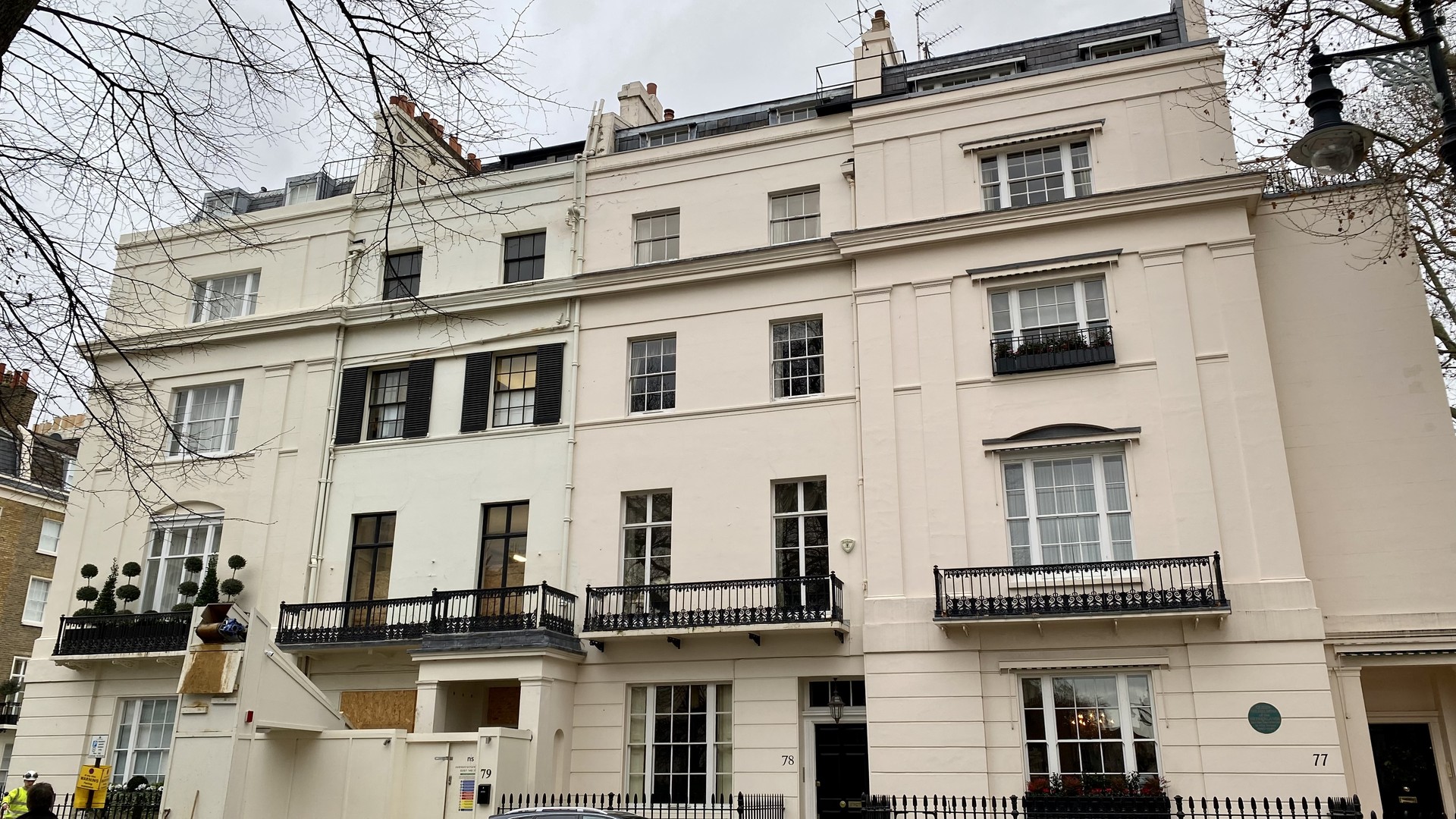
Average prices in prime central London have fallen 23% since their mid-2015 peak and 3.3% in the year to July 2026, the 39th consecutive month of annual declines, according to Knight Frank’s August 2026 prime London release — and after adjusting for the 42% of UK CPI inflation accumulated since then, the real decline is close to 46%. Event and data status as of 11 August 2026.
The arithmetic is worth doing slowly, because it is the part the headline figure hides. Knight Frank’s illustration: a property bought in prime central London in mid-2015 for £1 million should, on CPI alone, be worth £1.42 million today. It is worth about £770,000. That is the 23% nominal fall and a real fall of roughly 46% — the nominal number and the number describing what actually happened to an owner’s purchasing power are two very different figures, and only one of them is in the headline. Knight Frank attributes the decline to a succession of tax increases and political uncertainty.
Against that, today’s coverage carries an apparently encouraging transaction figure, and it needs to be read carefully. Tom Bill, head of UK residential research at Knight Frank, said transactions were 14% higher across the capital in the three months to July — but the rise in prime central London specifically was 3%. The 14% is London-wide; the PCL number is 3%. Bill’s own framing of the comparison is that the prime London market “is having a better summer than it did in 2025, but that’s not a particularly high bar”, 2025 having been subdued after the introduction of US trade tariffs, the ending of non-dom status and speculation about property taxation in the autumn Budget.
The figure that undercuts a recovery reading comes from the same release. Measured against the five-year average rather than against last year, property exchanges are down 6% in London and down 15% in prime central London. Bill notes that this comparison is itself distorted — by stamp duty cliff edges during and after the pandemic, and by the sharp re-pricing of mortgage rates that began in 2022 — with the consequence, in his words, that “accurately gauging the current strength of the market is not straightforward.” An agency’s head of research saying the market’s strength is hard to read is a more honest summary of this data than either the fall or the rebound taken alone.
On the political backdrop, Bill said speculation ahead of October’s Budget has been more muted this year, particularly after Prime Minister Andy Burnham ruled out a land value tax, and that the high-value council tax rates announced in November “look like the thin end of the wedge for a government with limited capacity to fund its spending plans, but they weren’t as bad as feared”. PropertyWire reported that by March the number of offers made in prime central and prime outer London was 8% higher than a year earlier.
**Zagdim’s View** — Three different questions are being answered by one dataset, and mixing them produces the wrong conclusion. Has prime central London fallen a long way? Yes, and more in real terms than nominal terms — 46% against 23%. Is activity recovering? Across London more than in prime central London, and from a baseline its own researcher calls not a high bar. Is it back to normal? Not against a five-year average, where exchanges remain 6% down in London and 15% down in PCL. An owner deciding whether to sell and a buyer deciding whether to enter are looking at the same numbers for opposite reasons, and neither should take the 14% as a prime central London figure — it is not one.
References
Property Industry Eye — Prime Central London property prices have fallen 23% since 2015
PropertyWire — Prime London property transactions rise 14% in Q3