





























Introduction: Why Understanding Thailand’s Handover Process Matters
As Thailand’s property market keeps attracting overseas investors, more and more foreigners are buying condos in Bangkok, Pattaya, or Chiang Mai. For a first-time buyer, though, the handover process is often the step that’s easiest to overlook — and one of the most consequential.
Handover isn’t as simple as walking into a new unit and picking up the keys. It involves several linked steps: the final payment, inspecting the unit, the title transfer at the Land Office (Land Office transfer), settling fees and taxes, and understanding the developer’s warranty obligations. A mistake at any one step can leave title incomplete, delay moving in, or affect a later resale or rental.
For an overseas buyer, understanding Thailand’s current (2023–2025) handover procedure means avoiding the risk of feeling lost, and also helps secure three things:
- Secure title: the title transfer (Chanote transfer) is legally valid, and the buyer genuinely becomes the owner.
- Cost transparency: knowing in advance what taxes, sinking fund contributions, and management fees will be due, so nothing gets added at the last minute.
- Protected rights: understanding the inspection process and the Defects Liability Period in detail, to protect the quality of the home.
In other words, the handover process is the dividing line between “the investment is protected” and “life in the new home begins.” Understanding these steps is what turns an overseas purchase into a secure, well-managed decision.
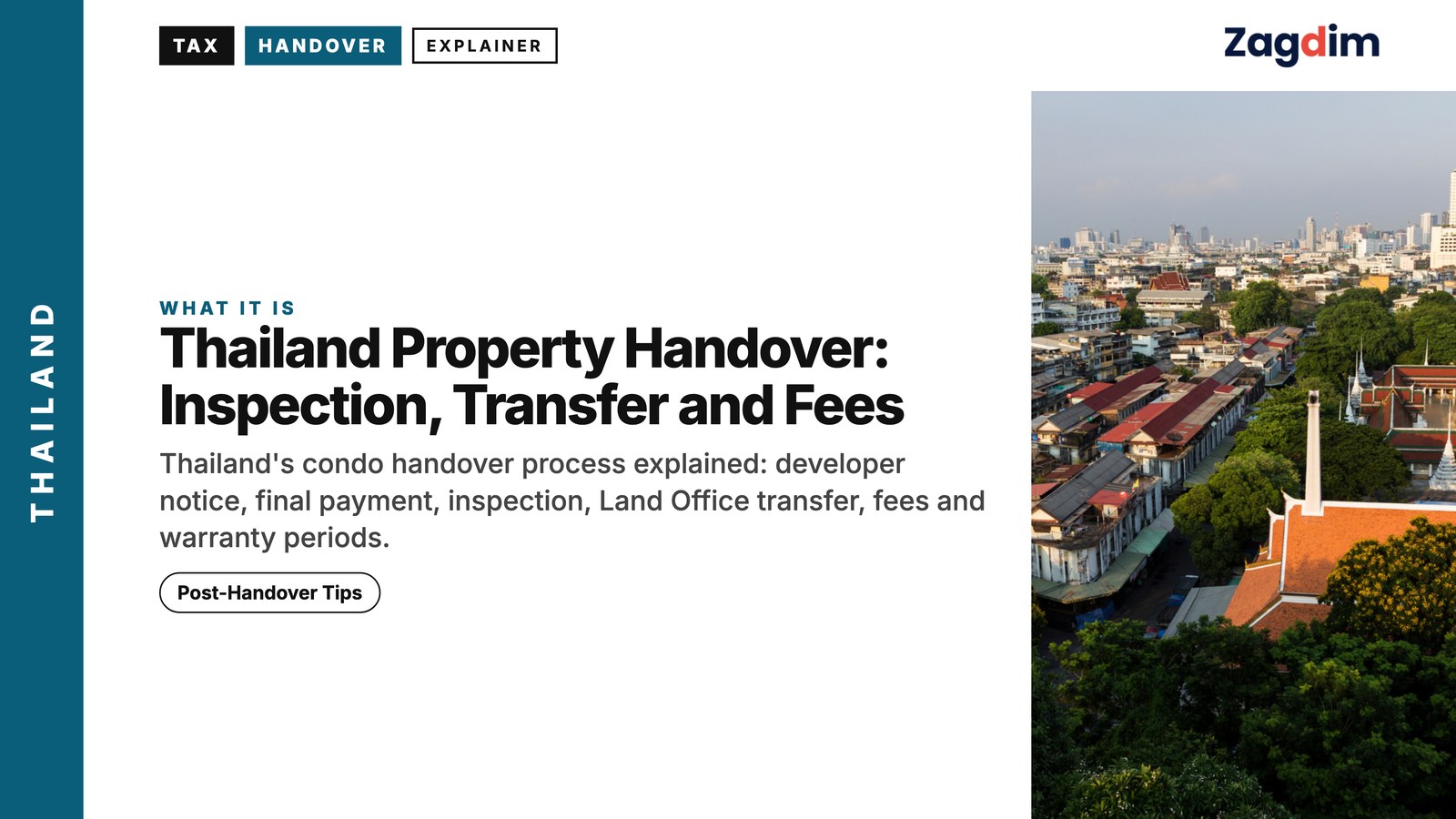
Handover Steps in Thailand: Overview
In Thailand, condo handover usually happens once a project is completed and the buyer has paid the final balance. The process generally runs as follows:
- Developer notice: once the project is complete, the developer issues a formal notice, asking the buyer to prepare the final payment and arrange a handover date.
- Final payment: the buyer settles the remaining balance plus any related fund and tax payments, with help from the bank or the developer’s collections team; if a mortgage is involved, the bank disburses its final payment to the developer at the same time.
- Unit inspection: the buyer inspects the unit together with the developer’s technical team, sometimes with the help of a third-party inspection company, listing any defects found for the developer to commit to repairing.
- Signing the handover documents and receiving the keys: with the developer’s customer service team as witness, the buyer confirms the unit’s condition and signs the handover documents, then receives the keys and access card, formally gaining the right to move in.
- Land Office transfer (Chanote Transfer): finally, the buyer and a developer representative go together to the Land Office, where an officer verifies the documents and processes the title transfer; once the relevant fees are paid, the buyer receives the formal title deed.
Timeline: completion notice → 1–2 weeks to arrange payment and scheduling → inspection and handover → Land Office transfer (usually completed within a single day).
Land Office Title Deed Transfer
In Thailand, a title deed transfer must be completed at the Land Office — this is the step that formally makes the buyer the registered owner. On the day of transfer, the buyer must attend in person or through a lawyer, submitting a passport and proof of an inbound foreign-currency remittance (a Foreign Exchange Transaction certificate, or FET), and paying the transfer fee. The seller or developer must bring the title deed (Chanote), the sale and purchase agreement, and proof of tax payment, to ensure title is clear and free of dispute. A Land Office officer checks the documents submitted by both sides, calculates the transfer taxes due, and updates the title registration once everything is confirmed. Once this process is complete, the buyer receives the formal title deed and becomes, in law, the sole owner of the unit.
Inspection Checklist and Defects Liability
During handover, inspection is one of the most important steps for the buyer. The buyer needs to check the unit item by item, confirming that the walls, floors, doors and windows, electrical and plumbing systems, and air conditioning all meet the standards set out in the contract, and clearly recording any issues found. Some buyers also hire a third-party inspector to provide a professional check and recommendations, to avoid missing details. The developer’s technical team then carries out repairs based on the buyer’s defect list, and only proceeds to formal handover once the unit meets the delivery standard.
On the warranty period: between 2023 and 2025, most newly built condos in Thailand offered a 1–2 year defect warranty (this particular handover’s warranty period is 5 years), while the structural elements (such as beams, columns, and the foundation) may be covered for up to 5 years. If a problem arises during this period, the developer must take on the cost of repairing it free of charge; the buyer only needs to submit a request within the warranty period.
*(For a full step-by-step walkthrough of the inspection process, a self-inspection vs. professional-inspector comparison, common defects and typical repair times, and a nine-point room-by-room checklist, see Zagdim’s companion guide on Thailand property handover inspection.)*
Fees and the Sinking Fund
At handover in Thailand, buyers must settle the final balance on the property, plus a set of fees tied to the transfer and to property management. These are split between buyer, seller, and developer according to the contract, but there is a fairly consistent general practice:
- Transfer Fee: usually 2% of the appraised property value, generally paid by the buyer, though in some deals this may be negotiated and shared between buyer and seller.
- Stamp Duty: a 0.5% rate, usually paid by the seller if Specific Business Tax does not apply; the specific party responsible still depends on the contract terms.
- Specific Business Tax: a 3.3% rate, payable by the seller if the seller has held the property for less than five years.
- Withholding Tax: calculated based on the seller’s status and length of ownership, also borne by the seller.
Beyond the transfer taxes, the buyer also pays property-management-related costs at handover:
- Sinking Fund: a one-time payment for the building’s long-term maintenance, generally running THB 400–650 per square meter in 2023–2025.
- Maintenance Fee: calculated monthly, usually THB 30–70 per square meter, with 6–12 months typically prepaid at handover.
- Defects Liability Period: the developer must provide a 1–2 year defect warranty after handover, with the structural elements potentially covered for up to 5 years; if the unit shows a defect, the developer is responsible for the repair.
Post-Handover Tips
Once handover and the title transfer are complete, buyers still need to take care of a few practical, compliance-related matters.
First is transferring utilities — this is generally done by the buyer in person at the electricity authority and the waterworks authority, though some property management companies can also handle this on the buyer’s behalf, to make sure the unit’s basic utilities are properly connected.
Second, the buyer needs to register with the property management office, which registers the owner’s details and issues an access card — a necessary step for entering the development and using shared facilities.
On renting the unit out, the owner must comply with Thai law and the building’s own regulations — short-term rentals in the Airbnb style are, in most condos, against the rules, and the property management office has the authority to monitor and enforce this.
Finally, owners must meet their tax obligations. If the property is rented out, rental income must be declared to the Revenue Department and tax paid on it. Since 2020, Thailand has also applied a Land and Building Tax, and depending on the nature and use of the property, some owners are required to pay this too. These steps help ensure the property is used lawfully and its long-term value is protected.
Frequently Asked Questions
What documents does a foreigner need to prepare for handover in Thailand?
The buyer must prepare a passport, the sale and purchase agreement (SPA), and proof of an inbound foreign-currency remittance (FET), and pay the transfer fee at the Land Office. The developer or seller must provide the title deed (Chanote), proof of tax payment, and the relevant contracts. A Land Office officer checks both sides’ documents and completes the transfer registration once everything checks out.
Who is responsible for the inspection at handover?
The buyer needs to inspect the unit personally, checking the walls, floors, doors and windows, and the electrical, plumbing, and air conditioning systems. For a more thorough check, a third-party inspector can be hired to assist. The developer’s technical team is responsible for addressing the buyer’s snag list and re-delivering the unit once repairs are complete.
What extra costs come up at handover?
The buyer pays the sinking fund and the management fee (usually prepaid for 6–12 months), plus a deposit for the electricity and water meters. On transfer-related costs, the buyer generally bears the 2% transfer fee, the seller is responsible for Specific Business Tax (if the property has been held less than 5 years) and withholding tax, while stamp duty is paid by whichever party the contract specifies.
What’s the difference between handover and transfer?
Handover is when the developer delivers the unit to the buyer, who inspects it and signs the handover documents before receiving the keys. Transfer is when a Land Office officer processes the change of title ownership. Handover is mainly a matter between buyer and developer, while transfer involves three parties: buyer, seller, and the Land Office.
Who is responsible during the warranty period?
After handover, the developer must take responsibility for repairing defects, usually for a warranty period of 1–2 years, with structural elements covered for up to 5 years. The buyer needs to submit a repair request within that period, and the developer must carry out the repair on schedule and hand back a unit that meets standard, at no charge.
Can a foreign buyer handle the transfer themselves?
A foreigner can go to the Land Office and handle the title transfer personally, but this requires enough Thai-language ability and familiarity with the process. Most buyers choose to hire a lawyer or agent to help, to make sure the documentation is complete and to save time. A Land Office officer is responsible for the final document review and registration.
What taxes are due after handover?
If the buyer rents the property out after handover, rental income must be declared to the Revenue Department and personal income tax paid on it. If the unit falls within the taxable scope, Land and Building Tax is also due. The Revenue Department is responsible for collection and enforcement, and it is the buyer’s responsibility to file on time.
Conclusion and Recommendations
Overall, Thailand’s handover and transfer process is a multi-party undertaking: the developer is responsible for notification and repairs, the buyer must complete the final payment, the inspection, and tax compliance, while a Land Office officer acts as the final gatekeeper at the transfer stage. A lapse by any one party can cause delays or legal risk.
For buyers, three key pieces of advice matter most:
- Prepare documents and funds in advance. Make sure the remittance proof (FET), passport, and contract are all complete and correct, and have the final payment, fund contributions, and taxes ready, to avoid holdups during the Land Office process.
- Inspect carefully and make use of the warranty period. Go through the unit item by item with the developer’s technical team, hiring a third-party inspector if needed. Log every defect immediately and require it to be fixed, and keep following up throughout the 1–2 year warranty period.
- Get professional help where needed. If you’re not comfortable with Thai or unfamiliar with local law, it’s advisable to hire a lawyer or a professional agent to help with the Land Office transfer and fee calculations, reducing the risk of errors.
Handover is more than a ceremony for picking up the keys — it’s an important process for securing lawful title, moving in safely, and protecting your investment. Once a buyer understands the process, knows who is responsible for what, and makes good use of professional resources, handover can be significantly more efficient and far less stressful.
ZDelp’s Thailand service serves clients from Hong Kong, Macau, Taiwan, and overseas Chinese communities, helping applicants handle long-term Thailand visas and related local arrangements. It offers communication in Chinese, professional vetting, and a customized service, helping applicants complete the visa process more smoothly.
About ZDelp
ZDelp is an intelligent service network focused on overseas living and investment. ZDelp is not an agency itself, but an independent advisor and information guide. When you have a relevant need, ZDelp submits your situation to its network of more than 1,200 partner local agencies and professional service providers, selecting the option that offers the best value and fit, with the aim of helping you get the most suitable, most complete support.
For any questions, feel free to contact ZDelp, and its professional team will help analyze your options and match you with a tailored plan.
Have a question about this guide? Leave a comment below, or ask Zagdim directly.
Your first stop for international property and global living.
Research and insights. Know what’s changing. Understand what matters.