































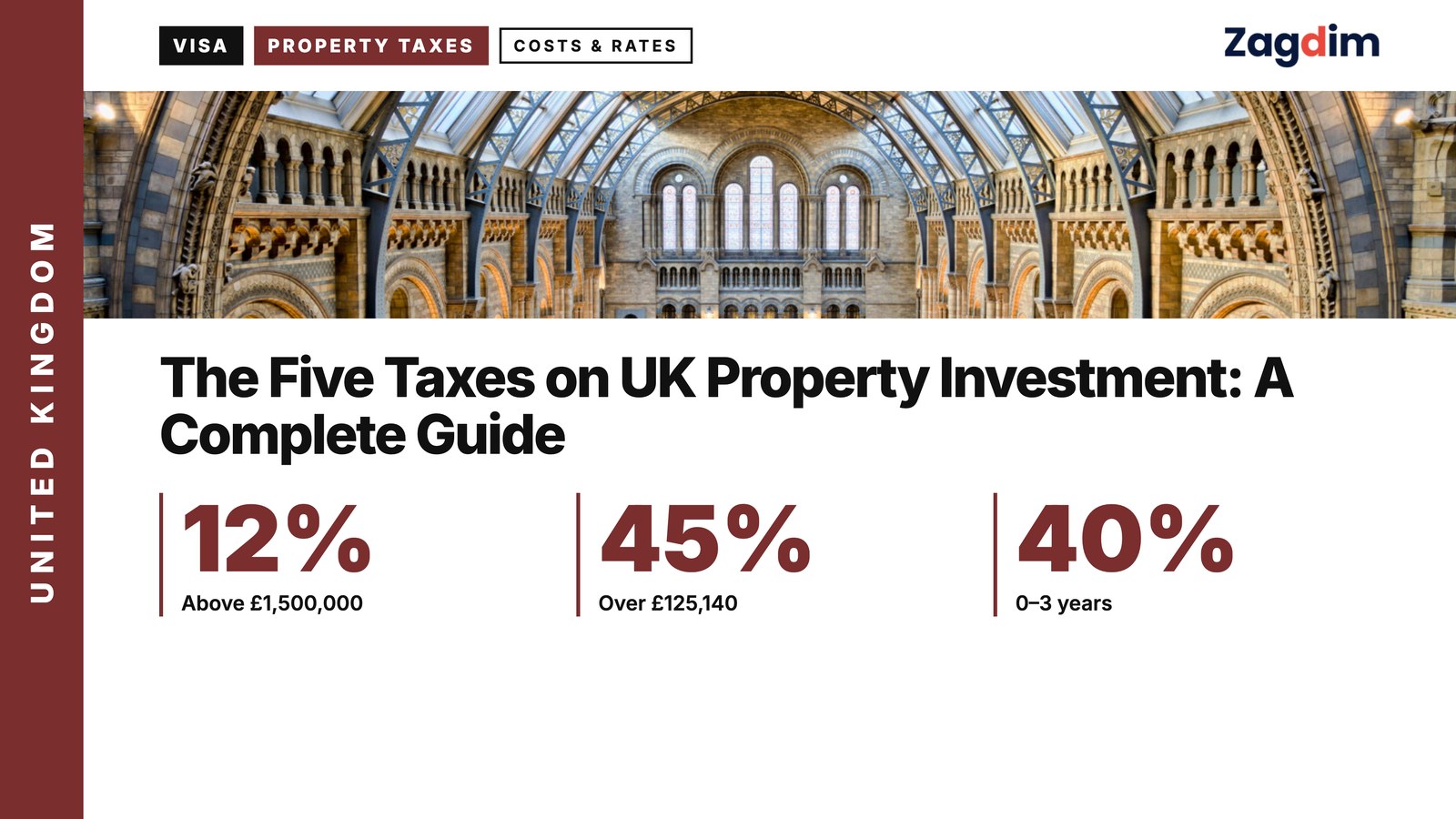
Benjamin Franklin said that only death and taxes are certain. The UK’s tax system covers property owners closely from the day they buy to the day they sell: you pay stamp duty when you buy, income tax on rental income, council tax if you live there yourself, capital gains tax when you sell, and, eventually, inheritance tax. Here is how each one works.
UK Stamp Duty Land Tax
Many places, including Hong Kong and Singapore, charge stamp duty, and the UK is no exception. The UK’s Finance Act 2003 introduced Stamp Duty Land Tax (SDLT). It is charged on a progressive scale according to the value of the transaction, with different bands taxed at different rates. No stamp duty is due if the purchase price is below the current £125,000 nil-rate threshold (from 1 April 2025); a separate first-time buyer relief applies below £300,000, tapering out at £500,000. The rates change from time to time as policy changes — for example, the stamp duty holiday that ran from 2020 to March 2021. The rates below are the current bands.
Current residential stamp duty rates (from 1 April 2025):
| Property value | Rate |
|---|---|
| £0 – £125,000 | 0% |
| £125,001 – £250,000 | 2% |
| £250,001 – £925,000 | 5% |
| £925,001 – £1,500,000 | 10% |
| Above £1,500,000 | 12% |
*A further 2% surcharge applies to non-UK-resident buyers (in force since 1 April 2021) on top of these bands.*
Worked examples:
Property value: £300,000, first-time buyer within the relief band:
0% (first-time-buyer relief applies in full up to £300,000)
Property value: £300,000, bought to let or as a second home (not a first-time buyer):
£125,000 × 0% + (£250,000 − £125,000) × 2% + (£300,000 − £250,000) × 5% = £5,000
There are certain circumstances where no stamp duty is due — for example, a transfer with no consideration (a gift), or a transfer on death, divorce or dissolution of a civil partnership. There is also no charge on replacing your own home: if you already own a home (A) but want to move to another owner-occupied home (B), and you sell A within 36 months of buying B, you can reclaim the 3% surcharge from HMRC. Note that this is measured from the “completion date” of the purchase.
Stamp duty holiday (8 July 2020 to 31 March 2021)
On 8 July 2020 the UK government introduced a temporary “save the housing market, save the economy” measure — the stamp duty holiday. Anyone buying a UK residential property of £500,000 or less within the holiday period was exempt from the corresponding stamp duty, even for buy-to-let or investment purposes, where only the 3% surcharge applied. This was again measured by the completion date of the transaction, so buyers needed to make sure their completion date fell within the holiday window to qualify.
Stamp duty holiday rates
| Property value | First property | Second property or more |
|---|---|---|
| £0 – £500,000 | 0% | 3% |
| £500,001 – £925,000 (above the £500,000 deducted) | 5% | 8% |
| £925,001 – £1.5 million (above the £925,000 deducted) | 10% | 13% |
| Above £1.5 million (deducted) | 12% | 15% |
Worked examples:
Property value: £200,000, owner-occupied:
£0 – £500,000 = 0%
Property value: £400,000, bought to let or as a second home:
£400,000 × 3% = £12,000
*Related reading: “Fierce Competition in the UK Property Market — Buyers Write CVs to Sellers, Who Receive More Than 20 Offers in a Week”; “Refunding the Non-Resident Stamp Duty Surcharge After Moving to the UK: Eligibility, Process and Method”*
Annual Tax on Enveloped Dwellings (ATED)
ATED is aimed mainly at stopping UK companies from stockpiling residential property. Where a company owns a UK residential property worth more than £500,000 (including a property held jointly with a company partner), it must pay this annual tax on enveloped dwellings, whether the company is UK-resident or not.
ATED charges:
| Property value | Annual charge |
|---|---|
| £500,000 up to £1 million | £4,600 (2026-27 chargeable period) |
| £1 million up to £2 million | £7,500* |
| £2 million up to £5 million | £25,200* |
| £5 million up to £10 million | £58,850* |
| £10 million up to £20 million | £118,050* |
| More than £20 million | £236,250* |
*ATED charges are uprated each chargeable period; the £500,000-£1 million band above reflects the current 2026-27 period. Check the current full table on gov.uk before relying on the higher bands.
Income Tax on UK Rental Income
If you let a UK property to a tenant, the rent you receive is subject to UK income tax. The 23 September 2022 mini-budget announcement by then-Chancellor Kwasi Kwarteng to remove the 45% additional rate band was reversed within weeks and never took effect; the 45% additional rate has continued to apply every year since, including the current 2026/27 tax year.
The income tax band that applies depends on the landlord’s level of UK rental income, as follows:
Current tax year
| Taxable income | Tax rate |
|---|---|
| Up to £12,570 | 0% |
| £12,571 to £50,270 | 20% |
| £50,271 to £125,140 | 40% |
| Over £125,140 | 45% |
You can, of course, deduct expenses against UK income tax. Deductible items generally include letting agent fees, property management fees, repairs, electricity, gas, water, council tax, decoration and maintenance, agency fees, check-in/check-out fees, cleaning, insurance, loan interest, accountancy fees, advertising costs, parish council fees, gardening fees, and legal and professional advice fees. Note that a non-UK tax resident (someone in the UK for more than 183 days is treated as resident) does not get the £12,570 personal allowance — all their rental income is taxed from the first pound at the 20% basic rate.
Worked example:
Reference property “QS” (value £412,890)
Annual rental income: £180,000
Less: letting agent fee: £1,560
Less: expenses (management fee): £2,273
Less: mortgage interest (estimated at 3.5%): £10,128*
Less: rates: £250
Taxable income: £3,789
Income tax (basic rate 20%): approximately £757.80
*Related reading: “Fierce Competition in the UK Property Market — Buyers Write CVs to Sellers, Who Receive More Than 20 Offers in a Week”*
UK Council Tax
The UK has had something like council tax since 1696, when it was a window tax charged on the number of windows in a home. It was not until 1993 that England, Wales and Scotland moved to a single council tax based on property value. Council tax mainly funds local public services such as libraries, schools, transport, waste collection, environmental health and the fire service. The amount charged varies by the property’s overall value, including its location, use, size and number of rooms — this information is normally already on file with the local council from when the property was developed, so once you take possession you simply register online.
*Related information: Pay your Council Tax — https://www.gov.uk/pay-council-tax/westminster; check your Council Tax band — http://cti.voa.gov.uk/cti/inits.asp*
Council tax bands are set by location and property value. England and Scotland base bands A–H on the property’s value as at 1 April 1991; Wales bases bands A–I on value as at 1 April 2003. You can look up your property’s band on the websites above.
Council tax also carries relief and discounts: full-time students, minors, homes left vacant by a bankrupt person’s estate, and homes owned by a charity can all apply for a reduction. The full charge assumes at least two adults live in the property; a single-adult household gets a 25% discount, and an empty property can get a 50% discount — though a local council may charge double council tax on a property left empty for two years or more, to discourage long-term vacancy. Homes where a disabled person lives can have their band lowered.
UK Capital Gains Tax (CGT)
Selling a UK property may trigger capital gains tax. Broadly, you will owe CGT in the following three situations:
- You are transferring a UK investment property (buy-to-let, i.e. bought to rent out).
- You realize a gain on a second home or further home.
- You are a non-UK tax resident (broadly defined as someone who has not spent 183 days or more in the UK).
Even if you are a tax resident, if you own more than one property (including overseas), you still need to pay this tax. Gifting a property used not to trigger CGT, but the rules changed in 2015: if your spouse or civil partner later sells the asset on, they are also liable, and the gain is calculated from the difference between the value when you first acquired the asset and the value when it is sold.
Historical individual CGT annual exempt amount
| Tax year | Personal allowance |
|---|---|
| 2024/25 onward | £3,000 |
| 2023/24 | £6,000 |
| 2020–2022 | £12,300 |
| 2019 | £12,000 |
| 2018 | £11,700 |
| 2017 | £11,300 |
| 2016 | £11,100 |
The rate applying to gains on UK residential property is as follows: if you hold the property in your own name (or through a trust), the first part of any gain on sale or gift is tax-free, up to the current £3,000 individual CGT annual exempt amount shown above (most trusts have a lower allowance).
Worked example — UK capital gains tax:
Property (value £412,890)
Acquisition (2019): £412,890
Resale (2023): £511,984
Net profit: £99,094
Less: expenses (2019 to 2023): (£45,000)
Taxable capital gain: £54,094
UK capital gains tax at the current higher rate of 24% (not the former 28%): approximately £12,983
The UK capital gains tax rate is linked to the taxpayer’s income and their applicable personal income tax rate — the higher the income tax rate, the higher the capital gains tax rate. A basic-rate taxpayer, on 20% personal income tax, pays 18% capital gains tax; a higher-rate taxpayer on 40%, or an additional-rate taxpayer on 45%, pays 24% capital gains tax (reduced from 28% for disposals from 30 October 2024). In practice, you add together your taxable income (total annual income minus your personal allowance and any other reliefs) and your net taxable capital gain (taxable capital gain minus deductions) to determine your income tax band, which in turn determines your capital gains tax rate; income tax and capital gains tax are then each charged at the rate that applies to that band.
Crucially, you generally owe no UK capital gains tax for the period during which the property was your main or only home. If you are not a UK tax resident, you can still qualify for this relief, but you must also have lived in the property for at least 90 days in the tax year (which may in turn affect your non-resident tax status). Where the property is held in a trust, the relief may also be available — but it is not available where the property is owned by a company.
It is generally not possible to avoid capital gains tax by selling shares in the company that holds a UK property instead of selling the property itself. Newer rules treat the sale or gift of 25% or more of a company’s shares in much the same way as a sale or gift of the underlying property, and they apply to companies that derive at least 75% of their total asset value from UK property.
UK Inheritance Tax (IHT)
The UK is one of the earliest countries to introduce inheritance tax — England and Wales began charging it in 1796.
UK inheritance tax is charged on a UK resident’s whole estate on death, or on gifts made to others within the seven years before death. The current top rate of inheritance tax is 40%. Inheritance tax on gifted property is paid by the recipient, at a rate of between 8% and 40% — the closer the gift date is to death, the higher the rate. Inheritance tax also has a tax-free threshold, currently £325,000: an estate below this threshold pays nothing. If everything above £325,000 is left to your spouse, civil partner, a charity or a community amateur sports club, no inheritance tax is due at all; and where it passes to children (including adopted, fostered or stepchildren) or grandchildren, the allowance can rise to £500,000 — combining the £325,000 nil-rate band with an additional £175,000 residence nil-rate band. Both thresholds are frozen until at least April 2028.
Worked example — UK inheritance tax:
Your estate is worth £500,000, and the tax-free threshold is £325,000. The inheritance tax charged is 40% of £175,000 (£500,000 minus £325,000).
Taper relief on gifts made before death
| Years between gift and death | Rate |
|---|---|
| 0–3 years | 40% |
| 3–4 years | 32% |
| 4–5 years | 24% |
| 5–6 years | 16% |
| 6–7 years | 8% |
*Related information: How Inheritance Tax works: thresholds, rules and allowances*
The tax information above is for reference only — always consult a professional if you have a specific tax question, or ask Zagdim.
Have a question about this guide? Leave a comment below, or ask Zagdim directly.
Your first stop for international property and global living.
Research and insights. Know what’s changing. Understand what matters.