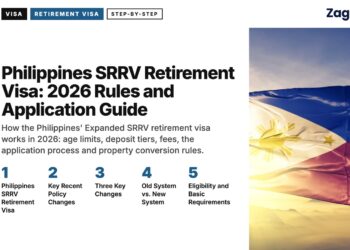





























Philippines SRRV Retirement Visa: Three Key Points
The Philippines’ SRRV (Special Resident Retiree’s Visa) is a special non-immigrant visa promoted by the Philippine Retirement Authority (PRA) and issued by the Bureau of Immigration (BI), allowing qualified foreign nationals and certain other categories of applicants to reside long-term in the Philippines. It is often used as an overseas Plan B, or for semi-retirement or FIRE (Financial Independence, Retire Early) planning.
Starting in 2025, the SRRV is administered under a unified Expanded SRRV Program. The minimum application age for new applicants has been lowered to 40, with deposit thresholds tiered by age and by whether the applicant is a pensioner (someone receiving a lifetime pension), and a clearer distinction is now made between the Classic category and the Courtesy/Expanded category.
Under certain conditions, the visa deposit for SRRV Classic can be converted into an investment — for example, to purchase a qualifying condominium unit under PRA rules — but this is subject to a minimum amount, a set conversion timing, and, in most cases, use only as the final installment of the purchase price. Applicants should still assess their own liquidity needs and the risks of the Philippine property market for themselves.
What Is the Philippines SRRV Retirement Visa?
The Philippines SRRV (Special Resident Retiree’s Visa) is a special non-immigrant visa promoted by the Philippine Retirement Authority (PRA) and issued by the Bureau of Immigration (BI), allowing qualifying foreign nationals and certain other categories of applicants to reside long-term in the Philippines.
Compared with an ordinary short-term visa or a work visa, the SRRV leans more toward being a “long-term residency status,” suited to individuals and families who want to retire or semi-retire in the Philippines, work remotely there, or build an overseas Plan B in advance.
Through the SRRV, holders can enjoy relatively stable residency benefits, and, where the rules allow, convert part of their visa deposit into property or other qualifying investments — combining lifestyle and asset allocation considerations at once.
Key Recent Policy Changes
Starting in 2025, the PRA has made a series of adjustments to the SRRV under the framework of the Expanded SRRV Program, focusing on three areas: age thresholds, tiered deposits, and compliance requirements.
SRRV Classic is aimed at the general public: applicants must be 40 or older, and must deposit between USD 15,000 and USD 50,000, depending on age and whether they have a pension. Its core advantage is flexibility of funds, allowing the deposit to be converted for use in purchasing property. SRRV Courtesy/Expanded is a benefit program for former Filipino citizens, retired military personnel, or members of international organizations; its threshold is much lower, at USD 1,500 to USD 6,000, and while the deposit cannot be converted into a property investment, it offers long-term residency in exchange for a very low deposit and annual fee.
Three Key Changes
- Minimum application age: Starting September 1, 2025, the minimum age for new applicants has been uniformly lowered to 40, allowing mid-career professionals to plan for retirement and long-term residency ahead of time through the Philippine SRRV.
- More finely tiered deposit thresholds: SRRV Classic sets visa deposits based on age (40–49, and 50 and above) and whether the applicant is a pensioner (has a lifetime pension). For non-pensioners aged 40–49, the threshold is USD 50,000; for non-pensioners aged 50 and above, it is USD 30,000.
- Clearer category and compliance terms: Under the new system, the Expanded/Courtesy categories set lower deposit thresholds for specific statuses (such as former Filipino citizens, or diplomatic/military personnel), and official documents and announcements now more clearly distinguish eligibility and exclusion conditions across categories.
Old System vs. New System
The data below is compiled from PRA’s official pages and interpretations by law firms and professional bodies from 2024–2025; in practice, follow the PRA’s latest announcements.
| Item | Old System (Overview) | New System (Expanded SRRV Program 2025) |
|---|---|---|
| Minimum application age | Generally 50 and above, with some category-specific exceptions | Uniformly lowered to 40 and above (with details varying by category) |
| Age tiers | Focused on the 50-and-above tier | Clearly divided into 40–49 and 50-and-above groups |
| Deposit threshold (Classic) | 35–49: $50,000; 50 and above: $20,000 (no pension) / $10,000 (with pension) | 0–49: $50,000 (no pension) / $25,000 (with pension); 50 and above: $30,000 (no pension) / $15,000 (with pension) (note: figures include 2 dependents; the deposit can be used toward a property worth USD 50,000 or more) |
| Category structure | Multiple parallel categories including Classic, Smile, Courtesy | Categories reorganized and consolidated under the Expanded SRRV Program, with Courtesy/Expanded options set for specific statuses |
Eligibility and Basic Requirements
The Philippines SRRV is not a single scheme — it is divided into different tracks, such as Classic and Courtesy/Expanded, depending on the applicant’s age, pension status and background.
Age and Who It’s For
Minimum age of the main applicant:
- Starting September 1, 2025, the Expanded SRRV Program requires new applicants to be at least 40.
Main groups it is aimed at:
- Foreigners planning long-term retirement or semi-retirement in the Philippines.
- Mid-career professionals, entrepreneurs or remote workers who want to build a life base in the Philippines.
- Former Filipino citizens, or those with a diplomatic or military background (most fall under the Courtesy/Expanded category).
Financial and Pension Requirements (SRRV Classic)
The figures below reflect the range that is most consistent between the PRA’s official website and 2024–2025 professional interpretations; in practice, follow the PRA’s latest schedule.
Age 50 and above
- Pensioner (holding a lifetime pension):
- Deposit: USD 15,000.
- Pension requirement: at least USD 800/month (single) or USD 1,000/month (couple).
- Non-pensioner (no lifetime pension):
- Deposit: USD 30,000.
Age 40–49
- Pensioner: deposit USD 25,000.
- Non-pensioner: deposit USD 50,000.
Courtesy/Expanded Category (Specific Statuses)
Some Expanded/Courtesy categories, aimed at former Filipino citizens, diplomatic/military personnel or other specific backgrounds, set significantly lower deposit thresholds, mostly in the USD 1,500–6,000 range, further broken down by age and pension status.
Document and Background Requirements (Common to All)
- Passport: A valid passport with sufficient remaining validity.
- Police clearance: A clearance certificate from the applicant’s home country or place of residence. Applicants staying in the Philippines beyond a certain number of days (for example, 90 days) may need to provide an NBI Clearance (issued by the National Bureau of Investigation).
- Medical certificate: A medical examination or certificate, per the PRA’s current requirements.
- Family documents: Marriage certificate, children’s birth certificates, etc., to establish dependents’ eligibility.
SRRV 2025 Core Conditions Overview
| Category | Who It’s For | Age | Deposit/Pension Threshold (Overview) | Convertible to Investment | Dependents Allowed |
|---|---|---|---|---|---|
| SRRV Classic | Foreign retirees or mid-career professionals generally | From age 40 | 40-49: Pensioner USD 25,000 / Non-pensioner USD 50,000; 50+: Pensioner USD 15,000 / Non-pensioner USD 30,000 | Yes, can be converted into a qualifying property or other investment under PRA rules | Yes — spouse, and unmarried dependent children under 21 |
| Courtesy/Expanded | Former Filipino citizens, diplomatic/military personnel and other specific statuses | From age 40 | Mostly in the USD 1,500–6,000 range, broken down further by status and pensioner status | Depends on the specific category and PRA’s latest rules | Yes, per each category’s dependent rules |
Application Process, Step by Step
The actual process can vary slightly depending on timing, category, and whether the applicant is already in the Philippines. Below is the typical path followed by most applicants — particularly those aged 40–55 considering the Classic category.
- Determine the right SRRV category — based on age, whether you have a lifetime pension, and whether you are a former Filipino citizen or have a diplomatic/military background, determine whether Classic or Courtesy/Expanded suits you.
- Plan documents and their validity — police clearances, medical certificates and similar documents usually have validity limits, and international applications may also require an apostille or consular certification — one of the most common sources of delay.
- Choose a PRA-accredited bank and arrange the visa deposit — following PRA instructions, choose a PRA-accredited bank and remit the visa deposit from overseas into the designated Philippine bank account via inward remittance. Obtain the bank’s proof of deposit, a core document for the application.
- Prepare and submit the SRRV application form and supporting documents — complete the application per PRA’s format, with a copy of your passport, photographs, police clearance, medical certificate, bank documents and family relationship documents attached.
- Pay the application fee and first-year annual fee — pay the application fee and first-year annual fee at a designated PRA office, commonly in cash (USD or PHP); whether other payment methods are accepted depends on PRA’s current rules.
- PRA and Bureau of Immigration review — the PRA first reviews eligibility and documents, then recommends the SRRV to the Bureau of Immigration (BI) for issuance. Immigration’s own processing time is generally not counted within PRA’s own processing time, so total approval time varies case by case.
- Visa issuance and follow-up registration — once approved, applicants follow PRA instructions to obtain an SRRV ID card, and, where needed, have their passport stamped or complete system registration. Annual fees must be paid on time each year to keep the SRRV valid in the Philippines.
- Most common causes of delay — expired police clearances or medical certificates, or incomplete certification procedures; visa deposit remittances that don’t meet PRA requirements, or bank proof documents with incorrect format or amount; choosing the wrong category (for example, applying under Classic when Courtesy/Expanded would have applied), leading to requests for further documents or reassessment.
Fee Structure and How Funds Are Used
Application and Annual Fees
Fee schedules may see minor adjustments from year to year and version to version of the documents; the figures below are common ones seen in 2024–2025 — follow PRA’s latest fee schedule in practice.
- Application/Processing Fee
- Main applicant: about USD 1,500 (some sources still cite a USD 1,400–1,500 range).
- Each dependent: USD 300.
- Annual Fee (Annual PRA Fee / PAF)
- SRRV Classic:
- Annual fee of USD 360, covering the main applicant plus up to 2 dependents.
- Each additional dependent beyond that adds USD 100 to the annual fee.
- SRRV Courtesy (certain foreign-national categories):
- Annual fee of USD 100; each additional dependent adds USD 10 to the annual fee.
Visa Deposit Overview (Classic)
- Age 50 and above:
- Pensioner: USD 15,000 deposit, plus a pension requirement of USD 800–1,000/month.
- Non-pensioner: USD 30,000 deposit.
- Age 40–49:
- Pensioner: USD 25,000 deposit.
- Non-pensioner: USD 50,000 deposit.
Connection to Property Investment (Classic Deposit-to-Investment Conversion)
What the Rules Allow
According to PRA guidance, once an SRRV Classic visa has been issued, the visa deposit may, subject to conditions, be applied for conversion into an “active investment” — one option being the purchase of a qualifying condominium unit or certain long-term lease arrangements.
This allows some applicants to allocate part of their capital into the local property market while establishing Philippine residency status — combining “status plus tangible asset” considerations.
Common Rules and Restrictions
Specific conversion conditions and thresholds follow the PRA’s latest checklist and guidance; the points below are commonly shared features.
- Only the SRRV Classic category may apply to convert the visa deposit into a designated investment; whether other categories qualify depends on PRA’s latest policy.
- The property or investment target generally must reach a minimum value — many professional sources cite a common minimum condominium value of at least the equivalent of USD 50,000 — and requires prior PRA approval.
- Conversion of the deposit into an investment generally can only happen after a period (for example, 30 days) following SRRV issuance, to ensure the visa status is stable and related registration is complete.
- In most cases, the visa deposit can only be used as the “final installment” of a property transaction; the down payment and interim payments must still be covered by the applicant’s own funds.
Risks and Points to Note
- Liquidity risk: Once the visa deposit is converted into property or another investment, its liquidity as a “cash deposit” drops significantly. If the SRRV is later terminated or asset allocation needs to be adjusted, dealing with selling or transferring the property may be required.
- Market and currency risk: The Philippine property market has its own cycle, and involves exchange rate fluctuations between the US dollar and the peso; rent and capital appreciation are not guaranteed, and carry typical investment risk.
- Compliance and documentation requirements: The conversion process generally requires written PRA approval and complete submission of related property documents; it is advisable to confirm with professional advisors and local lawyers before using the visa deposit this way.
Advantages, Limitations and Risks
Institutional and Lifestyle Advantages
- Institutionalized long-term residency: The Philippines SRRV is jointly administered by the PRA and Bureau of Immigration, offering foreigners a relatively stable, officially recognized path to long-term residency, offering more peace of mind than short-term visas or border-run arrangements.
- Flexible age and asset thresholds: The 2025 policy update lowered the threshold to age 40, giving FIRE-minded individuals and mid-career professionals who have not yet reached traditional retirement age more options to plan an overseas life earlier.
- Can be combined with property or other investment: The Classic category allows the visa deposit to be converted into a qualifying investment within the rules, letting those bullish on Philippine property or other assets combine residency and asset allocation under the same scheme.
Real-World Limitations and Constraints
- Funds are locked in and restricted in use: As the basis for the visa, the deposit is, at least initially, “earmarked funds”; conversion also comes with amount, timing and use restrictions, making it unsuitable for those who need high liquidity.
- Ongoing costs: Application and annual fees are fixed costs, and more dependents raise the annual fee — long-term holding requires factoring in total cost.
- Category choice affects cost structure: Classic and Courtesy/Expanded differ significantly in deposit size, but the latter usually requires a specific status; choosing the wrong category can lead to an unnecessarily high deposit or extra time cost.
Risk Notes
- Policy update risk: 2024–2025 has already seen multiple policy and process adjustments, including the launch of the Expanded SRRV Program and the lowered age threshold, showing the system is still in a period of adjustment; existing and prospective applicants should keep monitoring PRA’s latest announcements.
- Eligibility exclusion and compliance risk: The Expanded SRRV Program and related announcements apply stricter scrutiny to certain industries and backgrounds — for example, people connected to certain offshore gaming or sensitive industries may be excluded from eligibility on compliance grounds. Specific exclusion terms follow PRA’s latest documents and announcements.
- Currency and market volatility: Any allocation involving Philippine property or other local assets is exposed to market and currency changes; the SRRV only provides an institutional framework and does not guarantee investment performance.
Who Is It For? Common Planning Scenarios (Using Ages 40–55 as an Example)
Scenario One: FIRE/Semi-Retirees Wanting to Lock In Overseas Residency Early
- May be suitable for: individuals or couples who have already accumulated some assets and want to use the Philippines SRRV in their 40s–50s to secure stable residency early, gradually increasing time spent in the Philippines in the future.
- Points to note: the deposit threshold for non-pensioners aged 40–49 is USD 50,000 — a relatively high degree of funds lock-in, which should be weighed against retirement-visa allocations in other countries.
Scenario Two: Still Working, but Wanting to Build a Family Plan B Residency
- May be suitable for: those living long-term in high-cost cities such as Hong Kong or Singapore, wanting to establish a livable “backup base” in advance for themselves, their spouse and children, while still primarily based at their current work location in the near term.
- Points to note: the SRRV is fundamentally a residency scheme, not equivalent to a work permit or tax residency status; anyone planning to work, start a company, or arrange tax matters in the Philippines should separately check the relevant regulations.
Scenario Three: Focused on “Asset Reallocation,” Wanting to Convert Part of the Deposit into Philippine Property
- May be suitable for: those who have accepted SRRV Classic’s deposit threshold and liquidity constraints, and are bullish on the medium-to-long-term property outlook in areas such as Metro Manila, wishing to use the conversion rules to turn part of their visa deposit into local property.
- Points to note: the deposit can generally only be used as the final installment, and the property must meet PRA’s minimum value and documentation requirements; the investment itself still carries market and legal risk.
Scenario Four: Former Filipino Citizens or Those with a Specific Background Wanting to Return at a Lower Threshold
- May be suitable for: those who were formerly Filipino citizens, previously served in the diplomatic or military sector, or otherwise meet Courtesy/Expanded category requirements, wanting to obtain long-term residency at a relatively low deposit threshold.
- Points to note: eligibility and document requirements vary significantly by category; it is advisable to refer directly to the PRA’s latest Expanded SRRV Program documents or consult a professional advisor.
Frequently Asked Questions
Does SRRV 2025 have a minimum stay requirement?
PRA’s official public materials focus mainly on eligibility, deposits, fees and process, and do not present a minimum number of days of residence or a specific “immigration monitoring” requirement consistently across all documents. In practice, it is advisable to follow PRA’s latest announcements and actual implementation at the time of application, and confirm with an agent or PRA representative.
How do a spouse and children accompany the applicant? What are the age limits for children?
Expanded SRRV Program documents state that SRRV dependents may include a legal spouse and unmarried dependent children under 21 (including legally adopted children). The number of dependents affects the annual fee and, for some categories, the deposit requirement, so family structure should be factored into planning.
How much are the application fee and annual fee?
Based on PRA’s 2025-related materials, the main applicant’s application fee is commonly about USD 1,500, and USD 300 per dependent; the SRRV Classic annual fee is USD 360 (covering the main applicant plus up to 2 dependents), with each additional dependent adding USD 100 to the annual fee; some Courtesy categories have a lower annual fee (from about USD 100). Actual amounts follow PRA’s latest fee schedule.
Can the SRRV Classic visa deposit be used to buy property?
Where PRA rules are met, the SRRV Classic visa deposit may be applied for conversion to purchase a qualifying condominium or other qualifying investment, subject to a minimum amount, conversion timing and use restrictions. Many professional sources cite a common minimum property value of at least the equivalent of USD 50,000, and the deposit is usually usable only as the final installment. Specific conditions follow PRA’s latest conversion guidance.
Why is the Classic deposit threshold higher for ages 40–49 than for 50 and above?
This relates to how the Philippines SRRV system is designed: the PRA tiers thresholds by age and pensioner status, setting a higher deposit for non-pensioners aged 40–49 (USD 50,000) versus non-pensioners aged 50 and above (USD 30,000), reflecting different risk and policy considerations at different life stages.
Who is excluded from eligibility?
The Expanded SRRV Program and related announcements apply stricter scrutiny to certain industries and backgrounds — for example, people connected to certain offshore gaming or other sensitive industries may be excluded from eligibility on compliance grounds. Specific exclusion terms follow PRA’s latest documents and announcements.
How long can I stay in the Philippines before an NBI Clearance is required?
Generally, if an applicant stays in the Philippines beyond a certain number of days (commonly 90 days), the PRA may require a police clearance issued by the National Bureau of Investigation (NBI). The specific threshold and applicable circumstances follow PRA’s latest process documents.
Will policy changes affect people who already hold an SRRV?
The 2024–2025 updates mainly target new applicants (for example, the age threshold and the inclusion of new applications under the Expanded SRRV Program); existing SRRV holders can generally continue under their existing terms. Whether any larger future reform would apply retroactively, and how any transition would be arranged, would depend on PRA’s announcements at that time.
If you would like personal help assessing next steps, or comparing visa and asset-allocation options across different countries, ask Zagdim.
Have a question about this guide? Leave a comment below, or ask Zagdim directly.
Your first stop for international property and global living.
Research and insights. Know what’s changing. Understand what matters.
Sources
- Philippine Retirement Authority — *Special Resident Retiree’s Visa (SRRV)*
- Philippine Retirement Authority — *Expanded SRRV Program*
- Philippine Embassy in Singapore — *Special Resident Retiree Visa (SRRV) information page*
- ACCRALAW — *Updates on the Philippines’ Retirement Visa Program*
- Chambers & Partners — *Updates on the Philippines’ Retirement Visa Program*
- Emerhub — *Retirement Visa Philippines: Your Ultimate Guide*
- IMI Daily — *Philippines Retirement Visa (SRRV) – 2026 Update*
*Disclaimer: This page is compiled mainly from 2024–2025 public materials from the Philippine Retirement Authority (PRA), Philippine embassies abroad, and professional bodies and industry media including ACCRALAW, Chambers, Emerhub and IMI. It is for general informational reference only and does not constitute legal, tax or investment advice. Eligibility, fees and processes for the Philippines SRRV retirement visa may be adjusted over time; all specific conditions and procedures should follow the latest announcements from the Philippine Retirement Authority and relevant authorities, and a qualified professional should be consulted before making major financial or immigration decisions.*