





























“Investment immigration to Malaysia” is a phrase agents use constantly, but it does not exist in the official system — Malaysia has no channel that converts investment directly into permanent residence. What genuinely exists are three routes that trade capital or a business entity for long-term residency: MM2H’s fixed-deposit route, the SEZ/SFZ tier designed for special-zone investors, and the commercial route of setting up a company, appointing yourself as director, and applying for an Employment Pass under that company. The capital threshold, duration and obligations of these three routes differ enormously.
This article sets the three routes side by side so you can match them against your capital size and commercial intent, while seeing clearly the real distance between “investment” and “permanent residence.”
Three Core Questions
- Why “invest and get PR directly” does not exist in Malaysia, and what the official investment-based route to permanent residence actually is
- The thresholds, duration and obligations of the three real routes — the MM2H deposit, the SEZ/SFZ zone tier, and setting up a company for an EP
- What capital size and purpose suits which route — and which pitches are obviously sales talk
Who Is Looking for a Way to “Trade Investment for Status”?
The first group are pure capital investors: they have funds they can commit long term and want a long-stay foothold in Southeast Asia as a side benefit, with no intention of actually running a business. The second are genuine entrepreneurs: their goal is the market and the business, and status is a supporting need. The third are people reached by “investment immigration” advertising, who need to judge whether a pitch promising “invest RM X, secure residency” is genuine.
These three types of people suit completely different routes — and the first step is to separate “residency” from “permanent residency”: all three routes below give a fixed-term, conditional long-stay status that needs to be maintained; none of them leads automatically to permanent residence.
First, Be Clear on What the Only Official “Investment-Based PR” Actually Looks Like
Within the official Entry Permit (permanent residence) application categories, the only one connected to capital is the investment path under the “wholly foreign” category — publicly reported as depositing an amount equivalent to USD 2,000,000 at a Malaysian bank, locked for 5 years (per official guidance). And like every PR application, it comes with the same features: high discretion, no promised timeline, and the need for a Malaysian citizen sponsor. In other words, the official investment-based route to permanent residence has an extremely high bar and extremely low certainty, and is not a plannable main path for the vast majority of people — which is exactly why the three routes below are all “long-term residency,” not “permanent residence.”
Three Real Routes, Side by Side
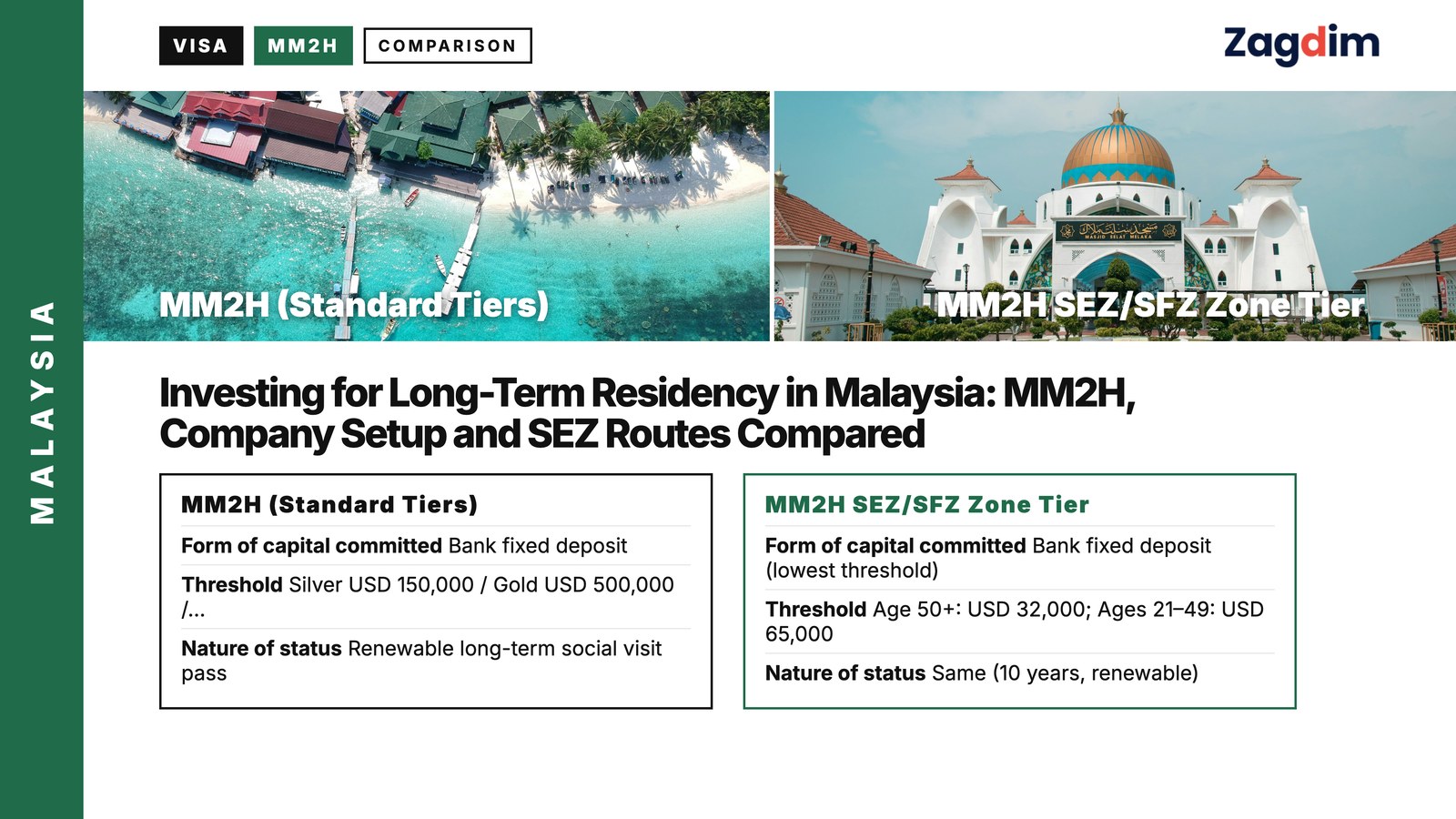
| Item | MM2H (Standard Tiers) | MM2H SEZ/SFZ Zone Tier | Setting Up a Company for an EP |
|---|---|---|---|
| Form of capital committed | Bank fixed deposit | Bank fixed deposit (lowest threshold) | Paid-up company capital plus genuine operations |
| Threshold | Silver USD 150,000 / Gold USD 500,000 / Platinum USD 1,000,000 | Age 50+: USD 32,000; Ages 21–49: USD 65,000 | In practice: around RM500,000 for a 100%-foreign-owned services company; RM1,000,000 for a trading company (also requiring a WRT licence); around RM350,000 for a 50:50 joint venture (follow current ESD/KPDN rules) |
| Nature of status | Renewable long-term social visit pass | Same (10 years, renewable) | Employment Pass (fixed term, tied to the company) |
| Duration | Silver 5 years / Gold 15 years / Platinum 20 years | 10 years each | Up to a maximum of 10 years depending on EP category (e.g. Category I at a salary ≥RM20,000), subject to renewal |
| Main attached obligations | Mandatory property purchase and 10-year resale ban after approval; 90 days/year stay for ages 25–49 | Same (property priced per zone project) | Company must have genuine operations and annual compliance; your own salary must meet the EP threshold |
| Who it suits | Pure capital allocation, retirement long-stay | Investors with limited funds willing to be based in a zone | People genuinely doing business in Malaysia |
A few words on each of the three.
MM2H standard tiers: capital buys time, and obligations come with it. This is the most established capital-based route. Viewed through an “investment” lens, two things matter: the fixed deposit is an opportunity cost (up to half the principal can be withdrawn after approval, and only for specified uses), and the property purchase is a mandatory obligation rather than an investment option — and cannot be sold within 10 years. Add both of these long-term commitments together to get the real “investment amount.”
SEZ/SFZ zone tier: the lowest threshold, but the deepest tie-in. The authorities explicitly designed this tier to attract investors settling in a Special Economic Zone or Special Financial Zone: the deposit threshold is the lowest across the whole system (USD 32,000 for age 50+), the minimum age is relaxed to 21, and the duration is 10 years. The trade-off is that the property purchase is tied to a zone project (priced per project) — in essence, “using residency status to steer your capital into a zone-based asset.” This suits someone who already likes the zone and is willing to live and buy property there; anyone who just wants a cheap status while having no intention of actually basing themselves in the zone should think carefully about whether that property becomes an asset or a liability for them personally.
Setting up a company for an EP: the only route where ‘investment’ means ‘a business.’ Foreigners can set up a company and, using that company as employer, apply for their own Employment Pass through the ESD system. In practice, a foreign-owned company needs to meet a capital threshold to qualify to apply for an EP for a foreign director: the commonly reported figures are around RM500,000 paid-up for a 100%-foreign-owned services company, RM1,000,000 for a company involved in trading/retail (which also requires a WRT licence), and around RM350,000 for a 50:50 joint venture with a local partner — these are practical thresholds reported from ESD approval practice, not statutory figures, so follow current ESD and KPDN rules. On top of that, the salary you pay yourself must also meet the relevant EP category threshold (Category I requires a monthly salary of RM20,000 or above), and the company must have genuine operations and annual compliance. What “investment” buys on this route is not the status itself, but a business that needs to be run — the status is simply a by-product of it.
The Most Common Misunderstandings and Risks Behind “Investment Immigration” Sales Talk
Misunderstanding One: Investing the Required Amount Gets You Permanent Residence.
The only official investment-based route to PR is the fixed-deposit path within the PR categories (publicly reported at the USD 2,000,000 level), and it is highly discretionary; all three of the real routes above give fixed-term residency. For any pitch promising “invest RM X, guaranteed PR,” ask first for the specific official category name it corresponds to.
Misunderstanding Two: The SEZ Tier — “USD 30-Something Thousand for a Ten-Year Visa” — Is Cheap.
The deposit is only the entry fee: on top of it comes a mandatory, zone-priced property purchase, a 10-year resale ban, and the officially listed 90-day annual stay requirement for the 25–49 age group. Add up the whole package before comparing it against the standard tier.
Misunderstanding Three: Setting Up a Shell Company Lets You Sponsor Your Own Visa.
EP approval looks at the company’s capital, the substance of its operations, and your own salary and role; a shell with no genuine business will not pass ESD’s review, and carries more risk at renewal. Treating company setup as a pure status tool means costs (capital, salary, compliance expenses) that are far higher than MM2H, with lower certainty in return.
Misunderstanding Four: Buying Property Counts as Investment and Can Offset the Threshold.
None of the three routes accepts property purchase as an entry qualification: MM2H’s property purchase is a post-approval obligation, and the EP route has nothing to do with property at all. “Buy my project and it counts as investment immigration” is sales talk stitching together two unrelated things.
Misunderstanding Five: The Routes Can Be Freely Stacked or Switched.
Each route has its own applying party, form of capital, and obligations; switching partway through means starting a fresh application. Choosing your main route based on a realistic three-to-five-year plan up front is far cheaper than “get on board first and figure it out later.”
Three Typical Scenarios: Matching Capital and Purpose
Scenario One: A Well-Capitalised Semi-Retired Investor With No Business Plans.
Mr A has liquid capital he can commit for the long term and wants a stable long-term status and a base for life. The MM2H standard tier — choosing a level based on asset size — is straightforward, and the commercial route is irrelevant to him; his homework is running the numbers on the deposit’s and property’s opportunity cost, and thinking through how the age-50 threshold and stay obligation affect his life plans.
Scenario Two: A Budget-Limited Young Investor Willing to Be Based in a Zone.
Ms B is 35, and her budget cannot stretch to the standard tier, but her work and life can genuinely be based in a zone. The SEZ/SFZ tier (USD 65,000 for ages 21–49) paired with a zone property is a workable combination for her — provided she treats the zone property as an asset she genuinely wants to live in and believes in, rather than a cost she is swallowing purely for the status.
Scenario Three: An Entrepreneur Who Wants to Run a Real Business in Malaysia.
Mr C’s goal is the market: setting up a company, hiring staff, doing business. His correct path is company-plus-EP — preparing the paid-up capital appropriate to his business type (services and trading have different thresholds), setting himself a salary that meets the threshold, and keeping annual compliance genuinely in order. His status will exist for as long as the business exists; conversely, if the company stops operating, the basis for the EP’s continuation disappears with it — how that is then handled follows current ESD rules.
FAQ: Foreigners Investing for Long-Term Residency in Malaysia
Q1: Does Malaysia have “investment immigration” or a “golden visa”?
There is no mechanism that converts investment directly into permanent residence. The only official investment-based route to PR sits within the permanent-residence application categories, via a fixed deposit (publicly reported at the USD 2,000,000 level, locked 5 years, highly discretionary); what is realistically plannable are the three long-term residency routes — the MM2H deposit, the SEZ/SFZ zone tier, and setting up a company for an Employment Pass — all of which are fixed-term and conditional.
Q2: What’s the minimum amount of capital needed to trade for long-term residency?
By deposit threshold, the lowest across the whole system is MM2H’s SEZ/SFZ zone tier: USD 32,000 for age 50+, USD 65,000 for ages 21–49 (10-year duration). But the full package needs to be counted: a mandatory, zone-priced property purchase and a 10-year resale ban after approval, plus a 90-day annual stay requirement for the 25–49 age group — the total commitment is far more than just the deposit figure.
Q3: Can I set up a company and employ myself?
Yes — this is a legitimate route: set up a company, then apply for your own Employment Pass through the ESD system with the company as employer. In practice, the reported thresholds are around RM500,000 paid-up capital for a 100%-foreign-owned services company, RM1,000,000 for a trading company (which also needs a WRT licence), and around RM350,000 for a 50:50 joint venture; your own salary must also meet the relevant EP category threshold, and the company must have genuine operations. Follow current ESD and KPDN rules for the specifics.
Q4: Which of the three routes makes it easiest to convert to permanent residence afterward?
None of them carries a “convert to PR” channel. Permanent residence is a separate, independent system (four categories, highly discretionary), and years spent on any of the three routes do not automatically accumulate toward PR eligibility. The sensible approach is to plan a long-term residency route as residency in its own right, and evaluate permanent residence separately against its own official categories if that is your actual goal.
Q5: An agent says “invest in this project and get a ten-year visa” — how do I verify that?
Three steps: first, ask them to name the exact official pass (“visa”) in question — it is most likely referring to MM2H’s SEZ/SFZ tier; second, check that tier’s deposit, property-purchase and stay obligations on the official website, and see what role “project investment” actually plays in the official conditions; third, remember that applications under official categories always go through a designated process (MM2H via a licensed agent, an EP via the ESD) — treat any claim of an “internal channel, no conditions required” as something to avoid outright.
Q6: If I go the company route, does the business’s performance affect my status?
Yes, materially — but the key factor is not “whether it’s profitable,” but whether the company maintains genuine operations, can pay you a salary that meets the EP threshold, and keeps its annual compliance in order. If any of these three break down, renewal will run into trouble. This route ties your status to the business — when assessing it, treat the company’s ongoing running costs (capital, salary, compliance) as the annual cost of maintaining your status.
Disclaimer
This article is a general information summary, prepared based on official sources current as of 2026 (the MM2H official website, the Immigration Department, and the ESD system) and publicly available professional-firm summaries of approval practice. It does not constitute immigration, legal, tax or investment advice, and does not guarantee the outcome of any individual application. The thresholds, obligations and approval practice for each route may change with policy; figures marked “practical threshold” or “publicly reported terms” should especially be checked against the current announcements of the ESD, KPDN, MOTAC and the Immigration Department. Readers should consult a qualified professional before making a capital commitment or setting up a company.
Have a question about this guide? Leave a comment below, or ask Zagdim directly.
Your first stop for international property and global living.
Research and insights. Know what’s changing. Understand what matters.
Sources
- Ministry of Tourism, Arts and Culture — MM2H Guidelines & Category Overview (including the SEZ/SFZ tier’s positioning)
- Jabatan Imigresen Malaysia — Permit Masuk official page
- Expatriate Services Division (ESD) — Employment Pass framework & 2026 salary policy
- KPDN — WRT licence regime (pointer)
- MISHU, SCS CPA, Horizon Hub and others — summaries of ESD practical capital thresholds for foreign-owned companies employing foreign directors.