






























Dubai is one of the world’s most active hubs for entrepreneurs, drawing founders from across the globe with advanced infrastructure, low tax rates and a business-friendly regulatory environment. Its Free Zones and Mainland company structures give founders a choice of routes into a fast-growing market, and the UAE government continues to actively court foreign investment and new company formation. According to 2024 figures, more than 25,000 new companies registered in Dubai that year, underlining the emirate’s pull as a startup hub.
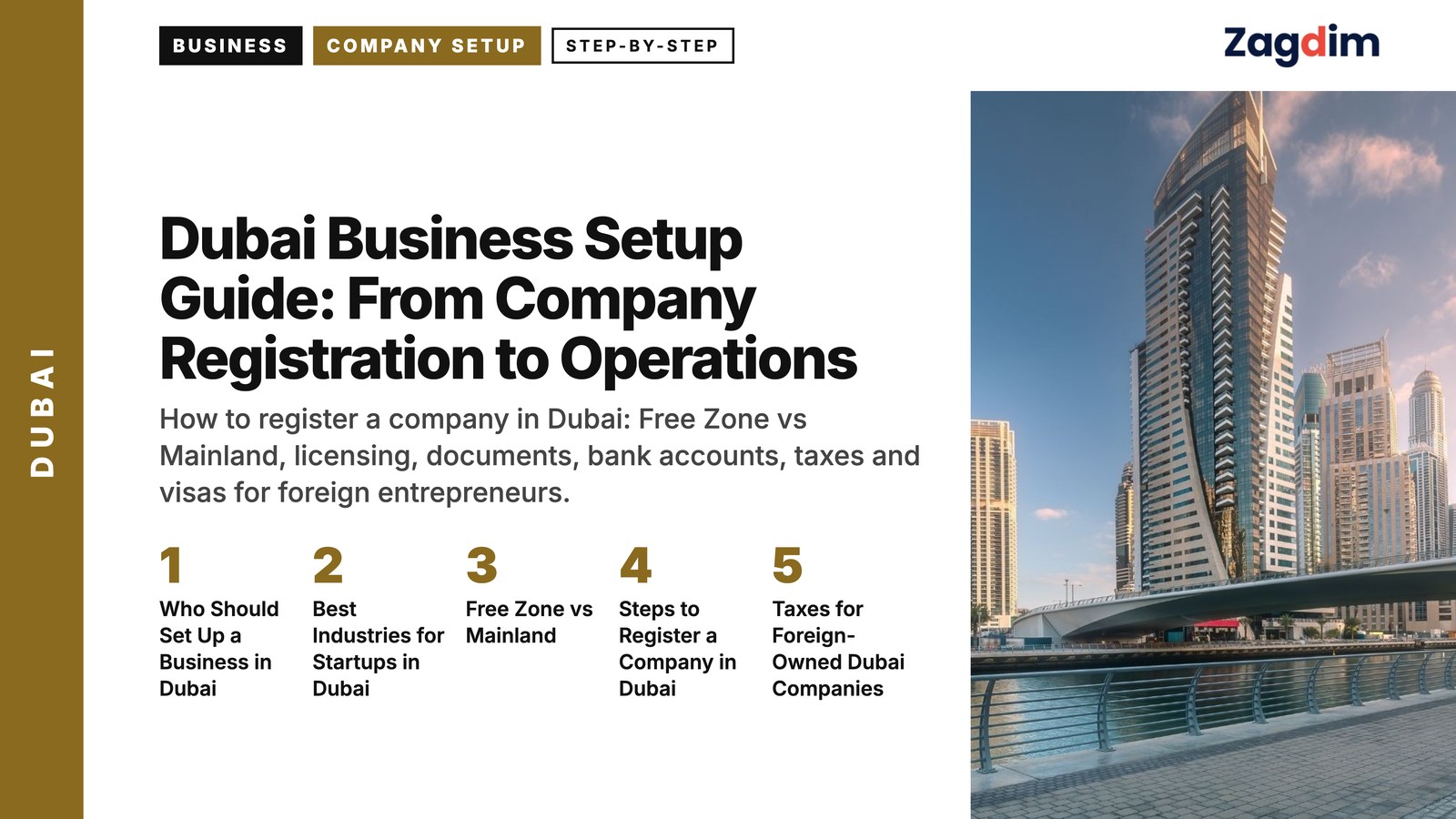
This guide walks through who Dubai’s business setup options suit, how to choose between a Free Zone and a Mainland company, the registration steps, the documents you need, tax rules, and the practical challenges foreign founders most often run into.
Who Should Set Up a Business in Dubai
Foreign nationals and first-time founders. Dubai’s free-economy policies, low tax rates and the option of 100% foreign ownership make it straightforward for foreign entrepreneurs to enter the market while keeping full control of their company. This is particularly attractive to founders targeting the wider Middle East market.
Prospective immigrants and long-term residents. For entrepreneurs considering relocating long-term and building an economic base locally, Dubai combines a strong economy with favorable residency and tax conditions.
Investor-immigrants. High-net-worth individuals and those seeking long-term residency through business activity can also use company setup as a route to the UAE’s Golden Visa program. Under UAE policy, foreign nationals who establish a qualifying company — particularly in certain targeted industries — can become eligible for a Golden Visa, extending high-quality residency to themselves and family members. Founders pursuing this route generally do best focusing on industries with strong long-term growth potential, such as high-end financial services, technology or healthcare.
High-net-worth investors looking for exposure to an emerging market or wanting to diversify their asset base can also use a Dubai company as a vehicle for growth, benefiting from the low-tax environment and a government that actively encourages investment and innovation.
Whichever category you fall into, understanding your business type — services, trade, technology and so on — along with your target market, will help determine the right setup path. Dubai’s options come with different conditions and requirements, so this judgment call is worth making carefully before you start.
Best Industries for Startups in Dubai
Dubai’s Free Zones offer particular policy support and competitive advantages to several sectors:
- Technology and innovation. Dubai’s tech startup scene is especially active in AI, fintech and blockchain. Free zones such as Dubai Silicon Oasis offer these sectors specific support, including lower setup costs and tax incentives.
- Finance and investment. As the Middle East’s financial center, Dubai attracts large numbers of financial institutions and investors. The Dubai International Financial Centre (DIFC) is a major financial free zone offering regulatory and tax advantages, making it a strong base for financial and capital-markets founders.
- Trade and logistics. Dubai has long been a global trade and logistics hub. Companies in trade or logistics benefit from strong infrastructure and trade networks, particularly through the Dubai Airport Free Zone (DAFZA), which offers a strategic location and logistics support.
- Healthcare. Dubai’s healthcare sector continues to grow into a regional hub for health management and medical tourism, creating openings for medical services, health management and clinic-type businesses.
- Education and training. Rising demand for quality education across the Middle East has made education a notable startup sector in Dubai, from language schools to professional skills training and tech-related education ventures.
Free Zone vs Mainland: Choosing Your Company Structure
Before registering, you need to decide between Dubai’s two main company types.
Free Zone company
- *Ownership:* 100% foreign ownership, with no requirement for a local partner. This suits founders who want to keep full control of their company.
- *Tax and setup:* Free Zone companies benefit from generous tax incentives (including 0% corporate and personal income tax, discussed below), flexible office-space requirements, and a comparatively fast, simple setup process.
- *Limitation:* Free Zone companies can typically only operate within their free zone and cannot trade directly with the UAE’s local (mainland) market without additional arrangements, such as a cooperation agreement or a mainland branch.
Mainland company
- *Ownership:* Since 2021, most Mainland (onshore) companies can be 100% foreign-owned — the old rule requiring a UAE national partner to hold at least 51% of the shares was abolished for most activities. Only a short list of “strategic impact” sectors (defence and security, telecommunications, banking/insurance/financing, commercial agencies, Hajj and Umrah organising, Holy Quran recitation institutes, and fishing/pearl and marine-animal catching) may still carry foreign-ownership restrictions or extra approval requirements.
- *Reach:* A Mainland company can trade anywhere across the UAE and deal directly with government entities, giving it broader market access — an advantage in some industries.
- *Setup:* The process is relatively more complex and involves more administrative approval steps than a Free Zone setup.
A common mistake among first-time founders is assuming there’s little practical difference between the two structures. There is: a Free Zone company offers full ownership but a narrower operating footprint, while a Mainland company requires a local partner but opens up UAE-wide trading and direct government contracts. Choosing the wrong structure for your business model can slow down — or limit — your growth.
If you’re weighing which structure fits your plans, ask Zagdim.
Steps to Register a Company in Dubai
Step 1: Choose your company structure. Decide between a Free Zone company and a Mainland company (see above) — this decision shapes your ownership structure, tax treatment and operating flexibility.
Step 2: Choose a business activity and license type. Dubai’s free zones issue different license types depending on your activity:
- Commercial license — for trading, import/export and similar activities.
- Professional license — for service businesses such as consulting, accounting or legal services.
- Industrial license — for manufacturing businesses.
- E-commerce license — for online and internet-based trading businesses.
Step 3: Reserve a company name and get it approved. Your company name must be unique and not duplicate an existing registered name. Submit your chosen name to the Dubai Chamber of Commerce (or the relevant free zone authority) for review and approval. Depending on your business type, there may be additional naming requirements or restrictions, so choose carefully.
Step 4: Prepare and submit the required documents. This includes shareholder identification, your Memorandum of Association (MOA), proof of your business address, and other documents — the full list is below.
Step 5: Choose a location or office space. Options vary by structure:
- *Free Zone office space* — most free zones offer flexible options, from co-working desks to private offices, generally with lower rents and more flexible lease terms.
- *Mainland office lease* — mainland businesses need to lease commercial office space, which tends to cost more, especially in central or popular districts.
- *Co-working space* — a common choice for startups needing flexibility, typically offering infrastructure such as high-speed internet and meeting rooms at a lower starting cost.
Step 6: Open a corporate bank account. Every company needs a dedicated business bank account to handle transactions and manage finances. Banks typically ask for your certificate of incorporation, identification documents and MOA, among other paperwork; opening an account can take several days, so prepare your documents in advance. All formal business transactions in Dubai should run through this account — this keeps your operations transparent and compliant with local financial regulation, and you should confirm the account can handle international payments and foreign-exchange transactions.
Step 7: Obtain your business license, apply for visas, and launch operations. Once your license is granted (via the Dubai Department of Economy and Tourism, formerly the Department of Economic Development (DED), or your free zone authority) you can formally begin operating. Depending on your company’s size and staffing needs, you’ll also apply for entrepreneur and employee visas — this typically covers company registration, bank account setup, and work/residency permits for staff, and some free zones allow the whole process to be completed without the founder needing to be present in person. As you launch, it’s worth localizing your operations to the market, using digital marketing (social media advertising, search engine optimization), and building relationships with local business networks.
Documents You’ll Need to Register a Dubai Company
- Company name application form — the first step in the process; the requested name must not already be registered and must meet Dubai Chamber of Commerce naming rules.
- Passport copies of all shareholders and directors — used to verify identity; passports must be valid for at least six months and copies must be clear.
- Memorandum of Association (MOA) and Articles of Association (AOA) — set out your company’s structure, operating scope and shareholders’ rights and obligations, and must comply with UAE law.
- Proof of residential or business address — residents typically provide a utility bill or bank statement; non-resident founders provide proof of their chosen business address, such as a lease agreement or office certificate.
- Proof of capital (where applicable) — such as a bank deposit certificate or other evidence of capital injection; requirements vary by company type and by free zone or mainland status.
- Business plan — sets out your company mission, target-market analysis, product or service description, competitive advantages and financial projections; licensing authorities commonly ask to see this to confirm the company has a clear direction.
Taxes for Foreign-Owned Dubai Companies
Dubai offers foreign entrepreneurs a favorable tax regime: 0% corporate income tax, 0% personal income tax, 0% import/export tax, 0% capital gains tax and 0% wealth tax. A 9% corporate tax now applies to companies with annual income above AED 375,000; even so, Free Zone companies can still qualify for tax exemption under certain conditions. Most industries pay no income tax, though a small number of sectors — including oil and gas, and financial services — may carry additional tax requirements, so founders should confirm the rules that apply to their specific business type.
Frequently Asked Questions
Can I register a Dubai company on my own, without a local partner?
Yes. Choose a Free Zone company and you can own 100% of it with full control over operations. Since 2021, most Mainland (onshore) companies can also be 100% foreign-owned — the old rule requiring a UAE national partner to hold at least 51% of the shares was abolished for most activities. Only a short list of “strategic impact” sectors (defence and security, telecommunications, banking/insurance/financing, commercial agencies, Hajj and Umrah organising, Holy Quran recitation institutes, and fishing/pearl and marine-animal catching) may still carry foreign-ownership restrictions or extra approval requirements.
Are there restrictions on hiring foreign staff?
Dubai applies certain quotas on foreign employees, depending on company size and industry. Many free zones offer more flexible staffing arrangements, adjusting the proportion of foreign employees allowed to suit the company’s needs — giving foreign founders more flexibility.
Do Dubai companies have to pay tax?
Most industries are exempt from income tax, which is a major draw for founders worldwide. Some sectors — such as oil and gas, and finance — may face additional tax requirements. See the tax section above for the specific rates that generally apply.
How long does it take to register a company in Dubai?
Registration generally takes around two to four weeks, depending on the company type and free zone chosen. Some free zones offer a faster process, while more complex business types may take longer.
Can I set up a branch office in Dubai?
Yes. Dubai allows foreign companies to establish branches or subsidiaries locally and operate in the Dubai market, letting you expand your business without relying entirely on a local joint-venture partner.
Is government funding or support available for startups?
Yes. Several government-backed programs support startups, particularly in technology and for small and medium-sized businesses — for example the Dubai Innovation Agency and Dubai Silicon Oasis, which offer startup funding, incubator support and business guidance. Eligibility and funding terms vary by industry and by the viability of the business plan.
Do I need to hire local staff?
There’s no requirement to hire local staff to start a business in Dubai. Depending on company size and type, hiring local staff can help a business adapt to the market and localize operations. In Free Zones, founders can hire foreign staff and obtain the necessary work visas, though staffing and office-space requirements vary by free zone.
How should I handle cash flow and financial management early on?
Run all business income and expenses through your formal company bank account. Dubai’s banking system offers efficient financial services, but you’ll still need to open and manage that account, and it’s worth engaging a professional accountant or financial advisor early on to help with bookkeeping, tax filing and compliance. Understanding Dubai’s tax policy, cash-flow rules and currency conversion will help your business launch smoothly.
Common Challenges for Foreign Founders
Cultural adaptation. Cultural differences show up not just in daily life but in business dealings and communication. Dubai is a multicultural city where the business environment blends Arab and international influences, so understanding local business customs and negotiation styles matters — relationship-building and etiquette tend to carry real weight in negotiations.
Regulation and tax complexity. Dubai’s legal and tax environment can feel unfamiliar to founders coming from very different legal systems, and business regulation and tax policy are updated fairly often, with compliance requirements continuing to rise. Free zone operating rules, foreign-ownership conditions and cash-flow regulations can all be sources of confusion, and the introduction of the 9% corporate tax makes tax planning more important than it used to be.
Summary
Success in setting up a business in Dubai comes down to understanding local law, tax policy and market conditions, and weighing the advantages and limits of a Free Zone company against a Mainland company. A precise registration process, clear business planning and flexible tax arrangements all support a smoother launch. If you’d like help thinking through which structure and setup plan fits your business, ask Zagdim.
Have a question about this guide? Leave a comment below, or ask Zagdim directly.
Your first stop for international property and global living.
Research and insights. Know what’s changing. Understand what matters.
Sources
- *Dubai Chamber of Commerce* – 2023 Dubai Business Setup Guide
- *Shuraa Business Setup* – How to Start a Business in Dubai
- *Centuro Global* – Setting Up a Company in Dubai
- *DMCC* – Step-by-Step Guide to Starting a Business in Dubai
- *Shuraa Business Setup* – How to Start a Business in Dubai Free Zones
- *Creative Zone* – Top 10 Challenges Faced by New Entrepreneurs in Dubai
- *IFZA* – 15-Min Guide to Obtain Dubai Business License
- *Savory and Partners* – Dubai Tax Rate Guide