





























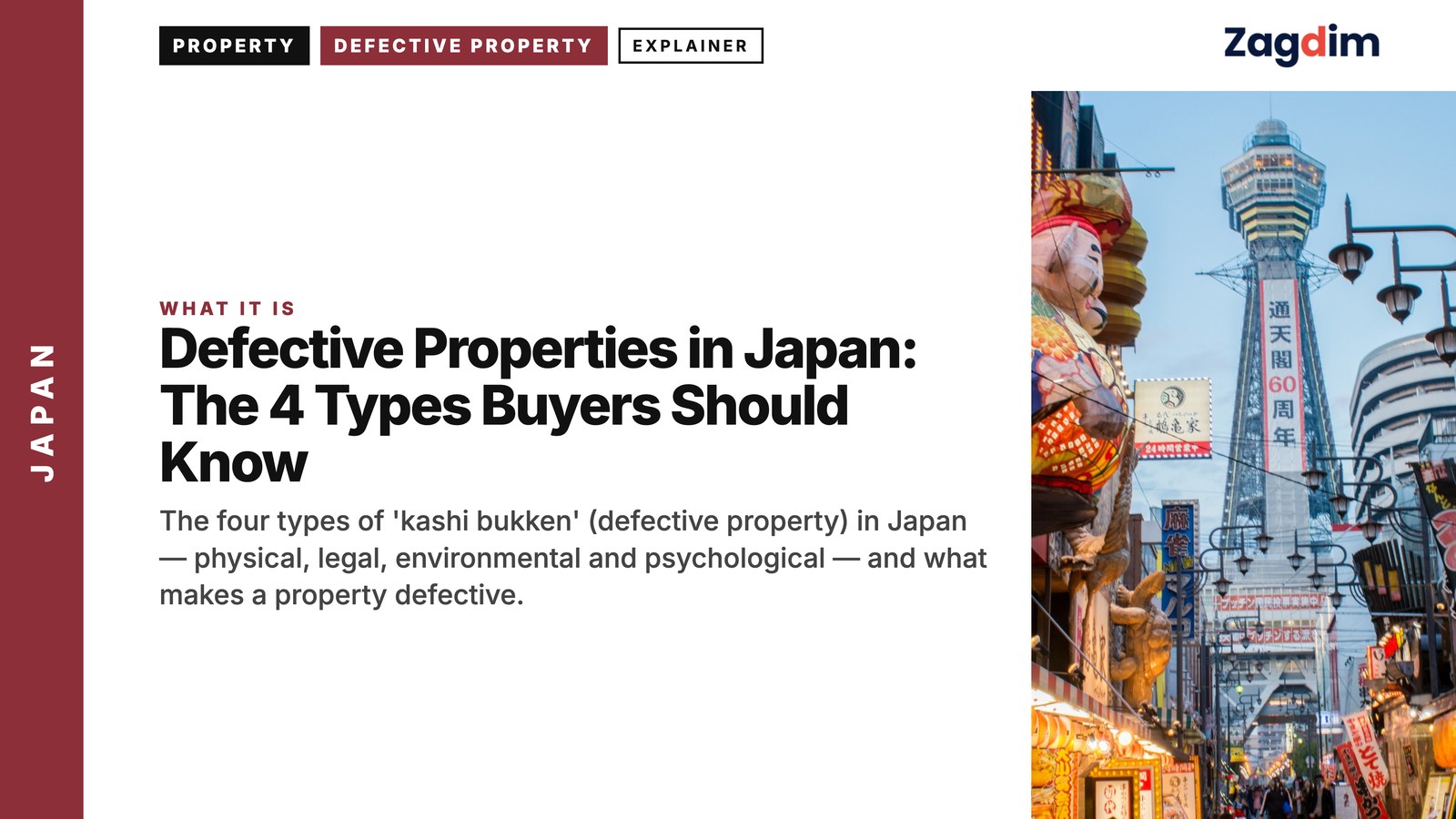
Investing in Japanese property involves a common concept known as “kashi bukken” (瑕疵物件, defective property). Defective properties can be broken down into physical defect properties, legal defect properties, environmental defect properties, and psychological defect properties. This article sets out in detail the concept of “kashi bukken” in Japanese real estate investment, and what makes a property “defective.”
Physical Defect Property
Simply put, this refers to cases where the building or land itself has suffered serious damage or has a flaw.
Examples of building defects include: rainwater leaks, upper-floor leaks, wall cracks, termite damage, use of asbestos in building materials, blocked or burst water supply and drainage pipes, insufficient seismic strength, and structural defects in the building. Ground subsidence and structural damage caused by flooding or similar disasters are also treated as physical defects. Examples of land defects include unstable or distorted ground, such as ground subsidence; soil contaminated by hazardous substances; and buried obstacles or objects underground, such as waste or debris. Unclear land boundaries are also considered a physical defect of the land. Depending on the applicable conditions, new-build and pre-owned properties generally carry a 2-to-10-year defect warranty liability under Japan’s Act on Securing the Performance of Housing Defect Warranty. Separately, under Japan’s Civil Code, the general term for defect liability has been 契約不適合責任 (contract non-conformity liability) since April 1, 2020, replacing the older 瑕疵担保責任 term used in this Act’s own name.
Legal Defect Property
As the name suggests, this refers to a property with a legal problem. In many cases, the issue is a violation of the Building Standards Act, Fire Service Act, City Planning Act, or similar laws. Under the Building Standards Act, for example, a property may violate or fail to meet legal standards for structural safety, setback requirements from roads, floor-area ratio, building coverage ratio, and the like.
Under the Fire Service Act, an apartment building’s fire-prevention equipment — fire alarms, sprinklers, fire doors, evacuation stairs and the like — may not meet installation obligations, or the equipment itself may be outdated. Even under the City Planning Act’s zoning rules, it is possible to imagine a property built within an “urbanization control area,” where development is essentially not permitted. Because it would be an illegal structure, a legal defect essentially cannot exist in a newly built property, but legal defects often turn up in pre-owned properties built before the relevant law took effect. A classic example is a city-center property that “cannot be rebuilt.” In general, though, such matters must be disclosed to the buyer in the Important Matters Explanation document.
Environmental Defect Property
This refers to a property that makes you feel uncomfortable or averse to living there because of environmental factors, and in some cases it may overlap with the psychological defect properties discussed below.
Specifically, even without direct harm, nearby facilities — crematoriums, funeral homes, cemeteries, amusement facilities, factories, waste treatment plants, gas tanks, nuclear power plants, sewage treatment plants, prisons, customs facilities and the like — fall into this category. So do noise and vibration from nearby railways and highways, and unpleasant odors from factories and processing plants. A property with an environmental defect is not, in practice, as harmful as one with a psychological defect, but it carries a defect that people find unpleasant, depending on their sensitivity to noise, vibration, odors caused by nearby facilities, and disagreeable activity in the area — a defect that directly affects the comfort of daily life.
Psychological Defect Property
A psychologically defective property is one where an accident, incident, or trouble has occurred in or around the property in the past, usually referred to as a “jiko bukken,” or stigmatized property.
Even if the property itself has no defect in performance or function, a resident’s psychological resistance or aversion — the feeling that “I cannot live here” — is itself considered a defect. This covers cases such as suicide, accidental death and murder, as well as cases with no direct damage but where a nearby facility is, for example, an office linked to organized crime. The Ministry of Land, Infrastructure, Transport and Tourism’s 2021 guideline gives real estate agents a concrete framework for this judgment, distinguishing natural or ordinary deaths — which generally need no disclosure — from other deaths, which do, subject to a roughly three-year non-disclosure window for rental properties, rather than leaving the question purely to individual perception.
Have a question about this guide? Leave a comment below, or ask Zagdim directly.
Your first stop for international property and global living.
Research and insights. Know what’s changing. Understand what matters.
Sources
- Ministry of Land, Infrastructure, Transport and Tourism (MLIT): https://www.mlit.go.jp/jutakukentiku/jutaku-kentiku.files/kashitanpocorner/rikouhou/index.html
- Japan Housing Warranty Inspection Organization: https://www.jio-kensa.co.jp/other/wound/