





























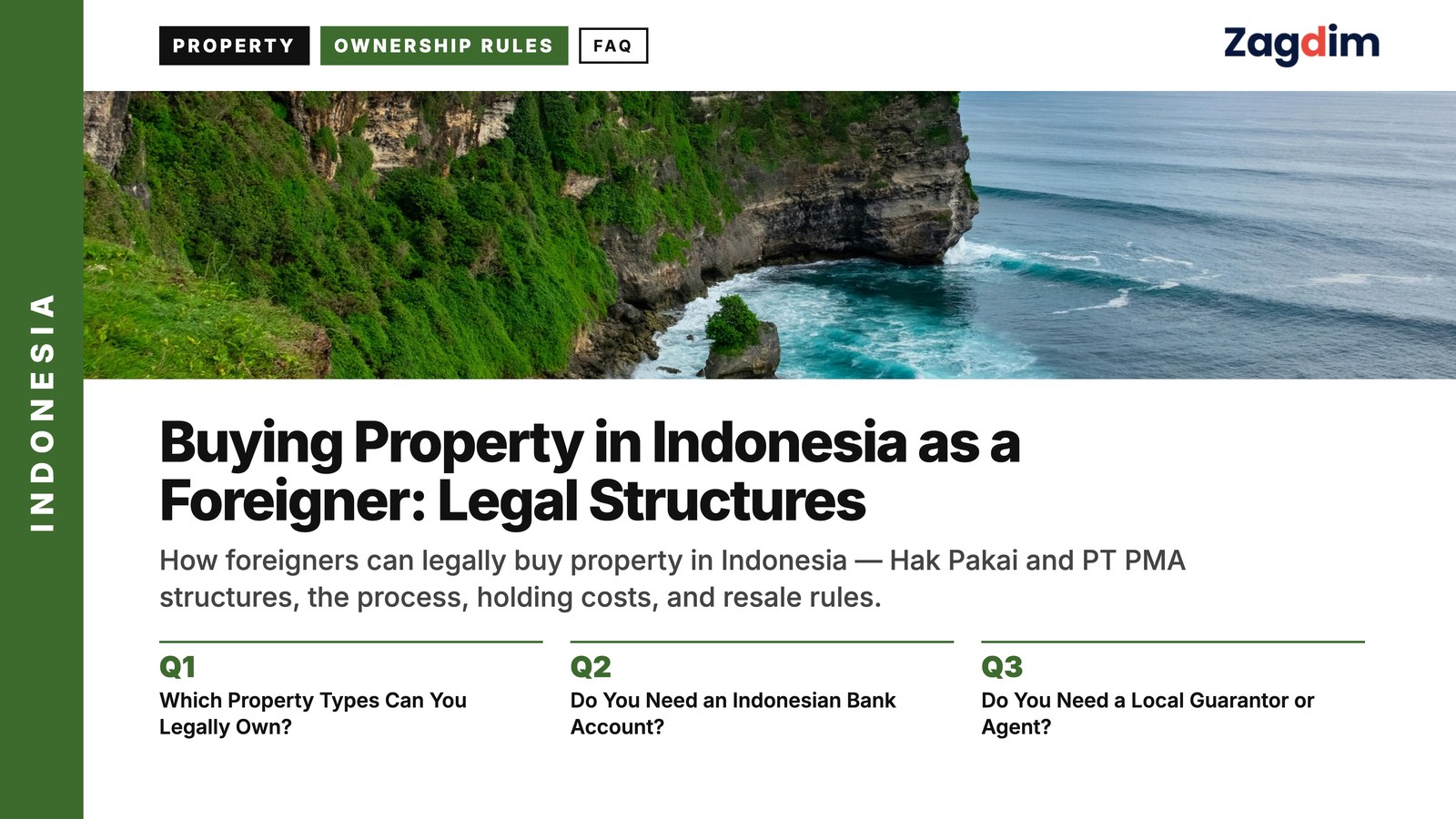
Thinking about buying property in Indonesia? Slow down — Indonesia has a distinctive and strict legal framework for foreign ownership of real estate. What can you actually buy? How long can you hold it? Do you need to set up an Indonesian company? How is tax calculated? Can you resell it? Can you move the money out? This guide answers all of that in one place: Hak Pakai and PT PMA structures explained, a full walkthrough of the buying process, annual holding costs and tax obligations, and resale and repatriation rules — everything you need to buy with a clear head, hold with peace of mind, and have an exit route ready. Whether you’re planning to relocate on a budget, buy a retirement property, or live in it while also running it as a short-term rental, this guide lays out the legal logic and risk considerations behind buying property in Bali.
I. Can Foreigners Buy? Legal Restrictions and Property Types
Indonesian land law strictly restricts foreigners from directly holding full land ownership (Hak Milik), but that doesn’t mean you can’t legally buy and hold property. For a foreigner considering buying in Bali, understanding what you can buy, how long you can hold it, and what qualifications you need is the first hurdle to clear before entering the market.
Which Property Types Can You Legally Own?
Foreign nationals cannot hold Hak Milik (full ownership) — that land title is reserved for Indonesian citizens. But you can legally hold property through the following routes:
- Hak Pakai (right of use): the most common form of foreign ownership, for residential use. The property must be an already-built structure (such as a villa or apartment), not vacant land.
- Strata-title units: if a developer has registered the land as Hak Pakai and obtained the proper building and use permits, foreigners can buy a unit directly.
- Leasehold (Hak Sewa): not ownership, but a contractual lease, typically for 25–30 years and renewable, carrying no land rights.
Maximum Holding Period: Hak Pakai Can Run Up to 80 Years
- Initial authorization period: 30 years
- First extension: up to 20 years more
- Second extension: a further 30 years
- Extensions require approval and must comply with local land-use planning rules
Unlike outright ownership, Hak Pakai emphasizes a “legal right of use with a term” — but a total of 80 years is enough to meet most long-term residency and investment needs.
Legal Conditions: Not Everyone Qualifies
If you’re a foreigner who wants to hold Hak Pakai in your own name, you must meet one of the following conditions:
- Hold a valid Indonesian long-term residency visa, such as:
- KITAS (limited-stay permit)
- KITAP (permanent-stay permit)
- Second Home Visa
In addition, the location and size of the property you buy must meet the statutory minimum price threshold. In Bali, for example, a foreign buyer’s purchase price must exceed a government-set minimum (for instance, IDR 2–5 billion, depending on the area).
II. What to Prepare Before Buying: Planning and Legal Setup
Buying property in Bali isn’t just about picking a house — it means stepping into a complete legal and administrative system. Many foreigners make their first mistake by assuming they can buy and sell property the same way they would back home. In fact, in Indonesia, identity planning, company setup, funding, and legal procedure all need to be designed in advance.
How Do You Plan to Hold the Property? Comparing Two Common Structures
| Holding Method | Who It’s For | Title You Can Hold | Typical Use Case |
|---|---|---|---|
| Foreign individual | Holder of a valid residency visa (KITAS/KITAP) | Hak Pakai (right of use) | Personal residence, long-term retirement, vacation home |
| PT PMA company | An Indonesian legal entity set up by a foreigner | HGB (right to build) | Rental investment, villa operation, development |
If you’re only planning to buy a home for your own use, “foreign individual plus Hak Pakai” is the simplest option. But if you plan to run a short-term rental or Airbnb-style business, you’ll need to set up a PT PMA (foreign-invested company) in order to legally obtain HGB land rights and apply for a business license.
Do You Need an Indonesian Bank Account?
Technically, no — but in practice, it’s highly recommended, for reasons including:
- Easier payment handling and fund oversight
- Smoother tax remittance on future rental income
- Cooperation with local bank due diligence, which makes it easier to move funds out of the country later (repatriation)
Many foreign buyers open a local Indonesian account around the same time they set up a PT PMA or obtain a residency visa.
PPAT Notaries and Lawyers: You Need Both
Indonesia doesn’t allow private, informal property transactions. The sale and purchase deed (Akta Jual Beli) must be drafted and certified by a PPAT (land deed notary) and registered with the National Land Agency (BPN). You’ll need:
- A local lawyer familiar with Indonesian real estate law (for due diligence and reviewing terms)
- A PPAT notary (to execute the sale and purchase deed and the title transfer)
It’s not advisable to rely solely on documents provided by a developer or agent. A professional team protects you from being disadvantaged on language, law, and tax matters.
Setting a Budget and the Minimum Property Value
Indonesian law sets a minimum purchase price for foreign buyers, to prevent speculation and nominee-based transactions. In Bali, for example:
- A residential property registered as Hak Pakai: a minimum of roughly IDR 2–5 billion (about USD 130,000–330,000)
- Thresholds may vary by region and by building type (apartment vs. villa)
Setting your budget, then, isn’t only a matter of funds — it’s also a question of whether you even qualify to buy.
Do You Need a Local Guarantor or Agent?
- Holding Hak Pakai doesn’t require a guarantor, though some areas still require a local contact or proof of address during processing.
- Setting up a PT PMA requires hiring a legal advisor and an accountant to handle company registration, capital verification, and tax planning.
Avoid using a nominee or an illegal arrangement to buy property — the legal cost of doing so is extremely high, and you could lose any protection over your ownership.
Contract Language and Legal Versions
- All property contracts and government registration documents must be in official Indonesian.
- If you use an English version, it can only serve as a reference — the Indonesian-language contract governs.
- A bilingual contract, reviewed by a lawyer for consistency between the two versions, is recommended to avoid disputes.
If you’re planning to start a new chapter of life in Bali, getting these legal and administrative details in order is a worthwhile upfront investment. Next, we’ll walk through the practical process — from viewing a property to registering title.
III. The Full Buying Process: From Viewing a Property to Title Registration
Indonesia’s property transaction process isn’t especially complicated, but for foreigners, every step has a formal procedure and documentation requirement that can’t be skipped. From selecting a property to obtaining the formal title certificate, the process breaks down into five main steps, and it must go through a PPAT (land deed notary) — private or informal agreements aren’t permitted.
Step 1: Sign a Letter of Intent (LOI) and Pay a Deposit
- Buyer and seller sign a Letter of Intent (LOI) confirming basic terms (price, handover date, payment method)
- A deposit of roughly 5–10% is typically paid at this stage to hold the property
- These terms carry moral weight but do not yet constitute a legal transfer of title
Step 2: Due Diligence and Legal Review
This is the most critical — and most often skipped — step. A lawyer should conduct a title investigation covering:
- Confirming the seller holds valid legal title (such as Hak Pakai or HGB)
- Checking for any mortgage registration, legal disputes, or overlapping land claims
- Verifying the property holds a valid building permit (IMB/PBG) and complies with zoning
- Confirming all applicable property taxes (PBB) have been paid
When needed, a lawyer can request a formal search at the National Land Agency (BPN) to protect the buyer’s interests.
Step 3: Sign the Official Sale and Purchase Deed (Akta Jual Beli, AJB)
- Once title is confirmed, both parties sign the official deed (AJB) at the PPAT’s office
- The deed covers the property description, price, tax allocation, payment terms, and handover deadline
- Both parties must sign in person, with the PPAT reading the deed aloud and completing notarization on the spot
- At the same time:
- The seller pays the final income tax (PPh) (2.5% of the sale price, rising to 20% if the seller has no valid NPWP tax ID or is a non-resident taxpayer)
- The buyer pays the BPHTB acquisition tax (5%)
Step 4: Title Transfer Registration (BPN Registration)
- After the AJB is signed and taxes are paid, the PPAT submits the transfer application to the BPN
- The BPN cancels the previous owner’s registration and issues a new Hak Pakai (or HGB) certificate
- Registration typically takes a few weeks
- Once this step is complete, the buyer formally holds legal title
Step 5: Obtain the Title Certificate and Tax Identification (NOP)
- After the BPN completes the title transfer, the buyer receives the formal land-title certificate
- At the same time, the buyer must apply to the tax authority for an NOP (property tax identification number) to pay the annual PBB property tax
- If the property will be rented out or operated commercially, it’s advisable to also apply for an NPWP (tax ID) at the same time
A Note on Informal Agreements
Indonesian law strictly requires that property sales go through a PPAT for formal deed execution and title registration. Any privately signed agreement (such as an English-language contract or a bill of sale) has no legal effect in transferring title, cannot be registered with the BPN, and cannot result in a valid title certificate.
IV. Costs and Obligations During the Holding Period
Buying isn’t the finish line — the real cost of ownership starts the day you receive your title certificate. For a foreigner holding property in Indonesia, ongoing costs fall into three main categories: tax obligations, maintenance and management, and rental compliance. Whether you live in the property or rent it out, you need to understand these “invisible costs” to avoid penalties or violations down the line.
Annual Fixed Cost: Property Tax (PBB)
Indonesia’s property tax is called PBB (Pajak Bumi dan Bangunan), paid annually by the title holder. It’s calculated as follows:
- Rate: roughly the government-assessed value (NJOP) × 0.1%–0.3%
- Residential use (such as Hak Pakai): typically 0.1–0.2%
- Commercial use (such as rental or short-term-rental operation): can run as high as 0.3–0.5%
- Example: if the NJOP is IDR 3,000,000,000, the tax could be roughly IDR 3–9 million (about USD 200–600)
PBB is due before August each year, and the payment notice (SPPT) is mailed to the registered address. Keep the payment receipt — it’s an important document for future sale or application purposes.
Management Fees, Maintenance, and Common Costs
Different types of property come with different maintenance and management costs:
| Item | Range and Estimated Cost (Reference) |
|---|---|
| Apartment management fee | IDR 10,000–25,000 per square meter, per month (covers security, utilities in common areas, elevators) |
| Standalone villa upkeep | Hiring your own caretaker, gardener, or cleaner, typically from around USD 100–300 per month |
| Repairs and renovation | Budget roughly USD 1,000–2,000 a year for things like roof, air-conditioning, and plumbing repairs |
| Trash collection, water, and other local fees | Varies by area; some more rural areas require extra payment for service |
If you’re going to be away from Indonesia for long stretches, it’s worth hiring a local property management company to handle day-to-day maintenance, bill payment, and tenant liaison.
If You Plan to Rent It Out: Tax and Registration Must Be Legal
If you plan to rent out the property, whether long-term or short-term, you’re not just a homeowner — you’re also a taxpayer:
You’ll need to handle the following:
Apply for an Indonesian tax number (NPWP). This is required whether you’re renting it out as an individual or operating through a PT PMA; an accountant or agent can help you apply.
File and pay rental income tax (PPh Final): generally 10% of gross rental income for resident taxpayers, rising to 20% if you’re a non-resident taxpayer (a residency-based rule, not purely an NPWP-registration penalty, though the two often coincide). It must be filed monthly or quarterly — file late and you risk penalties.
For short-term rentals (such as Airbnb-style listings), you’ll need a local lodging permit (Pondok Wisata or Hotel License). Renting out without one risks fines, a forced shutdown, or even visa revocation or property closure.
In short: legal rental = tax ID + tax filing + a license — you need all three.
Recommended Management Strategy
- If you only own one property, it’s worth partnering with a reliable local management company (which can handle rental management, tax filing, repairs, and more)
- If you’re taking an investment-led approach with multiple properties run commercially, consider setting up a PT PMA and hiring an accountant to handle tax and annual filings
V. Overview of Buying and Selling Taxes and Fees
Buying or selling property in Bali involves more than just the property price — there’s a series of taxes and administrative fees to factor in. These generally fall into buyer’s taxes and fees and seller’s taxes and fees, most of which are one-off costs incurred during the transaction. Understanding these items helps you budget and negotiate more precisely.
Taxes and Administrative Costs the Buyer Pays
| Item | Description |
|---|---|
| **BPHTB** (land and building acquisition tax) | The rate is **5% × NPOP (transaction value) minus a tax-free threshold (NPOTKP)**; in practice, most transactions are charged the full 5% |
| **Notaris/PPAT fees** | Generally **1–2%** of the transaction amount, depending on scope of service and location |
| **Administrative and registration fees** | Covers document processing, title transfer, land registry searches, and similar items; generally a small fixed fee (several million IDR) |
Rough example: for a property valued at IDR 300 million, total transaction-related costs run roughly IDR 15–18 million (about USD 1,000–1,200).
Taxes and Selling Costs the Seller Pays
| Item | Description |
|---|---|
| **Final Income Tax (PPh)** | The rate is **2.5% × sale price** for resident sellers, rising to **20%** for a seller without a valid NPWP or who is a non-resident taxpayer |
| **Agent’s fee/commission** | Typically **3–5%**, depending on the agreement with the agent |
| **Other administrative or termination fees** (if applicable) | If the property is sold early or has an existing lease or mortgage, additional processing costs may apply |
Note: if the property is held through a PT PMA, sale proceeds must be included in the company’s annual accounts and handled under corporate tax rules — the tax treatment differs from a sale in an individual’s own name.
Other Points to Note
- Taxes and fees are generally settled and paid in Indonesian rupiah (IDR) — foreign currency isn’t accepted
- The tax payment receipt (SSP) is a required document for title-transfer registration — the BPN won’t process registration without proof taxes have been paid
- All fees and taxes should go through formal channels — never accept a “cash discount” or a “dual contract” arrangement, which are illegal and risk legal exposure or future title disputes
The costs each side bears often affect the final agreed price and negotiating leverage. It’s therefore worth having a lawyer or property consultant produce a full tax and fee estimate before signing the letter of intent, so the transaction goes more smoothly and stays under control.
VI. Resale Restrictions and Repatriating Funds
Whether it’s for capital appreciation or a change in life plans, at some point you may consider selling your Indonesian property. For a foreign owner, though, the type of title, your eligibility status, and the fund-repatriation mechanism are all critical factors you can’t ignore at resale.
Resale Restrictions for Foreigners: You Can Only Sell to Someone Who Qualifies
Indonesian law provides that:
- Hak Pakai (right-of-use) property can only be resold to:
- A foreigner who is eligible to hold Hak Pakai (such as a KITAS, KITAP, or Second Home Visa holder)
- Or an Indonesian citizen
- HGB (right-to-build) held under a PT PMA:
- Can be resold to another Indonesian legal entity/PT PMA or a qualifying investor
- Must go through a formal transfer process and tax settlement
- Leasehold property:
- Only the remaining term of the right of use can be transferred, subject to the terms of the original lease
Note: you cannot resell to a foreigner who doesn’t qualify, and you cannot use a nominee or an illegal arrangement to hold title on someone else’s behalf — doing so makes the sale invalid and can carry criminal liability.
The Fund-Repatriation Process: Compliance First, Documentation Matters
Once you’ve successfully sold a property, moving the proceeds legally out of Indonesia requires the following documents:
| Required Document | Description |
|---|---|
| Akta Jual Beli (the official sale and purchase deed) | Notarized and registered by a PPAT |
| Land title certificate (Hak Pakai or HGB) | Shows you as the legal title holder |
| Tax payment records (PPh, BPHTB, PBB) | All taxes must be paid in full, with official payment receipts attached |
| NPWP tax number (if applicable) | Strengthens your tax credibility and can simplify bank review |
| Bank forms and proof of source of funds | Local banks require an explanation of the source and purpose of funds, as an anti-money-laundering measure |
| Passport and proof of residency (such as a KITAS) | Verifies identity; some banks require a certified passport translation |
If a single fund transfer exceeds the equivalent of USD 100,000, the bank will apply enhanced scrutiny and report the transaction to Bank Indonesia.
Currency Exchange Rules and Rate Risk: Rupiah Is the Primary Settlement Currency
Indonesian law provides that:
- All property transactions must be settled in Indonesian rupiah (IDR) — pricing or paying in foreign currency such as US dollars or euros is not permitted
- Repatriating funds requires first completing a currency conversion through an authorized foreign-exchange bank, in compliance with anti-money-laundering (AML) and tax rules
- Exchange-rate fluctuations directly affect the final repatriated amount — it’s worth discussing with your bank in advance and, if needed, using spot or forward hedging tools
Recommended Holding Period and Resale Timing
- In practice, Indonesian property suits a medium-to-long holding horizon: 5–10 years is a common planning cycle
- Reasons include:
- Upfront taxes and acquisition costs are relatively high and take time to amortize
- Capital appreciation tends to be steady, and a 5-year (or longer) hold is generally needed to offset transaction costs
- Policy shifts or changes to foreign-ownership conditions make a longer hold more flexible
If your focus is rental income, holding for 5 years or more can also let you accumulate rental returns and further improve your overall return.
Reselling isn’t difficult, but every step needs to be handled legally and transparently. Whether you hold through Hak Pakai or through a PT PMA, it’s worth consulting a professional lawyer and tax advisor before selling, to make sure the transaction is secure and the funds can be repatriated smoothly.
VII. Ten Frequently Asked Questions
Q1: Can foreigners buy land?
A: No. Foreign nationals cannot directly hold Hak Milik (full ownership) land, but they can legally hold property through Hak Pakai (right of use) or through a PT PMA company obtaining HGB (right to build).
Q2: I don’t have a residency visa — can I still buy a home?
A: No. Hak Pakai is available only to foreigners holding a KITAS, KITAP, or Second Home Visa. Without long-term residency status, your only option is a leasehold (Hak Sewa).
Q3: Do I need to set up a company to buy a property?
A: Not necessarily. If you’re buying purely for personal use, an individual name plus Hak Pakai is enough. But if you intend to run a homestay, short-term rental, or other for-profit activity, you’ll need to set up a PT PMA to hold the property and obtain the appropriate business license under law.
Q4: Can I buy a property under someone else’s name, such as an Indonesian friend?
A: Strongly not recommended. This kind of nominee arrangement is illegal. If a dispute arises later, you’ll have no legal protection, and the title could be revoked or forfeited.
Q5: Are all taxes and fees included in the sale price?
A: Usually not. Indonesian property transaction taxes and fees are borne separately by each side: the buyer pays BPHTB (5%) and notary fees; the seller pays income tax (PPh, 2.5%) and an agent’s fee, if applicable.
Q6: Can I pay for a property in US dollars or another foreign currency?
A: No. Under Indonesian regulation, all real estate transactions must be conducted in Indonesian rupiah (IDR), and exchange-rate risk is borne by both parties.
Q7: Can I legally rent out the property after I buy it?
A: Yes, but it must be done legally. You’ll need to apply for an NPWP tax number and file and pay rental tax (10%); for daily short-term rentals, you’ll also need a lodging license, such as a Pondok Wisata or Hotel License.
Q8: What fixed costs come with holding the property?
A: These mainly include property tax (PBB, roughly 0.1–0.3% a year), management fees, apartment common-area fees, and repair and maintenance costs, which vary by property type and location.
Q9: Can sale proceeds be repatriated to an overseas bank account?
A: Yes. This requires review by an authorized Indonesian bank and complete documentation (sale deed, tax payment records, and so on); transfers over USD 100,000 must also be reported to Bank Indonesia.
Q10: Can I transfer the property to a family member or a foreign friend after buying it?
A: Yes, but it depends on whether the other person qualifies. Hak Pakai can only be transferred to another foreigner holding a residency visa, or converted to Indonesian citizen ownership. Assets held under a PT PMA can be transferred through a change in company shareholding.
Conclusion: Buying a Home Isn’t Just a Transaction — It’s Understanding a Country’s Logic
On the surface, buying property in Indonesia might look like simply buying a dream vacation home. In reality, behind it sits a complete system of logic — land rights, residency status, tax rules, and foreign-exchange repatriation conditions — and every part of it requires you to understand and respect Indonesia’s framework.
Indonesia doesn’t reject foreign capital, and it doesn’t shut out foreign buyers. It simply wants every investment and transaction to be clear, legal, and verifiable. If you’re willing to spend the time to research, find the right partners, and choose the right structure, you can have a stable and enjoyable property experience on this culturally rich island with genuine international potential.
Whether you’re buying for retirement, a change of lifestyle, or because you believe in future appreciation, now is the time to understand the details and plan properly.
This article is compiled from Indonesian real estate law, government websites, and professional-organization publications from 2023 to 2025, cross-checked against multiple English-language sources. Actual policy or implementation details may vary by local government, annual budget law, or visa conditions; consult a local notary, lawyer, or relevant authority before proceeding.
If you’d like extra support at every step of living abroad, ask Zagdim.
Have a question about this guide? Leave a comment below, or ask Zagdim directly.
Your first stop for international property and global living.
Research and insights. Know what’s changing. Understand what matters.
Sources
- Indoned — *Navigating Bali’s Property Landscape: Leasehold vs Freehold for Foreign Investors*
- LinkedIn — *Key Features of Bali’s Real Estate Laws for Foreigners*
- Grow Indonesia — *Can Foreigners Sell Property in Bali?*
- Own Property Abroad — *What is Hak Pakai?*
- Bali Exception — *Understanding PT PMA in 2025*
- CPT Corporate — *Understanding the Role of PPAT in Property Transactions in Indonesia*
- Seven Stones Indonesia — *Complete Guide to the Legal Process for Land Purchase in Indonesia*
- Genie AI — *Template: Property Sale Agreement*
- Exotiq Property — *Selling Property in Bali*
- Putranto Alliance — *Land Sales & Purchase Deeds*
- ILA Global Consulting — *Can Foreigners Rent Out Property in Bali?*
- Villa Bali Sale — *Can Foreigners Own Land in Bali?*
- CCI Indonesia — *Types of Expatriate Property Ownership Rights in Indonesia*