
































Zagdim Overseas
Subscribe
  • Home
  • Real Estate & Economic News
    • All
    • Japan Market News
    • Other Market News
    • Thailand Market News
    • UK Market News
    • Vietnam Market News
    Singapore's Immigration & Checkpoints Authority (ICA) Commissioner at an official signing ceremony, with the Singapore state crest and national flag in the background

    Singapore Confirms Citizenship Age Threshold and Re-Entry Permit Conditions for PRs

    Matthew Pennycook, Minister of State at the UK's Ministry of Housing, Communities and Local Government, meets with housing-reform stakeholders as the department confirms mandatory property agent licensing and leasehold fee caps

    UK Government Confirms Property Agent Licensing and Leasehold Fee Caps

    A vacant undeveloped residential block in Victoria, Australia, with a developed suburb visible in the distance, illustrating the ATO land-banking enforcement case

    Foreign Investor Fined $508,000 as ATO Tightens Grip on Australian Land Banking

    Facade of Spain's Congreso de los Diputados in Madrid, where lawmakers vote Friday on whether the new housing decree survives

    Spain Approves New Housing Rules, but a Friday Vote Could Undo Them

    A DHS official speaks at the USCIS Headquarters groundbreaking ceremony

    USCIS More Than Doubles EB-5 Investor Visa Fees from 30 November

    The Eccles Building, headquarters of the U.S. Federal Reserve Board in Washington, DC, which released the draft stablecoin reserve and redemption rules

    Fed Proposes Detailed Stablecoin Reserve and Redemption Rules Under GENIUS Act

    Trending Tags

  • Zagdim Insights
    • All
    • Market Trends Overview
    • Policy Interpretation
    • Zagdim Insights
    Automated immigration gates at Suvarnabhumi Airport

    Thailand’s Suvarnabhumi Auto Gates Expand to 33 Nationalities: Full List, Eligibility and TDAC Guide

    1960 archive photo of Queen Sirikit at a gala concert in The Hague, with Bank of Thailand specimens of the THB100 and THB500 commemorative notes

    Thailand’s commemorative banknotes return in October: where to exchange the THB100 and THB500 notes

    Bangkok Aerial — Chao Phraya dusk, illustrating Thailand Joins Global Minimum Tax Information Exchange: What Businesses and Individuals Need to Know

    Thailand joins the global minimum tax information exchange: which businesses need to pay attention, and are individuals affected?

    A 2025 file photo of Australian Home Affairs Minister Tony Burke at a meeting, alongside Zagdim’s analysis title on Australia’s migration reforms.

    Australia announces migration reforms targeting student families, visa switching and longer stays

    China’s Entry-Exit Agency Rules: What Your Business Needs to Prepare. Paper folders labelled Deadlines, Documents and Partners, with a calendar, Chinese gateway and flight route. AI-generated illustration.

    China’s New Entry-Exit Agency Rules: What Your Business Needs to Prepare

    City of London skyline at sunset, illustrating UK New-Build Rules in 2026: Safety Levy, Staircases and the New EPC

    Three UK New-Build Thresholds for 2026: The Building Safety Levy, Second Staircases and the New EPC

    Zagdim Research cover: investigator setting up cameras in an empty Japanese apartment - Japan Prices Death Into Its Housing Market, and Buyers Have Begun to Bite

    Japan Prices Death Into Its Housing Market — and Buyers Have Begun to Bite

    Thailand to Cancel 60-Day Visa Exemption: What Long-Stay Options Are Available for Foreigners?

    Thailand to Cancel 60-Day Visa Exemption: What Long-Stay Options Are Available for Foreigners?

    Thailand Cabinet Approves Cancellation of 60-Day Visa Exemption for 93 Countries; Official Effective Date Still Pending Royal Gazette Publication

    Thailand Cabinet Approves Cancellation of 60-Day Visa Exemption for 93 Countries; Official Effective Date Still Pending Royal Gazette Publication

    • Zagdim Insights
    • Market Trends Overview
    • Policy Interpretation
  • Global Reports
    Zagdim Featured CBRE Thailand Mid-Year Outlook 2026

    CBRE Thailand Mid-Year Outlook: What Is Changing Across Six Real Estate Sectors?

    More Firms, a Busier First Half, a Softer Q2: What Vietnam’s Property Data Show, and Where ‘Repositioning’ Is a Reading

    More Firms, a Busier First Half, a Softer Q2: What Vietnam’s Property Data Show, and Where ‘Repositioning’ Is a Reading

    The Headline Number and the Real One: Reading UK Home Values After Inflation

    The Headline Number and the Real One: Reading UK Home Values After Inflation

    Tokyo’s Property Boom: How to Read AMRO’s ‘Warning, Not a Crisis’

    Tokyo’s Property Boom: How to Read AMRO’s ‘Warning, Not a Crisis’

    A Soft Summer for US Housing: What the Data Show, and Where ‘Hurting’ Is CNBC’s Word

    A Soft Summer for US Housing: What the Data Show, and Where ‘Hurting’ Is CNBC’s Word

    Malaysia’s Property Market Is Getting Choosier — What \”Selective\” Does and Doesn’t Say

    Malaysia’s Property Market Is Getting Choosier — What \”Selective\” Does and Doesn’t Say

    72% at the Top: What Mainland Buyer-Share Data Say About Hong Kong Property — and What They Don’t

    72% at the Top: What Mainland Buyer-Share Data Say About Hong Kong Property — and What They Don’t

    Hong Kong Home Prices Are Up ~10% This Year — but Can the Rebound Last Without Local Owners?

    Hong Kong Home Prices Are Up ~10% This Year — but Can the Rebound Last Without Local Owners?

    193 Deals in Dubai, 94 in Hong Kong: Reading a Super-Prime Quarter Without Calling It a Cycle

    193 Deals in Dubai, 94 in Hong Kong: Reading a Super-Prime Quarter Without Calling It a Cycle

  • Buying & Immigration Guide
    • All
    • Expat Lifestyle Guide
    • International Property Buying Guide
    • Overseas Leasing & Long-Term Stay
    • Real Estate Law & Taxation
    • Relocation, Immigration & Visa
    Five things a first-time overseas buyer must settle before buying in London: entry (SDLT and the two surcharges), financing (interest relief capped at 20%), holding (NRLS and letting compliance), title (leasehold and building safety), exit (NRCGT and your treaty position)

    Is London property worth buying? Five things a first-time overseas buyer must settle first

    Night — Dotonbori canal at night with neon signs, illustrating Japan's 2026 Condominium Law Reform: What Overseas Owners Need to Know

    Japan’s Revised Condominium Ownership Act (2026): What Overseas Owners Need to Know About Voting Rights, Resolutions, and the New Domestic Manager Requirement

    Before You Buy Property in Vietnam: Eligible Assets, Prohibited Categories, and How Land Rights Actually Work for Overseas Buyers

    Before You Buy Property in Vietnam: Eligible Assets, Prohibited Categories, and How Land Rights Actually Work for Overseas Buyers

    Buying Property in London: Key Risks to Check Before You Exchange — Leasehold, Service Charges, Off-Plan Deposits, and Contracts

    Buying Property in London: Key Risks to Check Before You Exchange — Leasehold, Service Charges, Off-Plan Deposits, and Contracts

    Opening a UK Bank Account as an Overseas Resident: Identity, Address, and What to Check Before You Apply

    Opening a UK Bank Account as an Overseas Resident: Identity, Address, and What to Check Before You Apply

    Street lamp under a tree, illustrating Residential Mortgages for Foreign Buyers in the UK: What Lenders Check

    UK Residential Mortgage Readiness for Overseas Buyers: What Lenders Check on Income, Status, and Deposit

    How should overseas owners manage and rent out property in Japan after purchase?

    How should overseas owners manage and rent out property in Japan after purchase?

    The retirees who no longer want to renew their Thai visa every year

    The retirees who no longer want to renew their Thai visa every year

    Same retirement age, different Thailand residence choices: Retirement O, LTR, and Thailand Privilege

    Same retirement age, different Thailand residence choices: Retirement O, LTR, and Thailand Privilege

    Trending Tags

  • About
    • Ask Questions
    • Zagdim Research
    • Contact Us — LINE / WhatsApp
  • 中文 EN
No Result
View All Result
Zagdim
  • Home
  • Real Estate & Economic News
    • All
    • Japan Market News
    • Other Market News
    • Thailand Market News
    • UK Market News
    • Vietnam Market News
    Singapore's Immigration & Checkpoints Authority (ICA) Commissioner at an official signing ceremony, with the Singapore state crest and national flag in the background

    Singapore Confirms Citizenship Age Threshold and Re-Entry Permit Conditions for PRs

    Matthew Pennycook, Minister of State at the UK's Ministry of Housing, Communities and Local Government, meets with housing-reform stakeholders as the department confirms mandatory property agent licensing and leasehold fee caps

    UK Government Confirms Property Agent Licensing and Leasehold Fee Caps

    A vacant undeveloped residential block in Victoria, Australia, with a developed suburb visible in the distance, illustrating the ATO land-banking enforcement case

    Foreign Investor Fined $508,000 as ATO Tightens Grip on Australian Land Banking

    Facade of Spain's Congreso de los Diputados in Madrid, where lawmakers vote Friday on whether the new housing decree survives

    Spain Approves New Housing Rules, but a Friday Vote Could Undo Them

    A DHS official speaks at the USCIS Headquarters groundbreaking ceremony

    USCIS More Than Doubles EB-5 Investor Visa Fees from 30 November

    The Eccles Building, headquarters of the U.S. Federal Reserve Board in Washington, DC, which released the draft stablecoin reserve and redemption rules

    Fed Proposes Detailed Stablecoin Reserve and Redemption Rules Under GENIUS Act

    Trending Tags

  • Zagdim Insights
    • All
    • Market Trends Overview
    • Policy Interpretation
    • Zagdim Insights
    Automated immigration gates at Suvarnabhumi Airport

    Thailand’s Suvarnabhumi Auto Gates Expand to 33 Nationalities: Full List, Eligibility and TDAC Guide

    1960 archive photo of Queen Sirikit at a gala concert in The Hague, with Bank of Thailand specimens of the THB100 and THB500 commemorative notes

    Thailand’s commemorative banknotes return in October: where to exchange the THB100 and THB500 notes

    Bangkok Aerial — Chao Phraya dusk, illustrating Thailand Joins Global Minimum Tax Information Exchange: What Businesses and Individuals Need to Know

    Thailand joins the global minimum tax information exchange: which businesses need to pay attention, and are individuals affected?

    A 2025 file photo of Australian Home Affairs Minister Tony Burke at a meeting, alongside Zagdim’s analysis title on Australia’s migration reforms.

    Australia announces migration reforms targeting student families, visa switching and longer stays

    China’s Entry-Exit Agency Rules: What Your Business Needs to Prepare. Paper folders labelled Deadlines, Documents and Partners, with a calendar, Chinese gateway and flight route. AI-generated illustration.

    China’s New Entry-Exit Agency Rules: What Your Business Needs to Prepare

    City of London skyline at sunset, illustrating UK New-Build Rules in 2026: Safety Levy, Staircases and the New EPC

    Three UK New-Build Thresholds for 2026: The Building Safety Levy, Second Staircases and the New EPC

    Zagdim Research cover: investigator setting up cameras in an empty Japanese apartment - Japan Prices Death Into Its Housing Market, and Buyers Have Begun to Bite

    Japan Prices Death Into Its Housing Market — and Buyers Have Begun to Bite

    Thailand to Cancel 60-Day Visa Exemption: What Long-Stay Options Are Available for Foreigners?

    Thailand to Cancel 60-Day Visa Exemption: What Long-Stay Options Are Available for Foreigners?

    Thailand Cabinet Approves Cancellation of 60-Day Visa Exemption for 93 Countries; Official Effective Date Still Pending Royal Gazette Publication

    Thailand Cabinet Approves Cancellation of 60-Day Visa Exemption for 93 Countries; Official Effective Date Still Pending Royal Gazette Publication

    • Zagdim Insights
    • Market Trends Overview
    • Policy Interpretation
  • Global Reports
    Zagdim Featured CBRE Thailand Mid-Year Outlook 2026

    CBRE Thailand Mid-Year Outlook: What Is Changing Across Six Real Estate Sectors?

    More Firms, a Busier First Half, a Softer Q2: What Vietnam’s Property Data Show, and Where ‘Repositioning’ Is a Reading

    More Firms, a Busier First Half, a Softer Q2: What Vietnam’s Property Data Show, and Where ‘Repositioning’ Is a Reading

    The Headline Number and the Real One: Reading UK Home Values After Inflation

    The Headline Number and the Real One: Reading UK Home Values After Inflation

    Tokyo’s Property Boom: How to Read AMRO’s ‘Warning, Not a Crisis’

    Tokyo’s Property Boom: How to Read AMRO’s ‘Warning, Not a Crisis’

    A Soft Summer for US Housing: What the Data Show, and Where ‘Hurting’ Is CNBC’s Word

    A Soft Summer for US Housing: What the Data Show, and Where ‘Hurting’ Is CNBC’s Word

    Malaysia’s Property Market Is Getting Choosier — What \”Selective\” Does and Doesn’t Say

    Malaysia’s Property Market Is Getting Choosier — What \”Selective\” Does and Doesn’t Say

    72% at the Top: What Mainland Buyer-Share Data Say About Hong Kong Property — and What They Don’t

    72% at the Top: What Mainland Buyer-Share Data Say About Hong Kong Property — and What They Don’t

    Hong Kong Home Prices Are Up ~10% This Year — but Can the Rebound Last Without Local Owners?

    Hong Kong Home Prices Are Up ~10% This Year — but Can the Rebound Last Without Local Owners?

    193 Deals in Dubai, 94 in Hong Kong: Reading a Super-Prime Quarter Without Calling It a Cycle

    193 Deals in Dubai, 94 in Hong Kong: Reading a Super-Prime Quarter Without Calling It a Cycle

  • Buying & Immigration Guide
    • All
    • Expat Lifestyle Guide
    • International Property Buying Guide
    • Overseas Leasing & Long-Term Stay
    • Real Estate Law & Taxation
    • Relocation, Immigration & Visa
    Five things a first-time overseas buyer must settle before buying in London: entry (SDLT and the two surcharges), financing (interest relief capped at 20%), holding (NRLS and letting compliance), title (leasehold and building safety), exit (NRCGT and your treaty position)

    Is London property worth buying? Five things a first-time overseas buyer must settle first

    Night — Dotonbori canal at night with neon signs, illustrating Japan's 2026 Condominium Law Reform: What Overseas Owners Need to Know

    Japan’s Revised Condominium Ownership Act (2026): What Overseas Owners Need to Know About Voting Rights, Resolutions, and the New Domestic Manager Requirement

    Before You Buy Property in Vietnam: Eligible Assets, Prohibited Categories, and How Land Rights Actually Work for Overseas Buyers

    Before You Buy Property in Vietnam: Eligible Assets, Prohibited Categories, and How Land Rights Actually Work for Overseas Buyers

    Buying Property in London: Key Risks to Check Before You Exchange — Leasehold, Service Charges, Off-Plan Deposits, and Contracts

    Buying Property in London: Key Risks to Check Before You Exchange — Leasehold, Service Charges, Off-Plan Deposits, and Contracts

    Opening a UK Bank Account as an Overseas Resident: Identity, Address, and What to Check Before You Apply

    Opening a UK Bank Account as an Overseas Resident: Identity, Address, and What to Check Before You Apply

    Street lamp under a tree, illustrating Residential Mortgages for Foreign Buyers in the UK: What Lenders Check

    UK Residential Mortgage Readiness for Overseas Buyers: What Lenders Check on Income, Status, and Deposit

    How should overseas owners manage and rent out property in Japan after purchase?

    How should overseas owners manage and rent out property in Japan after purchase?

    The retirees who no longer want to renew their Thai visa every year

    The retirees who no longer want to renew their Thai visa every year

    Same retirement age, different Thailand residence choices: Retirement O, LTR, and Thailand Privilege

    Same retirement age, different Thailand residence choices: Retirement O, LTR, and Thailand Privilege

    Trending Tags

  • About
    • Ask Questions
    • Zagdim Research
    • Contact Us — LINE / WhatsApp
  • 中文 EN
No Result
View All Result
Zagdim
No Result
View All Result

Buying Property in Vietnam: Process, Costs and Taxes for Foreigners

Home Vietnam
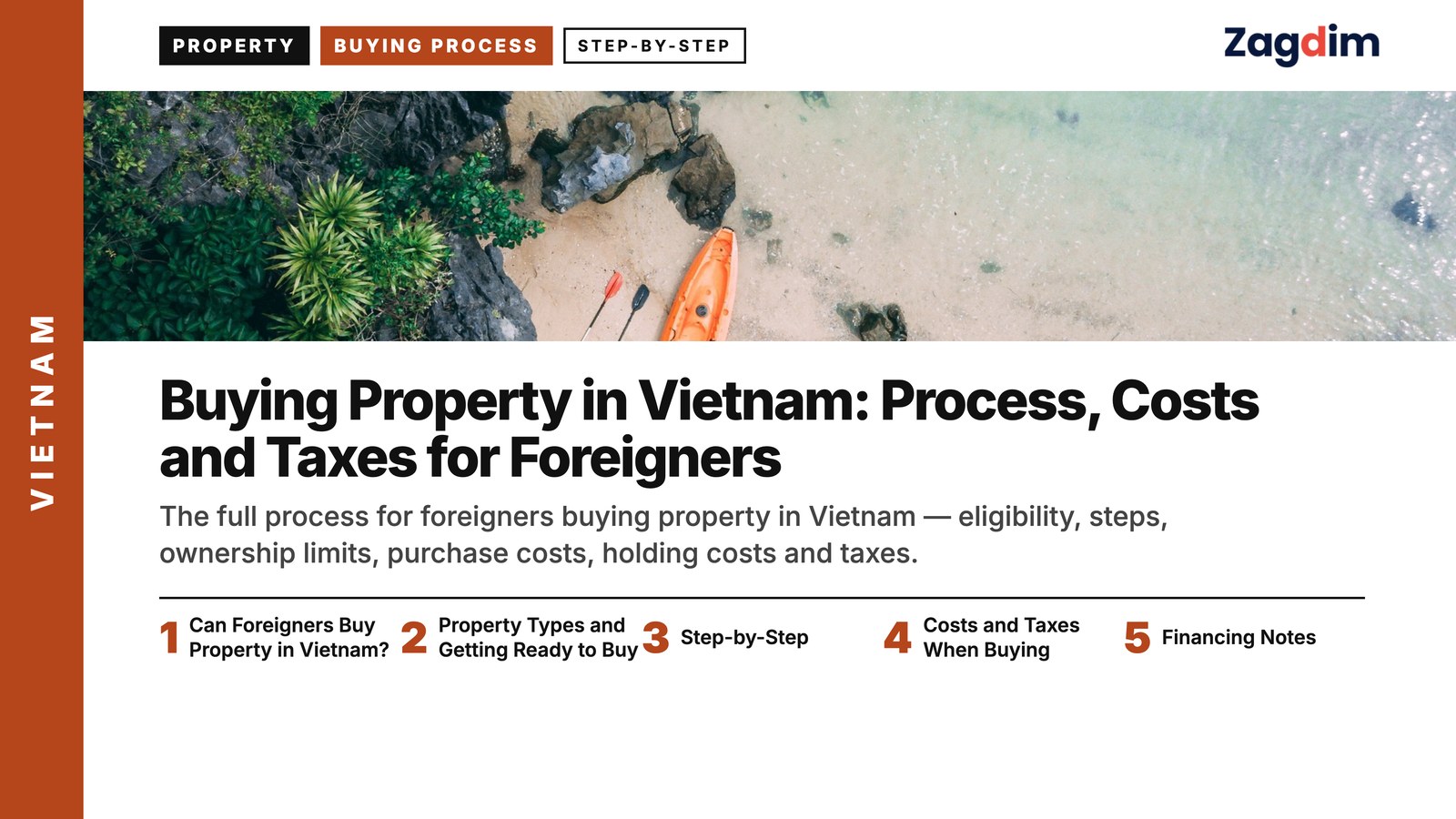
Aerial — Aerial view of turquoise cove with kayaks, illustrating Buying Property in Vietnam: Process, Costs and Taxes for Foreigners

Image: Zagdim

September 29, 2026
in Vietnam
Reading Time: 14 mins read
Tags: Tax

Vietnam’s property market has drawn a wave of foreign buyers, thanks to its economic stability, policy that has become more welcoming, and the potential for strong returns. At the same time, Vietnam’s property rules and tax treatment differ from many other markets: foreigners can only hold a right to use the land, not outright ownership, and the amount and proportion of property that can be bought are subject to clear limits. This article walks through what foreigners need to know before buying in Vietnam — from eligibility and the purchase process, to ownership limits, purchase and holding costs, and the taxes involved in buying, holding, selling and renting out property.

Can Foreigners Buy Property in Vietnam?

Since July 2015, Vietnam has opened its property market to foreign buyers under its residential housing law, actively encouraging foreign ownership. As in many other Southeast Asian countries, though, a foreigner cannot fully own land in Vietnam — land ownership is administered by the state and held by the Vietnamese people. If a foreigner marries a Vietnamese citizen, they can enjoy the same land ownership rights as a Vietnamese citizen. Under Vietnam’s national land law, foreign individuals and companies can use land by way of a land lease, with a maximum lease term of 50 years, extendable to 70 years for certain projects. After the term expires, an application can be made to renew it for a further period. Foreign buyers most often buy directly from a developer in the primary market, or from a foreign owner who already holds the property.

There are also clear caps on how much a foreigner can own:

  • In an apartment building, no more than 30% of the units may be sold to foreigners
  • For landed houses (villas/townhouses), no more than 250 units may be held by foreigners within a single ward (phường)
  • Foreign ownership is not permitted in areas designated for national defense or security

Property Types and Getting Ready to Buy

Vietnam’s property market mainly offers three property types, each with different conditions and ownership rules. Apartments are the most popular with foreign buyers, are relatively simple to manage, and are concentrated in the main urban districts; villas tend to be in suburban areas and suit family living or a longer-term investment; for land, foreigners can only obtain a right to use it through a lease, typically for 50 or 70 years, and must apply to renew it.

Vietnam’s government sets a few basic eligibility conditions for foreign buyers, including proof of identity and proof of financial capacity. A foreign national holding only a tourist visa can still buy Vietnamese property, provided they can show sufficient proof of financial capacity, such as a bank statement or income certificate. Since property transactions in Vietnam must be conducted in Vietnamese dong, it is advisable for foreign buyers to arrange currency conversion in advance and open a local Vietnamese bank account to simplify the flow of funds.

Documents typically needed for the purchase also include a translated copy of your passport, a power of attorney (if using an agent), and other financial documents related to the purchase. Preparing all necessary materials in advance helps speed up the transaction and avoid delays caused by missing paperwork.

Step-by-Step: Buying a New Property from a Developer

1. Find a Suitable Property

Vietnam’s property market offers a wide range of options, including apartments, villas and land. When choosing, factor in your financial capacity and investment goals, along with extra costs beyond the purchase price itself, such as agent fees, mortgage broker fees, and accountant or lawyer fees — these typically make up part of the overall investment, so it’s worth budgeting for them in advance. Maintaining good communication with a local agent also helps in finding a property with strong value for money. Popular Vietnamese property listing sites include Bat Dong San (available in English and Vietnamese, and one of the best known platforms, also offering advice on construction, interior/exterior design, legal questions and feng shui), Mua Ban Nha Dat (highly active with fast-updating listings, though Vietnamese-only), Do Thi (updated daily with the latest listings) and Nha Dat 24h (offering VIP promotions along with listings and market news). A typical agent’s commission runs about 1–1.5% of the property’s total price. Note also that Vietnam maintains foreign-exchange controls, so moving funds freely in and out of Vietnam requires a local bank account and compliance with Vietnam’s foreign-exchange rules.

2. Sign the Purchase Contract

Negotiate and sign a purchase contract with the property owner or developer. The contract should clearly specify:

  • the property’s details (address, size and included facilities)
  • the purchase price and the payment schedule
  • the handover date and the responsibilities of each party

It is advisable to have a professional lawyer review the contract to make sure the terms are clear and comply with Vietnamese law, before signing. A contract can be written in Vietnamese or English, but the Vietnamese-language version carries greater legal weight, so it is essential to have a lawyer check the Vietnamese contract to confirm there are no hidden or problematic clauses before signing.

3. Pay the Deposit

Some developers first require a reservation fee (sometimes called a booking fee) of roughly VND 50–100 million (about USD 2,150–4,250) before a formal contract is signed, to secure a place in the draw or the right to buy; this amount is refundable at any point before a contract is signed, but once you decide to proceed, it converts into a non-refundable deposit. Once the purchase contract is signed, a deposit — commonly around 10% of the purchase price, though the exact figure can be negotiated between the parties — is paid. After paying the deposit, you are considered to have entered into the “deposit agreement,” and that amount is no longer transferable. It is advisable to agree on a payment schedule with the seller before signing, and then to pay each installment according to the terms in the contract. Be sure to keep a bank transfer receipt or other proof of every payment for future reference.

4. Have the Property Reviewed

Engage a lawyer or a professional agency to conduct due diligence, checking for:

  • an ownership dispute
  • a mortgage or another legal restriction on the property
  • whether the land-use term complies with the regulations

Confirm that the building permit and the land-use documents are complete, and check whether the property complies with local law. It is also worth checking that the property has full inspection and acceptance documentation, to avoid a later problem caused by non-compliant construction.

5. Pay the Remaining Balance

The remaining balance is usually paid in installments tied to construction progress, with each installment — typically 20–30% of the total contract value — generally due within about a month of being invoiced; the developer provides a receipt by mail as proof of each transfer. Vietnamese law requires that payments be made in Vietnamese dong, so foreign buyers need to arrange currency conversion and transfer the funds into a local bank account in advance, keeping every payment record as legal proof. Make sure your payments comply with the regulations, so that later tax filing and title registration go smoothly.

6. Complete the Title Transfer

Documents needed for the transfer include:

  • the purchase contract
  • both parties’ proof of identity
  • proof of payment

Both parties then go together to the local Land Registration Office to complete the transfer of ownership and pay the registration tax. Once the office has verified the documents, the registration is completed and the buyer formally becomes the property owner.

7. Pay the Taxes

At this stage, the buyer needs to pay:

  • Value Added Tax (VAT): 10% of the purchase price
  • Registration tax: 0.5% of the purchase price

Submit the tax payment application to the local tax department to complete the transaction’s tax procedures, and keep the payment receipts, which will be needed later for the title certificate application and for tax filing.

8. Receive Your Title Certificate

After completing the purchase, you need to apply for a title certificate, commonly known as the “Pink Book” — the key document confirming lawful ownership of the property. The application is submitted to the Land Registration Office, and typically takes a few weeks to process. The Pink Book records the property’s details along with the owner’s name, formally confirming the buyer as the property’s lawful owner.

Buying a Resale Property from Another Foreign Owner

Under Vietnam’s ownership rules, if a foreigner wants to buy an existing (resale) property, they can only buy it from another foreign owner; when selling, a foreign owner can sell to either a local Vietnamese buyer or another foreigner. The process for a resale purchase differs somewhat from buying new from a developer:

  1. Price negotiation — buyer and seller negotiate the price by correspondence, with an agent mediating until a price is agreed.
  2. Confirm the price — once both sides agree on a price, the buyer receives the full set of documents needed to sign the contract.
  3. Sign a deposit agreement — the buyer agrees to and signs a “deposit agreement.”
  4. Submit for notarization — under the deposit agreement, the buyer must first pay the seller 5% of the total price. Once the deposit is confirmed received, the buyer is given 2–4 weeks to obtain the developer’s confirmation letter of the property transfer and submit it to the notary office.
  5. Notarized transfer — at notarization, both parties must be present; the buyer transfers 90% of the total price and signs the transfer confirmation letter prepared by the notary office. Once the seller confirms receipt of payment, they hand the original sale and purchase contract over to the buyer.
  6. Confirm handover — after notarization, the buyer gives the seller and the developer 2–4 weeks to process the paperwork. During this period, the seller must settle the 2% personal income tax due on the sale. The developer then updates the sale and purchase contract, or the long-term lease contract, to the buyer’s name, and issues a confirmation letter for the buyer to keep. Once the buyer receives the developer’s confirmation letter, the remaining 5% of the total price is transferred, completing the handover.

Costs and Taxes When Buying

Besides the purchase price itself, buying property in Vietnam involves several related costs, including a notary fee, a registration fee and an agent’s commission. A foreign buyer unfamiliar with local law who wants to reduce risk will typically need to engage a local lawyer to handle the transaction, which comes with its own legal fee. It is also worth noting that, besides the property’s ongoing management fee, every power of attorney also carries a minimum handling fee.

Down payment

As in most markets, the typical down payment in Vietnam is 30% of the price, though this can vary by bank and by the promotions on offer at the time, so it’s worth watching for the latest bank offers. If the buyer is married to a Vietnamese citizen, the down payment can be reduced to 20%, with a loan term of up to 15 years.

Mortgage financing

A foreign buyer must meet at least one of the following conditions to obtain a mortgage from a Vietnamese bank: (1) being an overseas Vietnamese (Việt kiều); (2) holding a residence card; or (3) being married to a Vietnamese spouse. A foreigner holding only a tourist visa generally cannot obtain a mortgage from a Vietnamese bank. Where a mortgage is available, a local bank will typically lend up to 70% of the property’s value, over a term of up to 25 years, with an annual interest rate typically in the 8–12% range. The borrower also needs to provide proof of their ability to service the loan.

Value Added Tax (VAT)

If a buyer purchases an apartment unit in the primary market, they must pay VAT of 10% on the purchase price. This tax is paid by both local and foreign buyers, calculated on the purchase price, and is paid at the time of purchase, generally already included in the quoted price.

Maintenance fund

The buyer also pays a one-time maintenance fund equal to 2% of the purchase price, used for the upkeep of the building and its common areas, and this is also paid at the time of purchase (typically at handover).

Registration fee

The registration fee is 0.5% of the property’s value, paid by the buyer, similar to a stamp duty used in other countries, and is paid at the time of purchase.

Financing Notes

A foreign buyer relying on financing should note that mortgage options in Vietnam remain fairly limited — a tourist-visa holder in particular generally cannot obtain a loan from a Vietnamese bank at all, and even where a product exists for other visa categories, it comes with strict conditions. It is advisable to choose a loan type that suits your own situation, whether fixed-rate or floating-rate, and to factor the down-payment proportion and future repayment pressure into your financial planning. Getting these financing arrangements right in advance meaningfully reduces the risk of unnecessary strain once you hold the property.

Holding Costs After You Buy

Buying the property is not the end of the spending — it is really just the beginning. To keep your budget under control, it helps to plan your annual holding costs item by item:

Property management fee

Every owner pays a management fee based on the property’s floor area, covering day-to-day management costs such as maintaining common facilities, security, cleaning and elevator operation. This is usually billed annually or quarterly, with the exact amount varying by property type and location — a luxury apartment or one in an up-and-coming area tends to command a higher fee. It is advisable to confirm the fee-adjustment clause for the next three years with the developer or management company before signing, to avoid a sudden increase in outlay later.

Non-Agricultural Land Use Tax

Vietnamese property is subject to an annual Non-Agricultural Land Use Tax. The rate for residential land use is generally 0.03% of the land’s assessed value; if the property is used commercially or rented out, the rate can rise to 0.07–0.15%. The local government periodically updates the land valuation, and owners need to file and pay based on the latest published figures. Failing to pay this tax on time can result in a fine or a claim for back payment.

Property insurance (optional)

Vietnamese law does not require an individual homeowner to buy property insurance, but to protect the asset — particularly for a high-rise building or a high-value property — buying basic fire insurance, natural disaster insurance, or even earthquake insurance is advisable. Some high-rise apartment projects require owners to jointly buy insurance for common areas, with the cost drawn from the management fee or maintenance fund.

Ongoing repairs and reserve funds

Beyond the one-time maintenance fund paid at purchase (2% of the purchase price, covering the long-term upkeep of shared facilities such as elevators, the lobby and the pool), it’s advisable to set aside part of your budget each year for repairs inside your own unit — air-conditioning servicing, plumbing renewal or painting — to avoid a small problem growing into a large expense. If the maintenance fund later runs short, the management company may put forward a proposal for owners to top it up, so it’s worth watching the property’s financial reports and owners’ meeting agendas.

Budget for unexpected costs

Beyond the fixed costs above, it is advisable to set aside a flexible annual budget for unpredictable extra expenses, such as a broken air conditioner, wall repainting, waterproofing work, or plumbing and electrical inspections — these smaller costs can add up. A commonly used benchmark is to set aside 0.5–1% of the property’s value each year as a buffer for unexpected costs.

Example Annual Holding Cost Overview (VND)

Item Annual Amount Range (VND) Notes
Property management fee 12,000,000–36,000,000 Varies by property location and size
Non-agricultural land use tax About 0.03% of the transaction price (residential use) Varies with the land’s assessed value
Property insurance (optional) 3,000,000–10,000,000 Depends on the insurer and the level of cover
Maintenance fund (one-time, first year) 2% of the purchase price A one-time payment for the upkeep of shared building facilities
Reserve for unexpected costs 0.5–1% of the property’s value Covers interior repairs, equipment replacement and minor renovation

Currency risk

Most overseas buyers budget in their home currency, while all holding costs in Vietnam are settled in Vietnamese dong. If the exchange rate moves — for example, if the dong strengthens or a foreign currency weakens — actual outlay will rise noticeably, and a budget set aside earlier may fall short, creating cash-flow pressure. It is advisable for a foreign owner to review the exchange rate every six months and adjust their budget accordingly.

Rental income adds to holding costs

If the property is rented out, an owner also needs to pay a 5% VAT and a 5% personal income tax on the rental income — a combined 10% of gross rental income. If the property is rented out and suffers wear and tear from tenants, this can also mean additional repair and upkeep costs.

Taxes When Selling or Renting Out

Capital gains tax

Even though there is, in theory, no separate capital gains tax, a foreign investor selling a property must still pay a 2% personal income tax on the sale, paid at the time of sale.

Rental income tax

If a foreign owner rents the property out for personal income, the owner must pay a 5% VAT and a 5% personal income tax, for a combined rate of 10% on the rental income, paid while the property is held and generating rental income.

Business license tax

Business License Tax on rental income is tiered by annual revenue: VND 100-300 million pays VND 300,000/year; VND 300-500 million pays VND 500,000/year; over VND 500 million pays VND 1,000,000/year; under VND 100 million (about USD 4,000) is exempt.

Land tax

All owners of Vietnamese property, regardless of nationality, are liable for the annual Non-Agricultural Land Use Tax described above; there is no blanket foreign-owner exemption under the 2010 Non-Agricultural Land Use Tax Law.

Points to Watch

Since Vietnam opened its property market to foreign buyers in 2015, the market has drawn large amounts of foreign capital every year. But buying property in Vietnam isn’t entirely risk-free — Vietnam is a developing country, and its legal framework isn’t as mature as that of Singapore, Taiwan or Hong Kong, so it’s important to do careful due diligence during the purchase process and seek professional help wherever possible.

Whether you get a title certificate, and whether the contract is a sale and purchase agreement (SPA) or a long-term lease (LTL)

In the Vietnamese market, plenty of apartment units sold to foreigners are actually a 50-year long-term lease contract (LTL) signed with the developer. This kind of lease cannot receive a title certificate, and the arrangement going forward is generally to resell the lease itself to another foreigner, or sell directly to a local Vietnamese buyer. Some agents claim that buying this kind of unit is fine as long as the developer is reputable, but the real risk to watch is the property’s liquidity and the developer’s financial stability.

There is also a case where a developer oversells: it initially advertises a foreign quota, but keeps failing to sign a sale and purchase agreement (SPA) with the buyer, and only once the buyer has paid a certain proportion does it inform them that this unit cannot receive an SPA — meaning it cannot receive a title certificate either.

Extra markups

There are two common situations where buying in Vietnam involves an extra markup:

First, for a popular project in a particularly good location, where foreign quota supply can’t meet demand and a draw is even required, if you don’t win a place in the draw you may need to pay a premium to buy someone else’s purchase right (a “red slip”) from another buyer once the draw has taken place.

Second, some large primary agents buy up an entire foreign quota directly, add their own margin, and then release the units back onto the market.

Discounts on the total price

Depending on a project’s particular strengths and weaknesses, and the developer’s own sales approach, a developer will offer different types of discount — for example, a certain percentage off for paying the full price up front, or a discount for buying within a set time window.

Related in this series:

  • Vietnam Tax Residency for Foreigners: Rules and Reporting Obligations
  • Dealing with a Bad Tenant in Vietnam: A Foreign Landlord's Legal Guide
  • Renting to Local Tenants in Vietnam: 5 Mistakes Foreign Landlords Make
  • Hiring Employees in Vietnam: Labor Law, Payroll Tax and EPF
  • Joint Venture Risks in Vietnam: Foreign-Local Shareholder Terms
  • Filing Vietnam Company Taxes: Accounting and Withholding Tax
  • Renting Out Property in Vietnam: Landlord Tax Rules, Rates and Filing

Have a question about this guide? Leave a comment below, or ask Zagdim directly.

Life abroad? Ask Zagdim.

Your first stop for international property and global living.

Research and insights. Know what’s changing. Understand what matters.

Sources

  • Savills – *Apartment Fees Explained: Service Fees vs Maintenance Fees*
  • Deloitte – *Vietnam Tax Newsletter: Real Estate Q3 2023*
  • Vietnam Briefing – *Vietnam’s Property Tax Regime 2024*
  • CBRE – *Vietnam’s Property Market 2024 Outlook*
  • Knight Frank – *Horizon 2024 Asia-Pacific Report*
Zagdim AI
All content is researched, written, or authorized for publication by the @Zagdim Overseas team. Sharing and reposting are welcome, but please make sure to credit the source and include the original article link from this website. Any plagiarism or unauthorized use may result in legal action. For article submissions, please contact us via Facebook. Thank you for your support!

For article submissions, press release publication, or interview notices, please contact [email protected]. 

Zagdim Ask

Have a specific question about overseas living, property, visa, or practical arrangements?

Fill in your situation and key concerns through Zagdim Ask. Our team will review your message and get back to you by email where appropriate.

Submit your enquiry →

Similar Topics

Singapore's Immigration & Checkpoints Authority (ICA) Commissioner at an official signing ceremony, with the Singapore state crest and national flag in the background
News

Singapore Confirms Citizenship Age Threshold and Re-Entry Permit Conditions for PRs

October 1, 2026
Matthew Pennycook, Minister of State at the UK's Ministry of Housing, Communities and Local Government, meets with housing-reform stakeholders as the department confirms mandatory property agent licensing and leasehold fee caps
News

UK Government Confirms Property Agent Licensing and Leasehold Fee Caps

October 1, 2026
A vacant undeveloped residential block in Victoria, Australia, with a developed suburb visible in the distance, illustrating the ATO land-banking enforcement case
News

Foreign Investor Fined $508,000 as ATO Tightens Grip on Australian Land Banking

October 1, 2026
Next Post
Landmark — Ba Na Hills French village at dusk, illustrating Renting Out Property in Vietnam: Landlord Tax Rules, Rates and Filing

Renting Out Property in Vietnam: Landlord Tax Rules, Rates and Filing

Nature — Waterfall cascading through green jungle foliage, illustrating How to Apply for a Vietnam Visa: E-Visa and Visa on Arrival

How to Apply for a Vietnam Visa: E-Visa and Visa on Arrival

Architecture — Colonial yellow building reflected in water, illustrating Overstaying Your Visa in Vietnam: Penalties and How to Fix It

Overstaying Your Visa in Vietnam: Penalties and How to Fix It

Facebook Twitter Youtube

About Us

Zagdim is a global knowledge platform focused on cross-border property, relocation, lifestyle, and location-based decision-making.

We provide insights on overseas real estate, market trends, regional analysis, economic developments, and practical relocation information. Through continuous market observation and on-the-ground research, Zagdim helps readers better understand a place before deciding where to live, invest, buy property, or establish a base abroad.

We currently follow markets including the UK, Japan, Thailand, Malaysia, Germany, Australia, the UAE, Greece, Portugal, and Spain, while continuing to track emerging lifestyle, relocation, and property trends worldwide.

Category

  • Australia
  • Buying & Immigration Guide
  • Cambodia
  • Canada
  • Costa Rica
  • Dubai
  • Encyclopedia
  • Europe
  • Expat Lifestyle Guide
  • Germany
  • Global Reports Analysis
  • Hong Kong
  • Human-Picked
  • Indonesia
  • International Property Buying Guide
  • Japan
  • Japan Market News
  • Kenya
  • Living Abroad
  • Malaysia
  • Mallorca
  • Market Trends Overview
  • News
  • Other Market News
  • Overseas Leasing & Long-Term Stay
  • Philippines
  • Policy Interpretation
  • Portugal
  • Property
  • Property Law & Tax
  • Real Estate & Economic News
  • Real Estate Law & Taxation
  • Relocation, Immigration & Visa
  • Singapore
  • South Korea
  • Spain
  • Switzerland
  • Thailand
  • Thailand Market News
  • UK Market News
  • United Kingdom
  • United States
  • Vietnam
  • Vietnam Market News
  • Visa & Immigration
  • Zagdim Insights
  • Zagdim Property Insights

Email:[email protected]


Add Friends


WhatsApp
Contact Us


Wechat:Zagdim

Work with Zagdim

Put your brand inside the overseas property research process — in English and in Chinese. Reaching buyers, expats and investors across 19 markets.

View partnership packages →

©2026 Zagdim Overseas All Right Reserved

No Result
View All Result
  • Home
  • Zagdim Property Insights
    • Market Trends Overview
    • Policy Interpretation
    • Forest
    • PLACEHOLDER sub-cate for Zagdim Property Insights
  • Global Reports Analysis
    • In-Depth Project Analysis
  • Real Estate & Economic News
    • Thailand Market News
    • UK Market News
    • Germany Market News
    • Japan Market News
  • Buying & Immigration Guide
    • Expat Lifestyle Guide
    • Real Estate Law & Taxation
    • Overseas Leasing & Long-Term Stay
    • Starting a Business & Company Setup
  • Zagdim Ask
  • 中文 EN

©2026 Zagdim Overseas All Right Reserved