
































Introduction
More and more foreigners are setting up companies in Vietnam, which has become a new hot spot for foreign-invested businesses, whether as a manufacturing base or a tech startup hub. But as a company moves from its founding phase into expansion, founders often face a critical challenge: becoming a formal “employer.”
Hiring staff in Vietnam is far more than finding the right person and signing a contract. You also need to understand the Vietnamese Labor Law, build a compliant payroll structure, correctly withhold Personal Income Tax (PIT), and handle a series of statutory obligations including social insurance, health insurance and EPF (employee provident fund).
Who This Applies To
If you run a business in Vietnam — whether as a foreign shareholder, a legal representative, or a senior manager with the authority to sign contracts and pay wages — as soon as you hire and pay staff on the company’s behalf, you must bear the formal legal responsibilities of an employer under the Vietnamese Labor Law.
If your company has completed its business registration, obtained an Investment Registration Certificate (IRC) and an Enterprise Registration Certificate (ERC), and has a local bank account to use as a payroll channel, then you already have the basic qualifications to be a compliant employer.
But what matters isn’t only your qualifications — it’s your actual conduct. Once you sign an employment contract and provide compensation, even without formally being registered as an HR manager, you must fulfill all employer obligations related to wages, insurance and tax.
Process Steps
From recruitment through to tax filing, every step matters for staying compliant. Below is the standard process and points to watch for a foreign-invested company formally hiring local staff in Vietnam:
Step 1 | Posting the Job and Screening Résumés
In Vietnam, foreign employers are not restricted to any particular recruitment platform and can freely choose a channel to recruit through. In practice, though, mainstream sites such as VietnamWorks, TopCV and ITviec are common channels for finding professionals, administrative staff and technical engineers.
It is advisable to write a clear job description in advance, stating compliant working hours and a salary range, to boost credibility and attract candidates.
Step 2 | Signing the Contract and Opening a Payroll Account
The employment contract must use a bilingual Chinese/English–Vietnamese version, with terms clearly setting out the probation period, the formal salary, job duties and benefits.
Under Vietnamese labor law, a probation period cannot exceed two months, and the contract should clearly specify how salary and insurance are handled both during probation and after becoming a permanent employee.
At the same time, the employer should set up a payroll account for the new employee, and it is advisable to use the company’s legally registered local bank account for transfers, to keep tax and compliance records complete.
Step 3 | Registering for Social Insurance, Health Insurance and EPF
Once a new employee formally joins, the employer needs to complete the following registrations within 30 days:
- Social Insurance (SI)
- Health Insurance (HI)
- Employee Provident Fund (EPF, implemented through integration with the social insurance system)
The above insurance costs are paid monthly based on the salary structure, shared proportionally between employer and employee. The employer is responsible for filing and paying on time; a late or incorrect filing will lead to a fine or a tax risk.
Step 4 | Filing and Declaring Personal Income Tax (PIT)
A Vietnamese company is the withholding agent, and must calculate and withhold PIT each time wages are paid.
- For a Vietnamese tax resident, a progressive rate of 5% to 35% applies
- For a non-resident, a flat rate of 20% applies
At year-end, the employer must help the employee complete a tax settlement, submitting an income statement and settling any amount owed or to be refunded.
Step 5 | Year-End Settlement and Performance Reporting
At the end of each year, a company also needs to complete the following:
- Submit the PIT Finalization form (the annual personal tax settlement summary)
- Submit an annual summary of social insurance and health insurance contributions
- Compile and report bonuses, performance pay and other additional income items
Vietnam Payroll Structure and Employer Obligation Split (2024)
| Item | Employer’s Share | Employee’s Share |
|---|---|---|
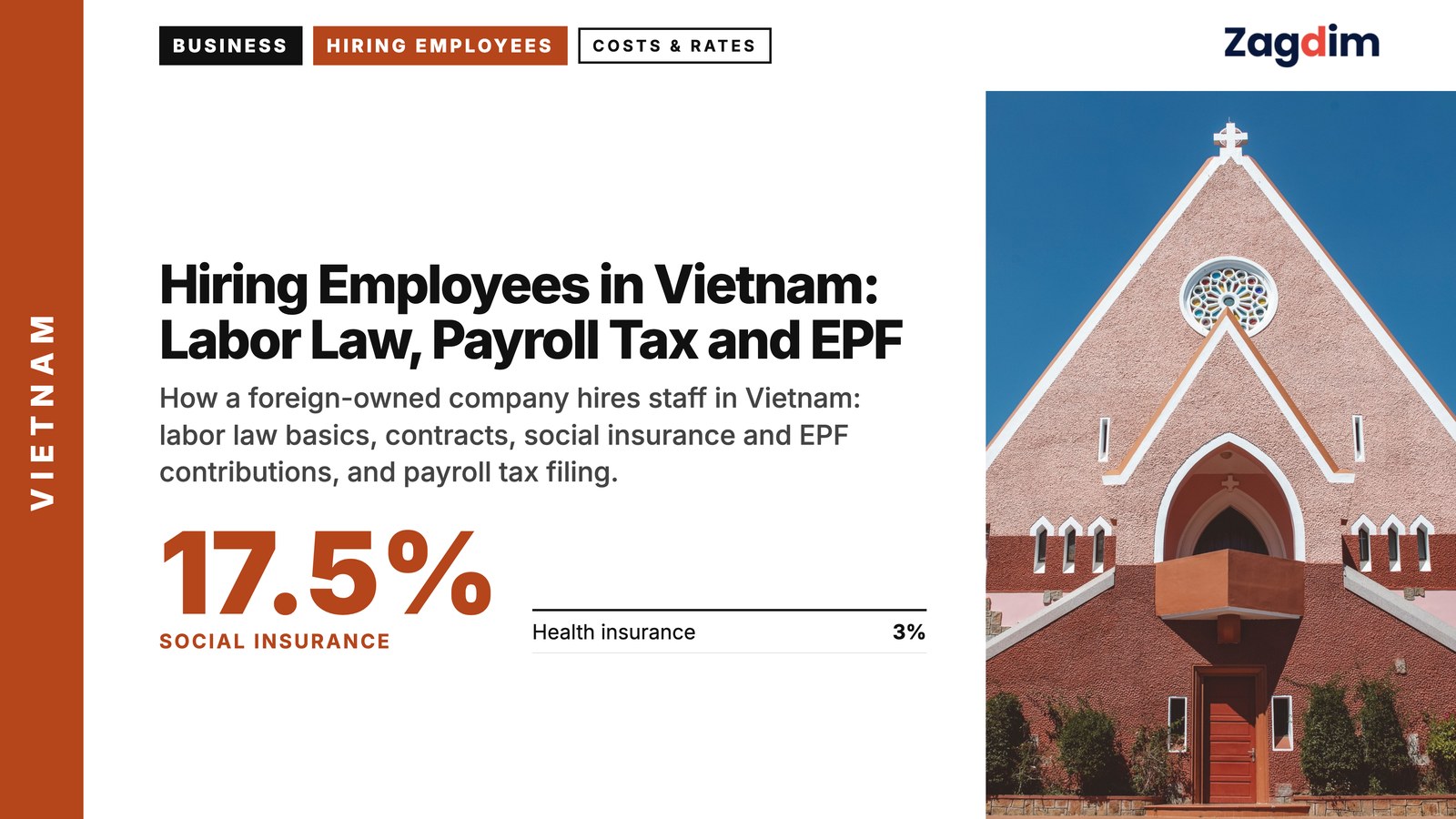
| Social Insurance (SI) | 17.5% | 8% |
| Health Insurance (HI) | 3% | 1.5% |
| Unemployment Insurance (UI) | 1% (Vietnamese nationals only) | 1% (Vietnamese nationals only) |
| **Total** | 21.5% (20.5% for foreign employees) | 10.5% (9.5% for foreign employees) |
This proportion is based on the base salary as the contribution base, and cannot exceed the statutory cap (VND 46,800,000 for 2024).
If you’re getting ready to start hiring in Vietnam and aren’t sure how to kick off the process, ask Zagdim and we’ll help you look into it.
FAQ
Q1: My company hasn’t opened a Vietnamese bank account yet — can I still pay employee salaries?
A: It is strongly advisable to set up a local Vietnamese bank account for payroll; otherwise you may be treated as non-compliant when filing tax and social insurance. A payment sent from outside Vietnam is difficult to document fully, and is also not formally recognized by the social insurance authority.
Q2: Can I hire someone as a “freelance contractor” to avoid labor-law obligations?
A: This is not advisable. As long as the actual working relationship has the features of employment (such as fixed working hours, a long-term arrangement, and regular salary payment), the law will still treat the person as an employee even if labeled a contractor, and the company must bear the related social insurance and tax responsibilities.
Q3: Do I need to arrange social insurance for part-time staff too?
A: Yes. As long as the employment relationship lasts more than one month, or the person’s income reaches the minimum wage standard, social insurance and health insurance must be paid by law, whether or not the role is full time.
Q4: As the employer, can I unilaterally terminate an employment contract?
A: No. Under Vietnamese labor law, terminating a contract requires a lawful reason and advance notice. If the procedure isn’t followed, the employee can seek compensation or file a complaint, and the company may also face a fine.
Q5: Do foreign employees in Vietnam also need to pay tax and join social insurance?
A: Yes. As long as a formal employment contract is signed in Vietnam, foreign employees are subject to the same rules as local employees, including social insurance registration and Personal Income Tax (PIT) withholding.
Q6: What happens if my company doesn’t pay social insurance for employees?
A: Besides having to pay the back contributions plus an administrative fine, it can also affect the company’s future business activities — for example, applying for work permits, a tax audit, or renewing a business license could all be restricted.
Points to Watch: Mistakes to Avoid
Even once you’re familiar with the hiring process and the compliance steps, there are still plenty of details in practice that often get overlooked, leading at best to filing errors and at worst to legal disputes. Below are the mistakes foreign employers in Vietnam most often make — be sure to avoid them:
1. Using the Wrong Contract Template
Many foreign-invested companies are used to drafting employment contracts in English, but under Vietnamese regulations, only the Vietnamese-language version carries legal effect. If a dispute arises between the company and an employee, the courts and relevant authorities will only rely on the Vietnamese-language terms, so it is advisable for every contract to have the Vietnamese version as the primary text, with English used only as a reference translation.
2. Don’t Blur the Line Between a Contractor and an Employee
Some companies try to package a full-time employee as a freelance contractor to avoid social insurance and tax obligations. But as long as the relationship has the features of employment — such as fixed working hours, regular salary payment, and being subject to the company’s direction and supervision — it constitutes employment, and social insurance and PIT withholding must be handled by law.
3. Avoid Paying “Cash Wages” or Using Non-Bank-Transfer Methods
Even though paying cash might simplify things in the early startup phase, this approach is difficult to prove lawfully during a tax audit or a payroll review, which is unfavorable for insurance filing and expense deduction. It is advisable to always pay salaries by transfer from the company’s bank account, to keep the data verifiable and the books clear.
Haven’t yet found a clear direction on any of these points? It’s worth checking with a professional before you proceed.
Summary
Hiring employees in Vietnam isn’t just a legal obligation — it’s also a reflection of a company’s integrity and governance ability. If you overlook the details of payroll structure, social insurance costs or the employment contract, at best you’ll face a fine, and at worst it will affect your overall operations. If you are planning to hire but aren’t sure how to allocate the budget, whether to expand in phases, or how social insurance contributions and PIT withholding should be designed, ask Zagdim and a professional can help you clarify the key blind spots and put together a hiring and expansion plan that fits your reality.
Have a question about this guide? Leave a comment below, or ask Zagdim directly.
Your first stop for international property and global living.
Research and insights. Know what’s changing. Understand what matters.
Sources
- Vietnam Briefing – *Labor Law Compliance Guide 2024*
- PwC Vietnam – *2024 Salary and Social Insurance Update*
- Tiger Consulting – *Vietnam Payroll & Tax Factsheet*
- LeTran Law – *Vietnam Labor Law for Foreigners Overview*
- Russin & Vecchi – *Hiring and Employment Regulations in Vietnam*
*This article is compiled from publicly available regulations, corporate guides and official explanatory documents from 2023-2024. All information comes from local Vietnamese law firms, international accounting firms and professional advisory websites, and has been cross-checked and restructured for clarity. It reflects the rules as of the time of writing — please follow the latest official announcements for any future regulatory changes.*