































Zagdim Overseas
Subscribe
  • Home
  • Real Estate & Economic News
    • All
    • Japan Market News
    • Other Market News
    • Thailand Market News
    • UK Market News
    • Vietnam Market News

    How Much Notice Must a Landlord Give You? Eviction Rules Across Europe Compared

    Residential apartment building in Madrid, illustrating an article comparing European tenant eviction protections

    Eviction Rules in Europe: How Much Notice Must a Landlord Give You?

    Official portrait of Dutch Prime Minister Rob Jetten — the Netherlands has scrapped its unrealised-gains wealth tax plan for a 36% capital gains tax

    Netherlands Drops Wealth Tax Plan Amid Exodus Fears

    Vietnam's Standing Deputy Prime Minister Pham Gia Tuc speaking at an official event, illustrating the news of Decree 342 easing foreign-investor trading and retail licensing rules

    Vietnam’s Decree 342 Sets New Trading and Retail Licence Rules for Foreign Investors

    Thai Prime Minister and Interior Minister Anutin Charnvirakul speaking at a podium, announcing the revocation of a Bangkok-based, Israeli-born businessman's Thai citizenship over passport irregularities

    Thailand Revokes Citizenship of Israeli-Born Businessman Over Passport Irregularities

    Front facade of the US Department of the Treasury building, with the Albert Gallatin statue on the portico

    US Treasury Issues First GENIUS Act Rule, Setting $10 Billion Line for Stablecoin Oversight

    Trending Tags

  • Zagdim Insights
    • All
    • Market Trends Overview
    • Policy Interpretation
    • Zagdim Insights
    Automated immigration gates at Suvarnabhumi Airport

    Thailand’s Suvarnabhumi Auto Gates Expand to 33 Nationalities: Full List, Eligibility and TDAC Guide

    1960 archive photo of Queen Sirikit at a gala concert in The Hague, with Bank of Thailand specimens of the THB100 and THB500 commemorative notes

    Thailand’s commemorative banknotes return in October: where to exchange the THB100 and THB500 notes

    Bangkok Aerial — Chao Phraya dusk, illustrating Thailand Joins Global Minimum Tax Information Exchange: What Businesses and Individuals Need to Know

    Thailand joins the global minimum tax information exchange: which businesses need to pay attention, and are individuals affected?

    A 2025 file photo of Australian Home Affairs Minister Tony Burke at a meeting, alongside Zagdim’s analysis title on Australia’s migration reforms.

    Australia announces migration reforms targeting student families, visa switching and longer stays

    China’s Entry-Exit Agency Rules: What Your Business Needs to Prepare. Paper folders labelled Deadlines, Documents and Partners, with a calendar, Chinese gateway and flight route. AI-generated illustration.

    China’s New Entry-Exit Agency Rules: What Your Business Needs to Prepare

    City of London skyline at sunset, illustrating UK New-Build Rules in 2026: Safety Levy, Staircases and the New EPC

    Three UK New-Build Thresholds for 2026: The Building Safety Levy, Second Staircases and the New EPC

    Zagdim Research cover: investigator setting up cameras in an empty Japanese apartment - Japan Prices Death Into Its Housing Market, and Buyers Have Begun to Bite

    Japan Prices Death Into Its Housing Market — and Buyers Have Begun to Bite

    Thailand to Cancel 60-Day Visa Exemption: What Long-Stay Options Are Available for Foreigners?

    Thailand to Cancel 60-Day Visa Exemption: What Long-Stay Options Are Available for Foreigners?

    Thailand Cabinet Approves Cancellation of 60-Day Visa Exemption for 93 Countries; Official Effective Date Still Pending Royal Gazette Publication

    Thailand Cabinet Approves Cancellation of 60-Day Visa Exemption for 93 Countries; Official Effective Date Still Pending Royal Gazette Publication

    • Zagdim Insights
    • Market Trends Overview
    • Policy Interpretation
  • Global Reports
    Zagdim Featured CBRE Thailand Mid-Year Outlook 2026

    CBRE Thailand Mid-Year Outlook: What Is Changing Across Six Real Estate Sectors?

    More Firms, a Busier First Half, a Softer Q2: What Vietnam’s Property Data Show, and Where ‘Repositioning’ Is a Reading

    More Firms, a Busier First Half, a Softer Q2: What Vietnam’s Property Data Show, and Where ‘Repositioning’ Is a Reading

    The Headline Number and the Real One: Reading UK Home Values After Inflation

    The Headline Number and the Real One: Reading UK Home Values After Inflation

    Tokyo’s Property Boom: How to Read AMRO’s ‘Warning, Not a Crisis’

    Tokyo’s Property Boom: How to Read AMRO’s ‘Warning, Not a Crisis’

    A Soft Summer for US Housing: What the Data Show, and Where ‘Hurting’ Is CNBC’s Word

    A Soft Summer for US Housing: What the Data Show, and Where ‘Hurting’ Is CNBC’s Word

    Malaysia’s Property Market Is Getting Choosier — What \”Selective\” Does and Doesn’t Say

    Malaysia’s Property Market Is Getting Choosier — What \”Selective\” Does and Doesn’t Say

    72% at the Top: What Mainland Buyer-Share Data Say About Hong Kong Property — and What They Don’t

    72% at the Top: What Mainland Buyer-Share Data Say About Hong Kong Property — and What They Don’t

    Hong Kong Home Prices Are Up ~10% This Year — but Can the Rebound Last Without Local Owners?

    Hong Kong Home Prices Are Up ~10% This Year — but Can the Rebound Last Without Local Owners?

    193 Deals in Dubai, 94 in Hong Kong: Reading a Super-Prime Quarter Without Calling It a Cycle

    193 Deals in Dubai, 94 in Hong Kong: Reading a Super-Prime Quarter Without Calling It a Cycle

  • Buying & Immigration Guide
    • All
    • Expat Lifestyle Guide
    • International Property Buying Guide
    • Overseas Leasing & Long-Term Stay
    • Real Estate Law & Taxation
    • Relocation, Immigration & Visa
    Five things a first-time overseas buyer must settle before buying in London: entry (SDLT and the two surcharges), financing (interest relief capped at 20%), holding (NRLS and letting compliance), title (leasehold and building safety), exit (NRCGT and your treaty position)

    Is London property worth buying? Five things a first-time overseas buyer must settle first

    Night — Dotonbori canal at night with neon signs, illustrating Japan's 2026 Condominium Law Reform: What Overseas Owners Need to Know

    Japan’s Revised Condominium Ownership Act (2026): What Overseas Owners Need to Know About Voting Rights, Resolutions, and the New Domestic Manager Requirement

    Before You Buy Property in Vietnam: Eligible Assets, Prohibited Categories, and How Land Rights Actually Work for Overseas Buyers

    Before You Buy Property in Vietnam: Eligible Assets, Prohibited Categories, and How Land Rights Actually Work for Overseas Buyers

    Buying Property in London: Key Risks to Check Before You Exchange — Leasehold, Service Charges, Off-Plan Deposits, and Contracts

    Buying Property in London: Key Risks to Check Before You Exchange — Leasehold, Service Charges, Off-Plan Deposits, and Contracts

    Opening a UK Bank Account as an Overseas Resident: Identity, Address, and What to Check Before You Apply

    Opening a UK Bank Account as an Overseas Resident: Identity, Address, and What to Check Before You Apply

    Street lamp under a tree, illustrating Residential Mortgages for Foreign Buyers in the UK: What Lenders Check

    UK Residential Mortgage Readiness for Overseas Buyers: What Lenders Check on Income, Status, and Deposit

    How should overseas owners manage and rent out property in Japan after purchase?

    How should overseas owners manage and rent out property in Japan after purchase?

    The retirees who no longer want to renew their Thai visa every year

    The retirees who no longer want to renew their Thai visa every year

    Same retirement age, different Thailand residence choices: Retirement O, LTR, and Thailand Privilege

    Same retirement age, different Thailand residence choices: Retirement O, LTR, and Thailand Privilege

    Trending Tags

  • About
    • Ask Questions
    • Zagdim Research
    • Contact Us — LINE / WhatsApp
  • 中文 EN
No Result
View All Result
Zagdim
  • Home
  • Real Estate & Economic News
    • All
    • Japan Market News
    • Other Market News
    • Thailand Market News
    • UK Market News
    • Vietnam Market News

    How Much Notice Must a Landlord Give You? Eviction Rules Across Europe Compared

    Residential apartment building in Madrid, illustrating an article comparing European tenant eviction protections

    Eviction Rules in Europe: How Much Notice Must a Landlord Give You?

    Official portrait of Dutch Prime Minister Rob Jetten — the Netherlands has scrapped its unrealised-gains wealth tax plan for a 36% capital gains tax

    Netherlands Drops Wealth Tax Plan Amid Exodus Fears

    Vietnam's Standing Deputy Prime Minister Pham Gia Tuc speaking at an official event, illustrating the news of Decree 342 easing foreign-investor trading and retail licensing rules

    Vietnam’s Decree 342 Sets New Trading and Retail Licence Rules for Foreign Investors

    Thai Prime Minister and Interior Minister Anutin Charnvirakul speaking at a podium, announcing the revocation of a Bangkok-based, Israeli-born businessman's Thai citizenship over passport irregularities

    Thailand Revokes Citizenship of Israeli-Born Businessman Over Passport Irregularities

    Front facade of the US Department of the Treasury building, with the Albert Gallatin statue on the portico

    US Treasury Issues First GENIUS Act Rule, Setting $10 Billion Line for Stablecoin Oversight

    Trending Tags

  • Zagdim Insights
    • All
    • Market Trends Overview
    • Policy Interpretation
    • Zagdim Insights
    Automated immigration gates at Suvarnabhumi Airport

    Thailand’s Suvarnabhumi Auto Gates Expand to 33 Nationalities: Full List, Eligibility and TDAC Guide

    1960 archive photo of Queen Sirikit at a gala concert in The Hague, with Bank of Thailand specimens of the THB100 and THB500 commemorative notes

    Thailand’s commemorative banknotes return in October: where to exchange the THB100 and THB500 notes

    Bangkok Aerial — Chao Phraya dusk, illustrating Thailand Joins Global Minimum Tax Information Exchange: What Businesses and Individuals Need to Know

    Thailand joins the global minimum tax information exchange: which businesses need to pay attention, and are individuals affected?

    A 2025 file photo of Australian Home Affairs Minister Tony Burke at a meeting, alongside Zagdim’s analysis title on Australia’s migration reforms.

    Australia announces migration reforms targeting student families, visa switching and longer stays

    China’s Entry-Exit Agency Rules: What Your Business Needs to Prepare. Paper folders labelled Deadlines, Documents and Partners, with a calendar, Chinese gateway and flight route. AI-generated illustration.

    China’s New Entry-Exit Agency Rules: What Your Business Needs to Prepare

    City of London skyline at sunset, illustrating UK New-Build Rules in 2026: Safety Levy, Staircases and the New EPC

    Three UK New-Build Thresholds for 2026: The Building Safety Levy, Second Staircases and the New EPC

    Zagdim Research cover: investigator setting up cameras in an empty Japanese apartment - Japan Prices Death Into Its Housing Market, and Buyers Have Begun to Bite

    Japan Prices Death Into Its Housing Market — and Buyers Have Begun to Bite

    Thailand to Cancel 60-Day Visa Exemption: What Long-Stay Options Are Available for Foreigners?

    Thailand to Cancel 60-Day Visa Exemption: What Long-Stay Options Are Available for Foreigners?

    Thailand Cabinet Approves Cancellation of 60-Day Visa Exemption for 93 Countries; Official Effective Date Still Pending Royal Gazette Publication

    Thailand Cabinet Approves Cancellation of 60-Day Visa Exemption for 93 Countries; Official Effective Date Still Pending Royal Gazette Publication

    • Zagdim Insights
    • Market Trends Overview
    • Policy Interpretation
  • Global Reports
    Zagdim Featured CBRE Thailand Mid-Year Outlook 2026

    CBRE Thailand Mid-Year Outlook: What Is Changing Across Six Real Estate Sectors?

    More Firms, a Busier First Half, a Softer Q2: What Vietnam’s Property Data Show, and Where ‘Repositioning’ Is a Reading

    More Firms, a Busier First Half, a Softer Q2: What Vietnam’s Property Data Show, and Where ‘Repositioning’ Is a Reading

    The Headline Number and the Real One: Reading UK Home Values After Inflation

    The Headline Number and the Real One: Reading UK Home Values After Inflation

    Tokyo’s Property Boom: How to Read AMRO’s ‘Warning, Not a Crisis’

    Tokyo’s Property Boom: How to Read AMRO’s ‘Warning, Not a Crisis’

    A Soft Summer for US Housing: What the Data Show, and Where ‘Hurting’ Is CNBC’s Word

    A Soft Summer for US Housing: What the Data Show, and Where ‘Hurting’ Is CNBC’s Word

    Malaysia’s Property Market Is Getting Choosier — What \”Selective\” Does and Doesn’t Say

    Malaysia’s Property Market Is Getting Choosier — What \”Selective\” Does and Doesn’t Say

    72% at the Top: What Mainland Buyer-Share Data Say About Hong Kong Property — and What They Don’t

    72% at the Top: What Mainland Buyer-Share Data Say About Hong Kong Property — and What They Don’t

    Hong Kong Home Prices Are Up ~10% This Year — but Can the Rebound Last Without Local Owners?

    Hong Kong Home Prices Are Up ~10% This Year — but Can the Rebound Last Without Local Owners?

    193 Deals in Dubai, 94 in Hong Kong: Reading a Super-Prime Quarter Without Calling It a Cycle

    193 Deals in Dubai, 94 in Hong Kong: Reading a Super-Prime Quarter Without Calling It a Cycle

  • Buying & Immigration Guide
    • All
    • Expat Lifestyle Guide
    • International Property Buying Guide
    • Overseas Leasing & Long-Term Stay
    • Real Estate Law & Taxation
    • Relocation, Immigration & Visa
    Five things a first-time overseas buyer must settle before buying in London: entry (SDLT and the two surcharges), financing (interest relief capped at 20%), holding (NRLS and letting compliance), title (leasehold and building safety), exit (NRCGT and your treaty position)

    Is London property worth buying? Five things a first-time overseas buyer must settle first

    Night — Dotonbori canal at night with neon signs, illustrating Japan's 2026 Condominium Law Reform: What Overseas Owners Need to Know

    Japan’s Revised Condominium Ownership Act (2026): What Overseas Owners Need to Know About Voting Rights, Resolutions, and the New Domestic Manager Requirement

    Before You Buy Property in Vietnam: Eligible Assets, Prohibited Categories, and How Land Rights Actually Work for Overseas Buyers

    Before You Buy Property in Vietnam: Eligible Assets, Prohibited Categories, and How Land Rights Actually Work for Overseas Buyers

    Buying Property in London: Key Risks to Check Before You Exchange — Leasehold, Service Charges, Off-Plan Deposits, and Contracts

    Buying Property in London: Key Risks to Check Before You Exchange — Leasehold, Service Charges, Off-Plan Deposits, and Contracts

    Opening a UK Bank Account as an Overseas Resident: Identity, Address, and What to Check Before You Apply

    Opening a UK Bank Account as an Overseas Resident: Identity, Address, and What to Check Before You Apply

    Street lamp under a tree, illustrating Residential Mortgages for Foreign Buyers in the UK: What Lenders Check

    UK Residential Mortgage Readiness for Overseas Buyers: What Lenders Check on Income, Status, and Deposit

    How should overseas owners manage and rent out property in Japan after purchase?

    How should overseas owners manage and rent out property in Japan after purchase?

    The retirees who no longer want to renew their Thai visa every year

    The retirees who no longer want to renew their Thai visa every year

    Same retirement age, different Thailand residence choices: Retirement O, LTR, and Thailand Privilege

    Same retirement age, different Thailand residence choices: Retirement O, LTR, and Thailand Privilege

    Trending Tags

  • About
    • Ask Questions
    • Zagdim Research
    • Contact Us — LINE / WhatsApp
  • 中文 EN
No Result
View All Result
Zagdim
No Result
View All Result

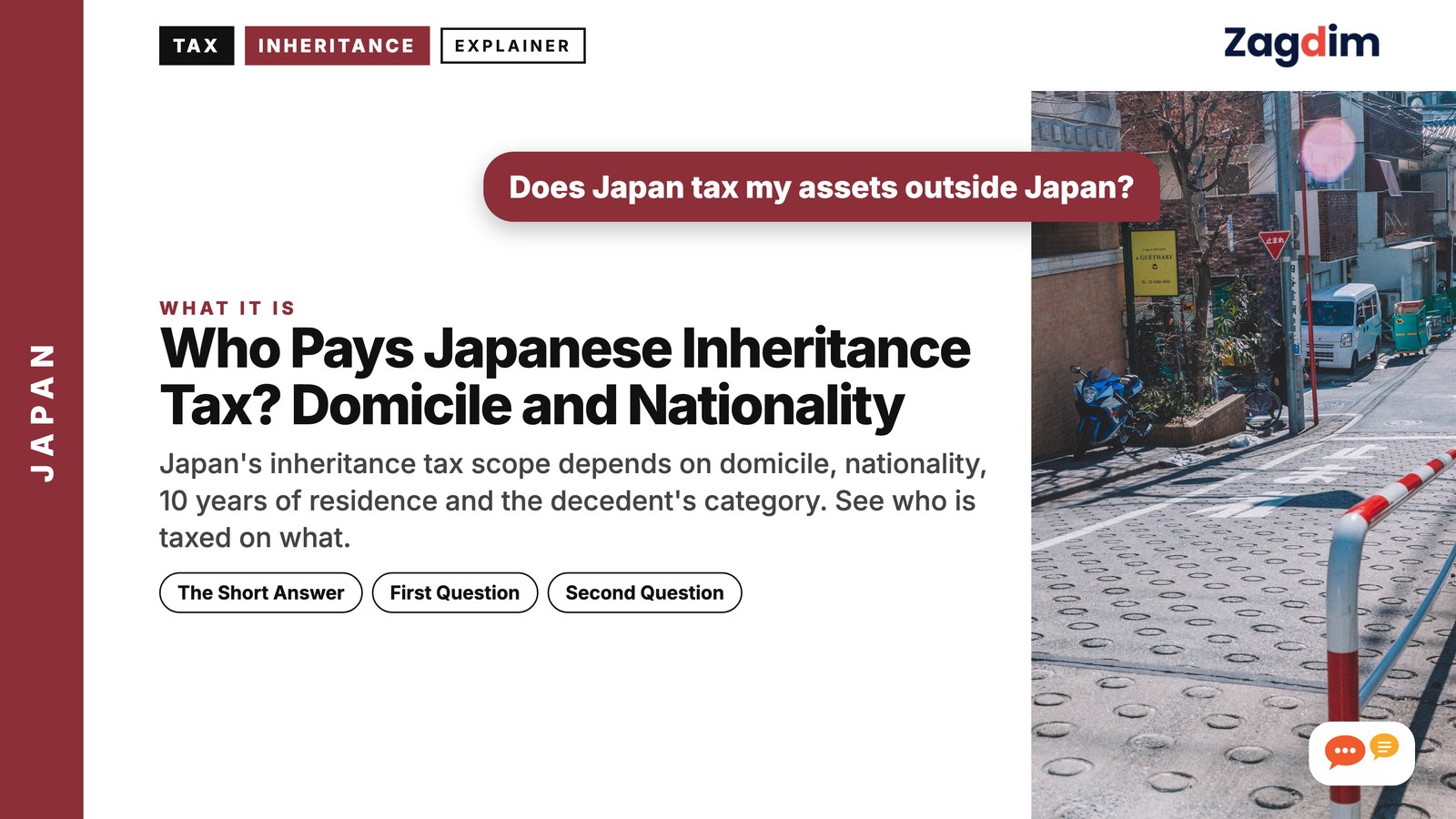
Who Pays Japanese Inheritance Tax? Domicile and Nationality

Home Japan
Paved pedestrian street lined with buildings, illustrating Who Pays Japanese Inheritance Tax? Domicile and Nationality

Image: Zagdim

October 3, 2026
in Japan, Living Abroad, Property
Reading Time: 13 mins read
Tags: Tax

This article is part of the “Inheritance and Gift Tax” series in the Japan property guide. It answers a question that overseas families who inherit Japanese real estate often ask: does Japan also tax the assets you hold in other places, such as Taiwan or Hong Kong? For the overall rules on inheriting Japanese property, see the main article “Overseas Families May Owe Japanese Inheritance Tax: Inheritance and Gift Rules for Non-Residents Who Own Japanese Property.”

Anyone who inherits Japanese real estate, whatever their nationality or place of residence, has that property within the scope of Japanese inheritance tax. For assets elsewhere, such as in Taiwan or Hong Kong, the answer depends on the domicile, nationality and residence history of both the person who inherits and the person who died.

Why Is This Step Easy to Get Wrong?

Families with property in Japan may have heard two statements: “foreigners are taxed only on their Japanese assets” and “if you live overseas, only Japanese assets are taxed.” Both leave out conditions and should not be treated as rules.

Japan’s inheritance tax is called sōzoku-zei (相続税). Its scope does not turn only on your nationality, nor only on where you live. The conditions of the heir and of the decedent must be combined to decide how far Japanese tax reaches.

The Short Answer: Four Things Decide How Far Japan Taxes

Inherited Japanese real estate is within the scope of Japanese inheritance tax whichever category you belong to. Whether tax is actually payable also depends on whether the net estate exceeds the basic deduction. What varies from person to person is whether assets outside Japan are counted.

That depends on four things: whether you had a domicile in Japan when you acquired the assets; whether you hold Japanese nationality; if you do, whether you had a domicile in Japan at any time in the past 10 years; and whether the decedent is a foreign decedent (外国人被相続人) or a non-resident decedent (非居住被相続人). For an heir who lives overseas and has no Japanese nationality, only the last one matters: if the decedent falls into one of those two categories, Japan taxes only Japanese assets; if not, assets in places such as Taiwan and Hong Kong are within the scope as well.

How Does Japan Classify Heirs?

Japan divides heirs (including people who receive assets by bequest) into four categories, according to whether they had a domicile in Japan when they acquired the assets and how far the tax reaches. “Resident” and “non-resident” refer only to domicile, not to nationality.

Category Situation when acquiring the assets Scope of Japanese tax Minor deduction Disabled person deduction
Resident unlimited taxpayer (居住無制限納税義務者) Has a domicile in Japan (temporary residents are an exception, see below) All assets Available Available
Non-resident unlimited taxpayer (非居住無制限納税義務者) No domicile in Japan, but falls under full taxation depending on nationality, domicile in the past 10 years and the decedent’s category (see below) All assets Available Not available
Resident limited taxpayer (居住制限納税義務者) Has a domicile in Japan, is a temporary resident, and the decedent falls into one of the two categories Japanese assets only Not available Not available
Non-resident limited taxpayer (非居住制限納税義務者) No domicile in Japan, and not a non-resident unlimited taxpayer Japanese assets only Not available Not available

“Available” in the table means the category is not excluded; the person must still meet the conditions. The minor deduction (未成年者控除) is for a statutory heir under 18, and the amount is the number of years until age 18 multiplied by JPY 100,000. The disabled person deduction (障害者控除) is for a statutory heir with a physical or mental disability, and the amount is the number of years until age 85 multiplied by JPY 100,000 (JPY 200,000 for a specially disabled person); for both, a period of less than one year counts as one year.

The category also affects the deductions available: a limited taxpayer can deduct a narrower range of debts and cannot deduct funeral expenses. The basic deduction is different: as of September 2026, the statute does not distinguish by category when calculating it. For the calculation, see the companion article “How Is Japanese Inheritance Tax Calculated? Basic Deduction, Rate Brackets and the Spouse’s Tax Credit.”

Beyond these four categories, there is also the specified taxpayer (特定納税義務者). A person who received gifts from the decedent only under settlement taxation at inheritance (相続時精算課税) and acquired nothing by inheritance or bequest falls into this category, and is liable to inheritance tax only on those gifted assets.

First Question: Did You Have a Domicile in Japan When You Acquired the Assets?

Domicile (住所) means the center of a person’s life and is decided on objective facts. There is no rule such as “a set number of days counts,” and the official definition does not equate it with the address on a residence certificate (住民票) or residence card.

Whether a temporary stay abroad is still treated as living in Japan depends on your status. For a person with Japanese nationality or permanent resident (永住者) status, in either of the following two situations they are treated as living in Japan unless the domicile is clearly abroad:

  • Studying abroad, and being a dependent relative of a person living in Japan.
  • Working abroad on an assignment expected to be short (roughly one year or less); the same goes for a spouse or other family members living with that person.

This presumption applies only to people with Japanese nationality or permanent resident status. Others, for example a foreign national living in Japan on a work-type residence status (在留資格, the category of status under which a foreigner may stay in Japan) who is temporarily back in Taiwan, are assessed individually on the actual center of their life.

An heir with a domicile in Japan is as a rule a resident unlimited taxpayer. The exception is the temporary resident (一時居住者): when the decedent dies, you hold a residence status such as work or study, and your periods of domicile in Japan within the past 15 years total 10 years or less (10 years included). A temporary resident has only Japanese assets taxed only when the decedent falls into one of the two categories.

Second Question: Do You Have Japanese Nationality? Did You Live in Japan in the Past 10 Years?

This step applies only if you did not live in Japan when you acquired the assets.

  • Japanese nationality and a domicile in Japan at some point in the past 10 years: assets outside Japan are also taxed, whichever category the decedent falls into. The 10 years means any point within the 10 years before the inheritance began; having a domicile at that point is enough.
  • Japanese nationality and no domicile in Japan at any time in the past 10 years: go to the third question.
  • No Japanese nationality: how many years you yourself have lived in Japan does not affect the assessment; go straight to the third question.

A person with both Japanese and another nationality is treated as having Japanese nationality.

Third Question: Which Category Does the Decedent Belong To?

These two categories decide whether an heir who lives overseas can be taxed on Japanese assets only:

  • Foreign decedent (外国人被相続人): a person who held a residence status such as work or study and lived in Japan at death. Under the current definition, the number of years lived in Japan is not considered. As of September 2026, a person living in Japan as a permanent resident does not fall into this category.
  • Non-resident decedent (非居住被相続人): a person who did not live in Japan at death and had no domicile in Japan at any time in the past 10 years; or who had a domicile in Japan within the past 10 years but never held Japanese nationality during that time.

When the decedent falls into neither category, the heir’s assets outside Japan are within the scope whatever the heir’s nationality or residence. Examples: the decedent held Japanese nationality, lived in Japan within the 10 years before death, or lived in Japan as a permanent resident.

The rules before April 1, 2021 were different. The corresponding category was then called the temporary-resident decedent (一時居住被相続人), which required that the decedent’s periods of domicile in Japan within the 15 years before death total 10 years or less. The current rules apply to assets acquired on or after April 1, 2021 and look only at whether the decedent held a residence status and lived in Japan at death. When reading material that mentions this years-of-residence condition, first check whether it describes the old rule.

**Example: A Taiwanese mother who dies in Tokyo, with different results depending on her status**

>

The mother is a Taiwanese national who lived in Tokyo and died there. The daughter lives in Hong Kong, has no Japanese nationality and has never had a domicile in Japan. The daughter inherits her mother’s apartment in Tokyo and her mother’s house in Taipei.

>

  • The mother held a work-type residence status when she died: she is a foreign decedent. The daughter is a non-resident limited taxpayer, and Japan taxes only the Tokyo apartment; the Taipei house is outside the scope of Japanese inheritance tax. – The mother was a permanent resident: as of September 2026 she is not a foreign decedent; she also lived in Japan at death, so she is not a non-resident decedent either. The daughter is a non-resident unlimited taxpayer, and the Taipei house is also within the scope of Japanese inheritance tax.

>

What the daughter should do: first confirm the mother’s residence status at death, and then decide which assets must be assessed. Where the mother was a permanent resident, it is advisable to confirm with a Japanese tax accountant (税理士) before filing.

Does the Same Test Apply to Gifts of Property to Family?

The structure is the same; only the person tested and the point in time differ. Japanese gift tax (贈与税) is decided by the domicile and nationality of the recipient and the donor at the time of the gift, and the 10 years are counted back from the time of the gift.

The two corresponding categories of donor are, first, the foreign donor (外国人贈与者): a person who held a residence status and lived in Japan at the time of the gift. Second, the non-resident donor (非居住贈与者): a person who did not live in Japan at the time of the gift and had no domicile in Japan within the 10 years before the gift, or who lived there during that period but never held Japanese nationality. The test for temporary residents is the same: a residence status and periods of domicile in Japan within the 15 years before the gift totaling 10 years or less.

Whichever category the recipient belongs to, Japanese real estate received as a gift is within the scope of Japanese gift tax. For the details of gifts, see the companion article “Gift Tax Rules and Annual Exemptions to Know Before Giving Japanese Property to Family.”

What Needs Particular Attention?

  • The decedent had Japanese nationality and moved to Taiwan late in life: if the decedent lived in Japan within the 10 years before death, the decedent is not a non-resident decedent. For an heir living overseas, whatever the nationality, assets outside Japan are within the scope.
  • The decedent lived in Japan as a permanent resident: see the example above. For a child who has no Japanese nationality and lives overseas, assets in Taiwan and Hong Kong are also within the scope.
  • A child holds both Taiwanese and Japanese nationality: Japan treats the child as holding Japanese nationality. If the child had a domicile in Japan at any point in the past 10 years, assets outside Japan are within the scope, whichever category the decedent falls into.
  • The heir lives in Japan: as a rule all assets are taxed. Only if the heir is a temporary resident and the decedent falls into one of the two categories are only Japanese assets taxed; as of September 2026, an heir with permanent resident status is not a temporary resident.
  • The heir lives in Japan at the time of inheritance and later moves away: a person who must file and who leaves Japan within the 10-month filing period without first submitting a tax representative notification form (納税管理人届出書) has the filing deadline brought forward to the day on which they no longer have a domicile or residence. A person who was already living overseas when the inheritance began is not subject to this shortening.

After the Category Is Settled, What Is the Next Step?

First list the details of the decedent and of each heir: nationality, place of residence at death or when acquiring the assets, the residence status held while living in Japan, and the domicile record for the past 10 years (15 years to assess temporary-resident status). Within one family, each heir’s category may differ and must be assessed one by one.

  • Only Japanese assets taxed: the next things to look at are the valuation of the Japanese property and whether it exceeds the basic deduction; see the companion article “How Is Japanese Inheritance Tax Calculated? Basic Deduction, Rate Brackets and the Spouse’s Tax Credit.”
  • Assets outside Japan also taxed: assets in places such as Taiwan and Hong Kong must also be assessed.
  • Living overseas and required to file: a tax representative (納税管理人) living in Japan must be appointed; for the procedure see the companion article “The Process of Inheriting Japanese Property: Filing Deadlines, Inheritance Registration and the Tax Representative.”
  • Taiwan and Hong Kong: these are assessed separately under local rules, subject to the current rules of the local authorities; see the companion article “Taiwan and Hong Kong Families Inheriting Japanese Property: How Filing and Foreign Tax Credits Fit Together.”

For permanent residents, dual nationals, or people who go back and forth between two places and whose domicile is unclear, it is advisable to confirm with the tax office (税務署) or a Japanese tax accountant. For an overview first, return to the main article and its summary table of tax scope.

FAQ: Scope of Japanese Inheritance Tax

I have no Japanese nationality, worked in Japan for a few years in the past and now live in Taiwan. Will Japan tax my assets in Taiwan?

Not because of that history. For an heir with no Japanese nationality who did not live in Japan when acquiring the assets, Japan looks only at whether the decedent is a foreign decedent or a non-resident decedent; how many years you yourself lived in Japan does not affect the assessment.

My child holds both Taiwanese and Japanese nationality. Is the child treated as Japanese when inheriting Japanese property?

Yes. Japanese inheritance tax treats a dual national as having Japanese nationality. If the child had a domicile in Japan at any point in the 10 years before the inheritance began, assets outside Japan are also within the scope; if not, the decedent’s category is checked next.

Can a minor child living overseas use Japan’s minor deduction?

It depends on the category. A non-resident unlimited taxpayer can; a limited taxpayer cannot. The person must also be under 18 and a statutory heir. The deduction is the number of years until age 18 multiplied by JPY 100,000, with less than one year counted as one year.

Glossary

  • Inheritance tax (相続税): Japan’s estate tax, paid by those who acquire assets by inheritance or bequest.
  • Domicile (住所): the center of a person’s life, decided on objective facts.
  • Unlimited taxpayer / limited taxpayer (無制限納税義務者 / 制限納税義務者): the former is taxed in Japan on assets wherever located; the latter only on assets located in Japan.
  • Specified taxpayer (特定納税義務者): a person who received gifts only under settlement taxation at inheritance, acquired nothing by inheritance or bequest, and is liable to inheritance tax only on those gifted assets.
  • Temporary resident (一時居住者): a person who holds a residence status such as work or study and whose periods of domicile in Japan within the past 15 years total 10 years or less.
  • Foreign decedent (外国人被相続人): a decedent who held a residence status such as work or study and lived in Japan at death.
  • Non-resident decedent (非居住被相続人): a decedent who did not live in Japan at death and had no domicile in Japan within the past 10 years, or who lived in Japan but did not hold Japanese nationality at the time.
  • Permanent resident (永住者): a residence status listed in Appendix II of Japan’s Immigration Control Act.
  • Minor deduction / disabled person deduction (未成年者控除 / 障害者控除): provisions that deduct an amount, by number of years, from the inheritance tax of a statutory heir who is under 18 or who has a physical or mental disability.
  • Tax representative (納税管理人): a person appointed by someone without a domicile in Japan to handle tax filings and related matters in Japan; must live in Japan.

Notes on Sources and Scope

  • Information checked as of September 30, 2026, based on the Inheritance Tax Act and the Act on General Rules for National Taxes, and on the National Tax Agency’s basic circular and Tax Answers.
  • The following points are drawn from the wording of the statutes; there is no direct official explanation for these situations. That a person living in Japan as a permanent resident is not a foreign decedent, and that an heir with permanent resident status is not a temporary resident, comes from reading together the Inheritance Tax Act (“residence status limited to Appendix I of the Immigration Control Act”) and the basic circular (“permanent resident is listed in Appendix II”); the full text of the Immigration Control Act appendices was not checked, and other statuses such as spouse of a Japanese national were not checked one by one. The application to Taiwan and Hong Kong families is inferred from the statutory text; National Tax Agency documents do not mention Taiwan or Hong Kong. That the basic deduction does not vary by category rests on the fact that Article 15 of the Inheritance Tax Act does not distinguish.
  • Domicile: the documents checked do not equate domicile with the address on a residence certificate or residence card. National Tax Agency Tax Answer No. 4138 also states generally that people temporarily away from Japan for study or an overseas business trip still have a domicile in Japan; this article follows the basic circular and writes only for people with Japanese nationality or permanent resident status and only for the situations listed.
  • National Tax Agency Tax Answers No. 4138 and No. 4164 still use the term “non-resident foreigner,” a term for a transitional rule that applies only to assets acquired from April 1, 2017 to March 31, 2022; this article follows the current statute.
  • Other exceptions are not covered here: a person who uses the tax payment deferral special provision for transfers abroad is subject to separate deeming rules, and assets acquired before April 1, 2021 follow the old rules.

Related in this series:

  • Japan Property Taxes: Registration, Acquisition, Fixed Asset
  • Japan Inheritance and Gift Tax for Overseas Families
  • How Japan Inheritance Tax Is Calculated: Deductions, Rates, Spouse Relief
  • Gifting Japanese Property to Family: Gift Tax Rules and the Annual Exemption

Have a question about this guide? Leave a comment below, or ask Zagdim directly.

Life abroad? Ask Zagdim.

Your first stop for international property and global living.

Research and insights. Know what’s changing. Understand what matters.

Sources

Titles are kept in their original wording; descriptions are in English.

  • e-Gov法令検索-相続税法(昭和25年法律第73号) (Inheritance Tax Act): https://laws.e-gov.go.jp/law/325AC0000000073
  • e-Gov法令検索-相続税法(2021年3月1日施行版) (Inheritance Tax Act, version in force March 1, 2021): https://laws.e-gov.go.jp/api/2/law_data/325AC0000000073_20210301_501AC0000000071
  • 国税庁-相続税法基本通達 第1条の3・第1条の4共通関係 (National Tax Agency, basic circular on the Inheritance Tax Act, Articles 1-3 and 1-4): https://www.nta.go.jp/law/tsutatsu/kihon/sisan/sozoku2/01/01.htm
  • 国税庁-タックスアンサー No.4138 相続人が外国に居住しているとき (Tax Answer No. 4138, when the heir lives abroad): https://www.nta.go.jp/taxes/shiraberu/taxanswer/sozoku/4138.htm
  • 国税庁-タックスアンサー No.4138 QA 相続税の納税義務者の範囲等 (Tax Answer No. 4138 Q&A, scope of inheritance tax taxpayers): https://www.nta.go.jp/taxes/shiraberu/taxanswer/sozoku/4138_qa.htm
  • 国税庁-タックスアンサー No.4432 受贈者が外国に居住しているとき (Tax Answer No. 4432, when the recipient lives abroad): https://www.nta.go.jp/taxes/shiraberu/taxanswer/zoyo/4432.htm
  • 国税庁-タックスアンサー No.4102 相続税がかかる場合 (Tax Answer No. 4102, when inheritance tax applies): https://www.nta.go.jp/taxes/shiraberu/taxanswer/sozoku/4102.htm
  • 国税庁-タックスアンサー No.4126 相続財産から控除できる債務 (Tax Answer No. 4126, debts deductible from the estate): https://www.nta.go.jp/taxes/shiraberu/taxanswer/sozoku/4126.htm
  • 国税庁-相続税の申告のしかた(令和8年分用) (How to file an inheritance tax return, 2026 edition): https://www.nta.go.jp/publication/pamph/sozoku/shikata-sozoku2026/index.htm
  • 国税庁-タックスアンサー No.4164 未成年者の税額控除 (Tax Answer No. 4164, tax credit for minors): https://www.nta.go.jp/taxes/shiraberu/taxanswer/sozoku/4164.htm
  • 国税庁-タックスアンサー No.4167 障害者の税額控除 (Tax Answer No. 4167, tax credit for persons with disabilities): https://www.nta.go.jp/taxes/shiraberu/taxanswer/sozoku/4167.htm
  • e-Gov法令検索-国税通則法(昭和37年法律第66号) (Act on General Rules for National Taxes): https://laws.e-gov.go.jp/law/337AC0000000066

Important Notice

This article is a general information summary and does not constitute tax or legal advice for any individual case. Information checked as of September 30, 2026. Japanese rules may change, so please rely on the current announcements of the competent authority, and consult a qualified professional for individual cases.
Zagdim AI
All content is researched, written, or authorized for publication by the @Zagdim Overseas team. Sharing and reposting are welcome, but please make sure to credit the source and include the original article link from this website. Any plagiarism or unauthorized use may result in legal action. For article submissions, please contact us via Facebook. Thank you for your support!

For article submissions, press release publication, or interview notices, please contact [email protected]. 

Zagdim Ask

Have a specific question about overseas living, property, visa, or practical arrangements?

Fill in your situation and key concerns through Zagdim Ask. Our team will review your message and get back to you by email where appropriate.

Submit your enquiry →

Similar Topics

Quiet backstreet with yellow corner building, illustrating Taxes on Selling Japanese Property: Gains, Resident Tax, Filing
Japan

Taxes on Selling Japanese Property: Gains, Resident Tax, Filing

October 3, 2026
Rooftop observatory interior at Umeda Sky Building, illustrating Selling Japanese Property: Valuation, Listing Agreement, Closing
Japan

Selling Japanese Property: Valuation, Listing Agreement, Closing

October 3, 2026
Delivery truck on empty city street, illustrating Japan Tenant Protection: Landlord Rules on Leases, Renewal, Move-Out
Japan

Japan Tenant Protection: Landlord Rules on Leases, Renewal, Move-Out

October 3, 2026
Next Post
Close-up temple roof ornament with swirl design, illustrating How Japan Inheritance Tax Is Calculated: Deductions, Rates, Spouse Relief

How Japan Inheritance Tax Is Calculated: Deductions, Rates, Spouse Relief

Modern hotel building with rooftop satellite dishes, illustrating Gifting Japanese Property to Family: Gift Tax Rules and the Annual Exemption

Gifting Japanese Property to Family: Gift Tax Rules and the Annual Exemption

Narrow alley with utility pole and wires, illustrating Inheriting Japanese Property: Deadlines, Registration and Tax Agent

Inheriting Japanese Property: Deadlines, Registration and Tax Agent

Facebook Twitter Youtube

About Us

Zagdim is a global knowledge platform focused on cross-border property, relocation, lifestyle, and location-based decision-making.

We provide insights on overseas real estate, market trends, regional analysis, economic developments, and practical relocation information. Through continuous market observation and on-the-ground research, Zagdim helps readers better understand a place before deciding where to live, invest, buy property, or establish a base abroad.

We currently follow markets including the UK, Japan, Thailand, Malaysia, Germany, Australia, the UAE, Greece, Portugal, and Spain, while continuing to track emerging lifestyle, relocation, and property trends worldwide.

Category

  • Australia
  • Buying & Immigration Guide
  • Cambodia
  • Canada
  • Costa Rica
  • Dubai
  • Encyclopedia
  • Europe
  • Expat Lifestyle Guide
  • Germany
  • Global Reports Analysis
  • Hong Kong
  • Human-Picked
  • Indonesia
  • International Property Buying Guide
  • Japan
  • Japan Market News
  • Kenya
  • Living Abroad
  • Malaysia
  • Mallorca
  • Market Trends Overview
  • News
  • Other Market News
  • Overseas Leasing & Long-Term Stay
  • Philippines
  • Policy Interpretation
  • Portugal
  • Property
  • Property Law & Tax
  • Real Estate & Economic News
  • Real Estate Law & Taxation
  • Relocation, Immigration & Visa
  • Singapore
  • South Korea
  • Spain
  • Switzerland
  • Thailand
  • Thailand Market News
  • UK Market News
  • United Kingdom
  • United States
  • Vietnam
  • Vietnam Market News
  • Visa & Immigration
  • Zagdim Insights
  • Zagdim Property Insights

Email:[email protected]


Add Friends


WhatsApp
Contact Us


Wechat:Zagdim

Work with Zagdim

Put your brand inside the overseas property research process — in English and in Chinese. Reaching buyers, expats and investors across 19 markets.

View partnership packages →

©2026 Zagdim Overseas All Right Reserved

No Result
View All Result
  • Home
  • Zagdim Property Insights
    • Market Trends Overview
    • Policy Interpretation
    • Forest
    • PLACEHOLDER sub-cate for Zagdim Property Insights
  • Global Reports Analysis
    • In-Depth Project Analysis
  • Real Estate & Economic News
    • Thailand Market News
    • UK Market News
    • Germany Market News
    • Japan Market News
  • Buying & Immigration Guide
    • Expat Lifestyle Guide
    • Real Estate Law & Taxation
    • Overseas Leasing & Long-Term Stay
    • Starting a Business & Company Setup
  • Zagdim Ask
  • 中文 EN

©2026 Zagdim Overseas All Right Reserved