






























This article is part of the Zagdim wiki series on Japanese property, in the section on inheritance and gift tax. It answers one question: what gift tax rules should you know before giving Japanese property to a family member? The overall rules for inheritance and gifts are covered in the main article, “Overseas Families May Owe Japanese Inheritance Tax”.
When Japanese property is given to a family member, Japan charges gift tax (贈与税), paid by the person who receives the property. The annual exemption is JPY 1.1 million in total per recipient per year. Anything above that is taxed under one of two rate tables, and when a parent or grandparent aged 60 or over gives to a child or grandchild aged 18 or over, a different method of calculation can be chosen instead. If the giver is a national of the Republic of China (Taiwan) who habitually lives in Taiwan, the same gift must also be considered for Taiwan gift tax, where the 2026 exemption is TWD 2.44 million.
The sections below follow the questions that come up before property is gifted.
Where Does Gifting a House Get Stuck?
Moving a house in Japan into the name of a child or spouse can involve two places and two different taxpayers: Japan taxes the recipient, while the home country, in the case of Taiwan, looks at the giver. Japan also offers two methods of calculation to choose between, and for the same giver, once one is chosen it cannot be changed back. The house is also not valued at its purchase price or market price.
The Short Answer: How Is Gifted Japanese Property Taxed?
A gift of Japanese property falls within Japan’s gift tax. As of September 2026, this is so even when both the giver and the recipient live overseas. Japanese gift tax is paid by the recipient. The basic method is calendar-year taxation (暦年課税): gifts received by the recipient from January 1 to December 31 are added together, and only the amount above JPY 1.1 million is taxed, at rates of 10% to 55%.
The other method is settlement-at-inheritance taxation (相続時精算課税). It is limited to gifts from a parent or grandparent aged 60 or over to a child or grandchild aged 18 or over (ages measured at January 1 of that year). The amount above the deduction is taxed at 20%, and when the giver dies, the gifts are combined with inheritance tax (相続税). On transfer, the recipient also bears registration and license tax (登録免許税), and real estate acquisition tax (不動産取得税) is also within scope on a gift (not charged when the taxable base is below the minimum threshold). Both of these are lower or not charged on an inheritance.
What Price Is Used to Value the House?
Neither the purchase price nor the market price. Gift tax and inheritance tax use the same valuation: land is valued separately by land category, residential land is generally valued by the road-rate value (路線価) or multiplier method, and a building is generally valued at its fixed asset tax assessed value (固定資産税評価額). For an apartment received on or after January 1, 2024, the valuation may also have to be multiplied by a condominium adjustment ratio (区分所有補正率). Each valuation method is explained in the main article.
The exceptions are a burdened gift (負担付贈与, a gift where the recipient must take on a certain burden) and a transaction between individuals for consideration. For land and buildings acquired in these two situations, gift tax is calculated at the usual transaction value (通常の取引価額), not the valuation above. If conditions are attached to a gift of property, or money passes between the parties, it is best to confirm first which kind of price applies.
Calendar-Year Taxation: How Much Is Payable Above JPY 1.1 Million?
The JPY 1.1 million is the basic deduction (基礎控除額). It is calculated on the recipient’s total for the year, not JPY 1.1 million per giver. If the year’s total is JPY 1.1 million or less, no gift tax is charged and no return is required.
If the total is higher, JPY 1.1 million is subtracted first, and the remaining taxable value is run through one of the two tables below. Which table applies depends on the relationship between recipient and giver and on the recipient’s age. The deduction in each table is a calculation shortcut, not a separate tax-free allowance.
Special Rates: Parents and Grandparents Giving to a Child or Grandchild Aged 18 or Over
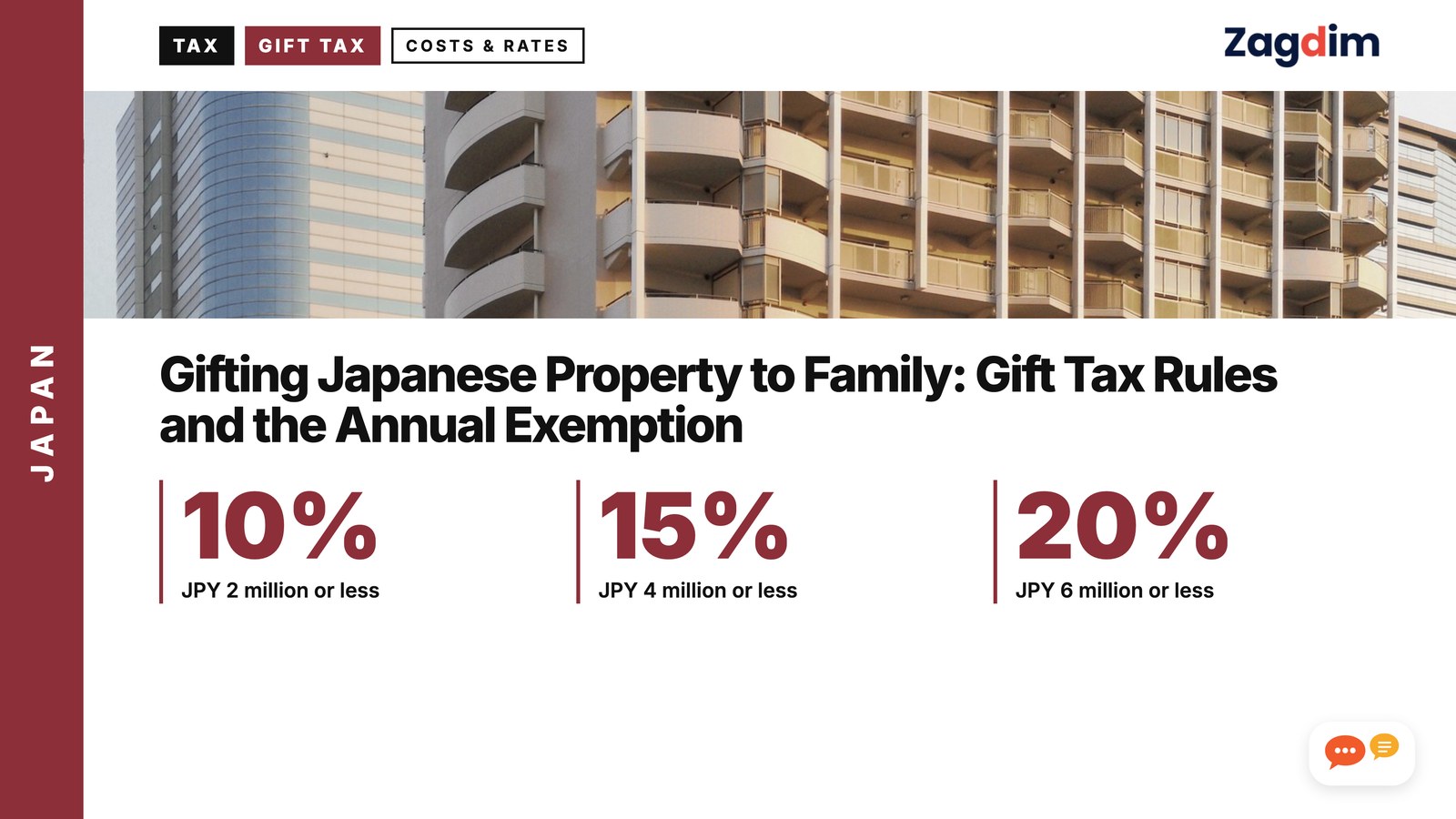
The special rate (特例税率) applies when the recipient has turned 18 by January 1 of the year of the gift and receives from a direct ascendant (直系尊属, such as a parent or grandparent). Age is measured at January 1, not on the day of the gift. For gifts made on or before March 31, 2022, the threshold was age 20. A parent-in-law is not a direct ascendant, so a gift to a son-in-law or daughter-in-law cannot use this table.
| Taxable value after the JPY 1.1 million deduction | Rate | Quick-calculation deduction |
|---|---|---|
| JPY 2 million or less | 10% | None |
| JPY 4 million or less | 15% | JPY 100,000 |
| JPY 6 million or less | 20% | JPY 300,000 |
| JPY 10 million or less | 30% | JPY 900,000 |
| JPY 15 million or less | 40% | JPY 1.9 million |
| JPY 30 million or less | 45% | JPY 2.65 million |
| JPY 45 million or less | 50% | JPY 4.15 million |
| Over JPY 45 million | 55% | JPY 6.4 million |
General Rates: All Other Cases
Gifts that do not qualify for the special rate fall under the general rate (一般税率). Examples are gifts between spouses, between siblings, from a parent to a child under 18, and from a spouse’s parent to a son-in-law or daughter-in-law.
| Taxable value after the JPY 1.1 million deduction | Rate | Quick-calculation deduction |
|---|---|---|
| JPY 2 million or less | 10% | None |
| JPY 3 million or less | 15% | JPY 100,000 |
| JPY 4 million or less | 20% | JPY 250,000 |
| JPY 6 million or less | 30% | JPY 650,000 |
| JPY 10 million or less | 40% | JPY 1.25 million |
| JPY 15 million or less | 45% | JPY 1.75 million |
| JPY 30 million or less | 50% | JPY 2.5 million |
| Over JPY 30 million | 55% | JPY 4 million |
The National Tax Agency gives this worked case: for gifts of JPY 5 million in a year, under the general rate the tax is (JPY 5 million – JPY 1.1 million) x 20% – JPY 250,000 = JPY 530,000, and under the special rate it is (JPY 5 million – JPY 1.1 million) x 15% – JPY 100,000 = JPY 485,000. This is purely illustrative and assumes no other gifts in the year; the actual tax is whatever the return calculates. If both kinds of gift are received in the same year, the tax must be apportioned, and there are further rules.
Settlement-at-Inheritance Taxation: Can You Choose It, and When Must You File?
This system combines gift tax with the future inheritance tax. Each year JPY 1.1 million is deducted first (for gifts from 2024), then the special deduction (特別控除額) of a cumulative JPY 25 million is applied, and the excess is taxed at 20%. When the giver dies, the property is added back to the estate at its value at the time of the gift. For property received from 2024, the annual basic deduction of JPY 1.1 million is subtracted each year before the add-back. Gift tax already paid can be deducted.
Anyone choosing this system must submit a notification of selection of settlement-at-inheritance taxation (相続時精算課税選択届出書):
- Deadline: Between February 1 and March 15 of the year after the first gift, to the tax office (税務署) for the taxpayer’s place of tax payment.
- Attachments: A family register transcript (戸籍謄本) or similar for the recipient, to prove the recipient’s name and date of birth and that the recipient is the giver’s presumptive heir (推定相続人) or a grandchild. The document must have been issued on or after the date of the gift. For families without a Japanese family register, it is best to confirm with the tax office before filing which document to attach.
- How to submit: If a gift tax return is required, submit it together with the return. If the gifts are within JPY 1.1 million and no return is required, submit the notification alone. The special deduction of JPY 25 million is also available only if the filing is made within the deadline.
Once chosen, the election cannot be withdrawn for that giver: from then on, all property received from that giver falls under this system, and the calendar-year JPY 1.1 million can no longer be used. Property received from other givers can still be taxed under calendar-year taxation.
A recipient who lives overseas can choose the system when the conditions are met. As of September 2026, the National Tax Agency has no direct statement on whether it can be chosen when the giver lives outside Japan, so it is best to check first with the tax office or a Japanese tax accountant (税理士). How to choose between the two methods depends on the giver’s age and residence, what is planned for the house later, and whether the home country requires a filing.
What Other Taxes Arise on Transfer?
Both of the following are generally calculated on the value registered in the fixed asset tax ledger (固定資産課税台帳), which is neither the market value nor the valuation used for inheritance and gift tax.
- Registration and license tax (登録免許税): Paid when ownership is transferred in the register. The rate is 20/1,000 for a gift and 4/1,000 for an inheritance.
- Real estate acquisition tax (不動産取得税): Charged by the prefecture on the person who acquires real estate. It applies to a gift and not to an inheritance. It still applies when the spousal deduction for gifts between spouses or settlement-at-inheritance taxation is used.
Real estate acquisition tax is calculated as follows, using the Tokyo Metropolitan Bureau of Taxation’s explanation as an example:
- Rate: For land or housing acquired on or before March 31, 2027, 3/100; for buildings that are not housing, 4/100.
- Residential land halving: For residential land and similar acquired on or before March 31, 2027, the taxable base for the land is 1/2 of its value.
- Minimum threshold: For acquisitions on or after April 1, 2026, no tax is charged if the taxable base is under JPY 160,000 for land, or under JPY 340,000 for buildings that are not newly built (sales and similar).
- Other reductions: New housing, and used housing occupied by the individual as a residence together with its land, have separate reductions that depend on the requirements, so it should not be assumed that every gift qualifies. Other prefectures generally follow the same Local Tax Act, but details of reductions and exemptions may differ.
From October 5, 2026, a person applying to be registered as the owner must also declare their nationality, including persons living abroad. Documents such as proof of address that a foreign-national recipient living overseas must prepare for registration are explained in the article “The Process of Inheriting Japanese Property”.
Does Gift Tax Also Matter in the Giver’s Home Country?
In Taiwan it depends on the giver’s status, while the official Hong Kong tax policy page does not list a gift tax. The Taiwan and Hong Kong rules below are subject to the current rules of the local authority.
Taiwan: It Depends on Whether the Giver Habitually Lives in Taiwan
- Scope: A national of the Republic of China who habitually lives in Taiwan is also subject to Taiwan gift tax when giving Japanese property. A national who habitually lives outside Taiwan, or a non-national, is taxed only on property within Taiwan. Habitually living in Taiwan means having a domicile in Taiwan within the 2 years before the gift, or having no domicile but a residence and staying in Taiwan for a total of more than 365 days within 2 years (with exceptions).
- 2026 (Year 115) amounts: The exemption is TWD 2.44 million. The bands are 10% up to TWD 28.11 million, 15% from over TWD 28.11 million to TWD 56.21 million, and 20% above TWD 56.21 million (New Taiwan dollars). These amounts are adjusted for prices and apply only to gifts made in 2026.
- Filing: When the giver’s gifts in a year total more than the exemption, a return is due within 30 days after the gift that crossed the threshold. Multiple gifts in a year are combined. Gifts between spouses and certain other cases are not counted in the total gifts, with separate rules.
- Tax already paid in Japan: Gift tax already paid in the country where foreign property is located can be credited against Taiwan gift tax by applying with the tax payment certificate from that country’s tax authority, authenticated, up to the increase in Taiwan tax caused by adding the foreign property. Japanese gift tax is paid by the recipient, while Taiwan looks at the giver, so the taxpayers in the two places differ. Whether Japanese gift tax already paid can be credited, and which documents are needed, should be confirmed with the national tax bureau before filing.
Hong Kong: Japanese Gift Tax Still Has to Be Considered
The Financial Services and the Treasury Bureau’s current tax policy page lists no gift tax among its taxes. However, the property being gifted is in Japan, so Japanese gift tax is still determined under Japanese rules.
**Example: a mother in Taipei wants to give an apartment in Osaka to her daughter**
>
The mother is a national of the Republic of China living in Taipei, and she had turned 60 by January 1 of the year of the gift. Her daughter also lives in Taipei and had turned 18 by January 1 of that year.
>
- **Japanese tax**: The apartment is in Japan, so the daughter must pay Japanese gift tax. The value is assessed using the road-rate value, the fixed asset tax assessed value and similar measures, and the apartment may also be multiplied by the condominium adjustment ratio. – **Which method applies**: The daughter receives from her mother and had turned 18 by January 1, so calendar-year taxation uses the special rate. Because the mother lives in Taiwan, whether settlement-at-inheritance taxation can be chosen must first be confirmed with the tax office or a Japanese tax accountant. – **Japanese filing**: If the apartment’s valuation exceeds JPY 1.1 million, the daughter must file and pay between February 1 and March 15 of the year after the gift. Because she lives overseas, she must first appoint a tax representative (納税管理人) and a place of tax payment. – **Transfer**: Registration and license tax is 20/1,000. Real estate acquisition tax applies, with the rate and residential land halving as above. – **Taiwan tax**: If the mother is a national who habitually lives in Taiwan, the apartment is also within the scope of Taiwan gift tax. For gifts made in 2026 totaling more than TWD 2.44 million, a return is due within 30 days after the gift that crossed the threshold.
>
What they need to do: first obtain the valuation data for the apartment, confirm whether settlement-at-inheritance taxation can be chosen, and then decide which method to use. The 30-day Taiwan deadline and the March 15 Japanese deadline must be watched separately.
Situations That Call for Extra Care
- The giver dies within a few years after the gift: For deaths on or before December 31, 2026, property received under calendar-year taxation in the 3 years before death is added back to the estate, including gifts of JPY 1.1 million or less. The add-back applies to people who acquire property through inheritance or a bequest. From 2027 the period is extended in stages, and for deaths on or after January 1, 2031 it is 7 years. Gift tax already paid on the added-back portion can be deducted from the inheritance tax.
- Gifts of a home between spouses: For a marriage of 20 years or more, when the gift is a residential property in Japan, a further deduction of up to JPY 20 million is available on top of the JPY 1.1 million. The conditions require the receiving spouse to move in by March 15 of the year after the gift and expect to keep living there. If the house will be used only as a vacation home or let out, it is best to check first whether it qualifies. The relief can be used only once in a lifetime for the same spouse, and a return is required even when the tax is zero. The amount equal to the deduction does not need to be added back to the estate later.
- Land given under settlement-at-inheritance taxation: Land received this way cannot later use the small-scale residential land special rule (小規模宅地等の特例).
- A recipient who lives overseas: When a return is required, the recipient must first appoint a tax representative and a place of tax payment, and submit the tax representative notification (納税管理人届出書). Late filing or under-reporting attracts an additional tax (加算税), and late payment attracts a delinquency tax (延滞税).
What to Work Out Next
Before gifting, confirm these five things:
- The recipient’s age on January 1 of the year of the gift, and the relationship to the giver: this decides whether the special rate applies and whether settlement-at-inheritance taxation can be chosen.
- The giver’s place of residence: a giver living outside Japan must first confirm whether settlement-at-inheritance taxation can be chosen, and a national who habitually lives in Taiwan must also file in Taiwan.
- The valuation of the house: the road-rate value or multiplier for the land, the fixed asset tax assessed value for the building, and whether an apartment must be multiplied by the adjustment ratio. Taxes on transfer are calculated separately on the value registered in the fixed asset tax ledger.
- Whether there are conditions or consideration attached: if so, the valuation may switch to the usual transaction value.
- Who will act as tax representative in Japan and who will file by March 15 of the year after the gift. If the recipient lives overseas, also who will submit the acquisition report under the Foreign Exchange and Foreign Trade Act (外為法, 外国為替及び外国貿易法).
If it is not yet confirmed whether settlement-at-inheritance taxation can be chosen, or how the attachments will be prepared, it is wise to pause there, because this election cannot be withdrawn for the same giver. If the family is still comparing “give now” with “leave it to inheritance”, return to the main article for the full picture of both routes. How tax is calculated on an inheritance is covered in the article “How Japan Inheritance Tax Is Calculated”. The family’s nationalities and residence history affect the scope of Japanese taxation, as covered in the article “Who Pays Japanese Inheritance Tax?”.
Japanese Property Gift Tax FAQ
If my father and mother each give me something in the same year, can I deduct JPY 1.1 million twice?
No. The JPY 1.1 million under calendar-year taxation is calculated on the recipient’s total for the year, so gifts received from both parents in the same year are added together and only the amount above JPY 1.1 million is taxed. The JPY 1.1 million under settlement-at-inheritance taxation is a separate deduction and is calculated separately.
Can parents-in-law who give Japanese property to a son-in-law use the special rate?
No. The special rate applies only to gifts from direct ascendants such as parents and grandparents. A spouse’s parent is not a direct ascendant, so the general rate applies. A son-in-law or daughter-in-law also cannot choose settlement-at-inheritance taxation, with some exceptions.
I have already chosen settlement-at-inheritance taxation for my father. Can I switch back to calendar-year taxation?
No. The notification of selection cannot be withdrawn. From then on, all property received from the father falls under settlement-at-inheritance taxation, and the calendar-year JPY 1.1 million deduction can no longer be used. Property received from others, such as the mother, can still be taxed under calendar-year taxation.
Glossary
- Gift tax (贈与税): Japan’s tax on a person who receives property by gift from an individual, paid by the recipient.
- Calendar-year taxation (暦年課税): The method that totals gifts received by the recipient from January 1 to December 31, deducts JPY 1.1 million, and taxes the rest.
- Settlement-at-inheritance taxation (相続時精算課税): The method that can be chosen when a parent or grandparent gives to a child or grandchild, under which the gifts are combined with inheritance tax when the giver dies.
- Direct ascendant (直系尊属): A parent, grandparent or other direct elder, not including a spouse’s parent.
- Presumptive heir (推定相続人): A person who would become an heir if the giver died now.
- Burdened gift (負担付贈与): A gift where the recipient must take on a certain burden; gift tax is valued at the usual transaction value.
- Fixed asset tax assessed value (固定資産税評価額): The value Japan uses for fixed asset tax; for gift tax, a building’s value is generally equal to this amount.
- Real estate acquisition tax (不動産取得税): A local tax charged by the prefecture on a person who acquires land or a building.
- Registration and license tax (登録免許税): The tax paid when registering real estate; the rate for a gift transfer is 5 times the rate for an inheritance.
- Tax representative (納税管理人): A person appointed by someone with no address in Japan to handle Japanese tax filings and similar matters.
- Foreign Exchange and Foreign Trade Act (外為法, 外国為替及び外国貿易法): The Japanese law governing foreign exchange and external transactions; a person who is a non-resident under this law and acquires Japanese real estate must report through the Bank of Japan within 20 days.
About the Information
- This article was checked as of September 30, 2026. It is based on Japan’s Inheritance Tax Act, Special Taxation Measures Act and Local Tax Act, documents of the National Tax Agency, the Tokyo Metropolitan Bureau of Taxation and the Ministry of Justice, Taiwan’s Estate and Gift Tax Act and Ministry of Finance notices, and the Hong Kong Financial Services and the Treasury Bureau’s page.
- Several points are applications or inferences drawn from the wording of the law, with no direct official statement for these situations: overseas family members giving Japanese property to each other fall within Japanese gift tax; whether settlement-at-inheritance taxation can be chosen when the giver lives outside Japan (the listed conditions have no residence limit, and the National Tax Agency has only answered the case where the recipient lives abroad); that Hong Kong has no gift tax is judged from the taxes listed on the Financial Services and the Treasury Bureau’s page, and Hong Kong stamp duty on gratuitous transfers was not checked; and that a recipient living overseas must submit an acquisition report under the Foreign Exchange and Foreign Trade Act is judged from the Ministry of Finance Q&A wording “inheritance, bequest and acquisition for JPY 0 must all be reported”, which does not literally mention gifts.
- Not addressed in the documents consulted: what document replaces the family register transcript when a family without a Japanese register files the notification of selection; whether Japanese gift tax can be credited under Article 11 of Taiwan’s Estate and Gift Tax Act; and which body authenticates documents for Taiwan in Japan or Hong Kong.
- Items that may change: the 3/100 real estate acquisition tax rate and the residential land halving are special measures to March 31, 2027, and whether they will be extended has not been checked; reductions and exemptions in prefectures other than Tokyo were not checked individually. The Taiwan amounts apply only to gifts made in 2026 (Year 115), and the 2027 amounts have not been announced. The add-back period for lifetime gifts is extended in stages by date of death. The rule requiring nationality to be declared at registration takes effect on October 5, 2026, which is after the check date, and the Ministry of Justice has said that how cases are handled before the system revision is complete will be notified separately.
Have a question about this guide? Leave a comment below, or ask Zagdim directly.
Your first stop for international property and global living.
Research and insights. Know what’s changing. Understand what matters.
Sources
- 国税庁-タックスアンサー No.4402 贈与税がかかる場合
- 国税庁-タックスアンサー No.4408 贈与税の計算と税率(暦年課税)
- 国税庁-タックスアンサー No.4429 贈与税の申告と納税
- 国税庁-タックスアンサー No.4432 受贈者が外国に居住しているとき
- 国税庁-タックスアンサー No.4103 相続時精算課税の選択
- 国税庁-タックスアンサー No.4304 相続時精算課税選択届出書に添付する書類
- 国税庁-質疑応答事例 受贈者が外国に居住している場合の相続時精算課税の適用
- 国税庁-相続税及び贈与税の税制改正のあらまし(令和5年度)
- 国税庁-タックスアンサー No.4161 贈与財産の加算と税額控除(暦年課税)
- 国税庁-タックスアンサー No.4452 夫婦の間で居住用の不動産を贈与したときの配偶者控除
- 国税庁-タックスアンサー No.4124 小規模宅地等の特例
- 国税庁-タックスアンサー No.4602 土地家屋の評価
- 国税庁-タックスアンサー No.4667 居住用の区分所有財産の評価
- 国税庁-タックスアンサー No.7191 登録免許税の税額表
- e-Gov Law Search: Inheritance Tax Act (Act No. 73 of 1950)
- e-Gov Law Search: Special Taxation Measures Act (Act No. 26 of 1957)
- e-Gov Law Search: Local Tax Act (Act No. 226 of 1950)
- 東京都主税局-不動産取得税
- 法務省民事局長通達-令和8年9月4日付け法務省民二第872号
- 財務省-外為法に基づく不動産取得報告 よくあるご質問(FAQ)
- 財務省-リーフレット 外為法に基づく「本邦にある不動産又はこれに関する権利の取得に関する報告書」の提出
- 法務部全國法規資料庫-遺產及贈與稅法 (Taiwan Estate and Gift Tax Act)
- 財政部-公告115年發生繼承或贈與案件適用遺產稅、贈與稅之免稅額及課稅級距金額 (Taiwan Ministry of Finance notice, 2026 exemption and tax bands)
- 香港財經事務及庫務局-現行稅務政策 (Hong Kong Financial Services and the Treasury Bureau: Prevailing Tax Policy)
Important Notice
This article is a general information summary and does not constitute tax or legal advice for any individual case. Information was checked as of September 30, 2026. Japanese, Taiwanese and Hong Kong rules may change, so please rely on the current notices of the competent authority in each place, and consult a qualified professional for your own case.