






























Look at What Each Pass Offers Before Deciding How Much to Invest
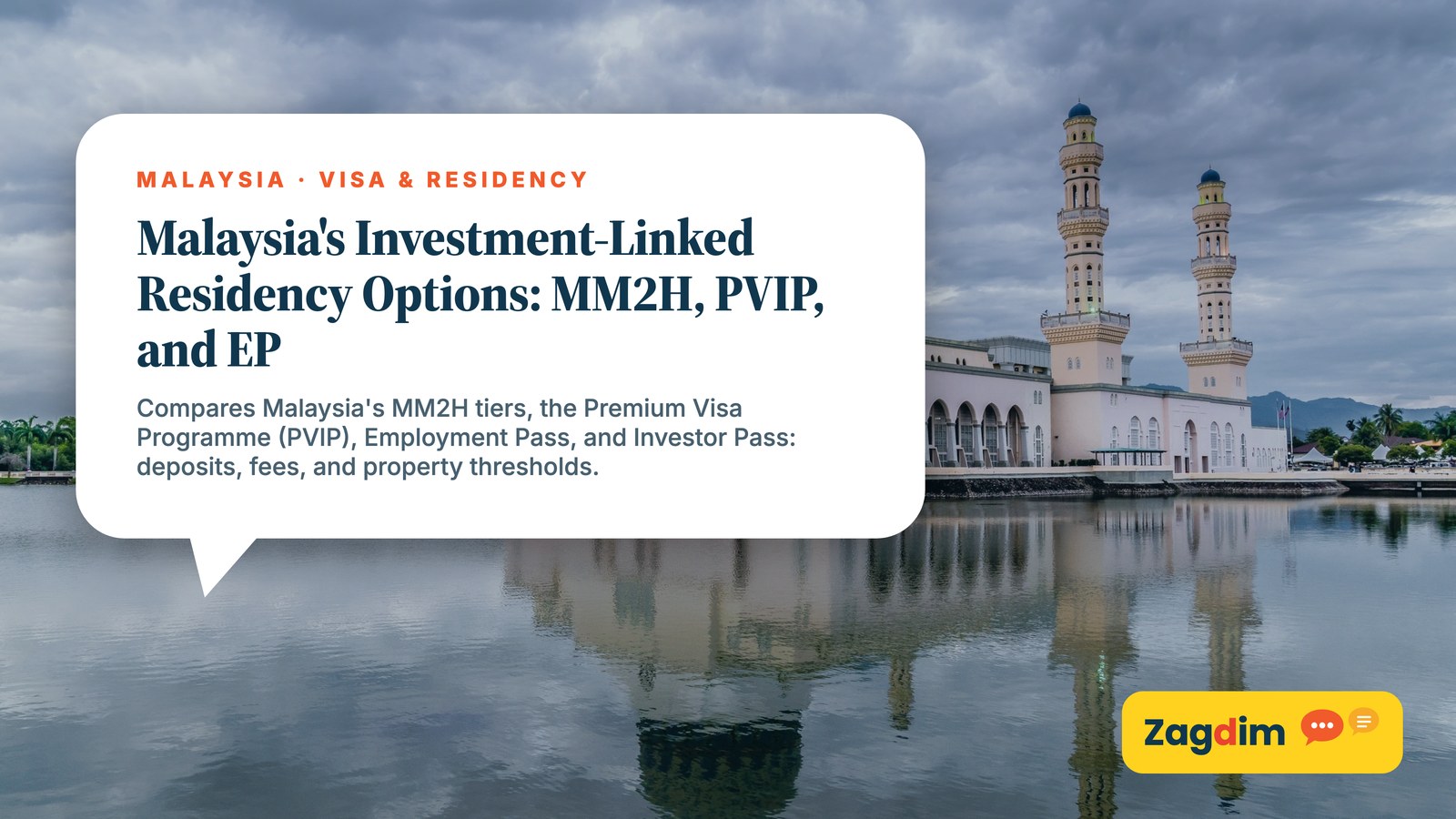
Anyone with capital to commit toward a long stay in Malaysia is likely to come across MM2H (Malaysia My Second Home) and the Premium Visa Programme (PVIP). Anyone planning to actually run a business and work in the country may instead be looking at the Employment Pass (EP).
These programs have different purposes and conditions, and none of them should be lumped together as “paying for status.” None of the arrangements described here is the same as permanent residence or citizenship, and putting money in does not guarantee approval.
Before comparing them, it helps to settle whether the goal is retirement-style residence, keeping family together, or working and running a business. There is no single “best” option that can be picked from the deposit amount alone.
MM2H: Fixed Deposits, Property, and Residency Conditions Belong Together
The current federal MM2H program has three main tiers, Silver, Gold, and Platinum, plus a separate Special Economic Zone / Special Financial Zone (SEZ/SFZ) category. SEZ/SFZ itself sets different deposit requirements by age band, so it should not be read as two more tiers just because a comparison table shows an extra column for it.
| Category | Fixed Deposit | Validity | Residential Property Requirement (Summary) |
|---|---|---|---|
| Silver | USD150,000 | 5 years, renewable | After approval, must buy and hold a residential property worth at least RM600,000 |
| Gold | USD500,000 | 15 years, renewable | After approval, must buy and hold a residential property worth at least RM1,000,000 |
| Platinum | USD1,000,000 | 20 years, renewable | After approval, must buy and hold a residential property worth at least RM2,000,000 |
| SEZ/SFZ | USD65,000 for ages 21 to 49; USD32,000 for age 50 and above | 10 years, renewable | Must buy a qualifying residential property directly from a developer, within a designated zone and under the applicable state policy |
The minimum age for the main applicant is 25 for Silver, Gold, and Platinum, and 21 for SEZ/SFZ. The table lists only the main comparison items; it does not include the participation fee, processing fee, insurance, or the transaction costs of buying property.
Program validity also has to line up with the applicant’s passport and the actual visa issuance arrangements. Anyone who joined an earlier version of MM2H should check their own approval terms and the transition arrangements that apply to them, rather than assuming the current application rules apply retroactively.
Buying Property Is an Obligation Under Some Tiers, Not a Guarantee of Approval
Under the MM2H categories above, buying property is a requirement to be fulfilled after approval, not a precondition that buys approval on its own. So the claim that “property purchase has nothing to do with MM2H” is inaccurate; the more accurate statement is that buying property by itself cannot get someone into MM2H.
The residential property is also subject to a 10-year resale restriction, though the terms allow upgrading to a higher-value property within that period. SEZ/SFZ is not a matter of picking any property in the zone either; applicants need to confirm the designated area, the counterparty (a developer), and the minimum price before proceeding.
The proportion of the fixed deposit that can later be withdrawn, what it can be used for, and when, also needs to be confirmed up front. A sum that may become withdrawable at some future point should not be treated as money already available to cover a full down payment today.
PVIP: A Separate Long-Term Residency Route With Its Own Costs
PVIP’s official terms include long-term residence for up to 20 years, with permission to work, run a business, or study, and an exemption from minimum stay requirements. It has its own financial proof requirements, fixed deposit, participation fee, and an appointed-agent system.
For example, the deposit requirement is RM1,000,000, and the participation fee for the main applicant is RM200,000. These are different in nature and should not be confused: the participation fee is not a deposit that can be recovered later. Income or other financial qualifications, dependent fees, and visa fees all need to be worked out together as well.
PVIP is not another tier of MM2H. The two programs’ work rights, fees, and withdrawal rules should not be applied to each other.
Company and Employment Pass: For Those With Real Work Plans in Place
A company that meets the employment conditions can apply for an Employment Pass on behalf of qualified foreign personnel, including a foreign shareholder or director who actually works at the company. Approval takes into account the company, its industry, the position, the salary, and the individual’s own qualifications; simply putting capital into a company does not complete the process.
The Employment Pass has a limited validity period and is tied to an approved employer, and the company itself has to keep meeting its ongoing operating and filing obligations. Anyone setting up a company with no real business purpose, purely to hold a status, should work out the ongoing cost of doing so first.
Separately, there is a visa called the Investor Pass, intended mainly to let qualified business visitors or investors enter Malaysia to handle business matters. It allows a stay of six months, extendable by another six months if the requirements are met. It should not be confused with multi-year long-term residence or permanent residence.
Commonly Misunderstood Scenarios
“MM2H is just putting money in a fixed deposit, with no other costs.”
There are also property, fees, insurance, and applicable stay requirements. Any comparison needs to look at the complete financial package, not the deposit alone.
“If the name of the pass includes ‘Investor,’ that means permanent residence.”
A name does not determine legal status. What matters is the actual validity period, the scope of permitted activity, and the renewal conditions.
“Buying a specific project guarantees long-stay status.”
A suitable property can only satisfy the purchase requirement attached to a program; it cannot substitute for an applicant’s own qualifications or for government approval.
What to Check Next
Start by writing down the purpose of the stay, whether work is involved, the family members involved, and how many days a year are actually available to stay in Malaysia. Then compare the deposit, fees, property requirement, and ongoing costs across options. The federal MM2H program and the related programs run by Sabah and Sarawak also need to be checked separately, since they are not the same scheme.
Frequently Asked Questions
Can buying a property get me long-term residence directly?
No, not automatically. But under the current federal MM2H categories, buying property is a requirement that has to be fulfilled after approval, not before.
SEZ/SFZ has a lower fixed deposit. Does that mean it is the cheapest option overall?
Not necessarily. The deposit is only one part of the cost; the designated property, fees, and the cost of holding everything over time also need to be added in.
Do MM2H, PVIP, or an Employment Pass automatically convert into permanent residence?
No. Permanent residence is a separate application system, and approval cannot be assumed from the amount of money involved or how long a pass has been held.
Disclaimer
This article is based on official information available as of October 8, 2026. It is not a complete list of every residency route, and it is not immigration, legal, or investment advice. Full eligibility, regional restrictions, and the actual approval documents for each program still need to be checked separately.
Sources
MOTAC — MM2H Category Overview; MOTAC — MM2H Guidelines; MOTAC — Compulsory Residential Purchase; MOTAC — SEZ/SFZ Terms and Regulations; Immigration Department — PVIP FAQ; ESD — Employment Pass; ESD — Investor Pass FAQ; Immigration Department — Entry Permit
Have a question about this guide? Leave a comment below, or ask Zagdim directly.
Your first stop for international property and global living.
Research and insights. Know what’s changing. Understand what matters.