
































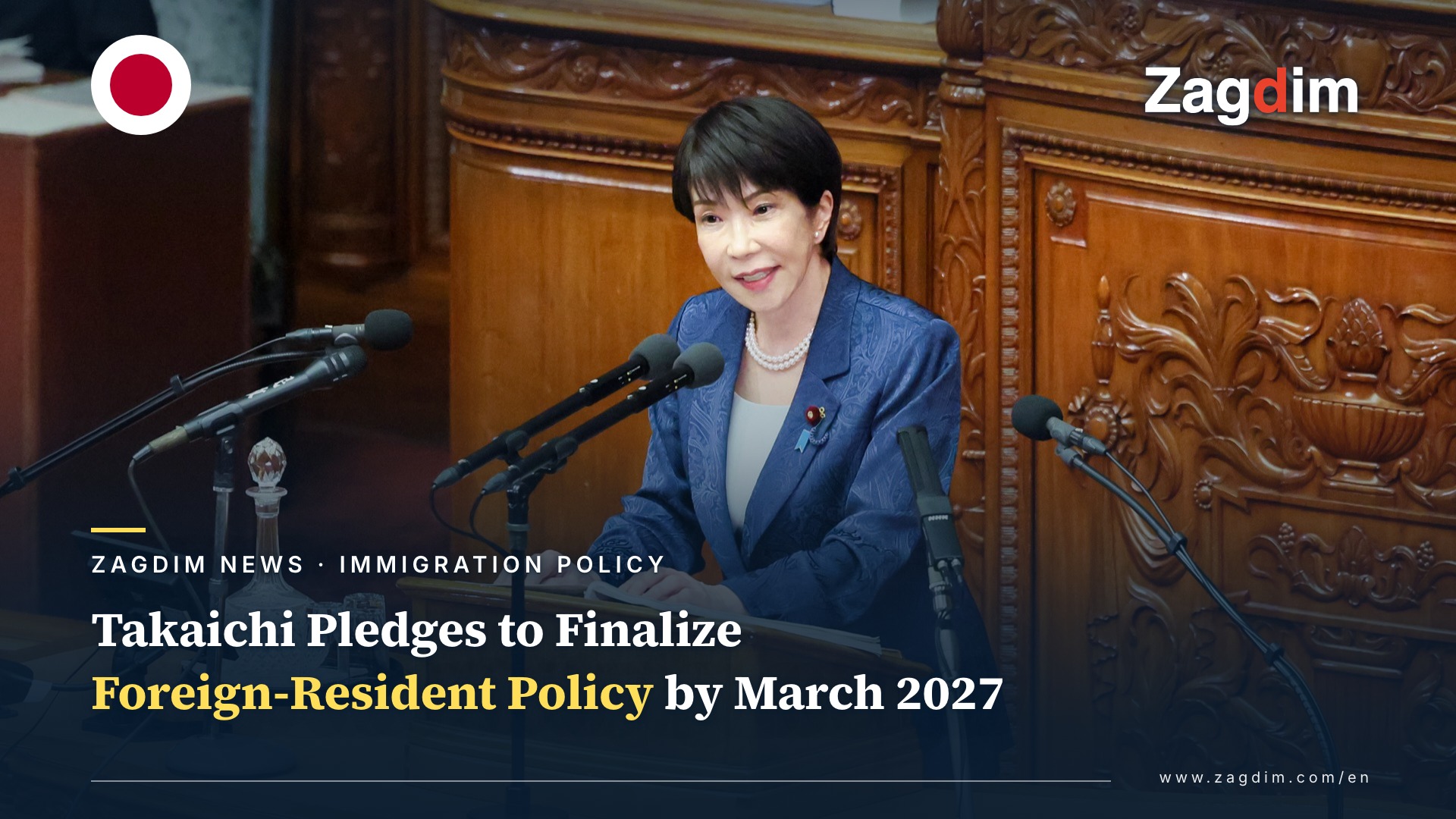
Prime Minister Sanae Takaichi has pledged to finalize Japan’s basic policy on accepting foreign residents by the end of the current fiscal year in March 2027, while the government continues to weigh whether to introduce a cap on immigration. During questioning in the Diet’s Upper House on Friday, Takaichi said the government would “present future simulations of population trends and a comprehensive picture of measures to address them.” The policy will be considered alongside a separate, broader population strategy the government plans to adopt by the end of 2026, built on the assumption that efforts to reverse Japan’s declining birth rate fail.
The pledge matters most for foreign residents and visa holders already in Japan, and for anyone weighing a move there: it signals that numerical limits on immigration — which do not currently exist at an overall level — are now an active policy question rather than a fringe one. Sanseito party leader Sohei Kamiya pressed Takaichi during the same session to introduce hard caps on the annual net inflow of foreign nationals, the total foreign-resident count, and their share of the population. Japan has no legislation capping its overall foreign population today, though numerical ceilings already apply to specific programs — most notably the Specified Skilled Worker (SSW) visa, which sets five-year, sector-by-sector intake limits. New admissions in the SSW restaurant category were suspended in April 2026 after reaching their 50,000-worker ceiling.
The push for caps has gained political momentum over the past year. Sanseito made large gains in last summer’s Upper House election after campaigning on a “Japanese First” platform. The Japan Innovation Party (JIP), the Liberal Democratic Party’s junior coalition partner, proposed an immigration cap to the justice ministry in September to avoid what it called a “Europe-type” scenario; the issue was folded into the LDP–JIP coalition agreement, though softened to the phrase “quantitative management.” A Jiji Press poll in August found support for accepting more foreign workers had fallen below 60%, with more than a third of respondents actively opposed. The same month, a government working group met for the first time to study foreign-population projections and their effects on the economy, social security and local communities; options it is weighing include population-based limits and extending numerical caps to more residence statuses. Japan’s own numbers underline the stakes: the internal affairs ministry reported in January that the number of Japanese nationals had fallen below 120 million for the first time in 42 years, and the National Institute of Population and Social Security Research projected in 2023 that total population could shrink to roughly 87 million by 2070, with foreign nationals making up more than 10% of that figure — a threshold a 2025 Justice Ministry report said could be reached “much sooner.” About 4.13 million foreign nationals, or 3.47% of Japan’s population, were living in the country at the end of 2025, per the government’s 2025 census.
While the broader cap question is still under study, narrower quota moves are already in motion under the existing SSW program. Nikkei Asia reports that Japan’s Immigration Services Agency and other ministries are coordinating a plan to reclassify some SSW sub-categories so hiring can continue in strained sectors without raising the program’s overall ceiling. One proposal would move catering operations at medical and welfare facilities out of the capped “restaurant” category into the “food and beverage manufacturing” category (cap: 133,500), potentially letting such facilities resume hiring from April 2027 — though Shohei Sugita, a lawyer who advises on foreign employment, estimates the food-and-beverage quota itself will fill by August 2028. A second proposal would shift 20,000 nursing-care positions into the SSW program from the incoming Employment for Skill Development program, expanding the SSW nursing-care quota by about 15% and delaying an expected suspension — while cutting nursing-care slots under the replacement program by roughly 60%. An expert panel is due to discuss the reclassification plan around mid-October, with the government targeting cabinet approval by the end of 2026. Tokai University labor-migration professor Masao Manjome cautioned that reallocating quotas between sectors, rather than adjusting the overall cap, “hollows out the original purpose of the system.”
References
The Japan Times – Takaichi to finalize Japan’s foreign resident policy by March / Nikkei Asia – Japan’s foreign worker system strains as officials eye quota shifts