
































Pattaya’s Motorbike Taxi Drivers Switch to Blue Vests From 16 October 2026: Check for a Yellow Plate, and the First 2 km Costs No More Than 25 Baht
A motorbike taxi in Thailand may charge no more than 25 baht for the first 2 km under a 2016 Ministry of Transport regulation, and a legal ride must be registered as a public motorcycle with a yellow number plate, with the driver, vest, ID card and plate details all matching.
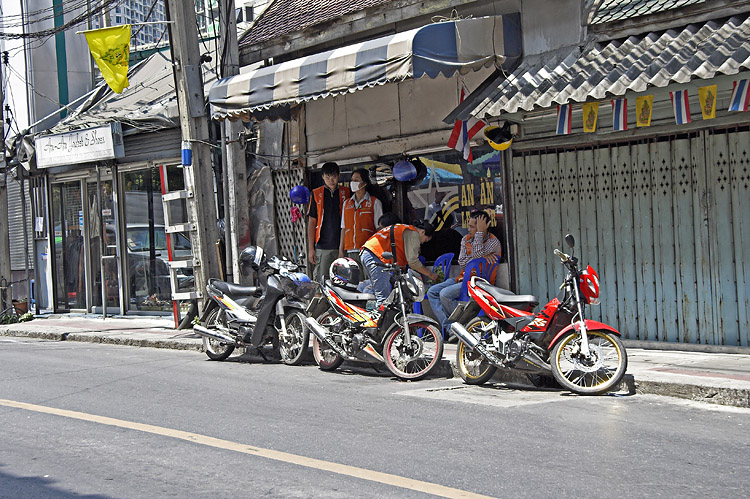
On the afternoon of 16 October 2026, Bang Lamung District in Chonburi Province, the district that includes Pattaya City, held a launch event at the Alcazar theatre in Pattaya: motorbike taxi drivers across the district are switching from the orange vests used for years to blue ones, and about 500 drivers in the new vests paraded along Pattaya 2nd Road. Thairath, Bangkok Biz News, The Pattaya News and Naewna reported the change on 16 and 17 October, and Thairath’s Facebook post on 17 October drew more than 500 comments. According to these reports, the colour change was approved at a meeting of the Chonburi provincial sub-committee for Bang Lamung District on 20 November 2025; the district has 5,281 registered drivers and more than 500 stands.
Pattaya has changed the colour of the vest, but the rules on whether a ride is legal and how much it may cost apply nationwide. This guide first explains how to spot a legal motorbike taxi in Thailand, then sets out the fare caps, the difference from app-based rides such as Grab and Bolt, helmets and insurance, and where to turn if you are overcharged or have an accident.
Key Points
- Who should pay attention: travellers heading to Thailand who want to hop on the back of a bike in Bangkok or Pattaya; foreign residents who rely on the motorbike taxi stand at the end of their soi every day; anyone planning how family or friends will get around in Thailand.
- A legal ride carries a yellow number plate, and the driver wears a stand vest and carries a photo ID card; the vest number, ID card and plate must match. Carrying paying passengers on a privately registered motorbike is illegal.
- Fares are capped nationwide: no more than 25 baht for the first 2 km, up to 5 baht more per km from 2 to 5 km, no more than 10 baht per km counted from the first km once a trip exceeds 5 km, and fares agreed in advance beyond 15 km.
- Overcharging, dangerous riding or illegal rides can be reported to the Department of Land Transport’s 24-hour 1584 hotline. Passengers must wear a helmet too, with a fine of up to 2,000 baht.
How to Spot a Legal Motorbike Taxi: Plate, Vest and Driver ID
Thailand’s Department of Land Transport (DLT, กรมการขนส่งทางบก) states in its public guidance that a motorbike taxi must be registered as a public motorcycle, and that the plate, driver, vest, ID card and registration details must be correct and consistent. All five conditions below come from that DLT guidance:
| What to check | What a legal ride looks like |
|---|---|
| Number plate | Registered as a public motorcycle with a yellow plate; private motorbikes may not carry paying passengers |
| Vest | The number on the stand vest matches the driver’s ID card, which is displayed on the vest |
| Driver ID card | Shows a photo and name that match the rider and the plate |
| Driver eligibility | At least 20 years old, holds a public motorcycle driving licence, has passed a police criminal record check and is on the register |
| Vehicle | Total engine capacity no more than 125cc |
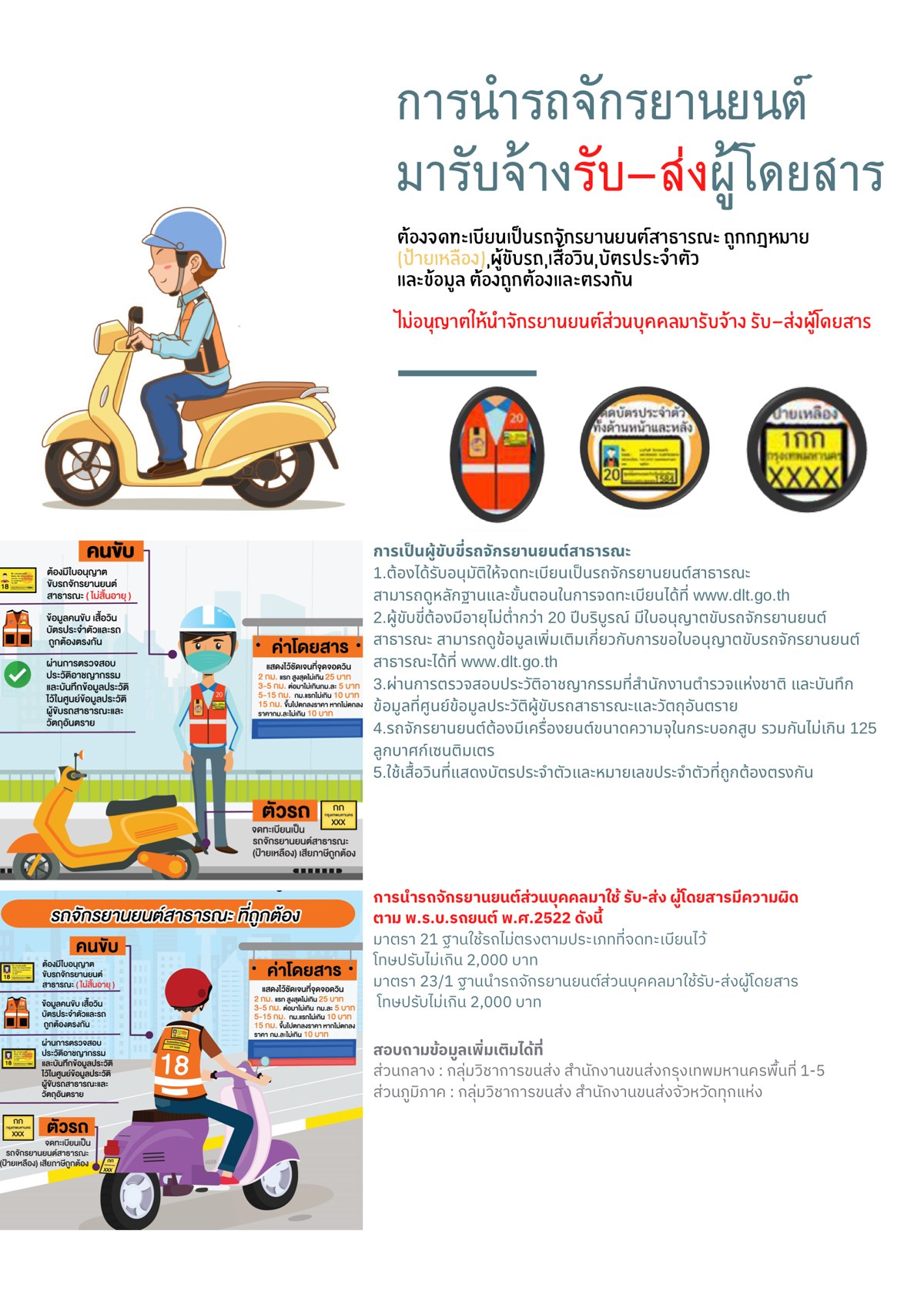
Before you get on, take a few seconds to check three things: is the plate yellow, do the vest number and ID card belong to the same person, and does the plate on the ID card match the bike in front of you. Under Sections 21 and 23/1 of the Motor Vehicle Act B.E. 2522, using a private motorbike to carry paying passengers can each be fined up to 2,000 baht, and it is the driver who is fined.
Motorbike Taxi Fare Caps in Thailand: 25 Baht for the First 2 km, Agree the Price Beyond 15 km
Motorbike taxi fare caps in Thailand are set by a Ministry of Transport regulation on public motorcycle passenger fares, published in the Royal Gazette on 24 March 2016. It applies nationwide, and the fares must be clearly displayed at each stand. The four tiers below follow that regulation and match the fare table in the DLT guidance:
| Distance | Cap |
|---|---|
| Up to 2 km | No more than 25 baht |
| Over 2 km up to 5 km | No more than 5 baht per km for the distance beyond 2 km |
| Over 5 km up to 15 km | No more than 10 baht per km, counted from the first km |
| Over 15 km | Agreed between driver and passenger before the trip; if not agreed, no more than 10 baht per km |
Note how the third tier works: once a trip exceeds 5 km, the whole trip is capped at 10 baht per km, not just the distance beyond 5 km. For common distances, the caps work out roughly as follows (calculated by Zagdim from the table above; the fares posted at the stand apply in practice):
| Trip distance | Cap under the regulation |
|---|---|
| 1 km | 25 baht |
| 3 km | 30 baht |
| 5 km | 40 baht |
| 8 km | 80 baht |
| 12 km | 120 baht |
These are caps, not fixed fares. What a stand actually charges is set out on its posted fare list, so check the list or ask the price to your destination before you set off; for trips over 15 km, agree the price before you get on.
Pattaya’s Motorbike Taxi Drivers Switch to Blue Vests: What the New Vest Shows
According to Bangkok Biz News and Thairath on 16 and 17 October 2026, the new blue vests in Bang Lamung District show the driver’s queue number, stand name and operating area on the front and back, with a clear pocket on the chest holding the driver’s ID card, which carries a photo, name and plate number. Local officials said one aim of the change is to distinguish locally registered drivers from drivers coming in from elsewhere, especially during festivals. The district chief also stressed that drivers can buy or have the vest made at any shop, as long as it meets the specification.
A few points the reports leave open:
- No deadline for replacing the old orange vests has been reported, and the switch is happening gradually, so you may still see legal drivers in orange vests in Pattaya for a while.
- No new fares were announced, so Pattaya remains under the nationwide caps above.
- Reports give two figures for the number of stands, 564 and 554, and the province’s original notice has not been published, so this guide says more than 500.
In other words, a blue vest is a new clue in Pattaya, but a yellow plate and a vest number and ID card that match remain the core test of a legal ride.
Motorbike Taxi Stands vs Grab and Bolt Bike Rides
In Bangkok and other cities, you can book a motorbike through an app as well as at a stand. In guidance reported by Thairath on 7 November 2025, the DLT’s director-general said motorbikes carrying passengers through apps must also be yellow-plate public motorcycles, and drivers must wear the platform’s vest or jacket while working; at that time the DLT had certified nine ride-hailing apps, including Grab, Bolt, inDrive, LINE MAN, Maxim, Lalamove, AirAsia, TADA and Fingogo.
The practical differences:
- How the fare is set: stand drivers charge within the regulated caps and the stand’s posted fares; app rides show a price when you book. We found no official standard for app fares, so no figures are given here.
- Where to complain: for app trips, you can report problems through the app’s customer support first; for both stand and app rides, illegal rides and dangerous riding can be reported to 1584.
- How to check: the app shows the driver’s name, photo and plate, so check the plate before getting on. If the bike that arrives has a white private plate, it is not a legal passenger vehicle according to the DLT.
Helmets and Insurance on a Motorbike Taxi: What Visitors and Residents Should Know
Passengers must wear a helmet too
Section 122 of Thailand’s Land Traffic Act requires both motorbike riders and passengers to wear a helmet. According to a government summary of the Land Traffic Act (No. 13) amendments of 2022, the maximum fine for not wearing a helmet rose from 500 baht to 2,000 baht, with one demerit point. Media reported that Thai police stepped up enforcement nationwide from 1 June 2025. When the driver hands you a helmet, put it on and fasten the strap; if the driver has none, you can choose another ride.
What compulsory insurance covers for passengers
Every registered vehicle in Thailand must carry compulsory insurance under the Protection for Motor Vehicle Accident Victims Act (known in Thai as พ.ร.บ.), and injured passengers are covered. According to the compulsory insurance policy form published by Thailand’s Office of Insurance Commission (OIC, คปภ.) in 2025, compensation has two layers:
| Item | Initial payment, without waiting for fault to be determined | Maximum once liability is established (including the initial payment) |
|---|---|---|
| Medical costs for injury | Actual costs up to 30,000 baht | Up to 80,000 baht |
| Loss of a body part or permanent disability | 35,000 baht | 200,000 to 500,000 baht depending on policy conditions |
| Death | 35,000 baht | 500,000 baht |
Initial payments are capped at 65,000 baht per person in total. These amounts come from the OIC’s 2025 compulsory insurance policy form; claims questions can go to the OIC hotline 1186 (as reported in the media).
Short-term visitors: check your travel insurance first
The medical limit under compulsory insurance is modest. Before travelling, check whether your travel insurance covers accidents and medical costs while riding as a motorbike passenger; policy wording varies between insurers, so ask your insurer directly if in doubt.
Long-term residents: daily riders should keep records
If you live in Thailand and ride to work this way every day, you ride more often and are more likely to run into problems. Note the name of the stand you use and the vest numbers of drivers you ride with, and check whether your medical insurance in Thailand covers traffic accidents.
Overcharged or in an Accident? Where to Report a Motorbike Taxi Problem
The 1584 hotline below is from the DLT; 1155, 1669 and 191 come from the list of useful numbers for visitors on the Thai government portal Thailand.go.th:
| Situation | Who to contact |
|---|---|
| Fare above the cap, rude driver, private-plate bike carrying passengers | DLT hotline 1584 (24 hours) or LINE @1584dlt |
| Visitors needing help in English | Tourist Police 1155 |
| Someone is injured and needs an ambulance | 1669 |
| Police | 191 |
When reporting, the DLT advises giving the plate number or a photo in which the plate is clearly visible. Noting the vest number and stand name makes any follow-up much faster.
Common Misconceptions About Motorbike Taxis in Thailand
- Misconception: anyone in a vest is a legal driver. The vest is only one element; a yellow plate and a vest number that matches the ID card matter just as much. Tip: check all three, and choose another ride if anything does not match.
- Misconception: only blue vests are legal in Pattaya. No replacement deadline has been reported and the switch is gradual. Tip: if you see an orange vest in Pattaya, check the plate and ID card rather than refusing outright.
- Misconception: beyond 5 km, only the extra distance is charged at 10 baht per km. The regulation caps the whole trip at 10 baht per km from the first km once it exceeds 5 km. Tip: ask the price before longer trips.
- Misconception: foreign passengers are not fined for riding without a helmet. Section 122 covers both riders and passengers, with a fine of up to 2,000 baht. Tip: put the helmet on and fasten the strap as soon as you get on.
- Misconception: a bike booked through an app is always legal. The DLT requires app motorbikes to have yellow plates too. Tip: if a white-plate bike arrives, you can cancel the trip and report it to the platform.
Motorbike Taxi in Thailand: Example Scenarios
Scenario 1: a first-time visitor to Pattaya riding from a hotel to Beach Road. The driver at the stand wears a blue vest, and the fare list is posted at the stand. Under the regulation, a 3 km trip is capped at 30 baht. Before getting on, check that the plate is yellow and that the vest number matches the ID card, and wear the helmet the driver hands over. If the driver asks for clearly more than the posted fare, take another bike, or note the number and call 1584.
Scenario 2: a foreign resident in Bangkok who rides from the end of the soi to the train station every day. A regular 1 to 2 km trip costs no more than 25 baht. For regular use, note the stand name and the vest numbers of familiar drivers, and check whether your medical insurance in Thailand covers traffic accidents; if something happens, call 1669 for an ambulance first, then claim the initial payment under compulsory insurance.
Scenario 3: a traveller in a hurry late at night, approached by a rider on a white-plate motorbike. According to the DLT, carrying paying passengers on a private motorbike is itself illegal, which also complicates cover and accountability if something goes wrong. The safer choice is to walk to a junction with a stand and find a yellow-plate bike, or book through a DLT-certified app and check the plate.
Motorbike Taxi in Thailand: Frequently Asked Questions
How much does a motorbike taxi cost in Thailand?
Under the 2016 Ministry of Transport regulation, a trip of up to 2 km costs no more than 25 baht; from 2 to 5 km, each extra km adds no more than 5 baht, so 5 km is capped at 40 baht; from 5 to 15 km, the cap is 10 baht per km from the first km; beyond 15 km, the price is agreed before the trip. These are nationwide caps, and the fares posted at the stand apply in practice.
How can I tell if a motorbike taxi is legal?
Check three things: a yellow plate, a driver wearing a stand vest with a photo ID card, and a vest number, ID card and plate that match. The DLT does not allow private motorbikes to carry paying passengers, and offenders can be fined up to 2,000 baht under the Motor Vehicle Act. Bang Lamung District, which includes Pattaya, switched to blue vests in October 2026, but the plate and ID remain the core test.
Can I still take a motorbike taxi in Pattaya with an orange vest?
Check the plate and ID card first. 16 October 2026 was the launch date, no deadline for replacing the old vests has been reported, and the switch is gradual. The new blue vests show the queue number, stand name and operating area, with the driver’s ID card on the chest. No new fares were announced, so the nationwide caps still apply.
Where do I report being overcharged by a motorbike taxi?
Call the DLT’s 1584 hotline, which operates 24 hours, or contact the DLT’s LINE account @1584dlt. The plate number is the most useful detail, and a photo showing the plate clearly is even better; add the vest number, stand name, time and place. Visitors who need help in English can also call the Tourist Police on 1155.
Who pays medical costs if I am hurt on a motorbike taxi?
Every registered vehicle carries compulsory insurance, so an injured passenger can claim an initial payment without waiting for fault to be determined, covering actual medical costs up to 30,000 baht. Once liability is established, the caps are 80,000 baht for medical costs and 500,000 baht for death. These limits may not be enough, so visitors and residents should check their own travel or medical insurance.
How is a Grab or Bolt bike different from a motorbike taxi at a stand?
An app shows the price when you book, while stand drivers charge within the regulated caps and the stand’s posted fares. The DLT requires motorbikes carrying passengers through apps to be yellow-plate public motorcycles, with drivers wearing the platform’s vest or jacket. Check the plate shown in the app before getting on, and contact app support or call 1584 if something goes wrong.
Planning Life in Thailand? Ask Zagdim
If you want to understand transport, insurance and everyday arrangements for living in Thailand, Ask Zagdim.
Life abroad? Ask Zagdim.
Your first stop for international property and global living.
Research and insights. Know what’s changing. Understand what matters.
Newsletter for overseas updatesSubscribe →
Important Disclaimer
This article is general information and does not constitute legal, insurance or financial advice, nor does it represent the position of any government body or transport operator. Fare caps and the conditions for legal rides are based on the 2016 Ministry of Transport regulation and DLT guidance; helmet fines are based on a government summary of the 2022 Land Traffic Act (No. 13) amendments; compulsory insurance amounts are based on the policy form published by Thailand’s Office of Insurance Commission in 2025. Details of Pattaya’s vest change are based on Thai media reports from 16 and 17 October 2026, and the province’s original notice has not been published. Please follow the latest notices from the Department of Land Transport, the Royal Thai Police and local authorities.
Information is current as of 17 October 2026; please check the latest official notices from Thailand’s Department of Land Transport and other relevant authorities.
References
Department of Land Transport – การนำรถจักรยานยนต์มารับจ้างรับ-ส่งผู้โดยสาร (guidance on motorbike taxis) / Royal Gazette – Ministerial Regulation on Fares for Public Motorcycles B.E. 2559 (2016) / Department of Land Transport – Public Transport Protection Centre (1584) / Office of Insurance Commission – Registrar’s Order on the Compulsory Insurance Policy Form (2025) / Thai Government – Summary of the Land Traffic Act (No. 13) B.E. 2565 (2022) / Thailand.go.th – Important phone numbers during your stay in Thailand / Thairath – Pattaya and Bang Lamung riders switch to blue vests (17 October 2026) / Bangkok Biz News – Bang Lamung motorbike taxi vests change from orange to blue (17 October 2026) / Naewna – Bang Lamung drivers change vest colour (17 October 2026) / Thairath – DLT urges use of certified ride-hailing apps (7 November 2025) / Mango Zero – อัตราค่าบริการมอเตอร์ไซค์รับจ้าง (motorbike taxi fares) / Pattaya Mail – Pattaya police enforce hefty fines for helmet violations