




























Child Benefit in Germany Is €259 a Month and Already in Force; the €10 Early Start Pension Still Awaits the Bundesrat
According to the Kindergeld leaflet of the Familienkasse, the child benefit office of Germany’s Federal Employment Agency (July 2026 edition), child benefit in Germany (Kindergeld) is €259 a month for each eligible child from 1 January 2026, and whether a foreign family qualifies depends on the claiming parent’s residence status, not on the child’s nationality.
On 16 October 2026, the German Bundestag passed the Early Start Pension Act (Frühstartrente). Under the bill, the state is due, from 1 January 2027, to pay €10 a month into a retirement investment account in the child’s name for each child aged 6 to under 18 whose first residence is registered in Germany. The Christian Democrats and Christian Social Union (CDU/CSU) and the Social Democrats (SPD) voted in favour, the Greens and the Left voted against, and the Alternative for Germany (AfD) abstained. The law still needs the approval of the Bundesrat, the chamber of the federal states, before it can take effect.
The two payments are often discussed together, but the rules differ: child benefit is the system already in force and turns on the claiming parent’s residence status, while the early start pension is a new law not yet in force and, under the bill, turns on the child’s own residence registration. This article was written on 19 October 2026. Items marked “in force” are current rules; items marked “pending” are the bill’s contents and may change.
Key Points
- Who should pay attention: foreign families living in Germany or planning to move there with children; parents holding an EU Blue Card, permanent residence or another work-based permit; parents on student or job-seeker permits who want to know whether they qualify; families whose children were born or already go to school in Germany.
- In force: child benefit is €259 a month per child in 2026 and turns on the parent’s residence status. The rules for citizens of the EU, the European Economic Area (EEA) and Switzerland differ from those for citizens of other countries.
- Pending: the early start pension is €10 a month and turns on the child’s first residence and tax identification number. The bill sets no nationality or residence-permit condition. Children born in 2019 or earlier get no state money.
- Watch first: the early start pension is not yet in force, and the list of providers and the date accounts open have not been published. If a child leaves Germany, child benefit and the early start pension are treated differently.
In Force Versus Pending: Child Benefit in Germany and the Early Start Pension Side by Side
In the table below, the child benefit column draws on the Familienkasse leaflet (July 2026 edition) and Section 62 of the Income Tax Act (EStG). The early start pension column draws on the federal government’s bill (Bundestag document 21/7864), the Finance Committee’s amended version (21/8606) and the Federal Pension Insurance’s press release of 13 August 2026.
| Item | Child benefit (Kindergeld) | Early start pension (Frühstartrente) |
|---|---|---|
| Legal status | In force, current system | Pending: passed the Bundestag on 16 October 2026, awaiting the Bundesrat |
| Amount | €259 a month per child (from 1 January 2026) | €10 a month, paid by the state into an account in the child’s name (bill) |
| Age | Normally up to 18; can run to 21 or 25 in qualifying cases | From the 6th birthday to under 18; first group is children born in 2020 |
| Whose status counts | The claiming parent’s residence status; the child’s nationality does not matter | Whether the child’s own first residence is registered in Germany; where the parents live is irrelevant |
| Tax ID | The claimant needs a German tax identification number | The child needs a German tax identification number |
| How the money reaches you | Paid monthly by the Familienkasse to the claimant | Paid into the child’s retirement account; in principle not payable before age 65 |
| Expected start | In force | 1 January 2027; children born in 2020 are backdated to 1 January 2026 |
The “pending” column reflects the bill as worded on 19 October 2026. If the Bundesrat does not approve, the bill cannot take effect as worded; if it does, the start date and details still depend on the final text published in the Federal Law Gazette.
Child Benefit in Germany for Foreign Families Depends on the Parent’s Residence Status
Child benefit in Germany has two common conditions: the claimant has a home or habitual residence in Germany and has a German tax identification number (Identifikationsnummer). The child’s nationality does not affect the claim, but the child must live in Germany, another EU or EEA country, or Switzerland.
The table below is based on Section 62 of the Income Tax Act and the Familienkasse leaflet, and lists only the claiming parent’s status:
| Parent’s status | Can they claim? | What to watch |
|---|---|---|
| Citizen of an EU or EEA country, or Switzerland | Yes, once a home is established in Germany | No entitlement for the first three months (unless the person shows German-source income); from the fourth month the EU free movement residence conditions must be met, and the Familienkasse runs its own check |
| Citizen of another country with a settlement permit (Niederlassungserlaubnis) or EU long-term residence permit (Daueraufenthalt-EU) | Yes | Attach a copy of the permit |
| Citizen of another country with an EU Blue Card, an intra-corporate transferee (ICT) card, or a permit that allows work for at least six months | Yes | Not if the permit was issued for a purpose in the next row |
| Citizen of another country with a permit for training, au pair work, seasonal work, voluntary service, job search or recognition of qualifications | In principle no | Study, job-search and recognition permits are excluded only if the holder is not working, not on parental leave and not receiving employment-promotion benefits; where the holder works, the case needs separate assessment |
| Citizens of Turkey, Morocco, Tunisia, Algeria, Serbia, Bosnia and Herzegovina, Kosovo or Montenegro | May qualify while working in Germany | Based on agreements between those countries and Germany; confirm with the Familienkasse |
| Recognised refugees and asylum holders | Yes, once the recognition is final | The leaflet says finally recognised refugees and asylum holders can claim; humanitarian permits carry separate conditions |
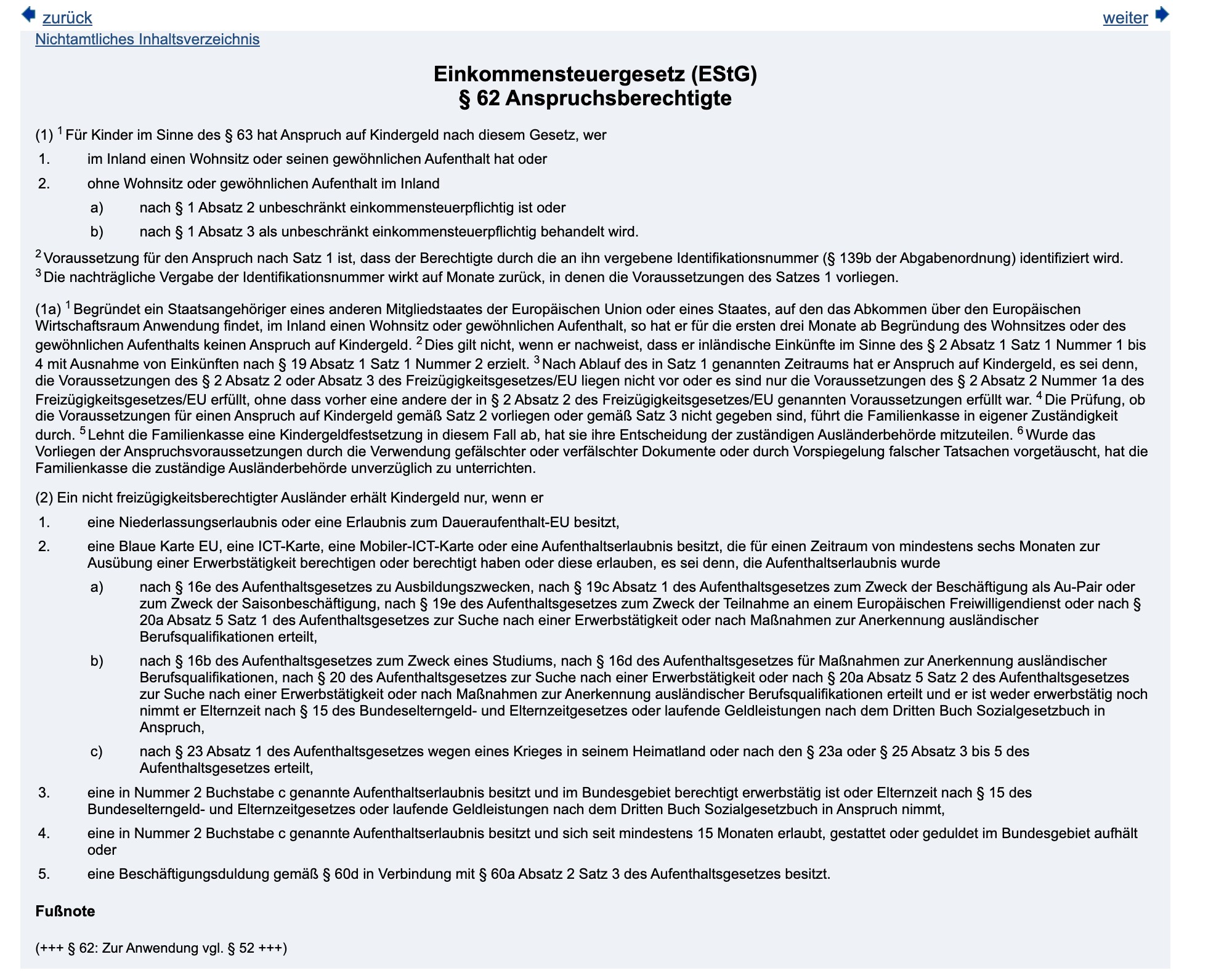
For citizens of other countries, the leaflet names only the settlement permit; for the rest it says certain other permits may also give entitlement and to ask the Familienkasse. A parent holding another permit therefore needs the Familienkasse to decide the individual case. Zagdim also has a comparison of how long it takes Blue Card holders to reach permanent residence.
How to Apply for Child Benefit in Germany and How Far Back It Is Paid
- Apply to the Familienkasse. The Federal Employment Agency’s online account includes a Familienkassen-Profil, through which applications and questions can be handled online.
- Both the claimant and the child need a tax identification number; the Familienkasse asks the claimant for it and looks it up itself if it is missing.
- Child benefit can be paid retroactively, but only for the last six calendar months before the application reaches the Familienkasse, so do not delay once you qualify.
- After the child turns 18, payment continues only in certain cases: up to 21 for a child who is not employed and is registered as job-seeking; up to 25 for a child in training or study; with no age limit for a child with a disability who cannot support themselves.
The Early Start Pension Turns on the Child’s Residence: Children Born in 2019 or Earlier Get No State Money (Pending)
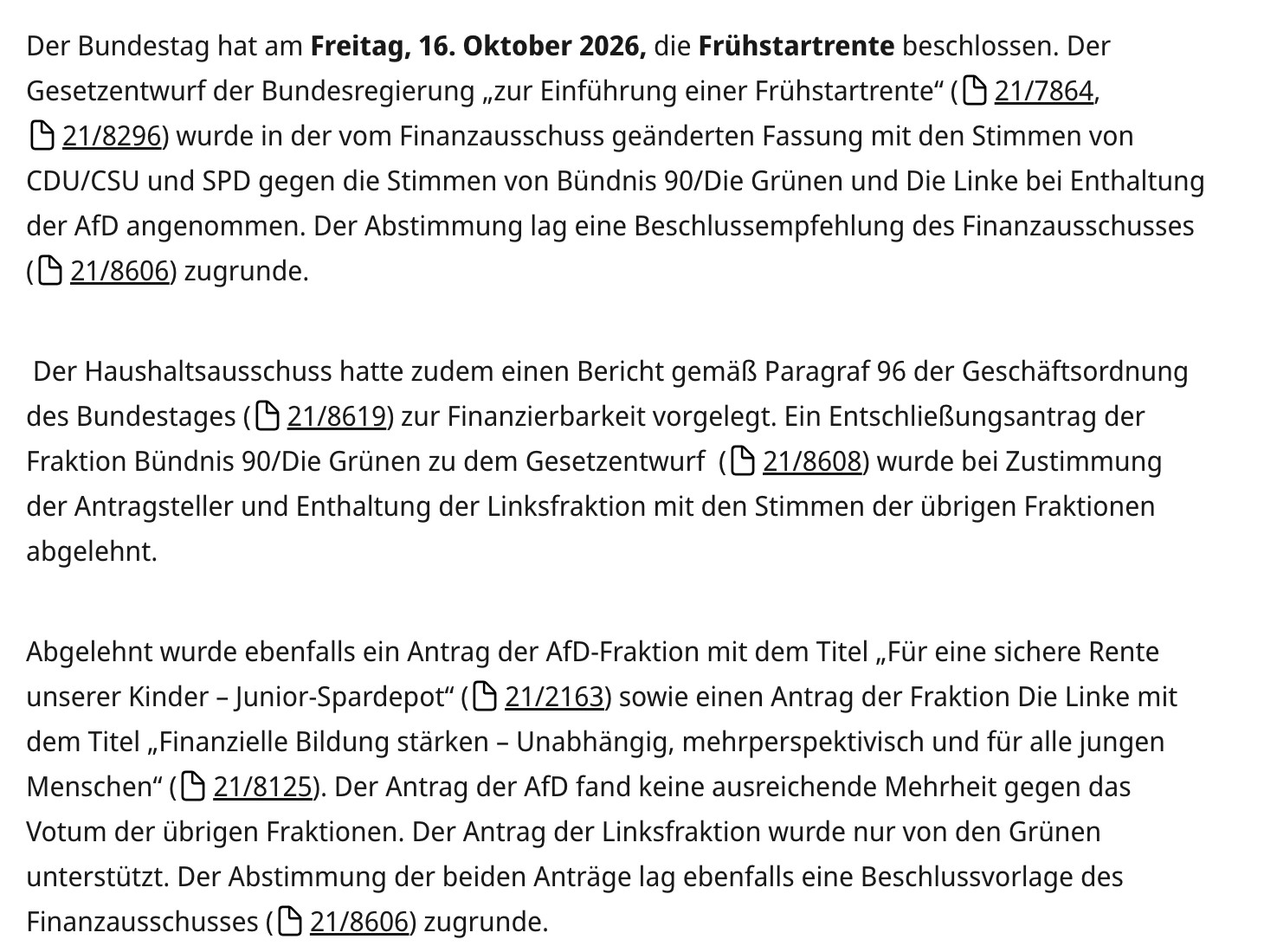
Everything below is the bill’s content and is pending. Section 1 of the bill (Bundestag document 21/7864) says that children aged 6 to under 18 whose first residence is registered in Germany are eligible, and they also need a tax identification number. The Finance Committee’s amended version of 14 October 2026 leaves this section unchanged.
Which Children Qualify
- Age and birth year: from the 6th birthday to under 18. The first group is children who turn 6 in 2026, meaning those born in 2020; each later year adds the group turning 6 that year, so a child born in 2022 would be added in 2028.
- Residence: the child’s own registration counts, and only the first residence. The bill’s explanatory notes state that where the parents live does not matter.
- Nationality: the bill’s text sets no nationality or residence-permit condition, so a foreign child whose first residence is registered in Germany and who has a tax identification number qualifies on the wording. There is no separate official explanation for foreign children yet, so how it works in practice depends on implementing rules.
- Children aged 7 and over: for children born in 2019 or earlier the state pays nothing, but parents can still open the same kind of retirement account for them without the state payment.
- Arriving after age 6: payment runs from the month in which the conditions are met (Section 2 of the bill).
The explanatory notes add that the original idea was children who attend school in Germany, but because Germany has no national school register, the bill uses residence registration instead, so the law does not require proof of school attendance.
How the Money Is Saved and When It Can Be Taken Out
- Opening an account: parents open a retirement investment account for the child with an approved provider. It can be signed online without financial advice, and the Bundestag text archive, summarising the bill, also says no advice is required.
- No separate application: the Federal Pension Insurance’s press release of 13 August 2026 says the government’s plan requires no separate application for the subsidy. Under the bill, the provider is treated as authorised to send the application data when the contract is signed, unless the family objects in writing before signing.
- Eligibility check: the central body (set up within the Federal Pension Insurance) automatically retrieves data from the Federal Central Tax Office (BZSt) to check eligibility.
- Fees: while the child is a minor, the state’s contribution may not be charged account-opening or sales fees (Finance Committee version).
- Extra savings: parents, grandparents and others can pay in more, up to €6,840 in total per calendar year.
- If parents do not open an account: the €10 a month still goes into a federal collective investment fund (the “Frühstartrente” special fund), due to be set up on 1 January 2028 and managed by the Deutsche Bundesbank, which under the amended version invests only in “broadly diversified global shares or equity funds”. According to the Bundestag’s news service describing the bill, money in the collective fund lapses if it is not moved into an individual retirement account before the child turns 35, and the Bundesrat has suggested informing the person again before that happens.
- Payout: the state-funded part is in principle not payable before age 65 and cannot be pledged, transferred or seized; the bill keeps the home-ownership uses listed in Section 92a of the Income Tax Act. Returns are tax-free during the saving phase and taxed under the general rules on payout.
- How much is the principal: from age 6 to 18 is 12 years at €10 a month, so the state pays in at most €1,440 (12 years × 12 months × €10, calculated by Zagdim from the bill’s amount). That is principal, not a return. For the collective fund, the bill says there is no claim to a particular return and the state does not compensate losses; an individual account chosen by parents is also invested in capital markets and its value will fluctuate.
What Is Still Undecided
- Bundesrat timing: the Bundesrat’s website says its next plenary session is on 20 November 2026, with the agenda expected on 13 November 2026; as of 19 October 2026 it is not known whether this bill is on that agenda.
- Bundesrat amendments: at first reading the Bundesrat proposed changes (21/8296), including that own contributions to a second account should not get tax relief, which the government has agreed to, and that children in the collective fund should find it easier to move to a publicly run standard account at 18, which the government has promised to examine. Whether the final text includes them will only be known once it is published.
- Account details: official documents have not yet listed which providers can open accounts or when applications start.
- Payment timing: the Federal Pension Insurance says first payments are expected in 2027, with children born in 2020 backdated to 1 January 2026; the actual date is not set.
If You Leave Germany: Child Benefit and the Early Start Pension Are Treated Differently
In the table below, the left column draws on the Familienkasse leaflet and Section 62 of the Income Tax Act, and the right column on the bill’s explanatory notes (Bundestag document 21/7864, Sections 7, 8 and 15 and their notes):
| Situation | Child benefit in Germany (in force) | Early start pension (pending) |
|---|---|---|
| Child moves to another EU or EEA country or Switzerland | A child living in those places is still a child covered by child benefit; if a parent works in another country, a separate leaflet on cases involving several countries applies | The child no longer has a German first residence, so payment stops; the notes say the early start pension is not a family benefit within the meaning of EU Regulation 883/2004 |
| Child moves to any other country | A child living outside Germany, the EU, the EEA and Switzerland is, under the leaflet, outside the scope of child benefit | Payment stops |
| Whole family leaves Germany | The parent must have a home or habitual residence in Germany to be paid (a few exceptions are set out separately) | Payment stops |
| Who to tell | Tell the Familienkasse when you or your child go abroad (holidays excepted) | The central body checks against tax office data automatically; when residence data change, the tax office passes the update on |
| Money already received | The Familienkasse may ask for repayment if the conditions were not met at the time | Money already in the account is not clawed back; whether state support must finally be repaid is assessed only when payout begins, under Sections 93 to 95 of the Income Tax Act |
The last row is the biggest unknown. The notes say that when a child permanently leaves Germany, payment simply stops and money already saved is not reclaimed, because the child may later return; whether anything must be repaid is assessed only when payouts start, and the bill does not say what that assessment will conclude. Families leaving Germany are safer treating this money as something that might be kept and might be recovered.
Common Misconceptions About Child Benefit in Germany and the Early Start Pension
Misconception 1: Foreigners cannot get child benefit in Germany
Not quite. Child benefit in Germany turns on the claiming parent’s residence status, not nationality: settlement permits, Blue Cards and permits that allow work can qualify, while permits for training, au pair work, seasonal work, voluntary service, job search and recognition of qualifications are in principle excluded, and study and job-search permits need separate assessment where the holder works. Practical tip: check the purpose printed on your residence card, then confirm with the Familienkasse before you apply.
Misconception 2: The early start pension starts paying out on 1 January 2027
Not quite. That is the date the bill sets for taking effect, and the bill still needs the Bundesrat’s approval; the Federal Pension Insurance says first payments are “expected” in 2027, and the collective fund is only set up on 1 January 2028. Practical tip: rely on the official start dates for accounts and payments once they are published.
Misconception 3: Any child in Germany gets €10 a month
Not quite. Under the bill the child must be 6 or older, have a first residence registered in Germany, hold a tax identification number and be born in 2020 or later to receive state money; children born in 2019 or earlier can only open an account at their own expense. Practical tip: check the child’s birth year and residence registration first.
Misconception 4: The early start pension is Germany’s statutory pension
No. The Federal Pension Insurance says it is not a benefit of the statutory pension insurance but a supplementary, capital-funded private retirement account. Its value moves with markets and payouts are taxed under the general rules. Practical tip: do not treat it as a fixed-amount guaranteed payment.
Misconception 5: If you leave Germany, the state’s money is taken back immediately
Not quite. Under the bill’s notes, payment stops and money already saved is not reclaimed, but the final assessment happens at payout and its outcome is undecided. Practical tip: keep records of the account and residence registration before you move.
Example Scenarios: Three Foreign Families and Their Child Benefit Position
Scenario 1: An engineer with an EU Blue Card moves to Berlin with a child born in 2020. A Blue Card is among the permit types that can qualify for child benefit under Section 62(2) of the Income Tax Act. Once the parent and child each have a tax identification number, the parent can apply to the Familienkasse, with up to six calendar months paid retroactively. The child was born in 2020 and has a first residence in Germany, so under the bill the child is in the first group for the early start pension, but that is a pending law; providers and the opening date have not been published, so the parents can only check the child’s tax identification number and residence registration for now.
Scenario 2: A master’s student on a study permit with a 4-year-old. A study permit is an excluded type unless the parent is also working, so the Familienkasse may decide the parent cannot claim child benefit, and the case needs individual confirmation. The child was born in 2022, so under the bill the child is only added in 2028, when the residence registration will be checked.
Scenario 3: A family that has lived in Germany for three years and plans to move back to Asia. Child benefit no longer applies once the child and parents leave Germany, and the Familienkasse should be told before departure. If the child already has an early start pension account, leaving only stops the payments; under the bill’s notes the money already saved is not reclaimed, though the final assessment at payout is undecided.
Child Benefit in Germany and the Early Start Pension: Frequently Asked Questions
How much is child benefit in Germany each month?
From 1 January 2026 it is €259 a month for each eligible child, the same for every child. The Familienkasse adjusts the amount automatically for people already receiving it, and the Federal Employment Agency’s press release says those already claiming or who have applied need to do nothing. The 2027 amount has not been announced.
Can foreigners get child benefit in Germany?
Yes, but it depends on the claiming parent’s residence status. Settlement permits, EU long-term residence permits, EU Blue Cards, ICT cards and permits that allow work for at least six months qualify; permits for training, au pair work, seasonal work, voluntary service, job search and recognition of qualifications are in principle excluded. Other permits may also give entitlement, and the Familienkasse decides each case.
How do I apply for child benefit in Germany and how far back is it paid?
Apply to the Familienkasse, including through the Familienkassen-Profil in the Federal Employment Agency’s online account. Both the claimant and the child need a German tax identification number. Child benefit can be paid retroactively, but only for the last six calendar months before the application arrives, so do not wait once you qualify, and keep a copy of your residence permit ready.
Will the early start pension be paid to foreign children?
The bill’s text sets no nationality or residence-permit condition, so a child aged 6 to under 18 with a first residence registered in Germany and a tax identification number qualifies on the wording. That is a reading of the text; there is no separate official explanation for foreign children, and the bill still needs the Bundesrat’s approval, so it is pending and practice depends on implementing rules.
When does the early start pension start, and can I open an account on 19 October 2026?
Not yet. The bill sets 1 January 2027 for taking effect and the law cannot take effect before the Bundesrat approves; official documents also do not yet list which providers can open accounts or when applications start. The Bundesrat’s website says its next plenary session is on 20 November 2026, and whether this bill is on the agenda has not been announced.
Does my child still get the early start pension if they are already 7 or older?
Not from the state. Under the bill the first group is children born in 2020; children born in 2019 or earlier can only open the same kind of account at their own expense, with no €10 a month. Younger children are added each year as they turn 6, so a child born in 2022 would be added in 2028.
Do child benefit in Germany and the early start pension continue if we leave Germany?
Child benefit requires the parent to have a home or habitual residence in Germany and the child to live in Germany, the EU, the EEA or Switzerland; outside those it stops, and you must tell the Familienkasse when you leave. Under the bill, the early start pension stops when the child leaves Germany and money already saved is not reclaimed, with a final assessment at payout.
Can the early start pension be taken out early?
Under the bill the state-funded part cannot in principle be paid out before age 65 and cannot be pledged, transferred or seized, though the bill keeps the home-ownership uses listed in Section 92a of the Income Tax Act. Official documents do not set out whether the parents’ own extra savings can be withdrawn earlier, which depends on the final text and the provider’s contract terms.
Planning Life in Germany With Children? Ask Zagdim
If you want to understand which residence and family-benefit arrangements to make before moving to Germany with children, Ask Zagdim.
Life abroad? Ask Zagdim.
Your first stop for international property and global living.
Research and insights. Know what’s changing. Understand what matters.
Newsletter for overseas updatesSubscribe →
Important Disclaimer
This article is general information and does not constitute legal, tax, financial or immigration advice. It was written on 19 October 2026 and is based on the Bundestag text archive of the 16 October 2026 vote, Bundestag documents 21/7864 and 21/8606, the Federal Pension Insurance press release of 13 August 2026, the Bundesrat’s website, the Familienkasse Kindergeld leaflet (July 2026 edition), the Federal Employment Agency’s press release 42/2025 and Section 62 of the Income Tax Act. The early start pension awaits the Bundesrat’s approval, and details may differ from this article. Child benefit entitlement is decided case by case; please rely on the Familienkasse’s decision and the latest official notices and, where needed, consult a qualified professional.
Rules are current as of 19 October 2026; please check the latest notices from the Familienkasse of the Federal Employment Agency, the Bundestag and the Bundesrat.
References
German Bundestag – Bundestag beschließt die Frühstartrente (16 October 2026) / German Bundestag – Government bill, Drucksache 21/7864: Entwurf eines Gesetzes zur Einführung einer Frühstartrente (7 September 2026) / German Bundestag – Finance Committee recommendation and report, Drucksache 21/8606 (14 October 2026) / German Bundestag – hib 821/2026: Finanzausschuss stimmt der Frühstartrente zu (14 October 2026) / German Bundestag – hib 764/2026: Bundesrat verlangt Änderungen an der Frühstartrente (1 October 2026) / German Federal Pension Insurance (Deutsche Rentenversicherung) – Bundeskabinett beschließt Gesetzentwurf zur Frühstartrente (13 August 2026) / German Bundesrat – BundesratKOMPAKT: next plenary session on 20 November 2026 / Familienkasse (Federal Employment Agency) – Merkblatt Kindergeld (as of July 2026) / German Federal Employment Agency – Pressemitteilung 42/2025: Kindergeld steigt ab Januar 2026 (10 December 2025) / German Federal Ministry of Justice – Income Tax Act (EStG) § 62 Anspruchsberechtigte / Zagdim – Which Countries Offer the Fastest Work-Visa-to-Permanent-Residency Pathways for Skilled Professionals? / Zagdim – Work-Visa-to-Permanent-Residency Pathways: Country Comparison