































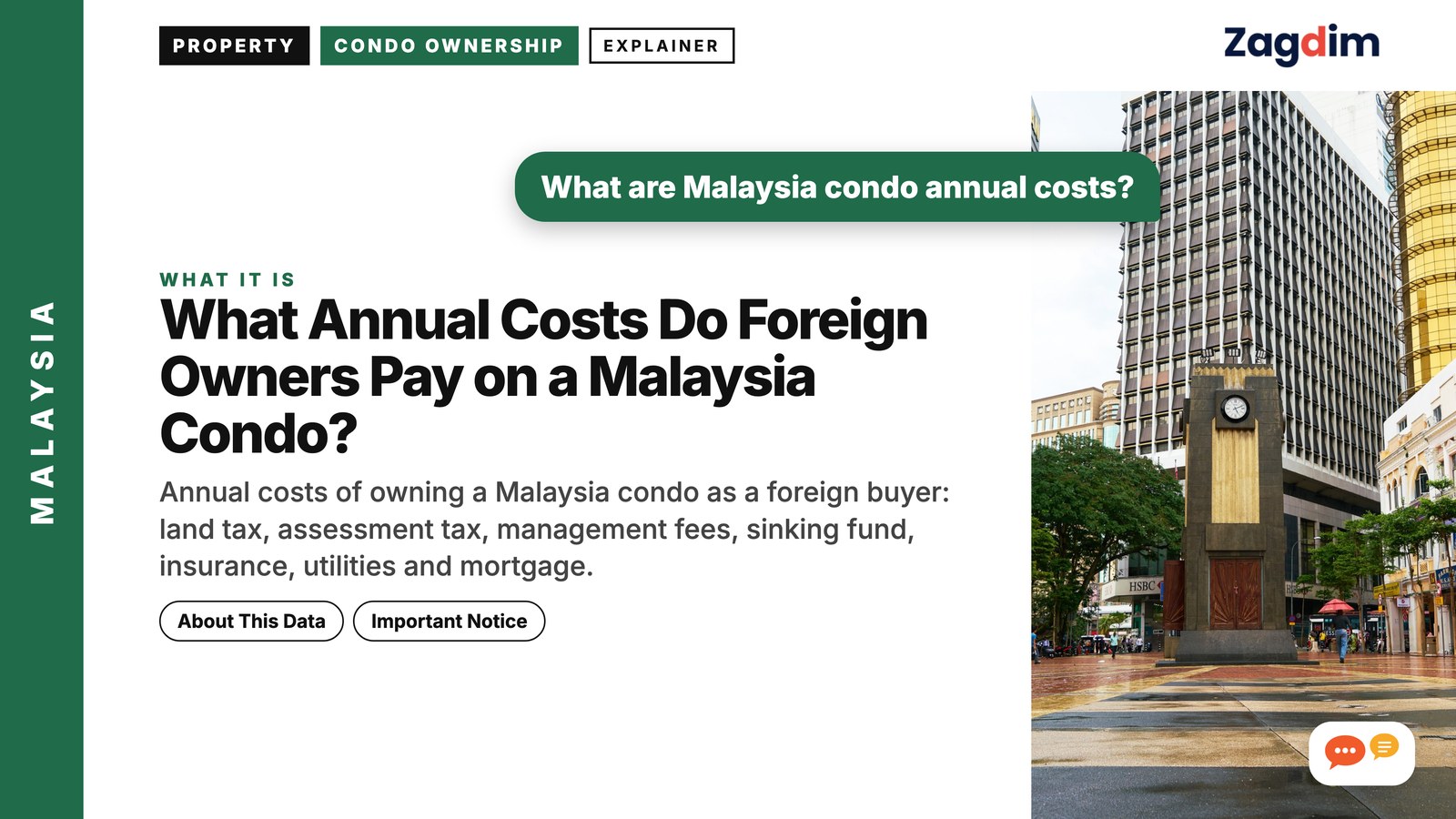
This article is part of Zagdim’s wiki series on property ownership in Malaysia. It sets out the recurring annual costs a foreign owner should budget for when holding a condominium unit, and how to check each cost against actual bills rather than online averages. Facts were checked as of October 21, 2026.
Annual Costs Don’t Mean the Amount Stays the Same Every Year
Owning a condo in Malaysia, even if it is not rented out, usually still carries tax, management and basic maintenance costs. These are ongoing holding costs, but the amounts can change because of reassessment, management budget decisions or maintenance needs.
When foreign buyers budget, the most useful references are the unit’s recent tax bills, management invoices and insurance arrangements. An average cost per square foot found online can be a starting point for questions, but it cannot replace the actual bills.
This article focuses on the stratified residential arrangements common in Peninsular Malaysia. The applicable systems in Sabah and Sarawak, and the charges of individual projects, need to be checked separately.
Separate Land Tax, Assessment Tax and Management Bills First
| Item | Main Purpose and What to Check |
|---|---|
| Land tax or strata land tax | Check with the local land office; charges on the overall master title may be apportioned by the developer or management body |
| Assessment tax | Charged by the local authority; separate from the management fee, so check the account number and payment period separately |
| Management fee | Covers day-to-day management and maintenance of common areas; check the current rate and how it is calculated |
| Sinking fund | Funds set aside for designated capital expenditure on common areas, recorded separately from the day-to-day management fee |
| Insurance | Check the building’s master insurance policy and fees already charged first, then consider separate cover for the contents of the unit |
| Utilities and sewerage | Confirm who pays based on the service account, tariff and tenancy agreement |
| Mortgage repayment | Only applies if you have a loan; watch for changes in the interest rate and repayment amount |
For a unit where strata land tax already applies, this tax replaces the original land tax arrangement, so the two should not be counted twice without first confirming which one applies. Assessment tax is a separate item and should not be skipped just because the management bill has been paid.
Look at the Formal Calculation for Management Fees, Not Just the Sales Quote
Charges for stratified property depend on the allocated share units and on the stage of management the project is in. The developer, the Joint Management Body (JMB) or the Management Corporation (MC) may be responsible for collecting fees at different stages.
If a quote states “RM0.40 per square foot,” confirm what floor area is used, whether the sinking fund is included, and whether there are separate legitimate charges for parking or other items. Do not simply multiply the brochure’s built-up area and treat that as the final monthly fee.
For example, suppose a formal bill lists a management fee of RM500 per month and a sinking fund contribution of RM50 per month; the two combined would total RM6,600 for the year. This is only an illustration of the calculation method. It excludes land tax, assessment tax, insurance and in-unit repairs, and it is not a standard market rate.
The Building Is Insured, But Check What the Cover Actually Includes
The management body for stratified property must arrange building insurance under the applicable regulations. The premium may already be collected through the management budget or another bill, so check this first when budgeting, to avoid double counting.
Cover for the building as a whole may not extend to an owner’s furniture, appliances, renovations, rental liability or loss of rent. Owners should obtain a summary of what is covered and confirm, based on how the unit is used, whether a supplementary policy is needed.
If the unit will be left vacant for an extended period or used for another purpose, also check the policy’s notification requirements and coverage conditions. Do not assume that, once the premium is paid, the unit is covered under any circumstance.
Leave Room for Unit Repairs and Large Common-Area Works
The sinking fund does not mean someone else pays for all repairs inside a private unit. For air conditioning, appliances, leaks and restoring a unit after a tenant moves out, confirm who is responsible first, then budget accordingly.
If there is a large-scale repair project planned for the common areas, also check meeting minutes, the fund balance and formal fee resolutions. Asking only about the current monthly fee at the time of purchase may overlook work that has already been discussed or approved.
Owners with a mortgage should include the full year’s principal and interest in their cash flow. Whether this can be deducted for tax purposes is a separate question.
Situations That Are Often Misunderstood
“Paying the Management Fee Covers All Government Taxes”
This cannot be assumed. Land tax, assessment tax and management charges each serve a different purpose and go to different accounts, so each should be confirmed separately.
“The Current Management Fee Will Stay the Same Every Future Year”
Fees can be adjusted through a lawful process and based on the actual budget, so there is no guarantee the amount will stay the same.
What Should You Check Next?
Before buying, request the most recent full year’s tax bills, a breakdown of management fees, any outstanding payment records and records of large-scale works. For a new project with no formal bills yet, mark the figures as estimates and update them after handover.
Frequently Asked Questions
Do I still have to pay the management fee if the condo is vacant?
Generally yes. Payment is still required under the applicable arrangement; it is not automatically waived just because no one is living there.
Will the sinking fund cover replacing appliances inside my unit?
No, this cannot be assumed. The fund is mainly used for designated capital expenditure on common areas; equipment inside a private unit is a separate matter of responsibility and contract.
If the building already has insurance, does the owner still need to check coverage?
Yes. Coverage should still be checked to avoid gaps for contents inside the unit, renovations or rental risk, and to avoid double-paying for the same premium.
About This Data
This article is based on information available as of October 8, 2026, and is for general information only; it does not constitute tax, legal or financial advice. Facts in this English adaptation were checked as of October 21, 2026. Tax, deduction and refund arrangements must be confirmed against the regulations applicable to where the property is located, the formal bills, the contract and individual circumstances. The RM500/RM50 monthly figures in the management-fee example are illustrative only and are not a standard market rate.
Have a question about this guide? Leave a comment below, or ask Zagdim directly.
Your first stop for international property and global living.
Research and insights. Know what’s changing. Understand what matters.
Sources
- KPKT (Ministry of Housing and Local Government) — Handbook Pengurusan Strata 2.0 (PDF)
- Petaling Land Office — Land Tax and Strata Land Tax FAQ
- Selangor Land and Mines Office — Tax Bills, Payment and Deadlines FAQ
- DBKL — Frequently Asked Questions by Department: Assessment Tax, Annual Value and Vacancy Arrangements
Important Notice
This article is a general information summary and does not constitute tax, legal or financial advice for any individual case. Facts were checked as of October 21, 2026. Rules on land tax, assessment tax, strata management charges and insurance in Malaysia may be updated; refer to the current announcements of the relevant land office, local authority and management body, and confirm against your own tax bills, management accounts and contracts, or consult a qualified professional for your own situation.