































This article is part of Zagdim’s wiki series on buying property in Japan. It sets out how investment property loans differ from home loans in interest rate, loan-to-value limit, and approval logic, for readers outside Japan who want to use a loan to buy a Japanese rental property.
Are Investment Loans and Home Loans the Same Thing?
No. Japan’s Financial Services Agency (FSA) classifies financing that an individual takes out for investment purposes to acquire condominiums, apartment buildings, shared housing, and other residential or lodging-use real estate as “financing for investment real estate” (投資用不動産向け融資), and has surveyed financial institutions on the scale and management of this kind of lending. Before applying, you need to be clear on whether the money is for a rental property or for a home you will live in yourself. That does not mean a home loan can never touch an investment use at all — it depends on the terms of the specific product.
Can You Use a Home Loan’s Terms to Buy a Rental Property?
It depends on the product. Flat 35 (フラット35), the home loan offered by the Japan Housing Finance Agency, cannot be used to acquire an investment property that will be rented out to a third party; if the agency finds that the property has been rented to a third party, the borrower must repay the entire loan in one lump sum. Foreign nationals applying for Flat 35 must, in addition to the general conditions, hold permanent resident or special permanent resident status — a requirement that applies only to Flat 35.
On the other hand, some products labeled “home loan” explicitly allow use for rental apartments. Shinsei Investment & Finance’s general real estate purchase loan page states that foreign customers with permanent residency or an appropriate status of residence can use the loan for investment property, a primary residence, or a second home. SBJ Bank’s ANY Home Loan product description likewise includes the purchase, construction, and refinancing of rental apartments and rental real estate among its permitted uses. So the product name alone is not enough — you need to check, product by product, whether the stated use of funds covers renting the property out.
Are Investment Loan Rates and LTV Limits Always Worse Than Home Loans?
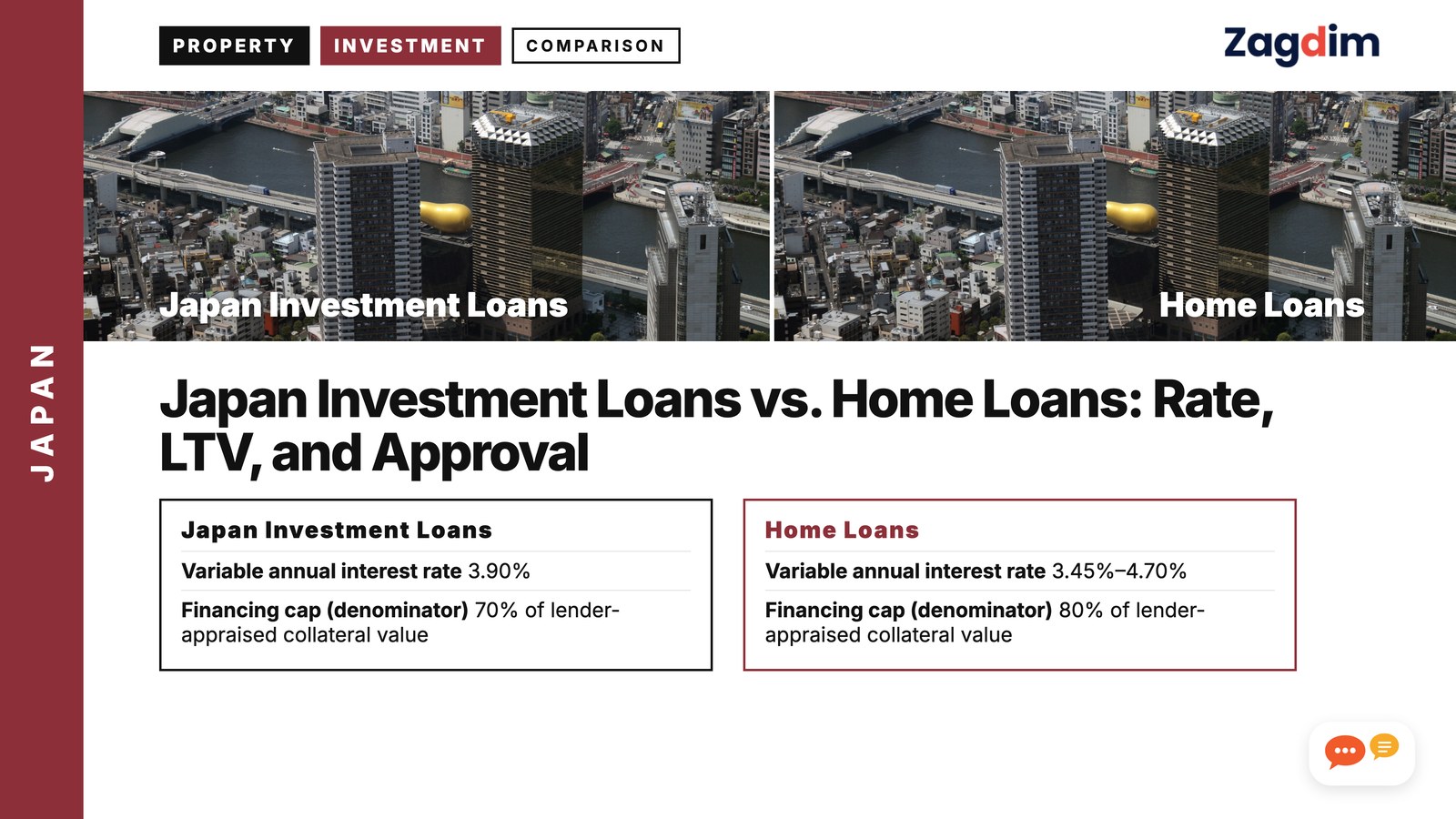
Not necessarily — it depends on the product and who it is aimed at. Take Shinsei Investment & Finance as an example: as of October 1, 2026 (the date shown on the product page), its product for overseas investors carries a variable annual interest rate of 3.90%, with financing capped at 70% of the lender’s appraised collateral value. The same company’s general real estate purchase loan, without group credit life insurance (団体信用生命保険) attached, carries a variable annual interest rate of 3.45% to 4.70%, with financing of up to 80% of the lender’s appraised collateral value.
| Comparison item (as of October 1, 2026) | Product for overseas investors | General real estate purchase loan (without group credit life insurance) |
|---|---|---|
| Variable annual interest rate | 3.90% | 3.45%–4.70% |
| Financing cap (denominator) | 70% of lender-appraised collateral value | 80% of lender-appraised collateral value |
With group credit life insurance attached, the general product’s variable annual interest rate runs from 3.75% to 5.00%. So the overseas-investor product has a lower financing-cap ratio; if a borrower qualifies for the general product, an investment-use loan may fall under a different rate range and a higher collateral-value ratio. In both cases, the denominator is the lender’s appraised collateral value, not the transaction price.
Loan amounts also vary by product: the overseas-investor product runs from ¥10,000,000 to ¥500,000,000, in increments of ¥100,000; Sumitomo Mitsui Trust Bank’s apartment loan runs from ¥1,000,000 to ¥300,000,000; and SBJ Bank’s ANY product caps financing at 90% of the purchase price. The overseas-investor product’s repayment period is 1 to 20 years, or 12 to 240 installments.
Beyond Income, What Else Do Banks Check at Approval?
Based on the product terms of Sumitomo Mitsui Trust Bank, 77 Bank, and Ichii Shinkin Bank reviewed for this article, an apartment loan’s term can be limited by the building’s statutory useful life, its age, and the borrower’s age at full repayment — not income alone. Sumitomo Mitsui Trust Bank’s apartment loan runs, in principle, for a maximum of 35 years and a minimum of 1 year, in 1-month increments, but the term is in principle capped by the building’s statutory useful life, and a refinanced loan’s term cannot exceed the remaining term of the original loan.
77 Bank’s financing term for wooden-structure buildings runs up to 22 years, extendable to up to 35 years when specified conditions are met; for a resale property purchase or refinancing, the term is calculated as the maximum term for that structure type minus the building’s age, and no grace period can be set. Individual applicants must be at least 18 and under 71 years old, and under 82 at the time the loan is fully repaid. Ichii Shinkin Bank’s apartment loan runs up to 35 years, and refinancing from another bank is capped at the original loan’s remaining term.
What Happens If You Use a Home Loan to Buy a Rental Property?
With Flat 35, the consequence is that the borrower must repay the entire loan in one lump sum. If Flat 35 finds that the property has been rented to a third party or used for an investment purpose, or used for a purpose outside its intended scope such as a shop or office, the borrower must repay the full loan amount at once.
On the tax side, the special deduction for housing loans (住宅借入金等特別控除) requires the borrower to move into the newly built home within 6 months of completion and to continue living there through December 31 of the year for which the deduction is claimed; switching the property to a rental use without maintaining continuous residence disqualifies it from this requirement. All of the deduction’s other requirements must also still be met, and there are separate rules covering up to the date of death in the year a borrower dies. By contrast, interest on a loan used for business purposes can be claimed as a necessary expense (必要経費). So using a home loan such as Flat 35 to buy a rental property can trigger both a lump-sum repayment demand and the loss of eligibility for the housing loan deduction.
How Do You Decide Which Loan Type Applies to You?
Start by confirming whether the funds are for a rental use, then compare different products on interest rate, collateral valuation, term, and fees. Shinsei’s overseas-investor loan carries an administrative handling fee of 1.50% of the loan amount, plus other costs that need to be confirmed separately with the lender.
The average lending rate statistics that the Bank of Japan publishes each month cover many categories of loans and are not a quote for any single investment property loan. SBJ Bank lists a base annual interest rate of 4.225% to 4.725% for “other” purposes as of October 1, 2026; a base rate is not an approved loan quote, and whether “other” covers an investment property is determined by the bank case by case, so an owner-occupier rate should not be applied directly to an investment property.
For how the overall loan approval, rental cash flow, and exit risk fit together, see Zagdim’s companion article on what to understand about bank approval, rental cash flow, and exit risk before using a loan to buy an investment property in Japan. For a first check on eligibility to apply, see Zagdim’s companion article on whether foreign buyers of Japanese rental property can apply for an investment property loan.
Frequently Asked Questions
What happens if I rent out a property I bought with Flat 35?
If Flat 35 finds that the property has been rented to a third party or used for an investment purpose, or used for a purpose outside its intended scope such as a shop or office, the borrower must repay the full loan amount in one lump sum.
Does the “70%” figure for investment loans mean 70% of the transaction price?
Not necessarily. Shinsei’s overseas-investor product caps financing at 70% of the lender’s appraised collateral value; Shinsei’s general product caps it at 80% of the lender’s appraised collateral value; and SBJ’s ANY product caps it at 90% of the purchase price. The denominator differs by product, so check the product description first.
Do foreign nationals need permanent residency to apply for a Japanese investment property loan?
Not necessarily. Permanent resident or special permanent resident status is a requirement Flat 35 imposes specifically on foreign nationals. Shinsei’s general loan page, by contrast, states that foreign customers with permanent residency or an appropriate status of residence can use the loan for investment property, a primary residence, or a second home.
Glossary
- Financing for investment real estate (投資用不動産向け融資): An FSA term for financing an individual obtains for the purpose of investing in residential or lodging-use real estate.
- Flat 35 (フラット35): A home loan offered by the Japan Housing Finance Agency; it cannot be used to acquire an investment property that will be rented out to a third party.
- Collateral appraisal value (担保評価): The value a lender assigns to the collateral real estate; it is the denominator used to calculate the financing cap for two of Shinsei’s products.
- Group credit life insurance (団体信用生命保険): An optional insurance attached to Shinsei’s general loan product; the interest rate range differs depending on whether it is attached.
About This Data
The facts in this article were checked as of October 21, 2026. The interest rates, financing ratios, and fees for Shinsei Investment & Finance and SBJ Bank reflect the terms shown on each product page as of October 1, 2026, and are not a quote for any single approved loan. The observation that “apartment loan terms are limited by useful life, building age, and the borrower’s age at repayment” is drawn from the product terms of Sumitomo Mitsui Trust Bank, 77 Bank, and Ichii Shinkin Bank; the official documents do not state directly that “banks look only at post-rental repayment ability.” Costs other than the administrative handling fee on Shinsei’s overseas-investor loan (for example, an early repayment fee) have not yet been verified word-for-word for this article; refer to each institution’s own documents. There is no official document that directly compares the underwriting logic for owner-occupier loans against investment loans, and there is no market-wide average rate or financing ratio for owner-occupier loans. Product terms can change, and actual eligibility depends on each institution’s current published terms and individual underwriting.
Have a question about this guide? Leave a comment below, or ask Zagdim directly.
Your first stop for international property and global living.
Research and insights. Know what’s changing. Understand what matters.
Sources
- FSA – Results of a Survey on Financing for Investment Real Estate
- Shinsei Investment & Finance – Loans for Overseas Investors
- Shinsei Investment & Finance – Real Estate Purchase Loan
- Japan Housing Finance Agency – Flat 35 Terms of Use
- National Tax Agency – Special Deduction for Housing Loans When Moving In From Reiwa 4 Onward
- National Tax Agency – Knowledge of Necessary Expenses
- Sumitomo Mitsui Trust Bank – Apartment Loan (PDF)
- 77 Bank – Apartment Loan
- Ichii Shinkin Bank – Apartment Loan
- SBJ Bank – ANY Home Loan Product Summary
- SBJ Bank – Loan Interest Rates
- Bank of Japan – Explanation of “Trends in Average Contracted Interest Rates on Loans”
Important Notice
This article is general information and does not constitute tax or legal advice for any individual case. The facts were checked as of October 21, 2026. Rules in Japan may be updated; refer to the current published guidance of the relevant authorities, and consult a qualified professional for your individual case.