































This article is part of Zagdim’s wiki series on setting up a company in the United Arab Emirates. It walks through the main steps for setting up a company in a Dubai free zone, including choosing a company type, meeting shareholder and capital requirements, applying online from abroad, deciding on office space, and understanding how (and whether) a setup leads to a residence visa. It is written for anyone considering buying property, starting a company, or relocating to the UAE, wherever they are currently based, including people who are not yet physically in the UAE.
Before starting, it helps to understand the difference between a mainland company, a free zone company, and an offshore company, along with each one’s business scope and costs. See the main articles [Setting Up a Company in the UAE as a Foreigner: Mainland, Free Zone and Offshore Explained] and [UAE Mainland vs. Free Zone Companies: Business Scope and Cost Compared].
**Example used throughout this article**: an entrepreneur based outside the UAE is planning to set up a one-person consultancy company in a Dubai free zone, acting as the sole shareholder, without being physically present in the UAE. The sections below use this scenario to show how the rules apply in practice. It is an illustration only, not a ruling on any individual case.
What Comes First: the Business Activity or the Company Type?
The business activity comes first; the company type and license are chosen afterward.
The UAE government’s guidance for setting up a mainland company states that the intended business activity is the basis for choosing the legal form and the commercial, industrial or professional license. The legal form is the company’s organizational structure under the law, and it must match the business activity. For the full explanation, see [Setting Up a Company in the UAE as a Foreigner: Mainland, Free Zone and Offshore Explained].
Example: the entrepreneur first settles on “consultancy services” as the business activity, then compares company types and licenses.
What Types of Free Zone Companies Are There, and Are There Rules on Shareholders?
The number of shareholders affects which company type is available, and the answer is yes, there are rules, but they differ by free zone.
The UAE government’s guidance for setting up a business in a free zone states that company types differ by, among other things, the number of shareholders and whether a shareholder is a natural person or a legal person:
- Natural person: an ordinary individual.
- Legal person: a company, institution or similar organization that is legally formed and can act in its own name.
Not every free zone registers every company type; this needs to be checked with each free zone’s own authority.
Using the Jebel Ali Free Zone (JAFZA) as an example:
| Company Type | Shareholders | Other Conditions |
|---|---|---|
| Free Zone Establishment (FZE) | 1 shareholder, natural person or legal person | Has a legal personality separate from its shareholder (the company is its own legal entity, distinct from the shareholder); liability is limited to paid-up capital (the shareholder’s liability is capped at the capital actually paid into the company) |
| Free Zone Company (FZCO) | 2 to 50 shareholders, who may be natural persons, legal persons, or a mix of both | – |
| Branch | 100% owned by a parent company established outside JAFZA | Must use the same name and carry out the same business activity as the parent |
It is also worth separating two things that are easy to confuse: company type and license type. Company type is like the company’s “skeleton,” and license type is like a “menu of permitted activities.” JAFZA’s own guidance defines the company formation type as the legal structure, while the license type provides the range of permitted activities; a company still has to select specific activities from an activity list, and that is what actually determines which business it can do. For how to choose a license, see [Choosing a UAE Business License: Trading, Consultancy, E-commerce].
Example: the entrepreneur has only one shareholder. Taking JAFZA as the example, an FZE can be set up with 1 shareholder, whether a natural or legal person; an FZCO needs 2 to 50 shareholders, so a single founder would not qualify for that type.
Is There a Minimum Share Capital for a Free Zone Company?
Share capital is the money shareholders put into the company. Taking JAFZA as the example, FZEs and FZCOs currently have no fixed minimum share capital, but the capital needs to be sufficient to support the activities approved on the license.
In other words, a company cannot simply operate with zero capital; the capital required depends on what the business activity needs.
If the company is being set up specifically to qualify for an investor’s green residence permit, there is a separate minimum investment threshold. See the “Does Setting Up a Company Get You a Residence Visa?” section below.
What Are the Application Steps, and Can It Be Done Online From Abroad?
Taking the Dubai Multi Commodities Centre (DMCC) as the example, yes, the application can be submitted online, but video identity verification is still required.
- Online processing: UAE government guidance states that applicants can apply, pay, and sign documents through the DMCC portal, then choose an office plan that fits their needs.
- Video verification: DMCC’s individual setup guide states that a Business Setup Executive (BSE) must verify the identity of all authorized company signatories by video call, checking against their passports.
For an overview of applying from abroad, see [Setting Up a Company in the UAE as a Foreigner: Mainland, Free Zone and Offshore Explained].
The main stages in DMCC’s individual setup guide (Version 5, dated January 11, 2024) are as follows:
| Stage | Key Points |
|---|---|
| Stage 1 | Pre-approval (official agreement to let you proceed, though you still cannot operate yet) is valid for 60 days from the date it is issued; the registration stage must be completed before this period expires. Each shareholder, director, manager and secretary must provide proof of address in their country of residence, such as a signed lease, a utility bill issued within the last 6 months, a bank confirmation letter issued within the last 6 months, or an official document issued by an authority in their country of residence within the last 6 months. A UAE residence visa and Emirates ID must also be provided where applicable. |
| Stage 2 | Video verification against passports to confirm the identity of all authorized company signatories; company documents are sent to signatories for signature through an electronic signature platform (DocuSign). |
| Stage 3 | The lease for the rented property must cover the full period the license is valid for, and remain valid for at least 1 year from the date of submission; it must state the full company name reserved by DMCC, the unit, and the lease details. Alternatively, applicants may use a DMCC serviced office contract, as set out in the guide. |
Getting pre-approval does not mean you can start operating. DMCC’s licensing rules state that a business cannot operate within, or from, the free zone without a valid license. The same principle applies to initial approval in the mainland company process: it only allows the next setup steps to proceed and does not grant permission to actually carry out business.
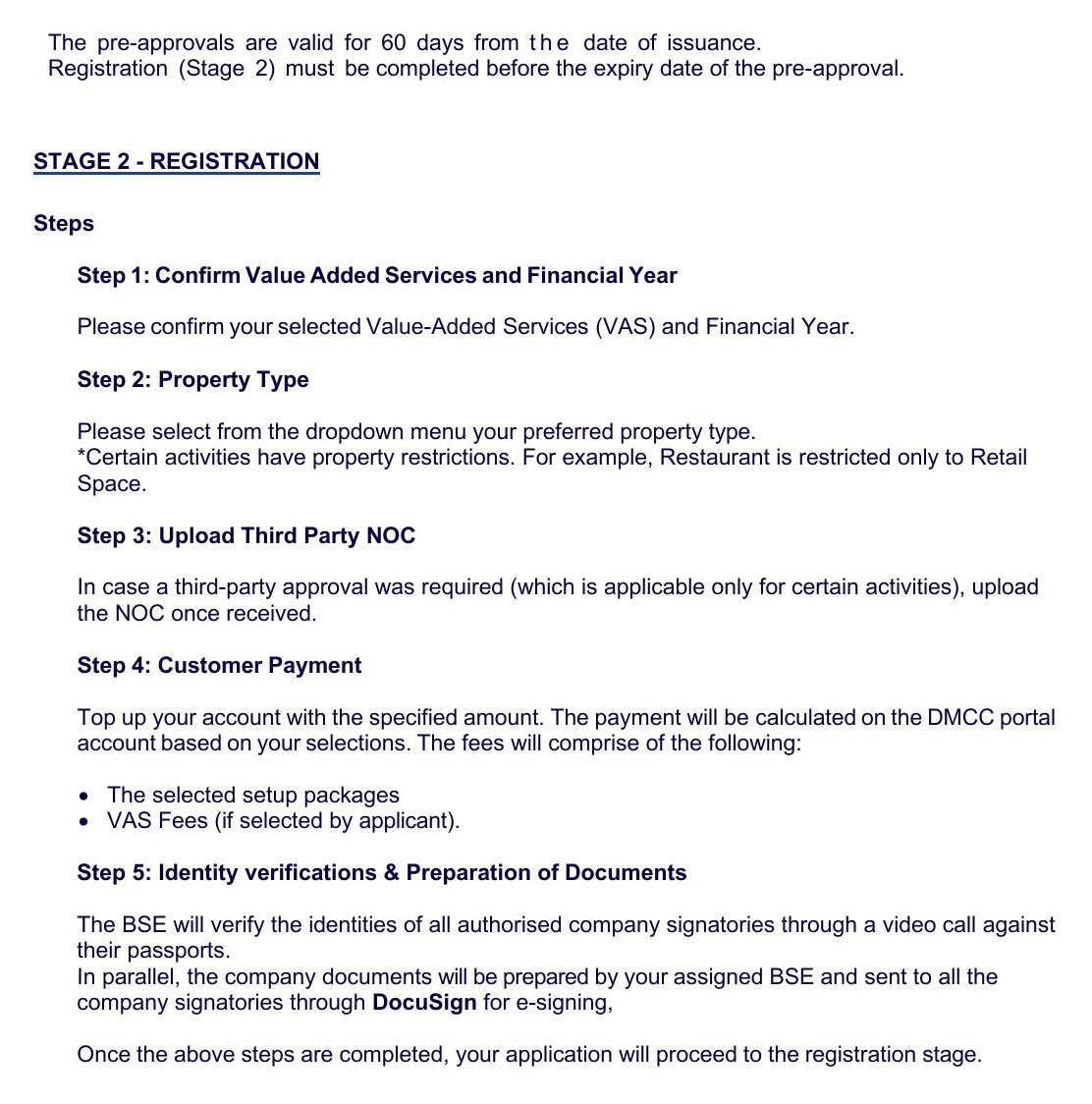
Example: the entrepreneur can apply, pay, and sign documents through DocuSign entirely online from abroad, but still needs to complete video verification against a passport. A utility bill issued within the last 6 months could serve as proof of address. Once pre-approval is granted, the entrepreneur has 60 days to complete the registration stage.
Do You Need to Rent a Full Office, or Is a Flexi-Desk Enough?
Office space requirements depend on the type of business. The short answer is that a full office is not always required, but the available options depend on the free zone and the business activity.
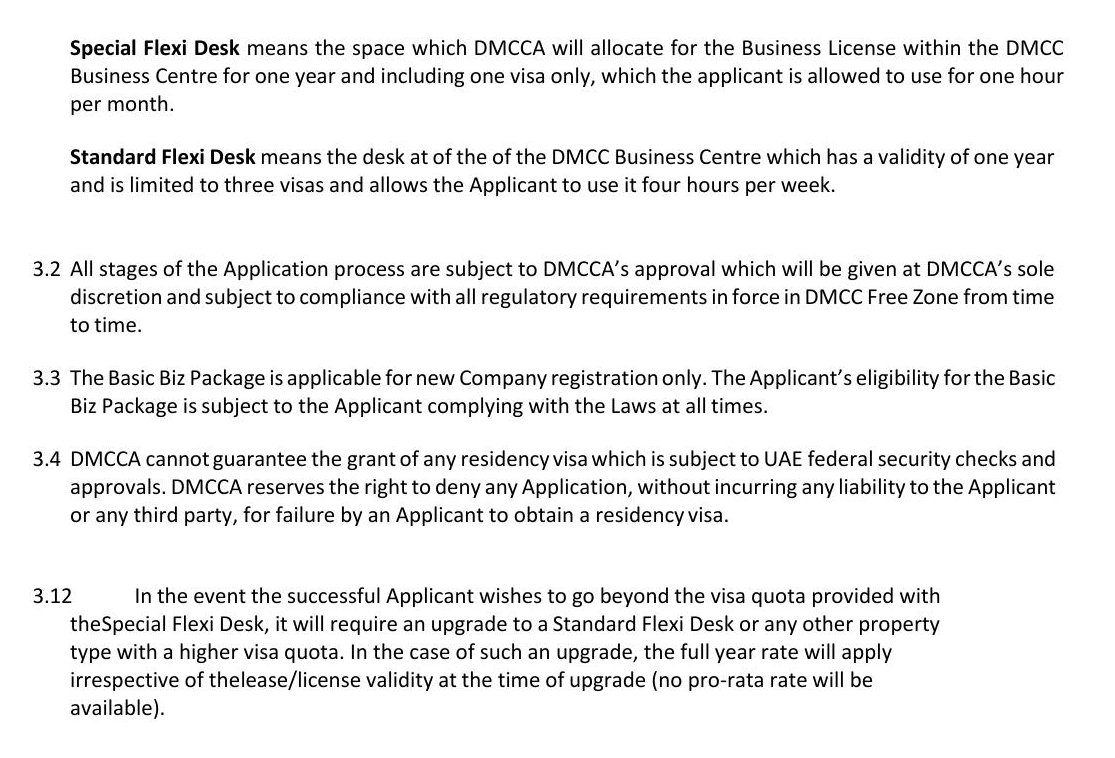
Using DMCC’s Basic Biz package terms as an example, there are two flexi-desk configurations:
| Plan | Validity | Visa Quota | Usage Time |
|---|---|---|---|
| Special Flexi Desk | 1 year | 1 quota | 1 hour per month |
| Standard Flexi Desk | 1 year | Up to 3 quotas | 4 hours per week |
If a company needs more visa quota than the Special plan allows, it needs to upgrade to a plan with a higher quota. The upgrade is charged at the full annual rate, not prorated for the remaining time on the current plan.
Industrial businesses have different requirements. JAFZA’s industrial license is for companies that intend to set up a manufacturing process, and the core requirements include:
- A production facility and warehouse within the free zone
- Licensed companies are subject to regular audits by the Health, Safety and Environment (HSE) authority
JAFZA’s operating conditions:
- Clients need a valid lease and a valid license to operate within the free zone, and must renew the lease and license according to JAFZA’s schedule.
- People using a workstation inside a business center or incubator may be subject to different requirements.
- An entity (company or organization) that is registered and licensed with another UAE authority and wants to rent space within JAFZA needs JAFZA’s permission.
Example: if the entrepreneur chooses DMCC’s Special Flexi Desk, there is only 1 visa quota available, usable for 1 hour a month. Needing more quota later would require an upgrade, charged at the full annual rate.
Does Setting Up a Company Get You a Residence Visa?
No, not automatically. Company approval and residence visa approval are two separate matters. See [Setting Up a Company in the UAE as a Foreigner: Mainland, Free Zone and Offshore Explained] for more detail.
Taking DMCC as the example, the Basic Biz package terms state that:
- Every stage of the setup application is approved at DMCC’s discretion, based on the regulatory requirements in effect at the time, meaning DMCC decides for itself whether to approve each stage.
- A residence visa still has to pass UAE federal security screening and approval; DMCC does not guarantee it will be issued.
- If an applicant has not obtained a residence visa, DMCC reserves the right to refuse the setup application.
In other words, the “visa quota” that comes with an office plan is only a cap on how many visas could be applied for, not a guarantee of approval.
Employee residence: the company first needs to meet these conditions:
- It needs a valid license and an establishment card before it can apply.
- Before applying, any sanctions already placed on the company’s account need to be cleared (meaning the company account is currently in a restricted state).
Required application documents include a valid passport with more than 6 months remaining, medical test results, valid health insurance, and a stamped Emirates ID registration form.
Investor or partner green residence: the General Directorate of Residency and Foreigners Affairs – Dubai (GDRFA Dubai) splits the entry visa and the residence permit into two stages:
| Stage | Conditions and Content |
|---|---|
| Green entry visa | The holder can stay in the UAE for 60 days from entry to complete the residence process. The company must use the legal form listed on this GDRFA service page. At incorporation or when contributing capital, the investor’s or partner’s share must be a paid-up amount (meaning funds actually paid in) of not less than AED 1,000,000, or the equivalent in another currency. Maintaining and renewing the green residence also requires continuing to meet the listed conditions. |
| Investor/partner green residence permit | Valid for up to 5 years, with no sponsor or employer required; renewed under the same conditions as the first issuance. Requires approval from the competent authority and authorization for the activity being carried out. Documents include a photo, a copy of a passport valid for at least 6 months, partnership or company formation documents or an investment contract, and the business license. (This document list is not the complete eligibility list.) |
The AED 1,000,000 figure is the paid-up share required of an investor or partner specifically for this residence route; it is not the minimum setup capital for every company. Whether this threshold applies to other residence routes, or to free zone companies generally, cannot be assumed from this figure alone.
Example: buying a plan with 1 visa quota does not mean the entrepreneur is guaranteed a residence visa. Pursuing the investor’s green residence separately requires meeting the paid-up share threshold and other conditions.
Is Renewing the License Just a Matter of Paying a Fee?
No, there is more to it than payment. After a company is set up, license renewal is an annual matter.
Taking DMCC as the example, its licensing rules require renewal before the expiry date shown on the license, and a business cannot operate within, or from, the free zone without a valid license. Except where the registrar specifies otherwise, renewal conditions include:
- Continuing to comply with the rules and maintaining all related valid licenses, permits, visas and approvals
- Submitting audited financial statements and reports as required by law (except where applicable law and rules provide an exemption)
- Demonstrating there are no outstanding amounts due
- Paying the renewal fee and any other applicable fees
- Providing any other information the registrar reasonably requires
For other ongoing responsibilities such as accounting, corporate tax and VAT, see [After Incorporation: UAE Accounting, Corporate Tax, VAT and License Renewal Duties].
On fees, DMCC’s fee schedule, as checked on November 2, 2026, shows:
- A 1-year renewal for a trading and services license: AED 20,265; adding activities may change this fee.
- This pricing does not apply to business centers, general trading, industrial activities or refineries, and it is not an all-inclusive annual fee that covers office space, residence, and all compliance costs.
- The fee schedule separately lists a general AED 20 knowledge and innovation fee, and DMCC reserves the right to adjust fees without notice.
Frequently Asked Questions
Can you start operating once you have pre-approval? No. Taking DMCC as the example, a business cannot operate within, or from, the free zone without a valid license; pre-approval is valid for 60 days from the date it is issued, and registration must be completed within that period.
Can a single shareholder set up a free zone company? It depends on the free zone. Taking JAFZA as the example, an FZE can be set up with 1 shareholder, whether a natural or legal person. Not every free zone registers every company type, so this needs to be checked with each free zone’s own authority.
Is there a minimum share capital for a free zone company? Taking JAFZA as the example, FZEs and FZCOs currently have no fixed minimum share capital, but the capital needs to be sufficient to support the activities approved on the license.
Does buying a setup plan guarantee a residence visa? Not necessarily. Taking DMCC’s Basic Biz package terms as the example, a residence visa still has to pass UAE federal security screening and approval, and DMCC does not guarantee it will be issued; a visa quota is not a guarantee of approval.
Can a JAFZA industrial license rely on just a flexi-desk? No. JAFZA’s core requirements for an industrial license include a production facility and warehouse within the free zone, and licensed companies are also subject to regular HSE audits.
Glossary
- Free Zone Establishment (FZE): taking JAFZA as the example, this company type can be set up with 1 shareholder, a natural or legal person, has a legal personality separate from its shareholder, and limits liability to the amount of capital paid in.
- Free Zone Company (FZCO): taking JAFZA as the example, this company type can be formed by 2 to 50 shareholders, who may be natural persons, legal persons, or a mix of both.
- Pre-approval: the approval granted at Stage 1 of DMCC’s setup process, valid for 60 days from the date it is issued, within which the registration stage must be completed.
Source Notes
Information in this article was checked as of November 2, 2026.
- Content on free zone company types, setup steps and fees is drawn from the official rules, terms and fee schedules of DMCC and JAFZA specifically; rules differ between free zones, and the conditions described here should not be assumed to apply to other free zones.
- The point that business activity is decided before company type, and the explanation of initial approval, follow the UAE government’s guidance for mainland company setup; the government guidance does not explicitly state that free zones follow the same sequence.
- JAFZA’s requirements for a valid lease, a valid license, and lease and license renewal are set out in Articles 6.2 to 6.3 of the JAFZA Rules 2023.
- The DMCC setup process follows the individual setup guide, Version 5, dated January 11, 2024 (the file itself is labeled V4); this has not been verified against every process in effect in 2026.
- The flexi-desk quotas are based on DMCC’s Basic Biz package terms and do not represent every DMCC office plan.
- DMCC renewal fees are taken from the fee schedule snapshot checked on November 2, 2026. Whether the AED 20 knowledge and innovation fee listed in the schedule is already included in the other listed amounts has not been confirmed, and this article has not added the figures together itself.
- The green residence section is drawn from GDRFA Dubai’s investor/partner green entry visa and green residence service pages; both are handled in stages, and the listed documents are not the complete eligibility list.
- DMCC and JAFZA fees may both be adjusted without notice; the actual amount follows the official announcement in effect at the time of application.
Need help with this? Talk to the Zagdim reader desk
Zagdim’s reader desk can help match you with a specialist to plan a Dubai free zone company setup that fits your situation.
Message the Zagdim reader desk on WhatsApp Message the Zagdim reader desk on LINE
Have a question about this guide? Leave a comment below, or ask Zagdim directly.
Your first stop for international property and global living.
Research and insights. Know what’s changing. Understand what matters.
Sources
- UAE Government Portal – Steps to start a business on the mainland
- UAE Government Portal – Starting a business in a free zone
- JAFZA – Company formation
- JAFZA – Business licence in Dubai with Jafza
- JAFZA – Jafza Rules 2023
- DMCC – Schedule of Charges
- DMCC – Company Formation Application – Individual, Version 5
- DMCC – Basic Biz Terms and Conditions
- DMCC – Licensing Rules Version 3
- DMCC – New Employee Residence Visa Guidelines
- GDRFA Dubai – Issuing green residence permit (partner investor)
- GDRFA Dubai – Green visa issuance (investor/partner)
Important Notice
This article is a general information summary and does not constitute tax or legal advice for any individual case. Information was checked as of November 2, 2026. UAE regulations, and the regulations of your own country or place of residence, may be updated; please follow the current guidance from the relevant authorities, and consult a qualified professional for your specific situation.