
































This article is part of Zagdim’s wiki series on setting up a company in the United Arab Emirates (UAE). It brings together the ongoing compliance duties that start once a UAE company has its license: accounting, corporate tax, VAT, e-invoicing, and license renewal. It is written for anyone planning to set up a UAE company or who already has one, including owners who do not live in the UAE.
Getting a license is only the first step. A license is the certificate a UAE authority issues that allows a company to operate. After that come ongoing responsibilities: bookkeeping, corporate tax, value-added tax (VAT), license renewal, and keeping beneficial-owner records up to date. VAT (Value Added Tax) is a tax added to the sale of goods and services. For how the different company structures and setup steps compare, see our guide to choosing between Mainland, Free Zone, and Offshore company structures in the UAE and understanding substance requirements.
**An example used throughout this article**: Mr. Lin does not live in the UAE. He set up a service company in the DMCC free zone in Dubai. The sections below apply the rules to Mr. Lin’s situation to help illustrate them. This is only an example; it does not represent the conclusion of any real case.
What Ongoing Compliance Work Comes After Incorporation?
Start with the big picture. Broadly speaking, there are seven categories of ongoing work after a company is formed, but which ones actually apply depends on the company’s situation, including:
- Which free zone the company is registered in, or whether it is on the mainland. A Free Zone is a designated area with its own regulator and rules; Mainland refers to the general area outside the free zones.
- The size of its revenue
- Whether it is registered for particular taxes
- Whether it carries out certain activities
The seven categories of ongoing responsibility:
- Accounting records and audit
- Corporate tax registration, filing, and payment
- VAT registration, filing, and payment
- Appointing a service provider for, and implementing, e-invoicing
- License renewal and keeping an office in place
- Updating beneficial owner and shareholder records
- Updating bank records and cooperating on the background of transactions
The details differ by free zone and emirate. The sections below go through each one.
Accounting and Audit: Which Companies Must File Audited Statements?
An audited financial statement is a report an auditor issues after reviewing a company’s financial statements. Whether one is required depends on two separate sets of rules: the rules of the registering authority, and tax law.
- Registering authority: DMCC member companies, for example, must submit audited financial statements within 6 months of the end of their financial year.
- Tax law: taxable persons with revenue above AED 50 million, and Qualifying Free Zone Persons, must prepare audited financial statements (see the corporate tax section).
DMCC’s Submission Rules
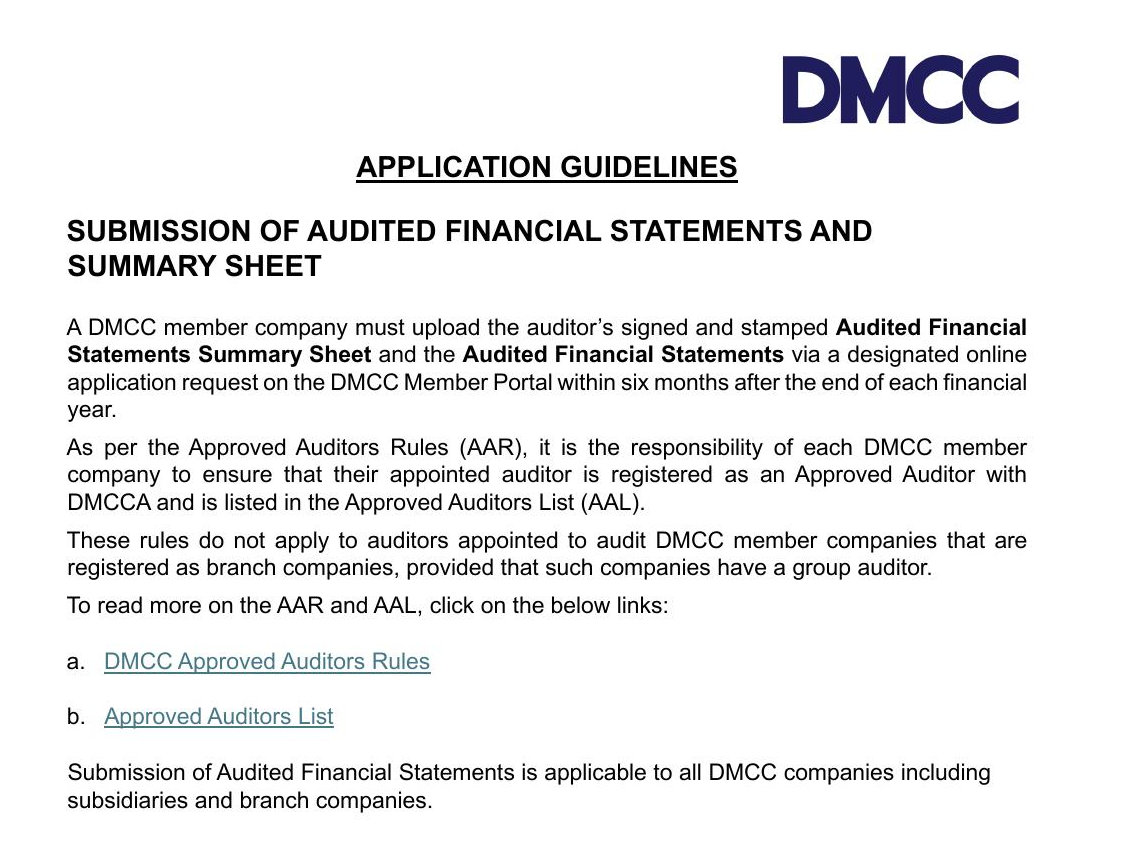
Taking the Dubai Multi Commodities Centre (DMCC) as an example, under DMCC’s guidelines on the submission of audited financial statements dated April 29, 2025:
- Deadline: within 6 months of the end of each financial year
- Method: submitted through the member portal
- Documents: audited financial statements, plus a summary sheet signed and stamped by the auditor
- Who it applies to: both subsidiaries and branches
- Auditor: in principle must be on DMCC’s approved list. A branch that already has a group auditor is not restricted to the approved-auditor list, but the branch must still submit audited financial statements.
**Example**: Even if Mr. Lin’s company has not exceeded AED 50 million in revenue, as a DMCC member company it must still submit audited financial statements within the deadline under DMCC’s rules.
How Long Must Records Be Kept?
Retention periods need to be checked against each rule separately. DMCC’s Company Regulations require companies to keep books and underlying documents (the original records that support the accounts) sufficient to explain transactions, show financial position, and support compliant statements. The regulations also state that where UAE tax law requires a longer period, the longer period applies.
| Rule | Covers | Retention Period |
|---|---|---|
| DMCC Company Regulations | Books and underlying documents | At least 5 years from the end of the relevant tax period (taxable companies) or calendar year (non-taxable companies); at least 15 years for real estate records from the end of the relevant calendar year; longer where tax law requires it |
| Corporate Tax Law | Records supporting filings and letting the tax authority confirm taxable income | 7 years after the end of the tax period |
| VAT Executive Regulation | Records related to real estate that are required to be kept by law | 15 years after the end of the tax period; other records follow the Tax Procedures Law and its executive regulation |
Corporate Tax: Thresholds, Filing Deadlines, and How the Free Zone 0% Rate Works
This section covers corporate tax. Two points are worth keeping in mind from the start. First, under the general regime, taxable income up to AED 375,000 is taxed at 0% and the portion above that at 9%. Second, a free zone company must qualify as a Qualifying Free Zone Person before its qualifying income gets the 0% rate; being registered in a free zone does not make income automatically tax free.
General Rate and Threshold
Under the UAE’s 2022 Cabinet Decision on annual taxable income, the rate for a general taxable person (an entity required to pay tax under the Corporate Tax Law) is:
- For each tax period (the period over which corporate tax is calculated), the portion of taxable income up to AED 375,000: 0%
- The portion above that: 9%
- If the same taxable person runs several businesses in the same period, the 0% allowance does not multiply
Taxable income is the income calculated under tax law for corporate tax purposes; it is not revenue. This is the rate under the general regime; it is not a complete rate table covering free zones, special taxable persons, and the various 2026 amendments.
How Soon Must a New Company Register?
The Federal Tax Authority (FTA) issued a public clarification on June 11, 2024, covering resident juridical persons (organizations treated as UAE residents for tax purposes) established, incorporated, or recognized on or after March 1, 2024:
- General case: register for corporate tax within 3 months of the date of establishment, incorporation, or recognition
- A juridical person recognized under foreign law but managed and controlled in the UAE: register within 3 months of the end of its financial year
This deadline applies to resident juridical persons; it cannot be applied directly to non-residents or natural persons.
Filing and Payment Deadlines
Under the UAE Corporate Tax Law (full citation in the sources note), for tax periods starting on or after June 1, 2023, a taxable person required to file must:
- File: within 9 months of the end of the relevant period, or by a date the tax authority specifies
- Pay corporate tax in full: within 9 months of the end of the relevant period, or by a date the tax authority specifies
These are the general statutory deadlines; any case-by-case extension needs to be confirmed separately.
The same law also requires a taxable person to keep records and documents for 7 years after the end of the tax period, including information supporting the tax return or other required filings, and information that lets the tax authority confirm taxable income. This 7-year period is specific to corporate tax; it does not mean accounting, VAT, or real estate records only need to be kept for 7 years.
Small Business Relief
Small Business Relief is an election available to resident taxable persons. Under the 2023 Ministerial Decision and its 2026 amendment:
- Conditions: revenue in the relevant period and every prior tax period must not exceed AED 3 million; exceeding it in any single period disqualifies the election going forward
- How revenue is calculated: under accounting standards accepted in the UAE
- Period covered: following the 2026 amendment, tax periods starting on or after June 1, 2023 and ending on or before December 31, 2029
- Does not apply to: members of defined Multinational Enterprise Groups, or Qualifying Free Zone Persons (QFZPs)
The Free Zone 0% Rate Is Not Automatic
A free zone company that wants the 0% rate first needs a status. A Qualifying Free Zone Person (QFZP) is a free zone person that meets a set of statutory conditions; only a QFZP’s qualifying income gets the 0% rate, and taxable income from non-qualifying income still gets the 9% rate. Being registered in a free zone does not by itself give QFZP status; a company also needs:
- Adequate substance in the UAE
- Qualifying income
- No election into the general tax regime
- Compliance with specific provisions of the Corporate Tax Law, and any other conditions the Minister sets
What counts as adequate substance? It means the company actually operates locally, not just holds a registered address:
- Core income-generating activities (the main business that earns the company its income) must be carried out, as required for that activity, in the free zone or in a designated zone (an area the Cabinet designates that meets set conditions)
- The company must have adequate assets, sufficient qualified full-time employees, and operating expenditure appropriate to the scale of each activity
- Ordinary activities can be outsourced to a person in the same free zone or designated zone, with adequate supervision
- Core activities relating to qualifying intellectual property are an exception: they can be outsourced to a person inside the UAE or to an unrelated party outside the UAE, still with adequate supervision
Non-qualifying revenue cannot be too large (the de minimis threshold): a QFZP’s non-qualifying revenue must not exceed the lower of 5% of total revenue for the relevant tax period or AED 5 million, to stay within the de minimis threshold (meaning an amount small enough to be tolerated). When calculating this, the following revenue is excluded from both non-qualifying revenue and total revenue:
- Revenue from free zone commercial real estate transacted with a non-free-zone person
- Revenue from free zone non-commercial real estate transacted with any person
- Revenue attributable to a domestic or foreign permanent establishment (a company’s fixed place of business elsewhere)
- Revenue from owning or exploiting intellectual property, though specific revenue related to qualifying income (see the sources note) is not covered by this exclusion
Consequences of losing the status: if the statutory conditions are not met at any point during a tax period, QFZP status is lost for that period and for the following 4 tax periods.
**Example**: Mr. Lin’s company being registered with DMCC does not mean its income is automatically 0%. To get QFZP treatment, it would need to meet all of the conditions above, and if it fails to meet them at any point during a period, the effect is not limited to that period; it carries through the following 4 tax periods as well.
How Does Audit Relate to Corporate Tax?
Tax law itself can also require an audit. Under the UAE’s 2025 Ministerial Decision on audited financial statements, for tax periods starting on or after January 1, 2025:
- A taxable person that is not part of a Tax Group (several companies treated together as one taxpayer) and whose revenue for the relevant period exceeds AED 50 million must prepare and keep audited financial statements. For a non-resident, only revenue earned through a UAE permanent establishment or nexus (the connection that makes a non-resident taxable in the UAE) counts toward that threshold.
- A QFZP must prepare and keep audited financial statements regardless of revenue; there is no AED 50 million threshold for QFZPs.
Tax Groups have their own special-purpose audited statement requirements. Falling under the AED 50 million threshold does not exempt a company from audit obligations under free zone or other rules, such as DMCC’s submission requirement described above.
An extra report for QFZPs that distribute goods: under a 2026 FTA decision, a QFZP carrying out the qualifying activity of “distributing goods or materials within or from a designated zone” must also obtain an agreed-upon procedures report from an independent external auditor (a report an auditor issues after checking specified matters against agreed procedures), for tax periods starting on or after January 1, 2026. This report must be submitted within 30 days of the corporate tax filing deadline for the relevant tax period, or by a date the FTA specifies. An annual financial statement audit does not substitute for this report. Failing to submit it means the relevant conditions under the 2025 Ministerial Decision on audited financial statements and the 2025 Ministerial Decision on qualifying activities are treated as not met.
Large International Groups Have Separate Rules
This section only concerns very large groups. In short, international groups that meet a revenue threshold must also look at the Domestic Minimum Top-up Tax; they cannot rely on the 0%/9% rates alone. Under the UAE Ministry of Finance’s explanation:
- Regime: Domestic Minimum Top-up Tax (DMTT)
- Effective: financial years starting on or after January 1, 2025
- Who it applies to: multinational enterprise groups operating in the UAE that had consolidated global revenue of at least EUR 750 million in at least 2 of the 4 financial years before the applicable year
- Purpose: to implement the 15% minimum effective tax rate under Pillar Two (the global minimum tax framework)
15% is an effective-rate framework, not a change to the statutory tax rate for every UAE company. For these groups, tax liability cannot be assessed using the ordinary 0%/9% corporate tax rates or the free zone 0% rate alone.
Under another 2026 FTA decision, an entity liable for the top-up tax must apply for Top-up Tax registration within 7 months of the end of the financial year in which it first falls within the regime. If that financial year ends before April 30, 2026, the registration must be made on or before November 30, 2026. This 7-month deadline is separate from the general corporate tax registration deadline and does not apply to every newly formed company.
VAT: When Must a Company Register, and What Are the Filing Deadlines?
VAT comes down to two things: the registration threshold and the filing deadline. If taxable supplies (sales subject to VAT) and imports over the preceding 12 months exceed AED 375,000, or are expected to exceed it in the next 30 days, mandatory registration applies. The return and the tax due must reach the tax authority by the 28th day after the end of the tax period. Non-resident businesses and free zone companies have separate rules; registration cannot be decided on residency status alone.
Mandatory and Voluntary Registration
Under the FTA’s VAT registration guidance:
| Mandatory Registration | Voluntary Registration | |
|---|---|---|
| Who | Businesses; this mandatory threshold does not apply to foreign businesses | Anyone who does not meet the mandatory conditions |
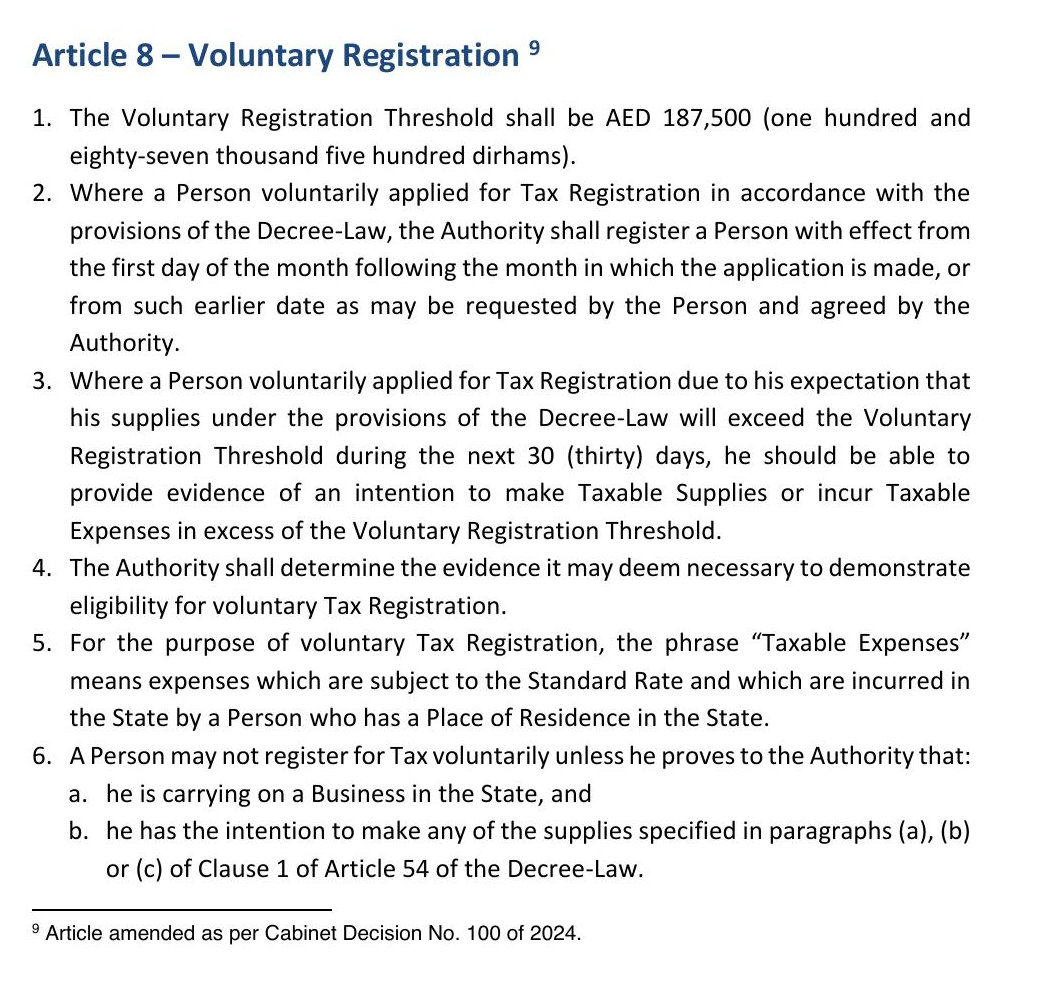
| Amount | Taxable supplies and imports over the preceding 12 months exceeding AED 375,000, or expected to exceed it in the next 30 days | Taxable supplies and imports, or taxable expenses, over the preceding 12 months exceeding AED 187,500, or expected to exceed it in the next 30 days |
| Result | Must register | May apply; meeting the amount does not guarantee approval |
Applying for voluntary registration also requires:
- Proving to the tax authority that the business is conducted in the UAE and that it intends to make specific supplies listed under VAT law (see the sources note); the tax authority may require evidence of eligibility
- Anyone applying based on expected amounts must provide evidence of the intention to transact or incur expenses
- Taxable expenses here are limited to: expenses incurred domestically at the standard rate by a person with a place of residence in the UAE
Non-resident businesses: a non-resident making taxable supplies in the UAE must in principle register even if the value of those supplies does not reach the general threshold, unless another party in the UAE is responsible for paying the VAT on those supplies, in which case this does not apply.
Supplies that are entirely zero-rated: zero-rated means a 0% rate that is still treated as a taxable supply. Under the September 2026 VAT Executive Regulation, a taxable person whose supplies are entirely zero-rated can apply for an exception from registration, but still needs to apply in the manner the tax authority specifies, and the tax authority decides whether to approve or refuse it. If circumstances change and the conditions are no longer met, the person must notify within 10 business days of making a standard-rated supply or import, and register once the exception no longer applies.
**Example**: If Mr. Lin’s company had taxable supplies and imports over AED 375,000 in the preceding 12 months, it would need to register. If it did not exceed that but exceeded AED 187,500, it could apply for voluntary registration, though it would still need to prove it is doing business in the UAE and meet the other conditions, and approval is not guaranteed.
Filing and Payment Deadlines
The tax authority must receive the return, and the tax due under that return, by the 28th day after the end of the relevant tax period, or by a date the tax authority specifies. Note this is the 28th day after the tax period ends, not the 28th of every month. A person whose registration has been cancelled must still file a final return for the last registered tax period.
Record Keeping
VAT records related to real estate that are required to be kept by law must be kept for 15 years after the end of the relevant tax period; other records follow the periods, limits, and conditions set in the Tax Procedures Law and its executive regulation.
A Free Zone Is Not the Same as VAT Exemption
Being in a free zone does not automatically mean VAT exemption. VAT is based on whether an area is a designated zone, and not every free zone is a VAT designated zone.
- A designated zone must be designated by the Cabinet and meet set conditions
- A person established, registered, or resident in a designated zone is treated as UAE-resident for VAT purposes
- Where the place of supply of a service (where tax law treats a transaction as occurring) is in a designated zone, it is in principle treated as being inside the UAE
There is also one specific exception: transport or delivery services directly connected to specific goods whose place of supply is outside the UAE are treated as supplied outside the UAE, if all four of the following apply:
- The service and the goods are supplied by the same supplier
- The supplier of the goods is a non-resident not registered for VAT
- The goods are sold through an electronic sales platform as defined by the regulation
- The platform owner is not the supplier of the goods
So free zone or designated zone status alone cannot be used to claim that an entire business is free of VAT. A QFZP’s 0% corporate tax rate and a VAT designated zone are two different systems.
E-Invoicing: Do Companies Not Yet Registered for VAT Need to Worry?
The answer is yes: the scope of Electronic Invoicing is not limited to businesses registered for VAT. Low-revenue companies and holding companies both need to confirm whether they are in scope.
Under the Ministry of Finance’s Version 2.0 Electronic Invoicing Guidelines dated October 26, 2026:
- In scope: in principle, business transactions of anyone conducting business in the UAE, whether or not established in the UAE or registered for VAT, except where specifically excluded
- Out of scope: supplies to, or received from, a natural person who is not conducting business
- Consumers: when supplying to consumers, the supplier or a collection agent has no e-invoicing obligation
How is the identifier assigned?
- The participant identifier for e-invoicing is the Tax Identification Number (TIN)
- For anyone already registered with the FTA for any tax, the TIN is the first 10 digits of their Tax Registration Number (TRN)
- Members of a VAT Tax Group use the first 10 digits of their own TRN, not the representative member’s TRN
- A person within e-invoicing scope who does not need to register for any tax still needs to register with the FTA to obtain a TIN; getting a TIN does not mean VAT registration is required
Implementation Timeline
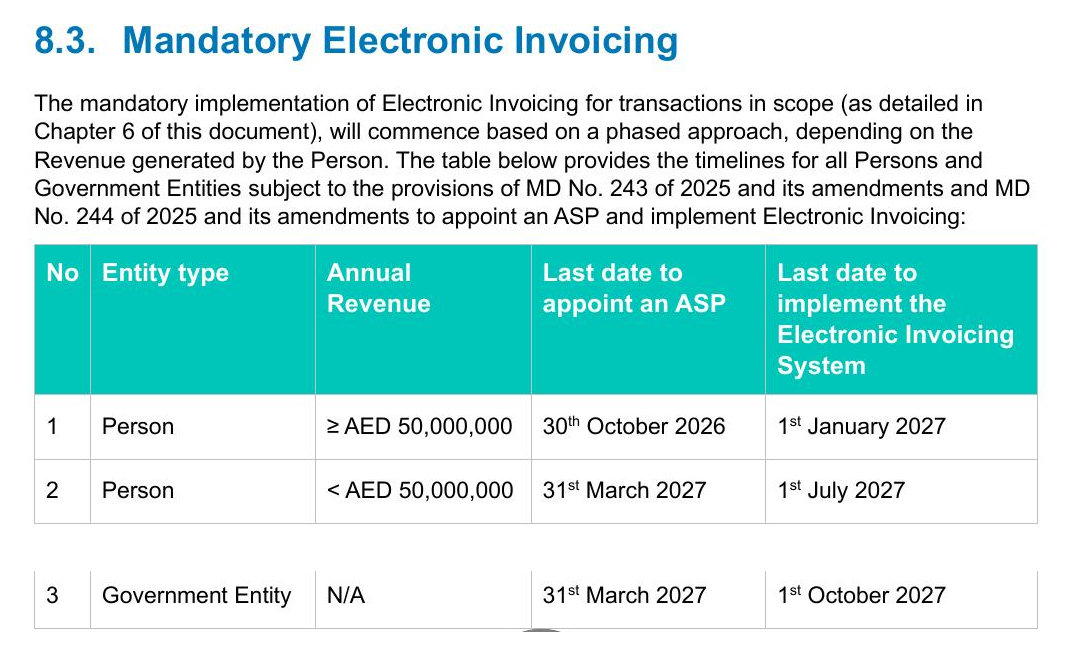
Businesses in scope are phased by annual revenue and must first appoint an Accredited Service Provider (ASP), an accredited e-invoicing service provider that an in-scope person is required to appoint:
| Annual Revenue | Deadline to Appoint an ASP | Deadline to Implement E-Invoicing |
|---|---|---|
| AED 50 million or more | Before October 30, 2026 | Before January 1, 2027 |
| Below AED 50 million | Before March 31, 2027 | Before July 1, 2027 |
Having lower revenue only means a later timeline, not a permanent exemption; government entities have their own separate timeline.
**Example**: Even if Mr. Lin’s company is not registered for VAT, if it has in-scope business transactions it still needs to follow the timeline. If its annual revenue is below AED 50 million, that means appointing an ASP by March 31, 2027 and implementing e-invoicing by July 1, 2027.
Exclusions and Exceptions
Under a Ministerial Decision effective October 1, 2026, certain transactions are outside the scope of e-invoicing, for example:
- Financial services that are exempt or zero-rated under the VAT Executive Regulation
- Business transactions between members of the same VAT Tax Group, for 24 months starting January 1, 2027
The Tax Group referred to here is a group registered as a single taxable person with the Federal Tax Authority under VAT law; it is not the same as a Corporate Tax Group, an accounting consolidation group, or every related entity in general. The 24-month exclusion is not a permanent exemption, and the group’s obligations for transactions with outside parties still need to be checked separately. There are also separate exclusions for government and aviation transactions and voluntary-adoption provisions, and the Minister may specify other excluded transactions.
Investment holding companies: a company is outside the scope of e-invoicing if it meets both of the following: all of its revenue comes from passive income (income not generated by day-to-day operations), and it has no business transactions at all. But if the company recharges operating costs or other expenses, such as management fees, to a third party or a related party, that recharge is a business transaction, and the company must register for e-invoicing under the phased timeline and issue e-invoices for those transactions.
What Are the Penalties for Non-Compliance?
The Ministry of Finance has published the new penalty text (a Cabinet Decision):
- Violation: an issuer or recipient failing to implement the e-invoicing system as required, including failing to appoint an ASP
- First offense: AED 5,000
- Continuing violation: an additional AED 5,000 for each month or part of a month
- Cap: total penalties within any 12 consecutive months are capped at AED 50,000
- Does not apply to: anyone who voluntarily adopted e-invoicing
The decision takes effect the day after it is published in the Official Gazette; the effective date of the new penalties depends on that publication date.
License Renewal: Is Paying the Fee Enough?
No. Taking DMCC as an example, renewal involves more than paying a fee: a company must also keep meeting the rules, file audited financial statements as required by law, and show it has no overdue liabilities. Rules differ across free zones and mainland licenses.
The DMCC Example
Under DMCC’s Licensing Rules, a company must renew its license before the expiry date shown on it, and may not operate in or from the zone without a valid license. Except where the Registrar specifies otherwise, renewal requires:
- Continued compliance with the rules and with relevant valid licenses, permits, visas, and approvals
- Submission of audited financial statements and reports as required by law (except where exempted by applicable law and rules)
- Proof of no overdue liabilities
- Payment of the renewal fee and any other applicable fees
- Any other information the Registrar reasonably requires
The Registrar is the DMCC official responsible for approving licenses and registration matters.
What if renewal is missed? The Registrar has discretion to grant a limited grace period (extra time granted after the deadline to complete renewal); it is not automatic. If the license is still not renewed within any grace period granted, the license can be suspended or terminated, and the Registrar can take other measures it considers necessary.
As listed in DMCC’s fee schedule on November 2, 2026:
| Item | Amount |
|---|---|
| Formation: License (annual) | AED 20,285 |
| Formation: Establishment Card (annual) | AED 1,825 |
| Trading and Services license, 1-year renewal | AED 20,265 |
Points to note about this table:
- Renewal pricing does not apply to business centers, general trading, industrial, and refining activities; adding activities can also change the fee
- The fee schedule separately lists a general AED 20 Knowledge and Innovation fee, but does not state whether it is already included in the amounts above
- Services not listed need to be checked separately; DMCC reserves the right to adjust fees without notice
- The renewal amount should not be treated as an all-in annual fee covering office space, residency, and all compliance costs
The JAFZA Example
Under the Jebel Ali Free Zone (JAFZA) 2023 Rules:
- Customers need a valid lease and a valid license to operate in the zone, and must renew both lease and license on the schedule JAFZA sets
- Different requirements may apply to users of workstations in business centers or incubators
- An entity registered and licensed by another UAE authority needs JAFZA’s permission to lease premises in the zone
The Dubai Mainland License Example
Under Dubai’s 2011 Law on Economic Activities:
- A business license is valid for 1 year and can be renewed for the same period
- At a company’s request, and with approval coordinated between the Department of Economic Development and the relevant authority, it can be issued for more than 1 year, up to a maximum of 4 years
- A company must renew its license within the last month before expiry
This reflects the 2011 version of the law; whether it has since been amended still needs to be checked against the regulator’s current rules.
License Renewal and Banks
Once a license is renewed, the bank also needs to be notified. Taking Abu Dhabi Commercial Bank (ADCB)’s FAQ as an example:
- The bank requires customers to submit the renewed license, and to update any change in activity, ownership, or company name
- If the license is not updated within 30 days of expiry, the account is charged an AED 150 monthly expired-license fee
- Failing to submit the updated license and company information can lead to the account being restricted or closed
This is this particular bank’s policy, not a general rule for every bank.
Separately, under the UAE’s 2025 Anti-Money Laundering Implementing Regulation, banks must continuously review transactions throughout the business relationship to confirm they are consistent with what the bank knows about the customer, the nature of the business, and risk information, including, where necessary, the source of funds. Banks also need to keep Customer Due Diligence (CDD, the bank’s process for verifying a customer’s identity and transaction background) documents and information up to date, particularly for higher-risk customer records. In other words, submitting a complete set of documents at account opening does not mean no further documents will ever be requested. For more on the conditions for opening an account, see our guide to UAE company bank accounts: KYC, substance, and transaction-background requirements.
**Example**: If Mr. Lin held an account with ADCB and did not update his license information within 30 days of expiry, the account would be charged an AED 150 monthly expired-license fee; if the update is never submitted, the account could be restricted or closed.
Company Changes: Do I Need to Apply When I Change Business Activity or Shareholders?
Running a company inevitably means adjusting its activities or shareholders at some point. The answer is yes: taking DMCC as an example, any change to a license’s address, activity, or other details requires the Registrar’s prior approval; a company cannot make the change first and register it later. Updating beneficial owner records also has a statutory deadline.
Changing License Details
Under DMCC’s Licensing Rules, subject to the relevant provisions of the Company Regulations, when a company plans to change the address, activity, or other details on a valid license, it must apply to the Registrar for approval in a timely manner, with supporting documents, and pay the fee set in the fee schedule; the Registrar can request further information before approving.
**Example**: If Mr. Lin’s company wanted to add a new business activity, it would need the DMCC Registrar’s approval first; it could not start the new activity and register it afterward. The fee schedule also notes that adding activities can change the license fee.
Beneficial Owner and Shareholder Records
A Beneficial Owner is the person who actually owns or controls a company, who is not necessarily the same as the shareholder registered on paper. Under the UAE’s 2025 Anti-Money Laundering Implementing Regulation, a company must:
- Keep up-to-date basic information, nominee director/shareholder information (a director or shareholder who holds the position on behalf of someone else), and beneficial owner information
- Update it within 15 business days of any change, and continually verify its accuracy
- Provide financial institutions and other regulated entities with complete, accurate, and current beneficial owner information
- Keep its register of shareholders in the UAE as a rule; if beneficial owner information is already kept in the UAE and can be provided promptly on request, the register of shareholders does not need to be kept in the UAE
Separately, the 2023 Beneficial Owner Procedure Decision requires a legal person to update its register within 15 days of becoming aware of a change to beneficial owner information. This decision applies to legal persons registered or licensed in the UAE, including those in commercial free zones; it does not apply to companies wholly owned by federal or local government (and companies wholly owned by those companies), financial free zones, and government partners. The two rules use different wording and different starting points for the clock, so they cannot substitute for each other:
| Rule | Deadline | Clock Starts |
|---|---|---|
| 2025 Anti-Money Laundering Implementing Regulation | 15 business days | After the change occurs |
| 2023 Beneficial Owner Procedure Decision | 15 days | From the date of becoming aware of the change |
Operating Outside the Free Zone: What Should a Free Zone Company Watch for When Doing Business Outside Its Zone or in Another Emirate?
A free zone company wanting to do business outside its zone needs to check location first. Within Dubai, a business approved to operate outside the free zones must follow two rules; going outside Dubai requires a separate local license. Under Dubai’s 2025 Executive Council Resolution:
- Inside Dubai, outside the free zone: the company must comply with the relevant federal and local activity regulations, and keep financial records for its outside-zone activity separate from its inside-zone business
- Outside Dubai: the company still needs whatever license and permit the local authority in that emirate requires
In other words, Dubai’s outside-zone permission does not extend to other emirates, and keeping separate financial records does not necessarily mean a separate legal entity must be set up.
Do Economic Substance Requirements (ESR) Still Apply?
They no longer apply to financial years ending after December 31, 2022, but obligations from the older 2019 to 2022 years still stand.
Economic Substance Requirements (ESR) is a regime requiring licensees to file notifications, submit reports, and meet substance tests. According to an official notice from the Abu Dhabi Global Market (ADGM), following a Cabinet Decision issued by the Ministry of Finance on September 2, 2024, ESR no longer applies to financial years ending after December 31, 2022; but licensees still need to file the notifications and reports that were originally due, and meet the substance tests, for the period from January 1, 2019 to December 31, 2022.
It is worth noting that the substance conditions for corporate tax QFZP status are a separate regime from ESR and should not be conflated.
Frequently Asked Questions
Is the AED 375,000 corporate tax threshold based on revenue? No. It is based on taxable income. Under the general taxable person regime, taxable income up to AED 375,000 is taxed at 0%, and the portion above that at 9%.
Is all income of a free zone company exempt from corporate tax? No. Only a company that qualifies as a Qualifying Free Zone Person (QFZP) gets 0% on its qualifying income; taxable income from non-qualifying income is taxed at 9%.
What is the VAT registration threshold? Mandatory registration applies once taxable supplies and imports over the preceding 12 months exceed AED 375,000, or are expected to exceed it in the next 30 days. This threshold does not apply to foreign businesses; non-resident businesses making taxable supplies in the UAE have separate registration rules.
Is paying the fee enough to renew a DMCC license? No. Besides paying the fee, a company must keep meeting the relevant rules, license, and visa requirements, submit audited financial statements as required by law (unless exempted), and show it has no overdue liabilities.
Does e-invoicing only apply to companies registered for VAT? No. In principle, business transactions of anyone conducting business in the UAE are within the scope of e-invoicing, whether or not they are registered for VAT, except where specifically excluded.
Glossary
- Taxable Income: income calculated under tax law for corporate tax purposes. The AED 375,000 0% threshold applies to taxable income, not revenue.
- Qualifying Free Zone Person (QFZP): a free zone person that maintains adequate substance, earns qualifying income, and meets other statutory conditions. Qualifying income gets 0%; taxable income from non-qualifying income gets 9%.
- Designated Zone: an area designated by the Cabinet that meets set conditions; not every free zone is a VAT designated zone.
- Accredited Service Provider (ASP): a service provider that an in-scope person must appoint by a set deadline under the e-invoicing system.
- Tax Identification Number (TIN): the participant identifier for e-invoicing. For anyone registered for any tax, it is the first 10 digits of their Tax Registration Number (TRN).
- Beneficial Owner: the person who actually owns or controls a company. Changes to this information have a statutory update deadline.
Sources and Caveats
This article was checked on November 2, 2026. The DMCC, JAFZA, and Dubai mainland licensing rules described here are examples from individual authorities; they do not represent every free zone or emirate. ADCB’s expired-license fee is a snapshot from that bank’s FAQ page; it does not represent every bank. “Mr. Lin” in this article is an illustrative example, not a real case.
The Corporate Tax Law referred to in this article is Federal Decree-Law No. 47 of 2022 on the Taxation of Corporations and Businesses, read in an unofficial English translation; the publicly available English texts of FTA Decision No. 6 of 2026 and No. 12 of 2026 are also marked as unofficial translations. Corporate tax deadlines in this article have not been checked against every subsequent amendment or case-by-case extension. Small Business Relief here only combines Ministerial Decision No. 73 of 2023 and its 2026 amendment, No. 131 of 2026. The description of ESR changes follows ADGM’s official notice, not a direct quote from Cabinet Decision No. 98 of 2024. The description of the 2023 Beneficial Owner Procedure Decision (Cabinet Decision No. 109 of 2023) is a verbatim copy of the officially archived text as it stood on the same date, and may not reflect the latest consolidated version; beneficial-owner reporting deadlines set separately by individual registering authorities have not been fully cross-checked. The term of the Dubai mainland license described here reflects the 2011 version of the law. Not yet confirmed: the Official Gazette publication date for the new e-invoicing penalties had not been found as of this check.
Articles and decision numbers cited in this article:
- Accounting and records: DMCC Company Regulations, Article 74; corporate tax record keeping is Corporate Tax Law, Article 56; VAT real estate records are VAT Executive Regulation, Article 71.
- Corporate tax: the general rate is Cabinet Decision No. 116 of 2022; filing and payment are Corporate Tax Law, Articles 53 and 48; Small Business Relief is Ministerial Decision No. 73 of 2023 and its 2026 amendment, No. 131 of 2026; the QFZP definition and rate are Corporate Tax Law, Articles 3 and 18, with conditions including compliance with Articles 34 and 55; adequate substance is Cabinet Decision No. 100 of 2023, Article 8; the de minimis threshold is Ministerial Decision No. 229 of 2025, Article 3 (the intellectual-property exclusion does not cover qualifying-income-related revenue under Cabinet Decision No. 100 of 2023, Article 7(1)); loss of status is Ministerial Decision No. 229 of 2025, Article 5; the audited-statement requirement is Ministerial Decision No. 84 of 2025; the agreed-upon procedures report for distribution activities is FTA Decision No. 6 of 2026, and the conditions treated as “not met” for failing to submit it are set in Ministerial Decision No. 84 of 2025 and No. 229 of 2025; Top-up Tax registration is FTA Decision No. 12 of 2026, Article 2.
- VAT: the supply intention required for voluntary registration is VAT Law, Article 54(1)(a)-(c); the zero-rated exception from registration is VAT Executive Regulation, Article 16; filing and payment are Article 64; designated zones are Article 51, with the specific transport/delivery exception at Article 51(7) and the goods it covers defined at Article 5(b)(c).
- E-invoicing: excluded transactions are set in Ministerial Decision No. 197 of 2026, with financial services defined under VAT Executive Regulation Article 42; the new penalties are Cabinet Decision No. 173 of 2026.
- License renewal and changes: DMCC Licensing Rules, Articles 3.3.1 to 3.3.3 (renewal), Article 3.3.4 (grace period; suspension or termination under Article 5), and Article 3.2.8 (changes); JAFZA 2023 Rules, Articles 6.2 and 6.3; the Dubai mainland license is Dubai Law No. 13 of 2011 on Economic Activities, Article 8.
- Banks and beneficial owners: 2025 Anti-Money Laundering Implementing Regulation (Cabinet Decision No. 134 of 2025), Article 8 (ongoing bank review) and Article 38 (updating company information); 2023 Beneficial Owner Procedure Decision (Cabinet Decision No. 109 of 2023), Article 8.
- Operating outside the free zone: Dubai Executive Council Resolution No. 11 of 2025, Article 3.
- ESR: the Cabinet Decision referenced by ADGM’s notice is Cabinet Decision No. 98 of 2024.
Need help with this? Talk to the Zagdim reader desk
If you are deciding which route fits you, or which authority to deal with, the Zagdim reader desk can arrange a suitable specialist for your situation. The first consultation is free.
Message the Zagdim reader desk on WhatsApp Message the Zagdim reader desk on LINE
Have a question about this guide? Leave a comment below, or ask Zagdim directly.
Your first stop for international property and global living.
Research and insights. Know what’s changing. Understand what matters.
References
- Dubai Supreme Legislation Committee, Executive Council Resolution No. 11 of 2025: https://dlp.dubai.gov.ae/Legislation%20Reference/2025/Executive%20Council%20Resolution%20No.%20%2811%29%20of%202025%20Regulating%20the%20Conduct%20of%20Free%20Zone%20Establishments%E2%80%99%20Activities.pdf
- Dubai Multi Commodities Centre (DMCC), Schedule of Charges, Company Setup Standard Pricing: https://dmcc.ae/members/support/schedule-charges
- Dubai Multi Commodities Centre (DMCC), Schedule of Charges, Standard Licenses Renewal: https://dmcc.ae/members/support/schedule-charges
- DMCC, Licensing Rules Version 3: https://dmcc.ae/hubfs/Compliance%20Documents%202024/Licensing%20Rules-%20Final.pdf?hsLang=en
- UAE Cabinet, hosted by JAFZA, Cabinet Resolution No. 134 of 2025 (Anti-Money Laundering): https://www.jafza.ae/resource-centre/downloads/cabinet-resolution-no-134-of-2025-regarding-anti-money-laundering/
- Abu Dhabi Commercial Bank (ADCB), Business Account FAQ: https://www.adcb.com/en/get-in-touch/faqs/accounts/business-choice-account-faq
- UAE Ministry of Finance, Ministerial Decision No. 84 of 2025 on Audited Financial Statements: https://www.mof.gov.ae/wp-content/uploads/2025/04/Ministerial-Decision-No.-84-of-2025-on-Audited-Financial-Statements.pdf
- DMCC, Guidelines, Audited Financial Statements Submission: https://dmcc.ae/hubfs/website%20support%20documents/15.%20Guidelines%20-%20Audited%20Financial%20Statements%20Submission.pdf?hsLang=en
- DMCC, DMCCA Company Regulations: https://dmcc.ae/hubfs/Compliance%20Documents%202024/DMCCA%20Company%20Regulations%20-%202024%20%5BAmended%5D.pdf?hsLang=en
- UAE Cabinet / Ministry of Finance, Cabinet Decision No. 116 of 2022 on Annual Taxable Income Subject to Corporate Tax: https://mof.gov.ae/wp-content/uploads/2023/04/Cabinet-Decision-No-116-of-2022-on-the-annual-Taxable-Income-subject-to-Corporate-Tax.pdf
- FTA, Corporate Tax Registration Timelines Public Clarification: https://tax.gov.ae/en/media.centre/news/federal.tax.authority.issues.public.clarification.on.registration.timelines.for.taxable.persons.for.corporate.tax.aspx
- FTA / UAE Federal Government, Federal Decree-Law No. 47 of 2022: https://tax.gov.ae/Datafolder/Files/Legislation/Corporate%20Tax/CT%20law%20final/Federal%20Decree-Law%20No.%2047%20of%202022%20-%20For%20publishing.pdf
- FTA / UAE Ministry of Finance, Ministerial Decision No. 73 of 2023; Ministry of Finance, Ministerial Decision No. 131 of 2026: https://tax.gov.ae/Datafolder/Files/Legislation/Corporate%20Tax/Ministerial%20Decision%20No.%2073%20of%202023%20-%20for%20publishing.pdf
- FTA, Registration For VAT: https://tax.gov.ae/en/taxes/Vat/vat.topics/registration.for.vat.aspx
- FTA / UAE Federal Government, VAT Executive Regulation, September 2026 edition: https://tax.gov.ae/Datafolder/Files/Legislation/2026/Law-No-8-of-2017-and-its-amendments–09-2026.pdf
- FTA, Value Added Tax (VAT) Registration FAQ: https://tax.gov.ae/en/services/vat.registration.aspx
- UAE Ministry of Finance, Ministerial Decision No. 229 of 2025 Regarding Qualifying Activities and Excluded Activities: https://mof.gov.ae/wp-content/uploads/2025/09/EN-Ministerial-Decision-No.-229-of-2025-Regarding-Qualifying-Activities-and-Excluded-Activities.pdf
- FTA / UAE Cabinet, Cabinet Decision No. 100 of 2023 on Determining Qualifying Income for the Qualifying Free Zone Person: https://tax.gov.ae/Datafolder/Files/Legislation/Cabinet%20Decision%20No.%20100%20of%202023%20on%20Determining%20Qualifying%20Income%20for%20the%20Qualifying%20Free%20Zone%20Person%20-%20for%20publishing.pdf
- FTA, Decision No. 6 of 2026 on Determining the Additional Procedures for the Compliance of QFZP: https://tax.gov.ae/Datafolder/Files/Legislation/2026/FTA%20Decision%20No.%206%20of%202026%20on%20Determining%20the%20Additional%20Procedures%20for%20the%20Compliance%20of%20QFZP%20-%20for%20publishing%20-%2007%202026.pdf
- UAE Ministry of Finance, Ministry of Finance Announces Amendments to the Corporate Tax Law (DMTT): https://mof.gov.ae/en/news/ministry-of-finance-announces-amendments-to-the-corporate-tax-law/
- FTA, Decision No. 12 of 2026 on Registration and Deregistration Timelines: https://tax.gov.ae/Datafolder/Files/Pdf/2026/legislation/FTA%20Decision%20No.%2012%20of%202026%20on%20Registration%20and%20Deregistration%20Timelines%20-%2008%202026.pdf
- UAE Ministry of Finance, UAE Electronic Invoicing Guidelines V2.0: https://mof.gov.ae/wp-content/uploads/2026/10/UAE-Electronic-Invoicing-Guidelines_En.pdf
- UAE Ministry of Finance, Ministerial Decision No. 197 of 2026, Amending Certain Provisions of Ministerial Decision No. 243 of 2025 on the Electronic Invoicing System: https://mof.gov.ae/wp-content/uploads/2026/10/Ministerial-Decision-No.-197-of-2026-%E2%80%93-Amending-Certain-Provisions-of-Ministerial-Decision-No.-243-of-2025-on-the-Electronic-Invoicing-System_En.pdf
- UAE Cabinet / Ministry of Finance, Cabinet Decision No. 173 of 2026 on the Violations and Administrative Penalties Resulting from Violation of the Legislation Regulating the Electronic Invoicing System: https://mof.gov.ae/wp-content/uploads/2026/10/Cabinet-Decision-No.-173-of-2026-On-the-Violations-and-Administrative-Penalties-Resulting-from-Violation-of-the-Legislation-Regulating-the-Electronic-Invoicing-System_En.pdf
- JAFZA, Jafza Rules 2023: https://www.jafza.ae/resource-centre/downloads/jafza-rules-regulations/
- Dubai Supreme Legislation Committee, Law No. 13 of 2011: https://dlp.dubai.gov.ae/Legislation%20Reference/2011/Law%20No.%20%2813%29%20of%202011.html
- UAE Cabinet / JAFZA, Cabinet Decision No. 109 of 2023 (Beneficial Owner Procedure): https://www.jafza.ae/resource-centre/downloads/regulating-beneficial-owner-procedure/
- Abu Dhabi Global Market (ADGM), ADGM Economic Substance, 2024 amendment notice: https://www.adgm.com/operating-in-adgm/obligations-of-adgm-registered-entities/economic-substance
Important Notice
This article is general information and does not constitute tax or legal advice for any individual case. Information was checked as of November 2, 2026. UAE regulations may be updated; please follow the current guidance of the relevant authorities, and consult a qualified professional for your specific situation.