






























This article is part of Zagdim’s wiki series on setting up a company in the UAE. It is written for anyone preparing to form a UAE company and open a business bank account for it, wherever you are based, and whether or not you plan to live in the UAE yourself. It covers:
- The basic eligibility for opening a business bank account for a UAE company
- Know Your Customer (KYC) checks: how a bank confirms who a customer is and what business they do
- Beneficial Owner (UBO) checks: identifying who actually benefits from or controls a company
- Common documents, and common reasons banks decline an application
Company formation and bank account opening are two separate processes. The bank reviews the account application separately, under its own anti-money-laundering rules. For the differences between UAE company types and their substance requirements, see Zagdim’s separate main article on Mainland, Free Zone, and Offshore company setup for foreigners forming a company in the UAE.
Example used throughout this article (a fictional scenario): An entrepreneur co-founds a UAE trading company with two business partners based in another country. She holds less than 25% of the shares but manages the company’s day-to-day operations; none of the three shareholders are UAE residents. The sections below apply the rules to this scenario.
Does Getting a UAE Company License Guarantee a Bank Account?
A bank is not obligated to open an account just because a company is registered and licensed.
The reason lies in the UAE’s 2025 anti-money-laundering implementing rules:
- If a financial institution cannot complete Customer Due Diligence (CDD), it may not establish or maintain a business relationship, or carry out transactions, and must consider filing a suspicious transaction report where necessary.
- CDD = the process by which a bank verifies a customer’s identity, business, and ownership structure.
- Suspicious transaction report = a formal report a bank files when it finds a transaction suspicious.
- There is one exception: if the bank suspects a crime and has reasonable grounds to believe that carrying out CDD would tip off the customer, it may skip CDD, but it must still file a suspicious transaction report and explain why. This is an arrangement to avoid alerting a suspect, not a general exemption from checks.
For readers, this means: successfully forming a company only gives you one of the basic qualifications to apply for a business account. If the bank cannot complete CDD, it cannot open the account. In the example above, getting the license only means the company can start applying; it does not mean the account will definitely open.
What Else Will the Bank Check Beyond the License?
In short, the bank wants to confirm who owns the company, who controls it, what business it does, and what the account will be used for.
Under the anti-money-laundering implementing rules, for a legal person or legal arrangement (a legal person is an organization such as a company that can own property and sign contracts in its own right; a legal arrangement, such as a trust, is not a company but is similarly used to hold or manage property), the bank must obtain:
- Name, legal form, and constitutional documents
- The tax registration number, for legal persons subject to corporate tax
- A unique reference number, if any
- The registered office or principal place of business address, with supporting evidence
- Information on senior management
- For foreign legal persons, the name and address of their UAE legal representative, if any
The bank also verifies the authorization and identity of any agent acting on the company’s behalf, and seeks to understand the purpose and intended nature of the business relationship, along with the customer’s business, ownership, and control structure.
If I Own Less Than 25%, Will the Bank Still Check Me as a Beneficial Owner?
Someone holding less than 25% of the shares can still be treated by the bank as a beneficial owner if they hold an actual controlling interest or have another form of control.
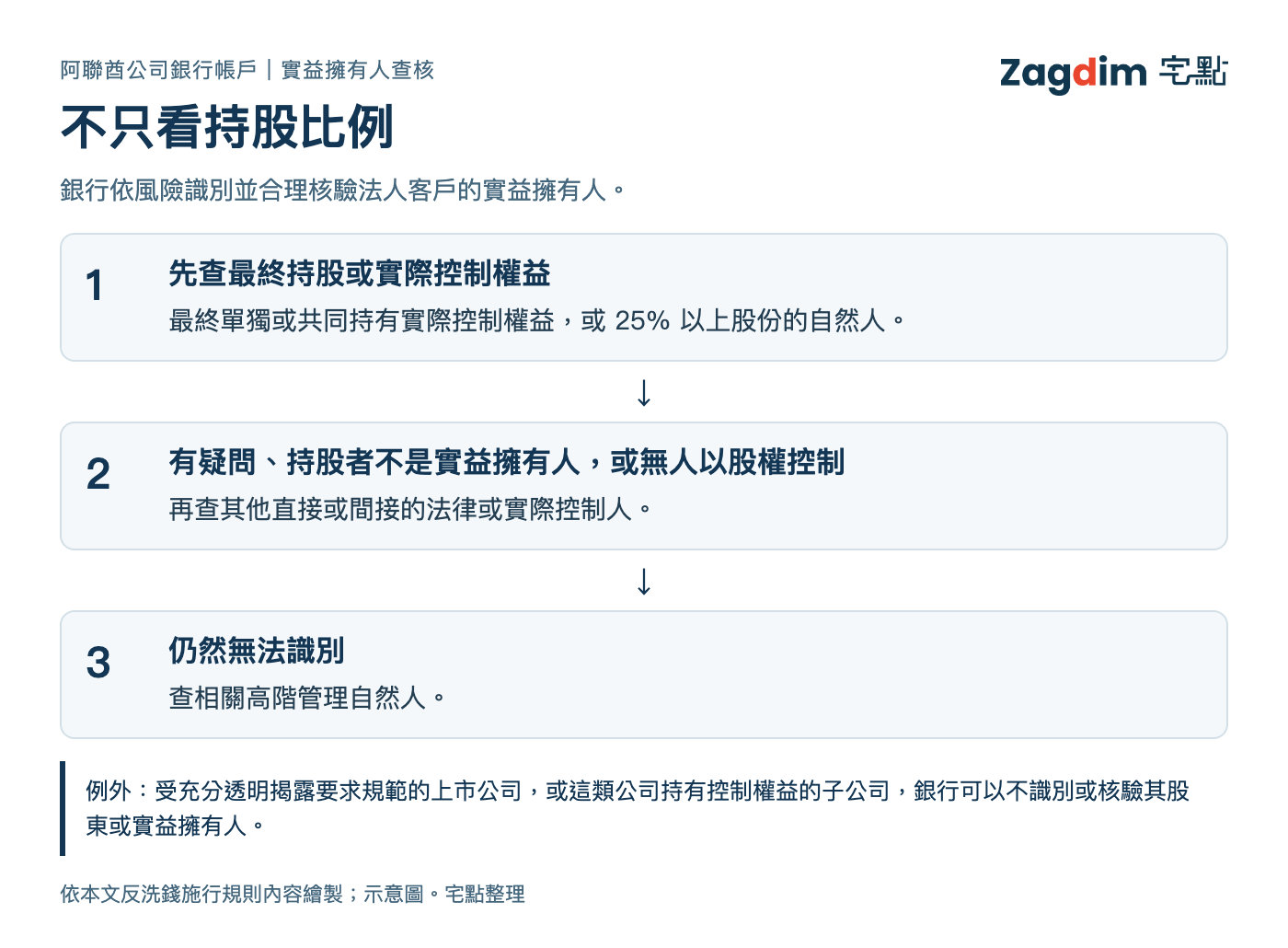
The anti-money-laundering implementing rules require banks to identify and reasonably verify the beneficial owners of a corporate customer on a risk basis, in this order:
- First, identify any natural person (a real individual, not a company) who ultimately holds, alone or jointly, an actual controlling interest or 25% or more of the shares.
- If there is doubt, if the shareholder identified is not actually the beneficial owner, or if no one controls the company through shareholding, identify other persons with direct or indirect legal or actual control.
- If still unable to identify anyone, identify the relevant senior managing individuals.
There is an exception: for listed companies subject to adequate transparency disclosure requirements, or subsidiaries in which such a listed company holds a controlling interest, the bank may choose not to identify or verify their shareholders or beneficial owners.
In other words, 25% is the first line of assessment, not the only standard. In the example above, even though her shareholding is under 25%, if she actually controls the company, the bank may still treat her as a beneficial owner subject to checks.
Does the Bank Stop Checking Once the Account Is Open?
Opening the account successfully does not end the bank’s checks. It is not a case of submitting everything once: the law requires banks to continuously review transactions and continuously update customer information.
- Banks must continuously review transactions throughout the business relationship to confirm they are consistent with the bank’s knowledge of the customer, the nature of their activity, and risk information, including the source of funds where necessary.
- Banks must also continuously update CDD documents and information, especially for higher-risk customers.
For readers, this means: after the account opens, the bank must still continuously review whether transactions are consistent with the customer, the nature of the activity, and risk information it holds, including the source of funds where necessary, and must continuously update CDD documents. Submitting everything once at account opening does not mean you will never be asked for documents again.
How Quickly Must the Bank Be Updated After a Shareholder or UBO Change?
When shareholding or beneficial ownership changes, there are two separate deadlines to watch. In short: the 2025 anti-money-laundering implementing rules require an update within 15 working days of the change; the 2023 beneficial owner procedures decision requires an update within 15 days of becoming aware of the change. The starting point and the way the days are counted differ between the two, so they cannot be used interchangeably.
| 2025 AML Implementing Rules | 2023 Beneficial Owner Procedures Decision | |
|---|---|---|
| Deadline | Within 15 working days after the change occurs | Within 15 days of becoming aware of the change |
| What must be done | The company keeps and updates its basic information, the latest information on nominee directors or shareholders, and beneficial owner information, and continuously verifies its accuracy | The legal person updates its register of beneficial owners |
| Who it applies to | Companies | Legal persons registered or licensed in the UAE, including commercial free zones; does not apply to wholly federal- or local-government-owned companies (and their wholly owned subsidiaries), financial free zones, or government partners |
A nominee director or shareholder is a director or shareholder whose name is recorded on the company’s documents while acting on behalf of someone else.
Under the 2025 rules, there are two further points:
- Companies must provide financial institutions and other regulated entities with sufficient, accurate, and up-to-date beneficial owner information.
- In principle, the register of shareholders must be kept inside the UAE; however, if beneficial owner information is already kept inside the UAE and can be provided immediately on request, the register of shareholders does not need to be kept inside the UAE.
For example, if one of the owner’s partners in the scenario above transfers out their shares, the company needs to separately confirm which rule and deadline applies, and provide the latest beneficial owner information to its bank.
Basic Account Requirements at Four Banks
The following summarizes four banks covered in this research. All of them accept applications from companies holding a valid UAE license, but residency conditions, documents, fees, and product limits differ between them; meeting the stated eligibility does not guarantee approval. The information comes from each bank’s website, FAQ pages, and Key Fact Statement (KFS: a document in which a bank sets out a product’s conditions and fees).
| Bank and Product (Document) | Residency-Related Condition |
|---|---|
| Emirates NBD Digital Application (business banking page) | At least 1 signatory must be a UAE resident |
| ADCB Business Account (KFS, Ver. 04, September 2026) | All shareholders, partners, and UBOs submit a passport copy; those with resident status also submit an Emirates ID copy |
| Mashreq NEO BIZ (FAQ page) | At least 1 signatory must be a UAE resident |
| Mashreq NEO BIZ Pro/Pro Plus (KFS, September 2026 version) | At least one partner or Power of Attorney (POA) holder must be a UAE resident |
| RAKBANK Business Current Account (KFS) | Product description lists UAE nationals, residents, and GCC nationals; the eligibility section separately lists that the applicant must be at least 18 and the company must hold a valid license |
A Power of Attorney (POA) holder is someone formally authorized to act on the company’s behalf. In the example above, none of the three shareholders are residents; if the company also has no qualifying resident signatory, partner, or POA holder, it would not meet the residency conditions listed for the Emirates NBD digital application or the Mashreq documents.
Emirates NBD
- Who the digital application is for: registered businesses in the UAE engaged in trade, manufacturing, contracting, transport, professional, or service activities, where at least 1 signatory must be a UAE resident. This does not mean every shareholder must live in the UAE.
- Commonly required documents (delays in submission can delay the application; the documents listed on the page are not necessarily all required for every legal form):
- Valid trade or commercial license
- Notarized Memorandum and Articles of Association (the document recording a company’s basic details and internal rules)
- Board resolution
- General partnership agreement and amendments, if any
- Emirates ID and passport copies for all shareholders and partners
- Lease as proof of address
- Connect plan: no minimum average monthly balance requirement and no below-minimum-balance fee; a monthly maintenance fee of AED 249, with the page not stating whether this is VAT-inclusive. No minimum balance requirement does not mean the account is free. This plan is aimed more at startups and professional-license businesses that bank mainly online; it has limited branch service, higher transaction fees, and no dedicated relationship manager.
Abu Dhabi Commercial Bank (ADCB)
- Basic eligibility: a business established in the UAE, holding a valid commercial license from the relevant UAE government authority, can apply for a Business Account.
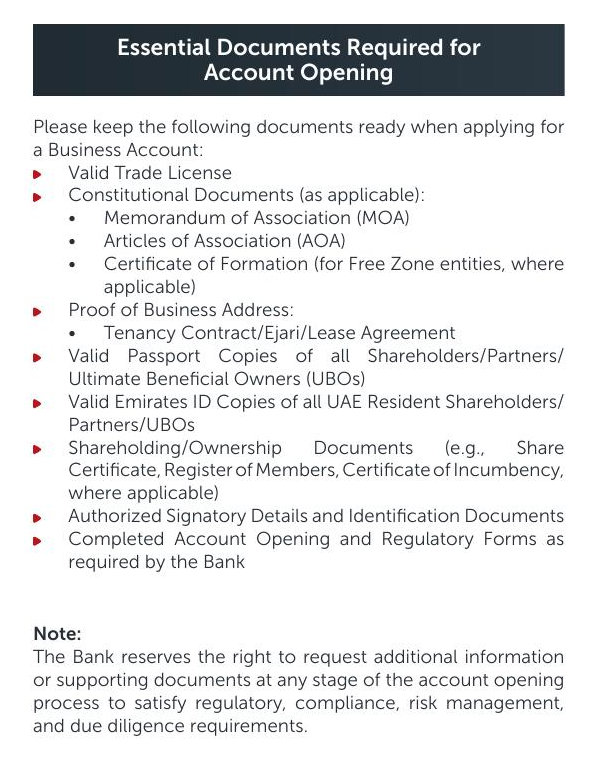
- Basic account-opening documents (the bank may request additional information or supporting documents at any stage of the process to meet regulatory, compliance, risk management, or due diligence requirements):
- Valid trade license
- Applicable constitutional documents (such as the Memorandum of Association (MOA), Articles of Association (AOA), or the relevant certificate of formation for free zone entities)
- Proof of business address (lease or Ejari)
- Valid passport copies for all shareholders, partners, and ultimate beneficial owners (UBOs)
- Valid Emirates ID copies for all shareholders, partners, and UBOs who hold UAE resident status
- Applicable shareholding or ownership documents
- Authorized signatory information and identity documents
- Account-opening and regulatory forms required by the bank
For residents, both the passport and the Emirates ID must be submitted; it is not a choice between the two.
- Smart Start account limits: transactions are restricted to within the UAE and in AED only; foreign-currency or international transfers in or out are not permitted. After 1 year, a customer can request to switch to a business account that allows foreign-currency transactions; this is not an automatic upgrade and is not guaranteed to be approved. For example, if the company in the scenario above used a Smart Start account, it would not be able to send or receive international transfers.
- Smart Start fees and opening amount:
| Item | KFS (Ver. 04, September 2026) | ADCB FAQ |
|---|---|---|
| Minimum average monthly balance | Not required | – |
| Minimum opening amount | AED 5,000 | – |
| Account maintenance fee | AED 125/month, with this section not stating whether VAT is included | AED 105/month, VAT-inclusive |
The minimum opening amount, the minimum average monthly balance, and the maintenance fee are three separate things: no minimum average monthly balance requirement should not be read as meaning no opening funds are needed, or that the account is free. The two documents give different figures, and neither is a confirmed quote for a specific customer.
- Risk after license expiry: the customer must submit a license renewal and update any change to activity, ownership, or company name. If the license is not renewed within 30 days of expiry, the account is charged AED 150 per month as an expired-license fee. Failing to submit the renewed license and company information can lead to the account being restricted or closed.
Mashreq
Mashreq’s FAQ page and its KFS state different conditions; they are listed separately below and should not be combined into one general rule for all NEO BIZ products:
| Condition | NEO BIZ FAQ Page | NEO BIZ Pro/Pro Plus KFS (September 2026 version) |
|---|---|---|
| Annual turnover | Not exceeding AED 30 million | Up to AED 100 million |
| Residency condition | At least 1 signatory must be a UAE resident | At least one partner or POA holder must be a UAE resident |
- Other FAQ content: the application is open to UAE-registered companies; commonly required documents include a trade license, Memorandum of Association, a board resolution or power of attorney authorizing account opening and operation, proof of UAE address, passports of owners and signatories, visas and Emirates IDs (where applicable), and the last 3 months of bank statements.
- Other KFS content: all owners, partners, or signatories must be at least 18 and able to complete KYC requirements; the business must be 100% owned by natural persons, and multi-layered ownership structures are not accepted. Meeting the conditions does not guarantee that the account will be opened.
- Account opening and activation process described in the FAQ:
- The bank first checks whether the documents and application are complete.
- A complete application is reviewed for eligibility before it is approved and the account opened.
- A bank representative meets the applicant in person to verify all original documents and obtain a signature.
- The account is activated only after this is completed.
- Reasons for decline listed in the FAQ: incomplete or unverifiable information about the company’s owners or signatories, the bank not supporting the relevant industry, and an inability to take on the business due to central bank compliance requirements. These are examples, not a complete list of reasons for decline.
RAKBANK
- Business Current Account eligibility: the product description lists UAE nationals, residents, and Gulf Cooperation Council (GCC) nationals holding a company with a valid license operating in the UAE; the eligibility section separately states the applicant must be at least 18, and the company must hold a valid license. The product description and the eligibility section are worded differently as to who may apply, so it cannot be assumed that all non-GCC, non-resident applicants are excluded.
- Nature of the KFS: a Key Fact Statement is not a legal contract; it does not obligate the applicant to take the account, nor does it obligate the bank to provide one. The formal application form sets out all applicable terms.
Does Having an Account Guarantee a Business Loan?
Once the account is open, the next step may be seeking a loan for working capital. But a successfully opened account does not guarantee loan approval: a business loan goes through a separate credit assessment (credit assessment = the bank’s evaluation of whether, and how much, to lend).
- Emirates NBD Term Loan: a sole proprietorship loan offered according to purpose and terms negotiated with the bank, at the bank’s discretion. The product is for UAE-licensed businesses, denominated in AED; the short-term tenor is up to 12 months, with medium- and long-term tenors agreed in the credit letter, up to 6 and 10 years respectively. Approved amounts are still reviewed internally case by case, and a separate credit agreement setting out detailed terms must be signed before funds are drawn.
- ADCB Retail Business Loan: a repayment period of up to 4 years, with repayment on an agreed schedule; taking this loan requires life insurance coverage under the bank’s group credit life policy, with the premium borne by the customer. Even after the bank approves the application, whether to disburse funds remains at the bank’s discretion.
- Mashreq Business Loan: when answering eligibility for newly formed companies, the page requires the business to have been operating for more than 2 years. The Merchant Lending online process returns an indicative loan amount, not a final approval; after accepting it, the customer must still be contacted by a relationship manager to complete the remaining application steps.
- RAKBANK Business Loan: the bank first requires all necessary documents and information in an acceptable form before assessing a financing application; approval depends on a credit review of the business’s background, repayment ability, and applicable eligibility, and the bank may request additional documents, with final loan terms communicated at the approval stage. Figures in any repayment simulation (an estimate of each installment) are illustrative only.
Frequently Asked Questions
If my company has a license, does the bank have to open an account for it?
No. A bank that cannot complete Customer Due Diligence (CDD) may not establish a business relationship; holding a license does not create an obligation for the bank to open an account.
If I own less than 25%, will the bank never check me as a beneficial owner?
No. 25% is the first line of assessment. If the bank has doubts, or if no one controls the company through shareholding, it will look further at other controlling persons or relevant senior managers.
Will the bank ask for more documents after the account is open?
It may. The bank must continuously review whether transactions are consistent with the nature of the customer’s business, and must continuously update CDD documents and information, including the source of funds where necessary.
If my company’s UBO changes, how quickly must I update the records?
Under the 2025 anti-money-laundering implementing rules, within 15 working days of the change. Under the 2023 beneficial owner procedures decision, the register must be updated within 15 days of becoming aware of the change. The two cannot be used interchangeably.
Without a UAE resident signatory, can I still apply for a digital business account?
Both the Emirates NBD digital application and the Mashreq NEO BIZ FAQ page require at least 1 signatory to be a UAE resident. Mashreq NEO BIZ Pro/Pro Plus (KFS, September 2026 version) instead requires at least one partner or POA holder to be a UAE resident.
Key Terms
- Customer Due Diligence (CDD): the process by which a bank verifies a customer’s identity, business, and ownership structure.
- Beneficial Owner (UBO): the natural person who ultimately benefits economically from, or actually controls, a company; not necessarily the person recorded as a shareholder.
- Emirates ID: the identity document for UAE residents; it appears on the document checklists for Emirates NBD, ADCB, and Mashreq account openings.
- Key Fact Statement (KFS): a document in which a bank sets out a product’s conditions and fees; RAKBANK’s KFS explicitly states it is not a legal contract and does not obligate the bank to provide an account.
Data Notes
- This article’s information was checked as of November 2, 2026; for the Emirates NBD business banking page and Connect plan, the page as archived on that date was used.
- “The 2025 anti-money-laundering implementing rules” refers to UAE Cabinet Resolution No. 134 of 2025: the handling of incomplete CDD and the exception to avoid tipping off a customer appear in Article 14; legal person information appears in Article 9; beneficial owner identification appears in Article 10, with the listed-company exception in Article 11; continuous transaction review appears in Article 8; and company recordkeeping and updating appears in Article 38. “The 2023 beneficial owner procedures decision” refers to Cabinet Decision No. 109 of 2023: the update deadline appears in Article 8, and excluded entities appear in Article 3.
- The statement that “a bank is not obligated to open an account just because a company is formed” is drawn from Article 14 of Cabinet Resolution No. 134 of 2025 (“a business relationship may not be established if CDD cannot be completed”); the authorities have not stated this exact sentence directly.
- For Cabinet Decision No. 109 of 2023: both the official legislation portal and the direct JAFZA link returned a 403 error at the time of checking. This article relies on a verbatim copy of the same official document preserved elsewhere, and this does not confirm that the most recently consolidated version has been obtained. Filing deadlines set separately by individual registration authorities have not been fully checked in this article.
- For the documents listed on the Emirates NBD page, alternative documents for each legal form have not been verified. Neither the Emirates NBD Connect AED 249 fee nor the ADCB Smart Start AED 125 fee states whether VAT is included in that section of the source; the ADCB FAQ and KFS give different maintenance-fee figures, and this article has not confirmed which figure is currently charged.
- The Mashreq NEO BIZ FAQ page and the September 2026 NEO BIZ Pro/Pro Plus KFS give different turnover and residency conditions; this article states them separately rather than combining them into one rule for all NEO BIZ products.
- The example used throughout this article is a fictional scenario, intended only to illustrate how the rules apply; it is not a judgment on any individual case.
Need help with this? Talk to the Zagdim reader desk
If you are deciding which route fits you, or which authority to deal with, the Zagdim reader desk can arrange a suitable specialist for your situation. The first consultation is free.
Message the Zagdim reader desk on WhatsApp Message the Zagdim reader desk on LINE
Have a question about this guide? Leave a comment below, or ask Zagdim directly.
Your first stop for international property and global living.
Research and insights. Know what’s changing. Understand what matters.
Sources
- UAE Cabinet
- JAFZA – Cabinet Resolution No. 134 of 2025 on anti-money-laundering implementing rules
- UAE Cabinet
- JAFZA – Cabinet Decision No. 109 of 2023 on beneficial owner procedures
- Emirates NBD – Business Banking digital account-opening eligibility and documents
- Emirates NBD – Term Loan KFS
- ADCB – Business Account FAQ
- ADCB – Retail Business Accounts KFS, Ver. 04/September 2026
- ADCB – Retail Business Loan KFS
- Mashreq – NEO BIZ FAQ
- Mashreq – NEO BIZ Pro/Pro Plus KFS, September 2026
- Mashreq – Business Loan
- RAKBANK – Business Current Account KFS
- RAKBANK – RAK Business Loan KFS
Important Notice
This article is a general information summary and does not constitute tax or legal advice for any individual case. Information was checked as of November 2, 2026. UAE rules, and any rules in your own country that may affect you, can change; check current announcements from the relevant authorities, and consult a qualified professional for your own situation.