































This article is part of Zagdim’s wiki series on setting up a company in the United Arab Emirates. It walks through the main UAE business licence types, whether activities on different licences can be combined, and the licensing requirements for e-commerce and for free zone companies that want to do business outside their free zone. It is written for anyone considering setting up a company in the UAE who is not yet sure which licence type applies, including people who are not yet physically in the UAE.
Before anything else, it helps to separate two things that are easy to confuse: the company’s formation type and its licence type. Using the Jebel Ali Free Zone Authority (JAFZA) as an example:
- Formation type: the legal structure the company takes – what kind of legal entity it is.
- Licence type: the range of activities the company is permitted to carry out. A licence works like a list of permitted business activities.
- Once a licence type is chosen, the company still has to select specific activities from an activity list before it knows exactly what it can do.
For the basics of company formation itself, see the main article [Setting Up a Company in the UAE as a Foreigner: Mainland, Free Zone and Offshore Explained].
**Example used throughout this article**: an entrepreneur based outside the UAE is planning to set up a company in Dubai. The plan is to trade goods, take on consulting work, and possibly open an online store or expand the business outside the free zone later on. The sections below use this scenario to show how the rules apply in practice. It is an illustration only, not a ruling on any individual case.
Should You Choose Your Business Activity or Your Licence First?
The business activity comes first.
The UAE government’s guidance for setting up a mainland company (a company established on the UAE mainland rather than in a free zone) states that the intended business activity is the basis for choosing both the legal form and the commercial, industrial or professional licence; the legal form must match the business activity. For the full explanation of setup order and foreign-ownership rules, see the main article [Setting Up a Company in the UAE as a Foreigner: Mainland, Free Zone and Offshore Explained].
During setup you will come across “initial approval.” Initial approval works like the government saying it has “no objection”: it does not object to the business being set up and allows the next steps to proceed, but it does not grant permission to actually carry out that business activity. In other words, getting initial approval does not mean the business can start operating yet.
Example: the entrepreneur in our scenario first needs to settle on “trading goods” and “consulting services” as the two activities, and only then work out which licence type each activity falls under.
What Are Trading, General Trading, Service and Industrial Licences?
In short: a trading licence is for buying and selling, a service licence is for providing services, and an industrial licence is for manufacturing.
The table below uses JAFZA as the example. Categories and naming differ somewhat between free zones, so the table reflects JAFZA’s own description specifically.
| Licence | JAFZA’s Description | Note |
|---|---|---|
| Trading licence | Priced by activity group: Category 1 allows up to 7 activities in one group; Category 2 starts from 2 groups, up to 12 activities; Category 3 starts from 3 groups or more with no limit on the number of activities, and is also classed as a general trading licence | Holding the licence does not mean every type of good is automatically exempt from further approval |
| Service licence | For businesses that mainly provide services, run on a consultancy model, or rely on transferring knowledge and skills; the business does not buy or sell, and does not hold physical stock of goods | The word “consultancy” does not exempt financial, legal, medical or similar activities from other required approvals |
| Industrial licence | For businesses intending to set up a manufacturing process; core requirements include a production facility and warehouse within the free zone, plus regular audits by the relevant health, safety and environment (HSE) authority | The facility and warehouse requirement is specific to industrial licences and should not be assumed to apply to other licence types |
Holding a trading licence is also not the same as completing customs registration. In Dubai specifically, a business must separately register with Dubai Customs and obtain a customs code (the code used for the company’s dealings with customs) before it can legally transact with customs:
- Process: submit the application, pay the fee, then receive the company registration and customs code by email.
- Documents: a copy of the business licence, and copies of the authorized signatory’s passport and Emirates ID.
- Fee: a service fee of AED 100, plus a knowledge and innovation fee of AED 20 on services priced at AED 50 or more. This fee does not cover the full range of import/export duties.
Example: if the entrepreneur sets up a company in JAFZA to trade goods, a trading licence is required – a service licence would not cover that activity. To deal with customs, the company would also need to separately register with Dubai Customs.
For a comparison of business scope and cost between mainland and free zone companies, see [UAE Mainland vs. Free Zone Companies: Business Scope and Cost Compared].
Does a DMCC Commercial Licence Count as a General Trading Licence?
No, it does not.
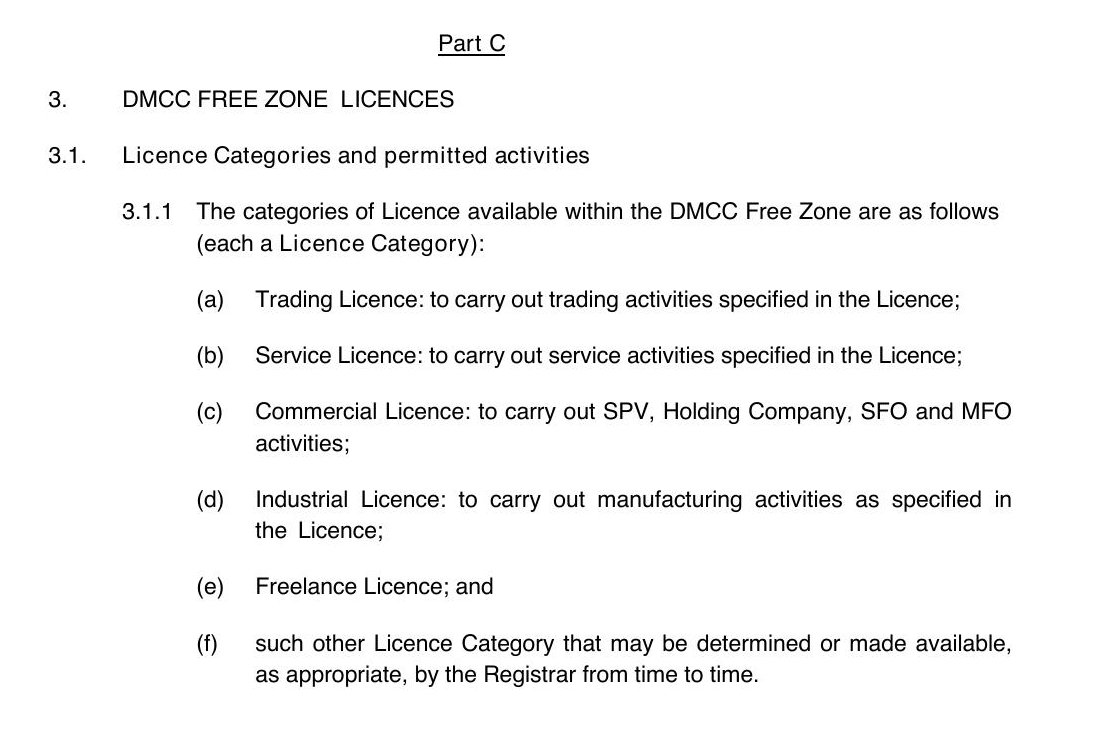
Under the licensing rules of the Dubai Multi Commodities Centre (DMCC), a Commercial Licence is used for activities such as:
- Special purpose vehicles (SPVs, companies set up for a specific purpose)
- Holding companies
- Single Family Offices (SFOs) and Multi-Family Offices (MFOs)
The same rules separately list Trading Licence, Service Licence, Industrial Licence and Freelance Licence as distinct categories, and the registrar may add further categories.
So a DMCC Commercial Licence is not a general trading or import/export licence, and it should not be treated as a universal definition carried over from other free zones.
Can a Trading Licence and a Consultancy Licence Be Combined?
In DMCC, no – they cannot simply be added to an existing licence; a new licence is required.
According to the DMCC Schedule of Charges, checked on November 2, 2026:
- Adding activities under a different licence type – service, trading or industrial – requires a new licence regardless of the activity code, with a listed annual fee of AED 20,265.
- Special and industrial licences are priced separately.
- The schedule separately lists a general AED 20 knowledge and innovation fee; fees may change without notice.
- Some activities must be held on their own and cannot be combined with other activities even under the same licence category – for example, single family offices, real estate, and Dubai Gold and Commodities Exchange (DGCX) activities.
Combination rules in other free zones depend on each free zone’s own regulations.
If a company is already established and later wants to change the activities or address on its licence, the DMCC Licensing Rules require that – subject to the relevant provisions of the company’s constitutional documents – the company apply to the registrar in good time, with supporting documents, and pay the fees set out in the schedule. The registrar may also request further information before approving the change. The key point is that a company cannot start a new activity first and register it afterward.
Example: if the entrepreneur’s company already holds a trading licence in DMCC and wants to add consulting services, a new licence is required – starting the consulting work first and registering it later is not an option.
Does an E-commerce or Purely Online Business Need a Licence?
Yes, if the business falls within the scope of the relevant law.
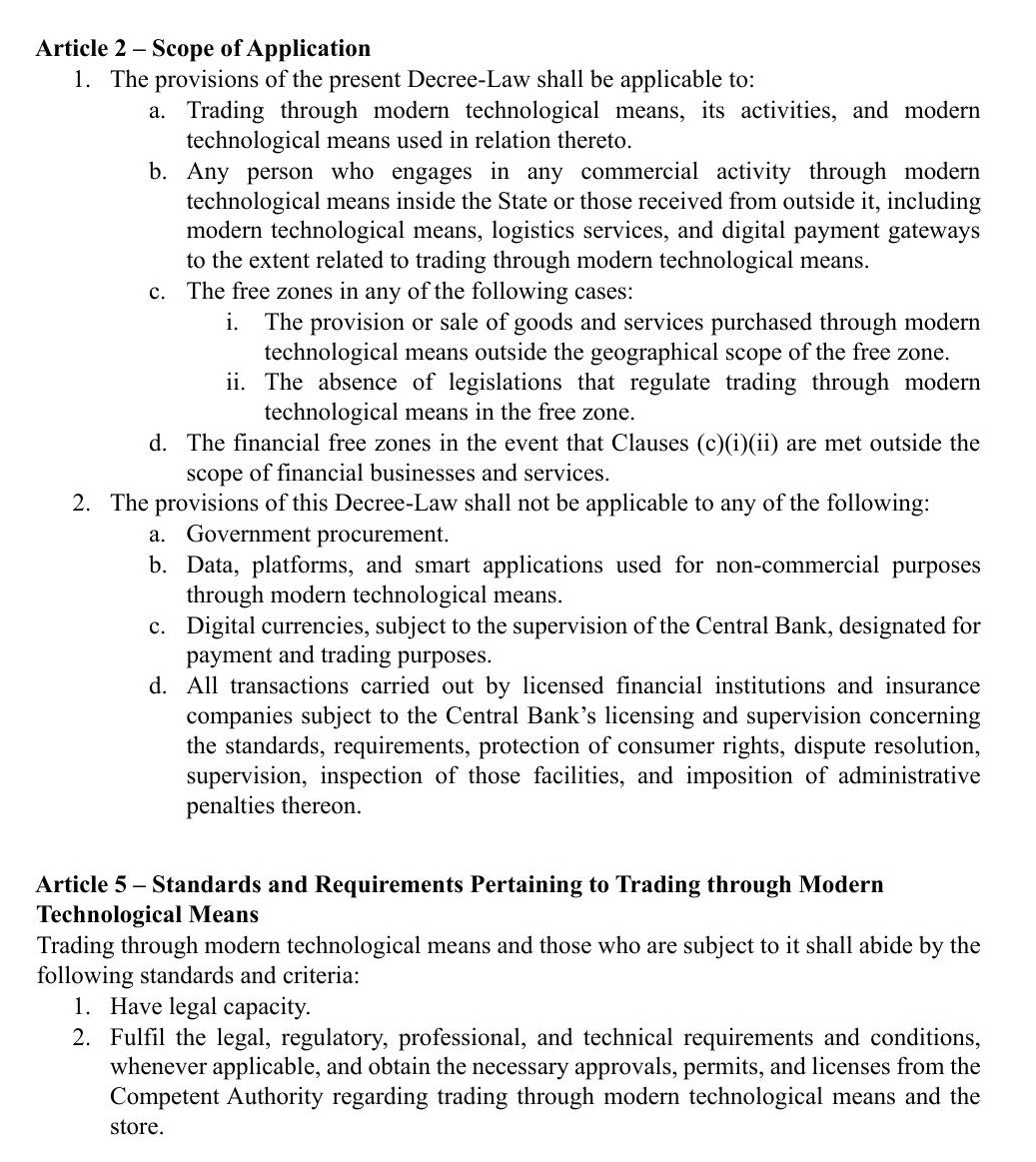
The UAE’s 2023 federal law on modern technology-based transactions requires technology-based transactions and operators that fall within its scope to:
- Have legal capacity (the legal standing needed to conduct transactions)
- Meet the applicable legal, regulatory, professional and technical conditions
- Obtain the necessary approvals, permits and licences for technology-based transactions and stores from the competent authority (the government body legally responsible for issuing the relevant approvals and licences)
In other words, not having a physical storefront does not mean a licence can be skipped. That said, the law sets out specific scope and exclusions for free zones and for different types of transactions, so it does not apply in full to every transaction or every free zone.
Example: if the entrepreneur in our scenario opens an online store, not having a physical shop does not by itself mean a licence is unnecessary – whether the business falls within the law’s scope needs to be confirmed first.
What Permit Does a Free Zone Company Need to Operate Outside Its Free Zone in Dubai?
A free zone company’s licence originally only covers business conducted within that free zone. To operate outside the free zone, a separate licence or permit is required – the original free zone licence cannot simply be used as-is.
Dubai’s 2025 Executive Council Resolution sets out that a free zone business wanting to operate outside its free zone but still within the Emirate of Dubai needs to obtain one of the following:
| Route | Term | Key points |
|---|---|---|
| A licence to establish a branch within the Emirate | 1 year, renewable for the same period | Issuance is subject to meeting the resolution’s conditions |
| A licence to operate a branch from the free zone | 1 year, renewable for the same period | Issuance is subject to meeting the resolution’s conditions |
| A temporary permit for a specific activity | Up to 6 months | The 1-year term does not apply; the activity must appear on the list specified in the resolution |
Applying for the temporary permit requires:
- Submitting the application following the Dubai Department of Economy and Tourism (DET) procedure
- Providing the information DET requires, along with company constitutional documents and a copy of the licence
- Obtaining consent from the original licensing authority and any necessary regulators
- Keeping the licence valid
- Paying the applicable fees
- Meeting any other conditions set by the Director General’s resolution
Not every activity qualifies for the 6-month permit.
Exception: this resolution does not apply to financial institutions licensed in the Dubai International Financial Centre (DIFC).
Example: if the entrepreneur’s company is set up in a Dubai free zone and wants to do business outside the free zone but still within Dubai, one of the three routes above would need to be applied for.
What Goes Wrong If You Choose the Wrong Licence?
A licence determines the scope of activities a company can legally carry out. Choosing the wrong licence can mean the business ends up operating outside what its licence actually permits. For example:
- In JAFZA, a service licence is specifically defined as not buying or selling, and not holding physical stock of goods – using it for trading goods would not match the licence type.
- An established DMCC company that wants to change its activities must first go through the registrar’s approval process; adding activities under a different licence type requires a new licence.
- Offshore companies: under JAFZA’s Offshore Companies Regulations (2023), an offshore company may carry out lawful activities permitted by the registrar from time to time. If it wants to actually conduct business on the ground, either within the free zone or in another jurisdiction, it still needs to obtain the appropriate licence or permit from the relevant authority – offshore registration by itself is not equivalent to an onshore business licence.
Before choosing a licence, it is worth confirming two things:
- Which licence category the main business activity falls under
- Whether there are additional requirements, such as facilities, customs registration or permits for operating outside the free zone
Frequently Asked Questions
Does a trading licence allow import and export directly? No. Taking Dubai as the example, holding a trading licence still requires separately registering with Dubai Customs and obtaining a customs code before the company can legally transact with customs.
Can a service licence be used to buy and sell physical goods? No. In JAFZA, a service licence is specifically defined as not buying or selling and not holding physical stock. Trading goods requires a trading-type licence instead.
Can one DMCC licence cover both trading and service activities at the same time? Not by simply adding them. The DMCC Schedule of Charges states that adding activities under a different licence type requires a new licence, with a listed annual fee of AED 20,265.
Can a Dubai free zone company do business outside its free zone? Under Dubai’s Executive Council Resolution No. 11 of 2025, it needs to obtain either a branch licence or a specific-activity permit listed in the resolution, subject to meeting the resolution’s conditions; this resolution does not apply to financial institutions licensed in the DIFC.
Glossary
- Initial approval: a step in the mainland company setup process indicating the government does not object to the business being set up and that the next steps can proceed, but it does not grant permission to actually carry out that business activity.
- General trading licence: JAFZA’s classification for a Category 3 trading licence, covering 3 or more activity groups with no limit on the number of activities.
- Emirates ID: when registering a company with Dubai Customs, a copy of the authorized signatory’s Emirates ID must be included.
Source Notes
Information in this article was checked as of November 2, 2026.
- The principle that business activity is chosen before legal form, and the effect of initial approval, come from the UAE Government Portal’s steps for mainland business setup.
- JAFZA and DMCC licence categories, pricing and change procedures come from each free zone’s own official website, licensing rules and fee schedule respectively; categories and definitions differ between free zones and should not be applied interchangeably.
- DMCC licence categories are set out in Article 3.1.1 of the DMCC Licensing Rules; the procedure for an established company changing activities or address is in Article 3.2.8.
- The original wording for JAFZA’s Category 2 trading licence is “a maximum of twelve activities starting from two groups” – it is not 12 activities per group.
- The DMCC fee schedule does not state whether the AED 20 knowledge and innovation fee is already included in the AED 20,265 annual fee; this article has not added the two together. Fees may change without notice.
- The rules on free zone companies operating outside the free zone come from Dubai’s Executive Council Resolution No. 11 of 2025: the routes for operating outside the free zone are in Articles 2 to 4, and the temporary permit is in Article 7; the actual list of activities referenced under Article 9 for the temporary permit is not set out in the resolution’s own text.
- The scope of offshore company activities is set out in Articles 14.1 and 14.3 of the JAFZA Offshore Companies Regulations 2023.
- The compliance obligations under the technology-transactions law are summarized from Article 5 of the UAE’s Federal Decree-Law No. 14 of 2023 on Trading by Modern Technological Means; actual scope of application follows Article 2 of that law and the competent authority’s own interpretation.
Need help with this? Talk to the Zagdim reader desk
If you are deciding which route fits you, or which authority to deal with, the Zagdim reader desk can arrange a suitable specialist for your situation. The first consultation is free.
Message the Zagdim reader desk on WhatsApp Message the Zagdim reader desk on LINE
Have a question about this guide? Leave a comment below, or ask Zagdim directly.
Your first stop for international property and global living.
Research and insights. Know what’s changing. Understand what matters.
Sources
- UAE Government Portal – Steps to start a business on the mainland
- JAFZA – Business licence in Dubai with Jafza
- Jebel Ali Free Zone Authority (JAFZA) – JAFZA Offshore Companies Regulations 2023
- Dubai Supreme Legislation Committee – Executive Council Resolution No. 11 of 2025
- DMCC – Licensing Rules Version 3
- Dubai Multi Commodities Centre (DMCC) – Schedule of Charges
- Dubai Customs – Request Business Registration
- UAE Ministry of Economy and Tourism – Federal Decree-Law No. 14/2023
Important Notice
This article is a general information summary and does not constitute tax or legal advice for any individual case. Information was checked as of November 2, 2026. UAE regulations may be updated; please follow the current guidance from the relevant authorities, and consult a qualified professional for your specific situation.