
*Researched and verified by: Zagdim Research Team. Last verified: 24 November 2026.*
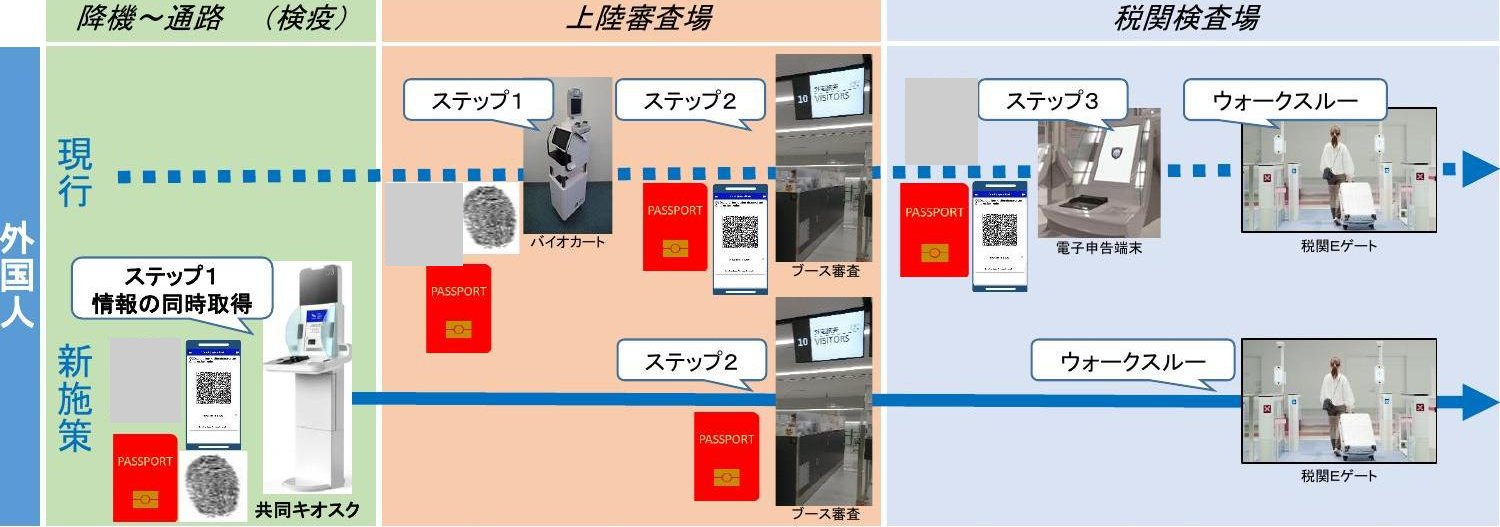
On 18 September 2026, Japan’s Immigration Services Agency announced that from 24 September, Terminals 1 and 2 at Narita Airport would start using “joint kiosks” (共同キオスク), where a traveler submits the information needed for both immigration and customs on the same machine. Many people who see the words “kiosk” and “automated gate” assume they can now scan a passport and a QR code at a Japanese airport and walk straight in. In practice, an ordinary foreign traveler has one more step after scanning. This guide to Japan’s automated gates explains which machines and gates you meet on arrival, who can use each one, and what to do when recognition fails.
The short answer: an ordinary foreign short-term traveler arriving in Japan still goes to a dedicated counter for inspection by an immigration officer after submitting information at the joint kiosk. The fingerprint gate is only for re-entering residents who registered in advance, and the TTP gate is only for travelers who have received a Registered Traveler card. Visa-free status only settles the visa condition, so it does not mean you can enter by face recognition. On departure, eligible short-term travelers can use the face-recognition gate with no registration.
This guide answers these questions:
- On a first trip to Japan, can you go straight to the automated gates on arrival?
- Who uses the joint kiosk, the fingerprint gate, the TTP gate and the face-recognition gate?
- What happens if a machine fails to recognize you, you do not have your card, or you do not qualify?
- How do these machines relate to Visit Japan Web?
Key Points
- Who should pay attention: travelers to Japan for travel, visiting relatives or viewing property, from Hong Kong, Taiwan, mainland China, Singapore and Malaysia; people who travel to Japan often on business; and residents of Japan who travel on a re-entry permit.
- Ordinary arrivals: the Immigration Services Agency says that even if you have submitted your foreign-national entry record electronically through Visit Japan Web, you still go through inspection by an immigration officer.
- Joint kiosk: this is for submitting information. An ordinary foreign traveler goes on to a dedicated counter for entry procedures afterward, so it is not automatic entry.
- Fingerprint gate: for foreign residents who qualify for re-entry and registered in advance. Registration and use are free.
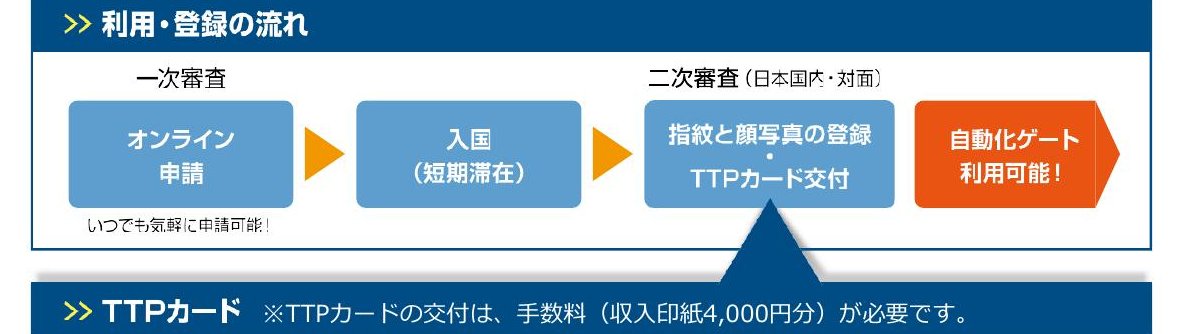
- TTP gate: for short-term travelers who have been approved and received a Registered Traveler card. The card issuance fee is 4,000 yen, and the card is valid for up to 3 years.
- Face-recognition gate on departure: eligible short-term travelers need no registration, and need a chip-embedded passport and a height of at least 135 cm.
- A scheme not yet started: the law establishing JESTA (the Japan Electronic System for Travel Authorization) has been promulgated, but the official start date for travelers to apply had not been announced when this guide was researched.
Can You Use the Automated Gates or Kiosks?
Japan’s airports have four kinds of equipment, each for people in a different position. Which one you can use depends on whether this trip is a new entry or a return on a permit, and on whether you have registered in advance or hold a card.
| Your status and conditions on this trip | On arrival in Japan | On departure from Japan |
|---|---|---|
| Ordinary foreign short-term traveler, no TTP card | Show your passport at the immigration counter; you can also send your information first through the joint kiosk, then go to the dedicated counter for inspection as directed | With a chip-embedded passport, height of at least 135 cm, able to operate it yourself, leaving as a short-term visitor and not using a re-entry permit, you can use the face-recognition gate with no registration |
| Short-term traveler who has been approved for TTP and has a valid card | At airports with automated gates you can use the gate with your card; the entry record is registered on the card, and no landing permission stamp is put in your passport | After you receive the card, you can use it from the next time you leave Japan |
| Resident of Japan returning on a re-entry permit | If you qualify for re-entry and registered as a user in advance, you can use the fingerprint gate; you still submit your passport and re-entry record card to staff afterward | A person leaving on a re-entry permit, or on the deemed re-entry permit, who has completed registration can use the fingerprint gate; a person simply leaving with no plan to return cannot, and uses the ordinary departure inspection counter |
| Special permanent resident traveling on the deemed re-entry permit | The fingerprint gate also requires advance registration and meeting the deemed re-entry permit conditions | For a person leaving on the deemed re-entry permit, the permit is valid for 2 years from the departure date (you must return to Japan within that period) |
Two points to note about this table. First, a TTP applicant who has passed the first-stage screening but has not yet received the card still goes through ordinary immigration inspection on arrival. Second, the walk-through entry gate used by Japanese citizens is linked to the joint kiosk, and foreign travelers cannot use that route.
Which One Applies to Your Passport?
Visa-free conditions and whether you can apply for TTP are two separate matters. Visa-free status settles the visa condition. To use an automated gate, you must also meet the conditions of the gate itself.
| Your passport | Visa-free condition | TTP list | First entry with no TTP card |
|---|---|---|---|
| If you hold a Hong Kong SAR passport | Visa-free short stays in Japan apply | Hong Kong is on the list | Ordinary immigration inspection; you can submit information at the joint kiosk first |
| If you hold a BN(O) passport | You must hold right of abode in Hong Kong | Applicants must attach a copy of the passport page showing the Hong Kong identity card number, or a copy of the Hong Kong identity card | Same as above |
| If you hold a Taiwan passport | The passport must show the identity card number | Taiwan is on the list | Same as above |
| If you hold a Singapore passport | Listed among Japan’s visa-free countries | Singapore is on the list | Same as above |
| If you hold a Malaysian passport | You must hold a chip-embedded passport that meets ICAO standards | Malaysia is on the list | Same as above |
| If you hold a mainland China passport | You need to obtain a visa first | Ordinary passports are not on this list | Ordinary immigration inspection |
Ordinary mainland China passports are not on TTP’s list of eligible Asian countries. For people already living in Japan, whether they can use the fingerprint gate on return depends on re-entry eligibility for that trip and on whether they have completed registration, not on the nationality of the passport.
What Is the Difference Between General Permanent Residents and Special Permanent Residents?
The difference is the validity of the deemed re-entry permit. Foreign residents covered by the general deemed re-entry permit must return to Japan within 1 year of leaving, or by the end of their period of stay if that expires sooner. A special permanent resident has 2 years from the date of departure. A person whose status is “temporary visitor”, or whose approved period of stay is 3 months or less, is not covered by the general deemed re-entry permit for foreign residents.
How to Tell the Joint Kiosk From the Fingerprint Gate at the Airport
They are different devices, and they are located in different terminals. Narita Terminals 1 and 2 have fingerprint gates and Terminal 3 does not. At Haneda the fingerprint gate is in Terminal 3 and is not installed in Terminal 2. At Kansai Airport, both Terminal 1 and Terminal 2 international areas have them. For joint kiosks, before Narita Terminals 1 and 2 joined on 24 September 2026, they were already in use at Narita Terminal 3, Haneda Terminals 2 and 3, and Kansai Terminals 1 and 2.
Of the three airports, Narita Terminal 3 has joint kiosks but no fingerprint gate, which makes it the easiest place to get confused. The registration counters, the gates and the joint kiosks each have their own installation list, so check their opening hours separately, and confirm with the airport or the Immigration Services Agency before you travel whether the equipment is open that day.
How to Clear: Four Routes by Status
Ordinary Foreign Travelers: Joint Kiosk Plus the Immigration Counter
For an ordinary foreign traveler, the process is to submit information at the joint kiosk first, then go to the dedicated counter for immigration inspection. The joint kiosk handles immigration and customs information together, and accompanying family members must each generate their own QR code in Visit Japan Web and go through one by one.
- Before you travel, create a QR code in Visit Japan Web, one for each person.
- After arrival, follow the on-site directions to the joint kiosk, scan your passport and QR code, and submit the information as the screen shows.
- When you have finished at the machine, go to the dedicated counter for joint kiosk users, where an immigration officer inspects you.
- After you pass inspection, go to customs. A traveler judged not to need a customs inspection after using the joint kiosk can pass customs by face recognition; a traveler directed to an inspection counter follows the instructions.
For travelers who are not comfortable with phones, the Immigration Services Agency says a paper entry record can be submitted instead.
TTP Travelers: Use the Automated Gate With Your Card
The Trusted Traveler Program (TTP) is for short-term travelers who come to Japan on business, for tourism or to visit relatives. After you pass approval and receive a Registered Traveler card, you use the automated gate with that card. The cardholder goes through landing inspection at the gate, which replaces the face-to-face inspection at the ordinary counter.
The application has several conditions:
- You must hold a passport from a country that Japan gives visa-free treatment.
- For the tourist category, proof of financial means is limited to platinum-level or higher credit cards of international brands recognized by the Immigration Services Agency, and corporate cards are excluded.
- A tourist-category applicant must have entered Japan at least 2 times in the past year when attending the second-stage screening in person, and the current entry counts.
- The family category is for the spouse or unmarried minor children of someone who has already received a card under the business or tourist category.
- Business category B requires being a manager or full-time employee of an organization listed by the Immigration Services Agency. Business category C requires business dealings with a designated Japanese organization or company, and that organization or company must make a registration request on the grounds that the traveler repeatedly needs to visit Japan for business.
The process is as follows. After you pass the first-stage screening, within 6 months you take the original first-stage documents to a designated registration location for the second-stage screening. If you pass, the Immigration Services Agency completes gate user registration on the spot and issues the card. The issuance fee has been 4,000 yen since 1 April 2025, and the card is valid for up to 3 years from the date of issue, or until the passport expires if that comes first. Fingerprints are required both to register and to use the gate.
Residents of Japan: Register First, Then Use the Fingerprint Gate
The fingerprint gate is for foreign residents who qualify for re-entry, and you must complete user registration at a designated location before the first use. At registration, in principle, you follow the instructions to provide the fingerprints of both index fingers and a face photo on the equipment. Registration and use are free, you can use the gate the same day you finish registering, and afterward you can use it at other airports that have these gates.
Documents to prepare:
- Under a re-entry permit: a valid passport and the re-entry permit.
- Under the deemed re-entry permit: a valid passport, plus a residence card or a special permanent resident certificate.
- After you get a new passport, a new residence card or a change of status of residence, you must apply for user registration again to keep using the fingerprint gate.
- The fingerprint gate has no minimum age, but a child must be able to provide fingerprints and operate the equipment alone.
Registration sometimes cannot be completed on the spot at the application location. If you are flying that same day, Zagdim suggests not treating same-day registration as your only plan, and checking first which other counter you would use.
Departure: The Face-Recognition Gate
Eligible foreign travelers can use the face-recognition gate on departure, with no registration in advance. Airports including Haneda, Narita and Kansai have these gates. There are four conditions: a chip-embedded passport, a height of at least 135 cm, the ability to operate it yourself, and leaving as a short-term visitor without using a re-entry permit.
If you need a departure stamp in your passport, ask the staff behind the gate or at the inspection area office before you board.
What to Do If Recognition Fails, You Have No Card or You Do Not Qualify
In short: the official materials say plainly that in the cases below you go to an inspection counter instead. For situations that are not spelled out, confirm with the staff on site.
- You did not bring your TTP card: a cardholder who did not bring the Registered Traveler card must use the ordinary immigration inspection counter.
- You are not registered, or registration is not finished: the fingerprint gate requires advance registration. Registration sometimes cannot be completed on the spot, so confirm with the staff on site whether you can use the gate that day.
- You do not meet the face-recognition conditions on departure: if you are under 135 cm, hold a passport without a chip, or are leaving on a re-entry permit, you are outside the conditions for the no-registration face-recognition gate, and you confirm with the staff on site which route you take. A person living in Japan who is simply leaving with no plan to return uses the ordinary departure inspection counter.
- A child under 135 cm: does not meet the conditions for the departure face-recognition gate. Families traveling with children should confirm with the airline or the airport before they go which route the child takes.
- The departure face-recognition gate does not recognize your face: the Immigration Services Agency explains that where the gate cannot be used, for example because the face image cannot confirm your identity, you go to the inspection counter.
- The joint kiosk or the fingerprint gate fails to scan or cannot read: the official materials checked for this guide do not give a uniform procedure, so ask the staff on site or the airline counter what to do.
How This Relates to Visit Japan Web
In short: Visit Japan Web is a tool for submitting information, and it is not a clearance permit. Through it, travelers can register in advance the information needed for immigration inspection and customs declaration, and you bring the QR code to the joint kiosk or counter to be read.
- What the joint kiosk reads is the QR code generated by Visit Japan Web. Accompanying family members each generate their own, and codes cannot be shared.
- Having a QR code does not mean you are allowed in. An ordinary foreign traveler still goes through inspection by an immigration officer.
- The TTP gate and the re-entry fingerprint gate are two separate registrations from the Visit Japan Web QR code. For TTP you apply to the Immigration Services Agency, and for the fingerprint gate you complete user registration at the airport.
How to fill in Visit Japan Web, and what to do if you have not, is covered in the related reading, the complete Visit Japan Web guide.
Recent News: Taoyuan Pre-Clearance and JESTA
Pre-clearance of entry at Taoyuan Airport: Taoyuan Airport announced on 20 January 2026 that, from 29 January to 25 February, travelers boarding designated flights from Taoyuan to specific airports in Japan could complete pre-clearance of entry while waiting to board. This was an arrangement for a set period and for designated flights, and not a standing service. Whether it will be run again, and which flights it will cover, should be confirmed with the airline or Taoyuan Airport. Do not use this announcement to judge whether you can do it on your next trip.
JESTA: the amended law creating Japan’s electronic travel authorization system (JESTA) passed on 29 May 2026 and was promulgated on 5 June. The date the provisions take effect is set by a cabinet order, with a statutory deadline of 31 March 2029, and the Immigration Services Agency plans to launch it within Japan’s fiscal year 2028. The date from which travelers can apply had not been announced officially when this guide was researched. The people covered and the application portal will be announced by the Immigration Services Agency.
FAQ
Can I enter Japan by face recognition on a first trip?
No, not even with a Hong Kong SAR or Taiwan passport. An ordinary foreign traveler on a first entry submits information at the joint kiosk first, then goes to the dedicated counter for inspection by an immigration officer. To use an automated gate you must first apply for TTP and receive the card, or qualify for re-entry and complete registration.
Can I apply for TTP with a mainland China passport?
TTP’s list of eligible Asian countries does not include ordinary mainland China passports. Whether you can use the face-recognition gate on departure depends on whether your passport is chip-embedded, your height, your short-term visitor status and how you are leaving, not on nationality.
After I pass the first TTP screening, can I use the gate on this arrival and get the card later?
No. After you pass the second-stage screening and receive the card, you can use the automated gate from the next time you leave Japan at the earliest. If you arrive in Japan before you have the card, you still go through ordinary immigration inspection.
Is there a fee for TTP or fingerprint gate registration?
The TTP card issuance fee has been 4,000 yen since 1 April 2025. Registration and use of the re-entry fingerprint gate are both free.
When the whole family enters together, does everyone scan a QR code?
Yes. Accompanying family members using the joint kiosk must each generate their own QR code in Visit Japan Web and go through one by one.
Do the three Narita terminals use the same equipment?
No. Narita Terminals 1 and 2 have fingerprint gates and joint kiosks. Terminal 3 has joint kiosks and no automated gate that matches the passport against fingerprints.
What if I use the departure face-recognition gate and my passport does not get an exit stamp?
A person who needs an exit stamp must ask the staff behind the gate or at the inspection area office before boarding.
Important Notice
This article is general information and is not financial, tax or legal advice. It draws on public information from Japan’s Immigration Services Agency, Ministry of Foreign Affairs, customs and Taoyuan Airport, checked from 23 to 24 November 2026. Airport equipment, the terminals and hours that are open, TTP conditions, fees and the JESTA timetable can all change, so rely on each organization’s latest announcements. Which route each traveler can use, and whether they may enter, is decided case by case by the Japanese immigration inspector.
Have a question about this guide? Leave a comment below, or ask Zagdim directly.
Your first stop for international property and global living.
Research and insights. Know what’s changing. Understand what matters.
Sources
- Immigration Services Agency of Japan, 入国審査時には「外国人入国記録」をご提出ください
- Immigration Services Agency of Japan, トラスティド・トラベラー・プログラムの概要
- Immigration Services Agency of Japan, トラスティド・トラベラー・プログラム
- Immigration Services Agency of Japan, 特定国一覧
- Immigration Services Agency of Japan, 自動化ゲート利用案内(TTP用)
- Immigration Services Agency of Japan, 自動化ゲート利用案内(在留している外国人の方用)
- Immigration Services Agency of Japan, 自動化ゲートの運用について(お知らせ)
- Immigration Services Agency of Japan, 顔認証ゲートの更なる活用について(お知らせ)
- Immigration Services Agency of Japan, みなし再入国許可(入管法第26条の2)
- Immigration Services Agency of Japan, 特別永住者の制度について!よくある質問
- Immigration Services Agency of Japan, 共同キオスクの運用について(お知らせ)
- Immigration Services Agency of Japan, 成田空港第1ターミナル・第2ターミナルにおける共同キオスクの運用開始について(2026年9月18日)
- Customs and Tariff Bureau, Ministry of Finance, and Immigration Services Agency of Japan, 関西空港・羽田空港・成田空港において、共同キオスクの運用を開始します
- Narita International Airport, 自動化ゲートのご利用で出入国審査を簡単スピーディーに!
- Ministry of Foreign Affairs of Japan, 査証免除国・地域(短期滞在)
- Digital Agency of Japan, Visit Japan Web
- Taoyuan International Airport, Taiwan-Japan airports cooperate again on “pre-clearance of entry” (臺日機場再次合作「入境事先確認」作業)
- Immigration Services Agency of Japan, 令和8年入管法等改正法について
- Immigration Services Agency of Japan, 「JESTA(電子渡航認証制度)の創設」