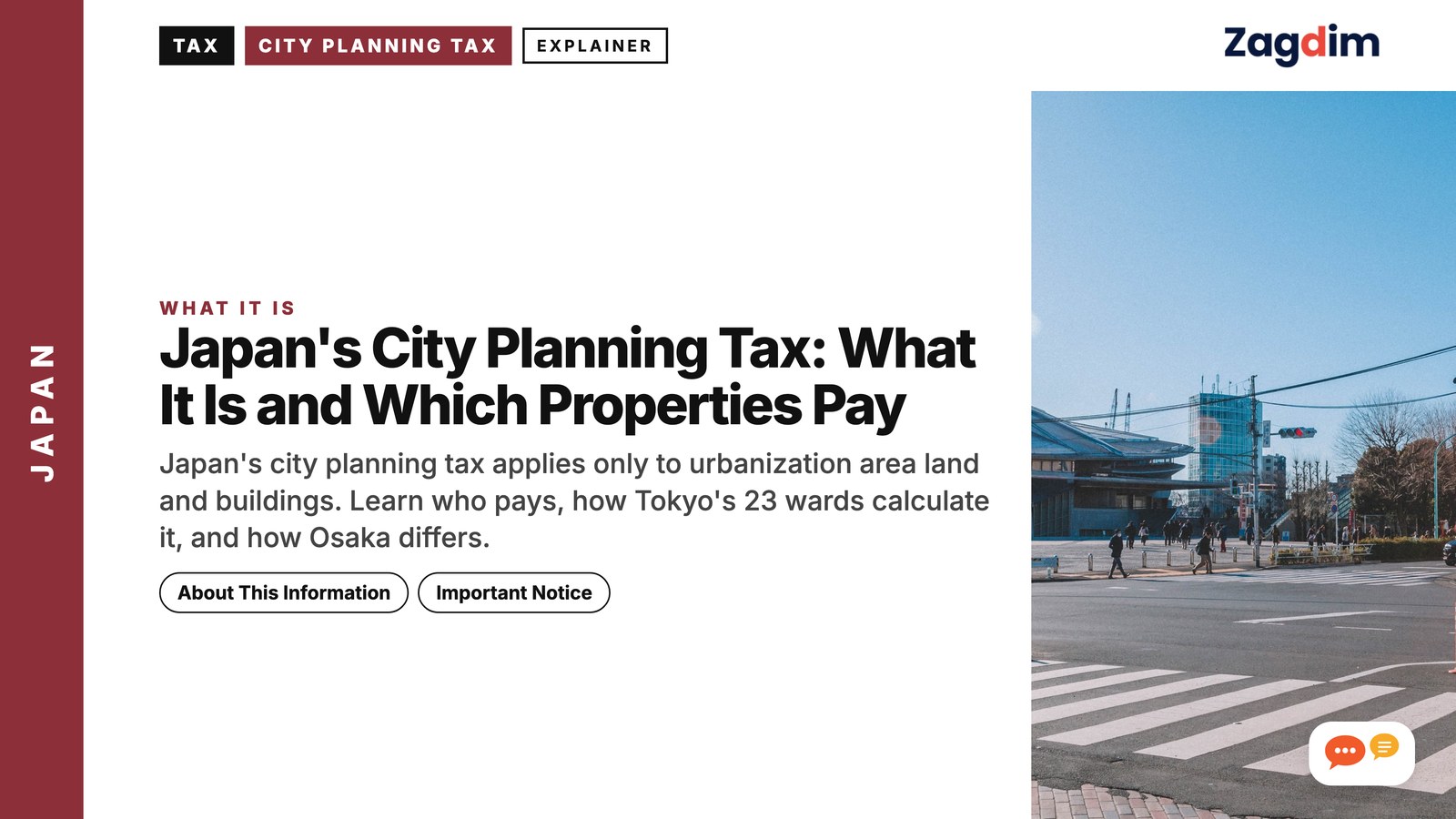
Owning property in Japan usually comes with more than one line on the annual tax bill. Alongside fixed asset tax, many property owners also pay a separate tax called city planning tax. This article explains what city planning tax funds, which properties must pay it, how Tokyo’s 23 wards calculate the rate, how Osaka City differs, and who is responsible for paying it. It is part of a series on the taxes that come with holding property in Japan.
Example (used throughout this article): Ms. Lin, who lives overseas, owns a condominium in Tokyo’s 23 wards and a house in Osaka City. The sections below apply the rules to her situation to show what she needs to check.
What Is City Planning Tax, and How Is It Different From Fixed Asset Tax?
City planning tax is a tax with a specific, earmarked purpose. It is billed together with fixed asset tax, but the two are separate taxes.
- Purpose: City planning tax (都市計画税) may only be spent on urban planning projects or land readjustment projects.
- Earmarked tax (目的税): this means the revenue is designated for a specific purpose from the start and cannot be redirected elsewhere.
- Relationship to fixed asset tax: according to Tokyo Metropolitan Government data, the two taxes are billed together, but they remain two separate tax items that need to be recorded separately.
Example: When Ms. Lin pays the holding tax on her Tokyo condominium, it arrives as a single payment, but the two taxes are still recorded as two separate line items.
For the full picture of what property owners in Japan pay each year, see the main article on the annual taxes for holding property in Japan: fixed asset tax, city planning tax, and rental income reporting.
Which Land and Buildings Must Pay? What About Depreciable Assets?
Owning property in Japan does not automatically mean city planning tax is due. The key question is whether the land or building sits inside an “urbanization area.”
- According to official data from the Tokyo Metropolitan Government and Osaka City, the tax applies, in principle, only to land and buildings inside urbanization areas (市街化区域) within city planning areas (都市計画区域).
- An urbanization area can be understood, as a starting point, as a specific zone mapped out within a city planning area. Whether a given parcel falls inside it needs to be checked directly.
- Depreciable assets (償却資産) — assets that depreciate year by year — are not subject to this tax.
How Are the Rate and Tax Base Calculated in Tokyo’s 23 Wards?
The tax rate in Tokyo’s 23 wards is 0.3%. This rate cannot be applied directly to other areas.
The tax amount is calculated using a “taxable base” (課税標準) — the base figure that the rate is multiplied against. Tokyo Metropolitan Government data sets separate rules for land and for buildings:
| Item | Tokyo’s City Planning Tax Taxable Base |
|---|---|
| Small-scale residential land (up to 200 square meters per unit) | 1/3 of the assessed value |
| Other residential land (the portion exceeding 200 square meters per unit) | 2/3 of the assessed value |
| Buildings | Calculated from the value used as the fixed asset tax base |
Tokyo property owners should also note two points:
- The January 1 snapshot: whether a parcel counts as residential land is determined by its status as of January 1 each year. How the land is used on that date affects that year’s taxable base.
- A cap applies: for purely residential land, the taxable base is capped at ten times the floor area of the building standing on it.
Example: Ms. Lin’s Tokyo condominium is taxed at 0.3%. Whether the 1/3 taxable base applies to the land depends on whether her unit’s allotted residential land exceeds 200 square meters.
Does Every Property in Osaka City Pay City Planning Tax?
Not necessarily — each parcel needs to be checked individually.
- Osaka City taxes land and buildings located inside urbanization areas within city planning areas in the city.
- Nearly all of Osaka City falls within urbanization areas, but individual parcels still need to be verified case by case.
- In Osaka City, if fixed asset tax is not due on a property, city planning tax is not due either.
Example: Ms. Lin cannot assume her Osaka house owes the tax just because it is located in Osaka City — she needs to confirm whether that specific parcel sits inside an urbanization area. She also cannot apply Tokyo’s 23-ward rate of 0.3% to it.
Who Is Liable to Pay, and How Is City Planning Tax Paid?
According to Tokyo Metropolitan Government data, whoever is registered as the owner as of January 1 each year is liable for that year’s tax.
- Taxpayer: the person legally required to pay this tax.
- How it is determined: whoever is listed as the owner of the land or building in the Fixed Asset Taxation Register (固定資産課税台帳) as of January 1 each year. This register is the local government’s record used for taxation purposes.
- How it is paid: in Tokyo, city planning tax is billed together with fixed asset tax. When an owner pays the holding tax, both taxes are settled in a single payment.
Example: If Ms. Lin is the registered owner of the Tokyo condominium in the register as of January 1, she is the one responsible for that year’s city planning tax.
For how overseas owners receive their tax bill and arrange payment, see the article on receiving a tax bill and arranging payment for Japanese property as an overseas owner. For how to list the two taxes separately on an annual cost worksheet, see the article on the annual cost table for holding property in Japan: fixed asset tax, management fees, repair reserves, and insurance.
Frequently Asked Questions
What is the city planning tax rate?
In Tokyo’s 23 wards, it is 0.3%. This rate cannot be applied directly in other areas.
Do depreciable assets pay city planning tax?
No. Depreciable assets are not within the scope of city planning tax.
Is city planning tax billed as a separate payment?
According to Tokyo Metropolitan Government data, it is billed together with fixed asset tax, but the two remain separate tax items.
Does every property in Osaka City owe city planning tax?
Not necessarily. Nearly all of Osaka City falls within urbanization areas, but individual parcels still need to be checked. In addition, when fixed asset tax is not due on a property in Osaka City, city planning tax is not due either.
About This Information
This article’s data was checked as of October 21, 2026.
- The purpose, applicable areas, taxpayer, taxable base, and payment method for city planning tax are compiled from the Tokyo Metropolitan Government Bureau of Taxation website (Tokyo Metropolitan Government data).
- The 0.3% rate applies only to Tokyo’s 23 wards.
- Osaka City’s taxable areas and non-taxable conditions are compiled from the Osaka City Finance Bureau website. Although nearly all of Osaka City falls within urbanization areas, individual parcels still need to be checked.
- “Ms. Lin” is an illustrative example used for explanation. She is not a real case, and the figures in this article are not a calculation for her or anyone else.
- This article does not cover tax rates, taxable bases, or exemption rules in municipalities other than Tokyo’s 23 wards and Osaka City, nor does it cover the taxable base for non-residential land or the handling of delinquent payments, and it does not provide a calculated amount.
- Rules in other areas may differ from Tokyo’s 23 wards. Check current official announcements from the relevant local authority.
Have a question about this guide? Leave a comment below, or ask Zagdim directly.
Your first stop for international property and global living.
Research and insights. Know what’s changing. Understand what matters.
Sources
- Tokyo Metropolitan Government Bureau of Taxation — Fixed Asset Tax and City Planning Tax (Land and Buildings)
- Osaka City Finance Bureau — Osaka City: City Planning Tax
Important Notice
This article is a general information summary and does not constitute tax or legal advice for any individual case. Data was checked as of October 21, 2026. Rules in Japan may be updated; check current official announcements from the relevant local authority, and consult a qualified professional for your individual case.