
































This article looks at how pets actually travel to Japan by air: whether an airline carries them in the cabin, as checked baggage, or only as cargo, and what four airlines currently require. It’s written for anyone outside Japan, wherever you live, who is planning to bring a pet into the country.
Whether a pet can go in the cabin, has to be checked, or must travel as cargo depends on the airline first. The four airlines checked for this article do not all handle it the same way.
Japan’s Animal Quarantine Service (AQS, part of the Ministry of Agriculture, Forestry and Fisheries, MAFF) sorts how animals arrive into two categories:
- Carry-on or checked baggage (携帯品/受託手荷物): the pet is treated as baggage, and may travel in the cabin or in the cargo hold. A pet in the cargo hold is handed over after landing at the baggage claim area or a similar point.
- Air cargo (貨物輸送): the pet is treated as cargo. After landing it is sent to the cargo area, where animal quarantine is handled first, followed by customs.
The transport method does not change what the quarantine inspection covers, but it does change where the pet is handed over and which procedure applies. For the rabies quarantine requirements, documents, waiting period and flight planning involved in moving a pet to Japan, see Zagdim’s companion article on moving to Japan with pets.
Worked example (hypothetical): picture an owner living outside Japan who wants to bring a French Bulldog into the country, with no flight booked yet. The rules below are applied to that example as they come up.
Can You File Japan’s Pre-Arrival Pet Notification Before Booking a Flight?
Yes, you can file it before a flight is booked. Advance notification (事前届出) means telling Japan’s Animal Quarantine Service, before departure, that you plan to bring a dog or cat into the country. The vessel/flight-number field can be filled in with a planned flight, or marked “undecided.”
An amendment still has to follow; it cannot be skipped:
- Once the flight is confirmed, the change has to be filed through NACCS (Japan’s Nippon Automated Cargo and Port Consolidated System).
- Anyone using the paper process has to email the amendment form back to the same Animal Quarantine Service station that first received the notification.
In the worked example, the owner could initially mark the flight as “undecided,” then come back and file the amendment once a ticket is booked.
Once the Animal Quarantine Service confirms there is nothing wrong with the notification, it issues a Notification Receipt (届出受理書). This document belongs to the notification stage; it is not the same as the Import Quarantine Certificate (輸入検疫証明書) issued after arrival. Departure-airport procedures and the airline’s own loading process may ask to see it, so keep a paper or electronic copy.
After the notification is filed, these changes are generally not allowed:
- Arriving earlier than stated
- Increasing the number of animals
- Substituting a different animal
- Changing anything after the planned arrival date has passed
Quarantine facility capacity and similar factors can also mean the import timing or location needs adjusting. If arrival passes without any contact, the notification may be treated as withdrawn and closed.
Can a Dog Enter Japan Through Any Airport?
No. Dogs may enter Japan only through specified airports and seaports:
- Airports: New Chitose, Narita, Tokyo International (Haneda), Chubu, Kansai, Osaka International (Itami), Kobe, Kitakyushu, Fukuoka, Kagoshima, Naha.
- Seaports: Tomakomai, Keihin, Nagoya, Hanshin, Kanmon, Hakata, Kagoshima, Naha.
Cats and legally certified assistance dogs that need to arrive through a different port have to ask the Animal Quarantine Service in advance. A legally certified assistance dog is a guide dog, mobility assistance dog or hearing dog, as defined under Japanese law, accompanying a person with a disability. A port that isn’t on the list cannot simply be assumed to accept entries.
In the worked example, the French Bulldog is an ordinary pet dog, so the owner has to pick a listed point of entry, for example Narita.
How Do Airline Pet Policies Differ?
Quite a lot: the four airlines checked for this article don’t all handle pet travel, or decide who they’ll carry, the same way. The table below reflects each airline’s own rules, not Japanese government quarantine law. It was checked on October 31, 2026.
| Airline | How Pets Travel | Main Restriction |
|---|---|---|
| All Nippon Airways (ANA) | When the passenger and pet travel on the same flight, the pet is accepted as checked baggage in the cargo hold; some countries or regions may only accept the pet as cargo | Must be at least 4 months old; short-nosed (brachycephalic) breeds on ANA’s list are not accepted from May 1 to October 31 |
| Asiana Airlines | Both cabin travel and checked baggage have their own weight and carrier requirements | Pets under 16 weeks old are not accepted; short-nosed breeds are not accepted as checked baggage |
| Cathay Pacific | Other than assistance dogs, pets cannot travel in the cabin and must be shipped as cargo | This rule does not mean an assistance dog is exempt from separate approval or from quarantine |
| Japan Airlines (JAL) | International dog and cat transport comes with purpose, age and health conditions | Must be at least 8 weeks old; French Bulldogs and Bulldogs are not accepted |
Applied to the worked example, the owner would get these results:
- ANA: if departure falls between May 1 and October 31, the French Bulldog would not be accepted. Outside that window, the other conditions would still have to be met.
- Asiana: the owner would first need to check whether the French Bulldog is on Asiana’s short-nosed breed list.
- Cathay Pacific: the French Bulldog could not travel in the cabin and would have to go as cargo.
- JAL: French Bulldogs are not accepted at all.
What Does ANA Require, and How Does It Transport Pets?
On ANA, when the owner and pet travel on the same flight, the pet is accepted as checked baggage held in the cargo compartment (貨物室預かり). Even so, some countries or regions may only be able to handle the pet as cargo. Buying a ticket does not by itself guarantee the pet can travel.
Booking has its own restrictions:
- Only passengers flying on an ANA-operated flight, booked under an ANA flight number, qualify.
- A ticket issued under another airline’s flight number is not accepted.
- For a codeshare flight (one aircraft carrying flight numbers for more than one airline), check with whichever airline is actually operating that flight.
ANA accepts only domesticated small animals suited to air transport, and the animal also needs to meet all of these conditions:
- Not for sale or commercial/industrial use
- Not pregnant
- At least 4 months old
- No heart or respiratory conditions
- Not sedated
Every year from May 1 to October 31, ANA stops accepting the short-nosed (brachycephalic) breeds on its list: Bulldog, French Bulldog, Boxer, Shih Tzu, Boston Terrier, Bull Terrier, Cavalier King Charles Spaniel, Tibetan Spaniel, Brussels Griffon, Chow Chow, Pug, Japanese Chin and Pekingese.
Carrier requirements:
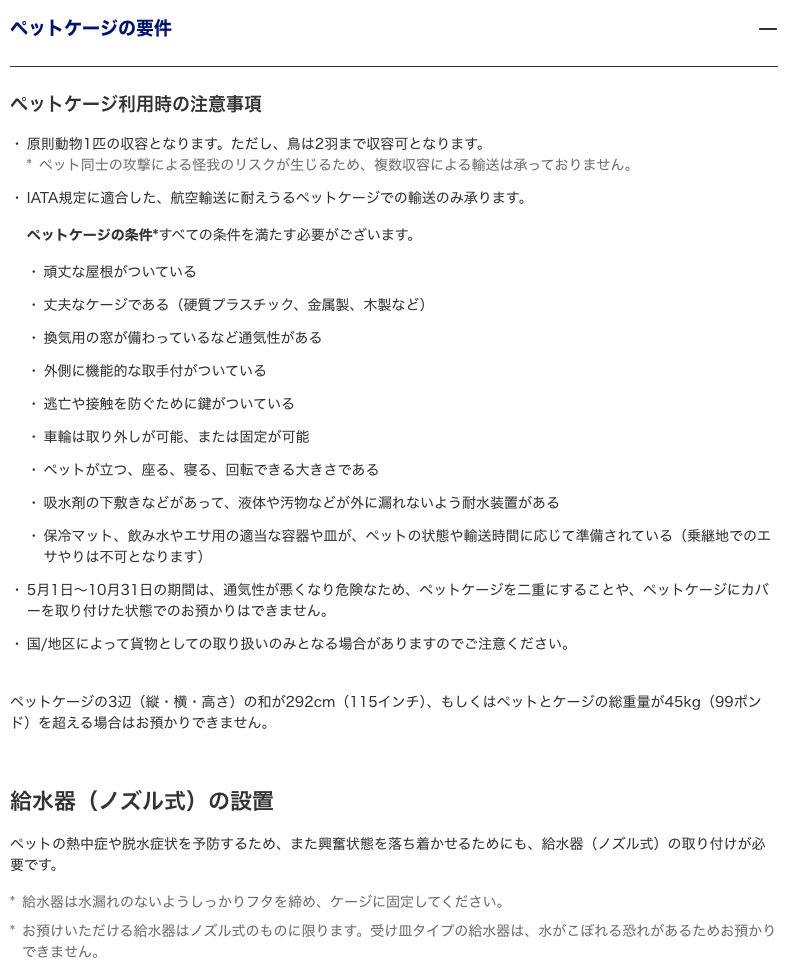
- Must meet International Air Transport Association (IATA) standards and be able to withstand air transport.
- Combined length, width and height of no more than 292 cm; pet plus carrier no heavier than 45 kg.
- As a rule, one animal per carrier, except birds, which may travel two to a carrier.
- Must use a nozzle-type water dispenser; bowl-type dispensers are not accepted.
- From May 1 to October 31, double-decker carriers and carrier covers are not allowed.
Meeting the size and weight limits doesn’t guarantee the pet will be accepted either. The carrier, health and cabin-space conditions all have to be met at the same time.
Checked pets require a signed consent form (同意書), which can be printed and filled in ahead of the airport visit. Export and import documents should be ready beforehand, too.
Check-in 120 minutes before departure is a reference point, not a total processing time that already includes quarantine. If quarantine is being handled at the departure airport, confirm the service hours first, then go to the check-in counter once the inspection is done.
Can Pets Travel in the Cabin on Asiana Airlines?
Conditionally, yes. Asiana sets weight and carrier requirements for dogs, cats and small birds traveling in the cabin. Pets under 16 weeks old, or that have been given a sedative or sleeping medication, are not accepted.
Cabin conditions:
- Combined weight of the pet and carrier must be 7 kg or under.
- The carrier must be no taller than 21 cm, no wider than 32 cm and no longer than 45 cm, and must fit under the seat in front.
- A soft-sided carrier may be up to 26 cm tall, but must compress to within 21 cm.
- A hard-sided carrier is capped at 21 cm regardless.
- The pet cannot come out of the carrier during the flight; only water may be given.
These terms are still subject to the route, aircraft type and destination regulations. Meeting them doesn’t mean every route into Japan offers in-cabin pet service, and meeting them doesn’t mean transport has already been confirmed.
Checked-baggage limits:
- Combined weight of pet and carrier: 45 kg
- Combined carrier dimensions: 285 cm
- Carrier height: 84 cm
Meeting these numbers doesn’t guarantee acceptance either. A few things to watch for:
- Some countries or regions may cap it at 32 kg, or restrict transport regardless of size.
- Aircraft type and route may limit the number of pets carried, or refuse them outright.
- The A321 is not accepted for pet checked baggage on international routes.
- Since July 1, 2019, short-nosed breeds, covering both dogs and cats, are not accepted as checked baggage.
- Air Busan codeshare flights also do not offer pet checked-baggage service.
On Asiana international flights, contact the reservations center at least 48 business hours before departure and get transport confirmed. The 48 hours is counted in business days, excluding weekends and holidays.
Arriving at the airport without approval means the pet cannot travel in the cabin or as checked baggage. Even with an existing booking, an unavoidable aircraft swap can still mean the pet isn’t accepted.
Can Pets Travel in the Cabin on Cathay Pacific?
No. Other than assistance dogs, pets cannot travel in the cabin on Cathay Pacific and must be shipped as cargo. This does not mean an assistance dog skips separate approval, and it does not mean Japan’s quarantine requirements can be skipped either.
What Age and Water-Dispenser Rules Apply on JAL?
On JAL international flights, dogs and cats must be at least 8 weeks old and also meet purpose and health conditions:
- Traveling as a pet, not for commercial purposes
- Not pregnant
- Healthy, without a strong odor
- Not a risk to other animals or to baggage
JAL does not accept French Bulldogs or Bulldogs, and dogs flying to the United States are subject to separate entry conditions. The 8-week minimum here is only JAL’s own threshold; it is not the same as Japan’s vaccination, antibody-titer and 180-day waiting-period requirements.
The water dispenser has to be fitted by the owner, and it has to be unlikely to break or leak. Once the pet has been handed over, staff will not feed it or refill water. For any journey of 12 hours or more, a water dispenser is mandatory.
On flights departing from Frankfurt, a bowl-type dispenser is mandatory, and a nozzle-type dispenser may be refused. So ANA’s nozzle-type requirement cannot simply be carried over to a JAL flight departing from Frankfurt.
Can a Pet Fly to Japan Alone, Without Its Owner?
Yes, but it has to go by air cargo, not as checked baggage. Here is what JAL Cargo’s international cargo service says:
- Bookings are usually made through an air cargo agent (a business that books cargo space with the airline on your behalf).
- Every leg of the journey has to be booked in advance.
- Documents and procedures vary by destination.
Typical documents include an Animal Declaration Form (動物申告書), an export quarantine certificate, and a vaccination certificate. The owner has to sign and confirm the Animal Declaration Form; it’s then submitted together with the other required documents, attached to the air waybill.
Once the pet arrives in Japan as cargo, it goes to a cargo-handling building (貨物上屋) in the cargo area. Animal quarantine is handled first, then customs. The exact location and service hours should be confirmed with the Animal Quarantine Service station with jurisdiction, not assumed to be the passenger baggage-claim area.
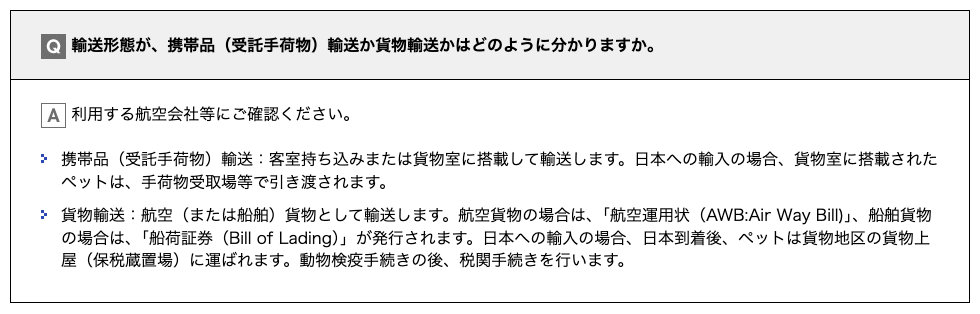
A pet arriving as carry-on or checked baggage is handled differently. The owner goes through an animal quarantine counter at the baggage-claim area before clearing customs.
Can Animal Quarantine Be Done Late at Night or on a Holiday?
It depends on the transport method: cabin or checked baggage, yes; cargo depends on set hours.
- Cabin or checked baggage: Animal Quarantine Service staff work around flight arrival times, including late night, early morning, weekends and holidays.
- Air cargo: there are set service hours, communicated when the notification is accepted; confirm them in advance with the Animal Quarantine Service station being used.
Where Is Quarantine Handled If You Transit or Connect to a Domestic Flight in Japan?
If you land in Japan and then connect to a domestic flight, import quarantine is handled by the Animal Quarantine Service station with jurisdiction over the airport where the international flight lands. If the transit happens outside Japan, which documents are needed depends on whether you actually enter the transit country.
For a dog or cat coming from outside a “designated region” (指定地域, a set of specific regions Japan recognizes):
- Transiting through an airport without entering the country: an export certificate from the exporting country’s government is enough for Japan’s quarantine purposes.
- Entering the transit country with the dog or cat: a certificate from that country’s government is also required.
This doesn’t mean the transit country or the airline has no other restrictions; still confirm with the airline and the transit location before connecting.
For a dog or cat coming from a designated region, a direct flight is required as a rule. If the animal is transshipped somewhere outside a designated region, one of the following has to be completed:
- The exporting country’s government seals the carrier and records the seal number on its certificate.
- A Supplementary Transport Certificate (ANNEX) is obtained, confirming the animal had no contact with other animals in transit. This certificate is issued by the animal quarantine authority, customs, the airline, the shipping company, or the captain of the aircraft or vessel at the transit point.
Without a complete seal or ANNEX, the animal faces a 180-day quarantine on arrival in Japan. This rule is part of the designated-region procedure; it doesn’t apply to every point of departure. Whether it applies when flying from Hong Kong, Taiwan or Singapore is covered in Zagdim’s companion article on moving to Japan with pets. Anyone considering a transit connection should check that point before deciding.
What Documents Must Be Handed to Airline Ground Staff Before Departing from Singapore?
On departure day, before handing the dog or cat to ground staff, these documents are required:
- A copy of the Animal & Veterinary Service (AVS) export permit
- The original veterinary health certificate meeting the destination’s import/entry requirements
- Any other supporting documents the destination requires
Ground-handling service has to be booked with the carrying airline before departure. The export permit needs to be a copy; the health certificate needs to be the original; don’t mix the two up.
If You Are Connected to Taiwan or Hong Kong
Being able to bring a pet into the cabin on the way to Japan doesn’t mean the same applies on the return trip; that depends on the rules of wherever you’re flying back to. For a Hong Kong resident, the Agriculture, Fisheries and Conservation Department (AFCD)’s Group I source terms for import set out these requirements:
- The animal has to arrive in Hong Kong by the fastest, most direct route.
- The animal has to travel as manifested cargo (cargo carried under a cargo manifest).
- The animal cannot be excess checked baggage or hand-carried baggage.
- Transiting through a Group II, IIIA or IIIB region requires prior approval.
Before flying back from Japan, check AFCD’s current classification for Japan and the applicable permit conditions, then get the relevant special permit and meet every condition in full.
In the worked example, the owner can’t assume that however the pet traveled on the outbound leg will also work for the return. Flying the pet as cargo doesn’t guarantee it will be cleared either, and an assistance dog’s approval route also has to be checked separately.
There is one exception to these terms. If a pet is exported directly from Hong Kong and has stayed continuously in a Group I source location, a residence certificate (proof the pet has stayed there) can be used instead of the 180-day requirement. Every other health, microchip, vaccination and documentation requirement still applies.
What Order Should You Follow When Arranging the Flight?
Confirm the arrival airport first, then the airline’s conditions. File the notification amendment once the flight is booked. If going by cargo, or connecting through another location, confirm the arrival procedure after that.
| Step | What To Do | Who To Confirm With |
|---|---|---|
| 1 | For a dog flying to Japan, confirm the arrival airport or seaport is on the approved list; for a cat or legally certified assistance dog arriving via another port, ask in advance | Animal Quarantine Service |
| 2 | Check cabin, checked-baggage and cargo acceptance conditions airline by airline | The airline |
| 3 | File the notification amendment once the flight is confirmed; arriving earlier, increasing the number of animals, substituting the animal, or changing anything after the planned arrival date is generally not allowed | NACCS or the original Animal Quarantine Service station |
| 4 | If going by cargo, confirm the arrival-handling location, service hours and procedure order; if connecting through another location, check for any other restrictions | The relevant Animal Quarantine Service station, the airline and the transit location |
Frequently Asked Questions
Can a pet travel in the cabin?
It depends on the airline. Other than assistance dogs, Cathay Pacific does not allow pets in the cabin. Asiana conditionally accepts dogs, cats and small birds in the cabin. ANA accepts pets as checked baggage in the cargo hold when traveling on the same flight as the owner.
Can a dog fly into any airport in Japan?
No. Dogs may enter Japan only through specified airports and seaports. A cat or legally certified assistance dog that needs to arrive through a different port has to ask the Animal Quarantine Service first.
Can the notification be filed before the flight is booked?
Yes, but an amendment has to follow once it’s confirmed. Arriving earlier, increasing the number of animals, or substituting the animal is generally not allowed.
Glossary
- Notification Receipt (届出受理書): the document Japan’s Animal Quarantine Service issues once it confirms the advance notification is in order. It is not the same as the Import Quarantine Certificate issued after arrival.
- Import Quarantine Certificate (輸入検疫証明書): issued after arrival in Japan. Different from the Notification Receipt issued at the advance-notification stage.
- Manifested cargo: cargo carried under a cargo manifest. Both Hong Kong AFCD’s import terms and Japan’s cargo procedure for pets use this concept.
- Short-nosed / brachycephalic breeds (短頭犬種): a category of breeds that airlines list and restrict from transport. ANA’s list covers dog breeds; Asiana’s short-nosed list covers both dogs and cats.
Methodology
This article’s facts were checked on October 31, 2026. The conditions attributed to ANA, Asiana, Cathay Pacific, JAL and JAL Cargo reflect what each company’s own official page stated as of that date; these are airline transport terms, not Japanese government regulation. The transport methods, port restrictions, notification-amendment rules and transit-quarantine content attributed to Japan’s Animal Quarantine Service come from official pages of Japan’s Ministry of Agriculture, Forestry and Fisheries (MAFF) Animal Quarantine Service. The definition of a legally certified assistance dog follows Japan’s Act on Assistance Dogs for Physically Disabled Persons.
The conclusion that whether a pet can travel in the cabin depends on the airline first, and the suggested order for arranging a flight, are this article’s own summary based on the rules above; the official sources don’t state this order directly. The owner and pet used in the worked examples throughout this article are hypothetical. In the Hong Kong return-trip section, AFCD’s terms are general import conditions; this article does not determine whether Japan currently falls under AFCD’s Group I classification, that should be confirmed against AFCD’s current classification.
This article does not cover pet-transport rules for airlines headquartered in Taiwan or mainland China, and it has not individually verified every transit point’s or airline’s additional restrictions. It does not cover anything not yet publicly announced. Airline policies can change at any time; confirm with the airline again before flying with a pet.
Important Notice
This article is a general information summary and is not legal or quarantine advice for an individual case. Facts were checked as of October 31, 2026. Japan’s, Hong Kong’s and Singapore’s regulations, along with airline terms, may be updated; follow the current announcements from the relevant authority or airline, and consult a qualified professional for individual cases.
Have a question about this guide? Leave a comment below, or ask Zagdim directly.
Your first stop for international property and global living.
Research and insights. Know what’s changing. Understand what matters.
Sources
- MAFF Animal Quarantine Service – Q&A on bringing dogs and cats into Japan
- MAFF Animal Quarantine Service – Entry of dogs and cats into Japan (regions other than designated regions)
- MAFF Animal Quarantine Service – Entry of dogs and cats into Japan (designated regions)
- All Nippon Airways (ANA) – Traveling with pets (international flights)
- Asiana Airlines – Traveling with pets
- Cathay Pacific – Are pets allowed in the cabin?
- Japan Airlines (JAL) – International flights: information for customers traveling with pets
- JAL Cargo – Information for customers shipping pets/animals (international cargo)
- National Parks Board, Animal & Veterinary Service (NParks/AVS) – Exporting dogs and cats
- Hong Kong Agriculture, Fisheries and Conservation Department (AFCD) – Group I source terms for import