

































This article is part of Zagdim’s wiki series on relocating to Japan with pets. It sets out the core documents a dog or cat needs before entering Japan: a microchip record, a rabies vaccination record, an antibody test report, and a government health certificate from the exporting country.
It is written for readers who own property in Japan, or are considering buying, and are planning to bring a pet with them when they relocate, whatever country they are departing from.
The same worked example is used throughout: a reader who already owns a home in Japan and wants to bring a puppy when they move there.
Which Documents Do You Need to Bring a Dog or Cat to Japan?
Departing from Hong Kong, Taiwan, Singapore, mainland China, or Malaysia, you need four groups of documents, plus a separate pre-arrival notification:
- A microchip
- A rabies vaccination record
- A rabies antibody test report
- A government health certificate from the exporting country
That is because none of these five places is on Japan’s list of “designated regions” (指定地域), a list maintained by Japan’s Animal Quarantine Service, the agency responsible for inspecting animals entering the country. The procedure differs depending on whether your departure point is on or off that list. As of October 31, 2026, all five places above fall under the “outside the designated regions” procedure.
Only Japan’s own list matters here. Neither the owner’s nationality nor a claim that a place has no rabies can substitute for it. Checking the list also does not replace the separate review of the animal’s vaccination history and transport conditions.
In the worked example, the reader’s puppy is departing from Taiwan, and Taiwan is not on the designated-regions list, so the puppy must follow the “outside the designated regions” procedure.
For the full process and the first step to take, see Zagdim’s companion guide on rabies quarantine, documents, waiting periods, and flight arrangements before moving to Japan with a pet.
What Microchip Standard Applies, and When Should It Go In?
As a rule, the microchip goes in first, and the first rabies vaccination follows. A microchip (マイクロチップ) identifies an individual dog or cat and can be read with a scanner to retrieve its number.
The chip must meet the ISO 11784 and ISO 11785 standards, and you also need to confirm that a scanner can actually read the number back.
There is a separate, conditional-acceptance procedure for pets vaccinated before being chipped, but it only applies to owners who follow that specific procedure. If you are not using it, plan to implant the chip before the first vaccination.
Three types of chip need particular attention:
Chips that are not ISO-standard. Contact the Animal Quarantine Service office at your arrival airport or port in advance. If its scanner cannot read the chip, the importer must bring a scanner that can. Bringing a working scanner does not guarantee approval on its own.
Chips whose first six digits are 900202. As of October 31, 2026, authorities are still verifying the validity of this chip code. For now, it is not accepted as a valid method of individual identification.
Chips that may be duplicated. On December 19, 2025, the Animal Quarantine Service warned that different animals had been found carrying the same chip number. The example given involved chips starting with 900, and the notice specifically named these six-digit prefixes: 900113, 900115, 900128, 900201, 900215, and 900263.
- This is a duplicate-number risk warning, not a statement that these numbers are all banned.
- It is separate from the 900202 non-acceptance issue above.
- Individual cases may need to be rechipped and re-processed.
- Once the import timing is set, submit the import notification to the Animal Quarantine Service covering your arrival airport as soon as possible.
- Do not simply replace a chip and keep using the old test results. Have the Animal Quarantine Service review the case first.
In the worked example, the reader has the puppy implanted with an ISO-standard chip and confirms a scanner can read the number before the first vaccination.
How Many Rabies Vaccinations Are Required, and Are There Age or Interval Limits?
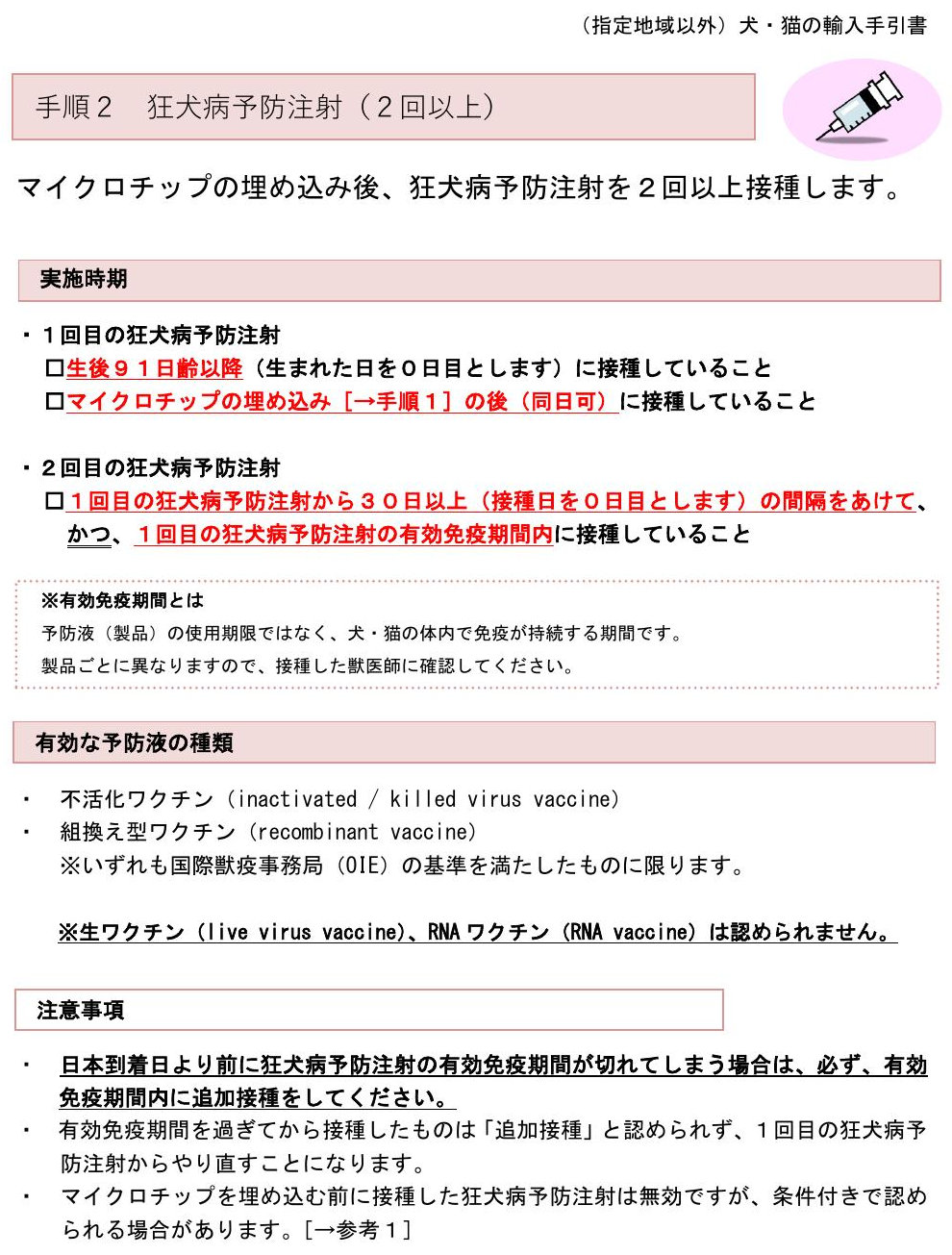
Departing from outside the designated regions, the rule is at least two rabies vaccinations after the chip is implanted. Both have timing limits:
| Dose | When to Give It | How the Days Are Counted |
|---|---|---|
| First | After the animal is at least 91 days old | Date of birth counts as day 0; can be the same day as chipping, but chipping must come first |
| Second | At least 30 days after the first, and still within the first dose’s effective immunity period | Date of the first vaccination counts as day 0 |
The “effective immunity period” (有効免疫期間) is how long the vaccine remains effective in the animal’s body, not the shelf life of the vaccine product.
A vaccination given before the chip is implanted is, as a rule, invalid; there is a separate conditional-acceptance procedure for that situation. When planning, do not substitute “three calendar months old” or “12 weeks old” for the 91-day requirement.
The vaccine type also needs to be checked, since a vaccine approved in the departure country is not necessarily one Japan recognizes:
- Accepted by Japan: inactivated vaccines (不活化ワクチン) and recombinant vaccines (組換え型ワクチン), both of which must meet the standards of the World Organisation for Animal Health (OIE).
- Not accepted as valid rabies prevention: live vaccines (生ワクチン) and RNA vaccines.
For any dog or cat going through the “outside the designated regions” vaccination-and-antibody-test procedure, the effective immunity period must be kept continuous all the way through to arrival in Japan by repeating booster vaccinations as needed.
If that immunity period lapses for even one day, any antibody test already completed becomes invalid, and the process must restart from the first vaccination. Animals that fully meet the designated-regions import conditions are reviewed under the designated-regions procedure instead, and this requirement does not apply to them directly.
How Does the Rabies Antibody Test Work, and How Long Is the Report Valid?
After the second vaccination, a blood sample is drawn for testing, and the result is valid for two years from the blood draw date, not from the date the report is issued. The test measures the antibody level, or titer, in the animal’s blood.
The test must meet three conditions:
- Timing of the blood draw: It can be on the same day as the second vaccination, but must fall within that vaccination’s effective immunity period.
- Testing laboratory: The serum must be sent to a laboratory designated by Japan’s Minister of Agriculture, Forestry and Fisheries (指定検査施設). Results from non-designated laboratories are not accepted.
- Passing threshold: The antibody titer must be at least 0.5 IU/ml.
Under the standard procedure, counting from the blood draw date as day 0, you must wait at least 180 days before arriving in Japan. Do not simply convert 180 days into “six months.”
On arrival, the animal must be within both its vaccine’s effective immunity period and the two-year antibody-test validity period at the same time. There is a separate preparatory procedure for a short re-entry to Japan after leaving the country; it does not apply to a pet’s first arrival from abroad.
If the original report would expire before arrival, it must be retested, and the animal must arrive within the new validity period. To skip the 180-day wait after a second test, all three of the following must be true:
- The effective immunity period has not lapsed for even one day, from the first vaccination through to arrival.
- The second blood draw is at least 180 days after the first, counting the first blood draw date as day 0.
- Every antibody test was done by a designated laboratory, and every result reached at least 0.5 IU/ml.
Having a second passing report alone does not entitle you to skip the waiting period.
In the worked example, if the reader’s puppy follows the standard procedure, the sequence runs as follows:
| Step | What to Do | Timing Condition |
|---|---|---|
| 1 | Implant an ISO-standard chip | Before the first vaccination; can be the same day, but chipping comes first |
| 2 | Give the first dose of a Japan-approved inactivated vaccine | After the animal is at least 91 days old, counting date of birth as day 0 |
| 3 | Give the second dose | At least 30 days after the first, and within the first dose’s effective immunity period |
| 4 | Draw blood and send it to a designated laboratory; titer must reach at least 0.5 IU/ml | On or after the second dose, within the effective immunity period |
| 5 | Wait while keeping the effective immunity period unbroken | At least 180 days, counting the blood draw date as day 0 |
| 6 | File the pre-arrival notification | No later than 40 days before arrival in Japan |
| 7 | Have a clinical exam done and obtain the exporting government’s certificate | The clinical exam must be within 10 days before departure |
One testing laboratory needs special attention. Biobest Laboratories (バイオベスト ラボラトリー社) has had its accreditation as a rabies antibody testing laboratory revoked for not meeting the designated standards.
If you hold a certificate this laboratory issued between November 27, 2024, and June 25, 2025, contact the Animal Quarantine Service office at your planned arrival airport. Anyone who has already filed an import notification will receive an individual notice.
A report still being within its two-year window from the blood draw date does not automatically mean it can be used. You should not assume on your own that every certificate from that period is now invalid, either.
Who Issues the Health Certificate, and What Must It Include?
The health certificate must be issued by a government agency of the exporting country; a document signed only by a private veterinarian cannot stand in for a government certificate on its own. That said, the pre-departure clinical exam itself, where a veterinarian physically examines the animal’s health, can be carried out by a private veterinarian.
- Who examines the animal: a private veterinarian or a government veterinarian of the exporting country.
- When: within 10 days before departure; this cannot be treated as 10 working days.
- For dogs: confirmation that the animal has not had, and is not suspected of having, rabies or leptospirosis (レプトスピラ症).
- For cats: confirmation of rabies status only.
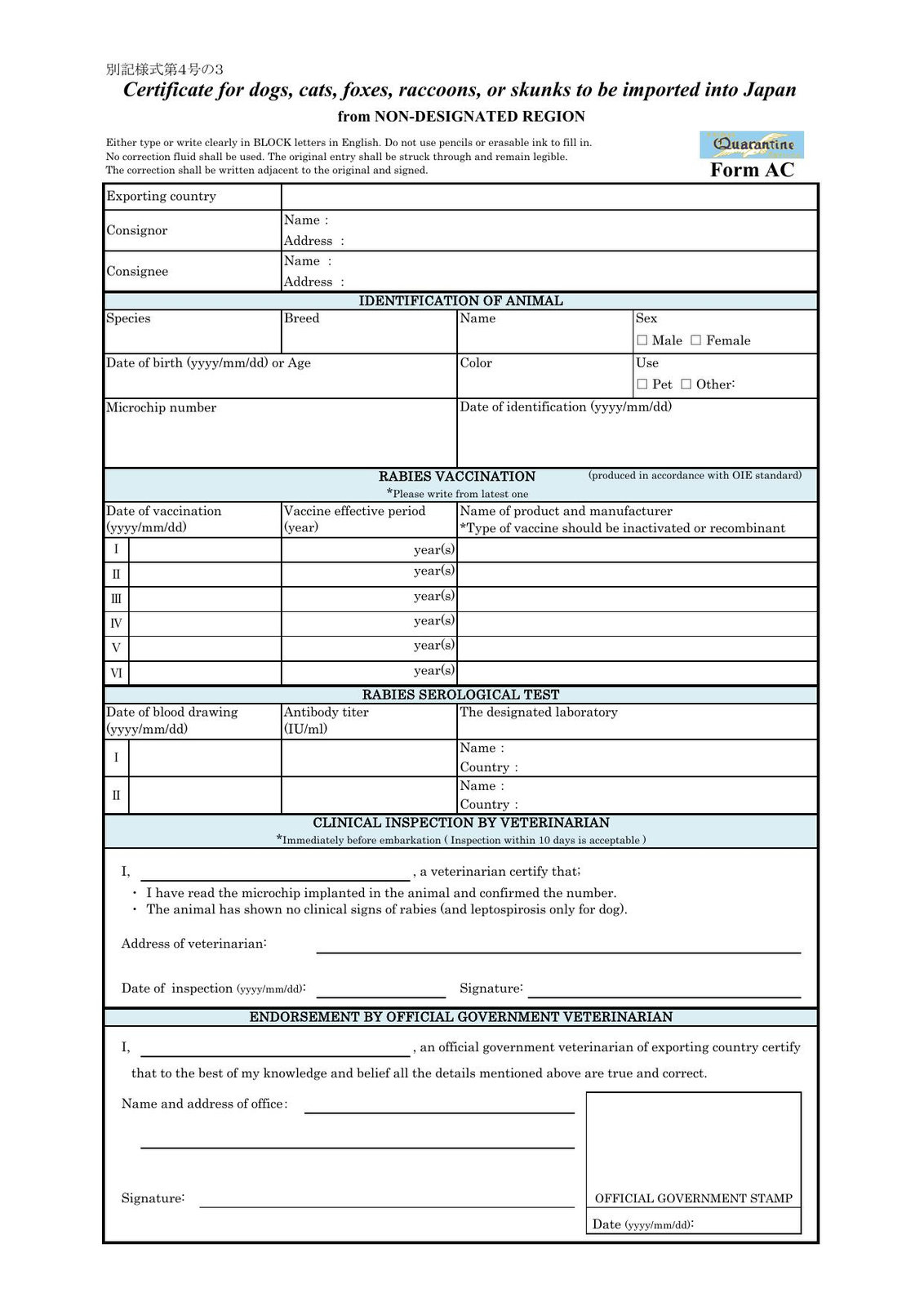
The certificate must record:
- Animal details: date of birth or age, microchip number, and implantation date.
- Vaccination: vaccination date, effective immunity period, and the vaccine’s type, product name, and manufacturer.
- Antibody test: blood draw date, titer, and the name of the designated testing laboratory.
- Clinical exam: the pre-departure exam result and date.
Japan’s Animal Quarantine Service recommends using the Form AC format, which can be completed in one of two ways:
- A private veterinarian completes it, and the exporting government then endorses it (裏書き証明), meaning the government certifies it.
- A government veterinarian completes every required item directly.
If there is not enough space on the form, you may attach a supplementary sheet. Form AC is the recommended official format, not the only legally valid one, but the government endorsement step cannot be skipped.
Since December 1, 2022, Japan’s Animal Quarantine Service has accepted an electronic record in place of an original paper certificate, but only if all of the following conditions are met at the same time:
- The exporting government has given advance notice that it will produce an electronic record.
- The record states everything the inspection certificate is required to state.
- The record can be verified as having been produced by that government.
Simply scanning a paper document or photographing it with a phone does not qualify for this exception.
Government endorsement procedures differ by location. This article checked the procedures for three places:
| Departure Point | Who to Apply To | Documents to Submit | Points to Note |
|---|---|---|---|
| Hong Kong | The Agriculture, Fisheries and Conservation Department (AFCD), for an official endorsement or data verification of the animal health certificate issued by a registered veterinarian | The completed health certificate, vaccination record, dog license (dogs only), import permit (if applicable), and other supporting originals | Hong Kong’s general processing timelines do not substitute for Japan’s own pre-departure clinical-exam deadline |
| Taiwan (per guidance from the Taichung Branch, Bureau of Animal and Plant Health Inspection and Quarantine, Ministry of Agriculture) | Bring the dog or cat to the branch office or a quarantine station to file the application | The quarantine/health certificate Japan requires signed, a test report signed by a designated laboratory, proof of rabies or immunization, pet registration proof, the applicant’s ID or passport, flight details, and destination-country requirement documents; an authorization letter is also needed if filing through an agent | Filing must occur within the destination country’s required validity window; the export animal quarantine certificate is only issued after the on-site inspection passes, and same-day issuance is not guaranteed |
| Singapore | A locally licensed private veterinarian examines and signs the forms, then the owner applies through GoBusiness to the Animal & Veterinary Service (AVS) for endorsement | The original certificate as specified on the checklist, original vaccination and test records (where applicable), and the application reference number | Manual endorsement has a standard turnaround of two working days once documents are complete, with no expedited service |
In the worked example, since the reader’s pet is a dog, the clinical exam must confirm both rabies and leptospirosis status. Because the puppy is departing from Taiwan, the Taiwan row above applies; that row follows guidance from the Taichung Branch specifically and has not been checked against every branch office nationwide.
More detail on these differences is covered in Zagdim’s companion guide comparing the pet-travel process from Hong Kong, Taiwan, and Singapore.
Once You Have the Documents, Can You Just Fly?
Not yet. You must still file a notification with Japan no later than 40 days before arrival, and your pet will also be inspected after arrival.
Before arrival
The pre-arrival notification (事前届出) is filed with the Animal Quarantine Service before arrival. It must go to the office covering your arrival airport or port, and late filings are not accepted as a rule.
Once the office confirms everything is in order, it issues a notification acceptance document (届出受理書). Departure-point procedures and airline loading procedures may require you to show this, so keep a paper or electronic copy.
After arrival
You will need to complete an import inspection with the Animal Quarantine Service, which usually requires submitting:
- The original government certificate from the exporting country.
- The antibody test result notice.
- The import inspection application. If you have already filed a combined notification and application through the Animal Quarantine-related business system (NACCS), you do not need to reapply.
- For cargo shipments, a copy of the Air Way Bill or Bill of Lading.
If someone other than the owner is handling this, they need a letter of authorization (委任状) prepared by the owner, and the original must also be presented on the day of inspection. Customs brokers are exempt from this requirement.
Results of the inspection
If the animal does not meet Japan’s import conditions, it may face quarantine detention (係留検査) of up to 180 days, or be refused entry. Quarantine detention means the animal must be held and examined separately; it cannot simply be taken home.
Once the inspection is passed, the Animal Quarantine Service issues an import quarantine certificate (輸入検疫証明書). This document cannot be reissued, so keep it safe.
In the worked example, the reader must file the notification no later than 40 days before arrival and keep the acceptance document. Once the puppy passes inspection, the reader needs to keep the import quarantine certificate safe.
Post-arrival procedures are covered in Zagdim’s companion guide on rabies quarantine, documents, waiting periods, and flight arrangements before moving to Japan with a pet; arrival inspection and detention risk are covered in Zagdim’s companion guide on Japan’s pet entry quarantine process, covering advance notification, airport inspection, and detention risk.
Frequently Asked Questions
How many rabies vaccinations are required?
Departing from Hong Kong, Taiwan, Singapore, mainland China, or Malaysia, the rule is at least two. The vaccinations must be given after the chip is implanted, must be an inactivated or recombinant type that Japan accepts, and must meet the standards of the World Organisation for Animal Health (OIE).
Does being within the antibody report’s validity window guarantee entry?
Not necessarily. The report must come from a designated testing laboratory, and the titer must reach at least 0.5 IU/ml. On arrival, the animal must also still be within its vaccine’s effective immunity period and must meet conditions such as the 180-day wait.
Can a certificate from a private veterinarian be used on its own?
No. A private veterinarian can carry out the pre-departure clinical exam, but the final certificate must be issued or endorsed by the exporting government. A paper document signed only by a private veterinarian is not sufficient on its own.
Glossary
- Microchip: a chip used to identify an individual dog or cat, with a number that can be read using a scanner.
- Inactivated vaccine: one of the rabies vaccine types Japan accepts; it must meet OIE standards.
- Recombinant vaccine: one of the rabies vaccine types Japan accepts; it must meet OIE standards.
- Effective immunity period: how long a rabies vaccine remains effective in the animal’s body, not the vaccine product’s shelf life.
- Designated testing laboratory: a rabies antibody testing laboratory designated by Japan’s Minister of Agriculture, Forestry and Fisheries.
- Import quarantine certificate: the certificate issued once a dog or cat passes Japan’s Animal Quarantine Service’s import inspection; it cannot be reissued.
- Pre-arrival notification: the notification procedure filed with Japan’s Animal Quarantine Service before arrival.
A Note on This Research
This information was checked as of October 31, 2026. The vaccination counts, antibody threshold, 180-day wait, and certificate fields in this article are drawn from official pages and FAQs published by Japan’s Animal Quarantine Service, not from secondhand summaries.
The groupings “four groups of documents” and “government endorsement cannot be skipped” are this article’s own organization of the official material; the source agency does not state them as single summary lines itself. The worked example throughout is illustrative, used to show how the rules apply.
The exporting-government procedures for Hong Kong, Taiwan, and Singapore follow the official guidance of, respectively, the Agriculture, Fisheries and Conservation Department, the Taichung Branch of Taiwan’s Bureau of Animal and Plant Health Inspection and Quarantine, and Singapore’s AVS. The Taiwan section follows the Taichung Branch’s guidance specifically and has not been checked against every branch office nationwide.
The government endorsement authorities and document checklists for mainland China and Malaysia were not covered in this research round; readers departing from either should confirm directly with their local authority before travel.
The validity of the 900202 chip prefix was still being confirmed as of the check date. Whether a duplicate-numbered chip needs to be replaced is decided case by case. Any further action on Biobest-issued certificates will be communicated individually by the Animal Quarantine Service.
Have a question about this guide? Leave a comment below, or ask Zagdim directly.
Your first stop for international property and global living.
Research and insights. Know what’s changing. Understand what matters.
Sources
- Japan Ministry of Agriculture, Forestry and Fisheries, Animal Quarantine Service — Bringing Dogs and Cats Into Japan (Outside the Designated Regions)
- Japan Ministry of Agriculture, Forestry and Fisheries, Animal Quarantine Service — Bringing Dogs and Cats Into Japan (Designated Regions)
- Japan Ministry of Agriculture, Forestry and Fisheries, Animal Quarantine Service — Q&A on Bringing Dogs and Cats Into Japan
- Japan Ministry of Agriculture, Forestry and Fisheries, Animal Quarantine Service — Biobest Laboratory Accreditation Notice
- Hong Kong Agriculture, Fisheries and Conservation Department — Issue of an Official Animal Health Certificate
- Taiwan Ministry of Agriculture, Bureau of Animal and Plant Health Inspection and Quarantine, Taichung Branch — Dog and Cat Export Section
- NParks/AVS — Exporting Dogs and Cats
- Japan Ministry of Agriculture, Forestry and Fisheries, Animal Quarantine Service — Import Manual for Dogs and Cats (Outside the Designated Regions)
- Japan Ministry of Agriculture, Forestry and Fisheries, Animal Quarantine Service — Form AC
Important Notice
This article is a general information summary and does not constitute quarantine or legal advice for any individual case. The information was checked as of October 31, 2026. Rules in Japan, Hong Kong, Taiwan, and Singapore may be updated; follow the current notices of the relevant authority in each location, and consult a qualified professional for individual cases.