
































This article is part of Zagdim’s wiki series on moving pets to Japan. It is written for readers outside Japan who are considering bringing a dog or cat to live in Japan with them. It covers advance notification before departure, inspection after arrival at the airport, and when a pet may be held in quarantine.
Dogs and cats entering Japan are both quarantined for rabies; dogs are also quarantined for leptospirosis (レプトスピラ症). Quarantine here means the official checks Japan carries out to prevent disease from entering the country. For the documents and waiting period you need to prepare in advance, see “Before You Move to Japan With a Pet: Rabies Quarantine, Documents, Waiting Period and Flight Arrangements.”
**Example (hypothetical):** Consider an owner planning to bring a dog to live in Japan. In this example, the dog is not departing from one of Japan’s “designated regions,” a departure-location category under Japan’s quarantine rules; departures from a designated region follow different procedures not covered in this article.
Who Do You Notify Before Departure, and By When?
Booking a flight does not complete your entry procedures. For dogs and cats departing from outside a designated region, you must submit an advance notification (事前届出) no later than 40 days before arrival in Japan. This notification tells Japan in advance that you intend to bring in a pet.
You submit it to the Animal Quarantine Service office that has jurisdiction over your arrival airport or port, Japan’s agency responsible for inspecting animals entering the country.
If your documents or waiting period do not meet Japan’s import conditions, your pet may be refused entry, or held in quarantine (係留検査) for inspection or to make up the remaining waiting days.
There are two ways to submit the notification:
- Through the NACCS animal quarantine system: you can submit the import inspection application at the same time.
- If you cannot use NACCS: email the notification form as an attachment.
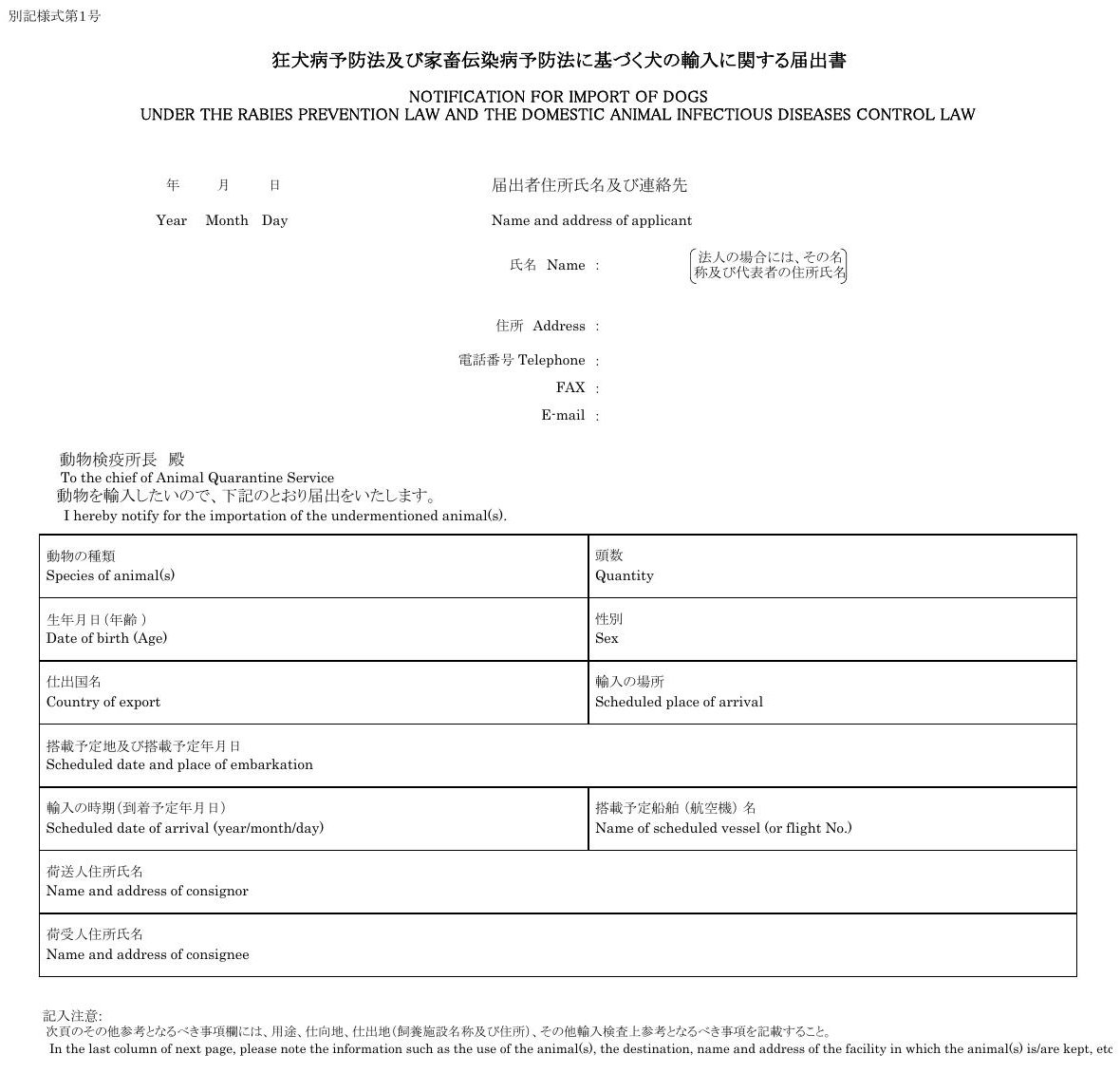
You can submit the notification before your flight is confirmed. Write the planned flight or “to be determined” in the vessel/flight field. Once the flight is confirmed, you still need to file a change:
- NACCS: file the change through the system.
- Paper process: email a change notification form to the office that originally accepted your filing.
**Example:** If the owner has not yet confirmed a flight, they can still submit the notification and write “to be determined” in the flight field. Once the flight is confirmed, they then need to file a change.
Once the Animal Quarantine Service confirms there is no problem with your notification, it issues a notification receipt (届出受理書). This document confirms your notification has been checked and accepted. You may need it for departure-side procedures and airline loading, so keep the paper or electronic copy.
A notification receipt is not the same as an import quarantine certificate (輸入検疫証明書). The import quarantine certificate is only issued after you arrive in Japan and the Animal Quarantine Service completes the import inspection and confirms there is no problem.
After submitting a notification, you generally cannot change your plans simply by changing your flight. The following are, in principle, not permitted:
- Arriving earlier than planned
- Increasing the number of pets
- Substituting a different animal
- Changing your arrival date to later than planned without prior notice
Quarantine facility availability and similar factors may also require you to adjust your arrival time or location. If you do not make contact by the planned arrival date, your notification may be treated as withdrawn and closed.
If you need to bring a pet without having filed a notification, you are expected to consider changing your import plan. If your situation is genuinely unavoidable, you must submit a notification form to the Animal Quarantine Service at your planned arrival airport or port and ask about it in advance. If you are departing from outside a designated region, you must also attach proof of a rabies antibody test.
Asking does not guarantee approval. If your pet would need more than 12 hours in quarantine and you cannot secure facility space or similar requirements, you may be asked to change your arrival location or timing.
Where Is Your Pet Inspected on Arrival in Japan?
This depends on how your pet travels. Carry-on or checked baggage is inspected at the animal quarantine counter in the baggage claim area; air cargo is inspected in the cargo area.
| How the pet travels | Where it is handled | Timing |
|---|---|---|
| Carry-on / checked baggage (携帯品/受託手荷物) | Inspected at the animal quarantine counter in the baggage claim area, before customs. | Inspection staff are on duty according to flight arrival times, including late night, early morning, weekends and holidays. |
| Air cargo (貨物輸送) | The pet is sent to a bonded warehouse in the cargo area (where cargo is held before clearing customs); animal quarantine is completed before customs. | There is a designated acceptance time, stated in your notification receipt notice. Confirm the actual handling location and acceptance time with the relevant Animal Quarantine Service office in advance. |
If your pet travels as carry-on or checked baggage, it may be in the cabin or the cargo hold. However, how the pet is transported does not change what the quarantine inspection covers.
**Example:** If the owner’s dog travels as checked baggage, the owner needs to go to the animal quarantine counter in the baggage claim area for inspection before going through customs.
Dogs and cats departing from outside a designated region must go through an import inspection with the Animal Quarantine Service on arrival. You generally need to submit:
- The original export certificate from your departure country’s government
- The antibody test result notice
- The import inspection application form
If you already submitted the notification and application together through NACCS, you do not need to reapply, and you do not need to print the NACCS application.
Since December 1, 2022, an electronic record can substitute for the original submission format if it meets all of the following conditions:
- The departure country’s government notified in advance that it would produce an electronic record.
- The record contains the required information.
- The record can be verified as produced by that government.
A file you scanned yourself, or a photo taken on your phone, does not qualify.
For cargo shipments, you also need a copy of the Air Waybill or Bill of Lading, the cargo transport documents, plus any other documents the Animal Quarantine Service requests. For what to prepare before departure, see “What Documents Do You Need to Bring a Dog or Cat to Japan? Microchip, Vaccines, Antibody Test and Health Certificate.”
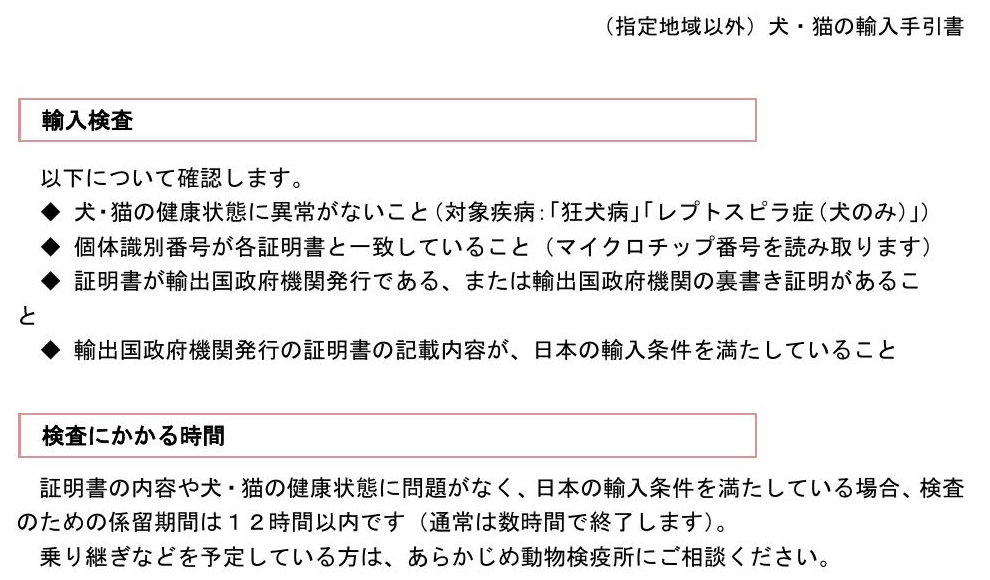
Inspection staff check the export certificate from your departure country’s government (it must be issued or endorsed by a government agency and meet Japan’s import conditions), the individual animal, and its health condition. When a dog or cat meets the conditions for 12 hours or less in quarantine, the Animal Quarantine Service’s own Q&A page states arrival procedures take about an hour, while the import manual states they are usually completed within a few hours. The actual time still depends on how busy the office is at the time.
When Is a Pet Quarantined, and for How Long?
When a dog or cat meets Japan’s import conditions, it is held in quarantine for 12 hours or less. If it does not meet the conditions, it may be quarantined for up to 180 days, or refused entry to Japan altogether.
If the only shortfall is the 180-day waiting period, and every other required condition is met, the number of quarantine days is calculated as:
Quarantine days = 180 days − days already waited
A few notes on this calculation:
- The day you submit the inspection application does not count toward the quarantine days.
- The day you receive the import quarantine certificate does not count either.
- An existing illness or older age in the pet does not shorten or waive the quarantine.
This calculation cannot be used if the pet is also missing a required vaccine, microchip, or valid certificate.
**Example:** If the owner’s dog is only short on the waiting period, and every other required condition is met, the calculation above applies. If a valid certificate is also missing, the calculation cannot be used.
During quarantine, a pet cannot leave the facility for any reason other than being returned to the departure country. If the pet needs treatment, only a private veterinarian may attend on site.
If a dog or cat shows signs of rabies or leptospirosis, its quarantine may be extended, or it may undergo detailed examination. For cats, this applies to rabies only.
Do You Pay for Inspection and Quarantine?
Inspection itself is free, but quarantine-related costs are your responsibility. The Animal Quarantine Service does not charge for its own inspection, but the importer (the person bringing the pet into Japan) must cover:
- Transport to the quarantine facility
- Care and management costs during quarantine
- Utility costs at the facility
- Fees for a private veterinarian attending on site
Confirm care and management fees directly with the facility operator.
Can a Family Member or Agent Handle This on Your Behalf?
Yes, but the person handling it on your behalf generally needs a power of attorney (委任状) prepared by the pet’s owner. This is a document in which the owner authorizes someone else to carry out the procedures. Apart from customs brokers, anyone other than the owner handling a dog or cat’s import or export procedures needs this document.
A family member may also need one. If a family member is not the applicant or the consignor/consignee, but needs to stand in for inspection, the applicant must prepare a power of attorney; more than one applicant may be named jointly.
The power of attorney should be attached to your NACCS or email notification/application, with the original submitted on the day of inspection. Being able to have someone act on your behalf does not mean your pet already meets the import conditions.
**Example:** Suppose the owner is the applicant, and a family member needs to stand in for inspection without being the consignor/consignee. In that case, the owner needs to prepare a power of attorney.
Which Japanese Airports Can Dogs Enter Through? What About Transit and Domestic Flights?
Not any airport. Dogs may, in principle, only enter Japan through the following airports and seaports:
- Airports: New Chitose, Narita, Tokyo International (Haneda), Chubu, Kansai, Osaka International (Itami), Kobe, Kitakyushu, Fukuoka, Kagoshima, Naha
- Seaports: Tomakomai, Keihin, Nagoya, Hanshin, Kanmon, Hakata, Kagoshima, Naha
If you want a cat to arrive through a different port, you need to ask the Animal Quarantine Service in advance. The same applies if you are traveling with a guide dog, assistance dog or hearing dog that meets the legal definition under Japan’s Act on Assistance Dogs for Physically Disabled Persons.
For departures from outside a designated region, the transit rules are:
- Transiting through an airport without entering that country: the departure country’s government certificate can still be used for Japan’s quarantine.
- Entering a transit country with your pet: you separately need that country’s government certificate.
- Connecting to a domestic Japan flight after arrival: import quarantine is still handled by the Animal Quarantine Service office responsible for the international arrival airport.
This does not mean the transit country or the airline has no additional restrictions of its own. You need to confirm those separately with the transit country and the airline. If you have a transit arrangement, you should also consult the Animal Quarantine Service in advance.
**Example:** If the owner’s dog flies into Narita and then connects to a domestic flight within Japan, import quarantine is still handled by the Animal Quarantine Service office responsible for Narita.
How Should You Sequence This?
It helps to lay out three steps on one timeline:
- Before departure: Prepare your documents and work out your waiting period.
- 40 days before arrival: Complete your advance notification.
- After arrival: Go through inspection at the airport.
For the documents and waiting period to prepare before departure, see “Before You Move to Japan With a Pet: Rabies Quarantine, Documents, Waiting Period and Flight Arrangements.” For cabin, checked, cargo and airline requirements, see “Flying Pets to Japan: Cabin, Checked, Cargo and Airline Requirements.”
Frequently Asked Questions
Does “40 days before” mean 40 business days?
No. The rule is no later than 40 calendar days before arrival in Japan, not 40 business days.
Does getting a notification receipt mean my pet has passed quarantine?
No. A notification receipt is issued once your advance notification has been confirmed as having no problems. The Animal Quarantine Service only issues the import quarantine certificate after your pet passes the import inspection.
Does the Japanese government cover food and housing costs during quarantine?
No. The Animal Quarantine Service’s own inspection is free, but costs arising from quarantine, such as transport, care and management, and facility utilities, are the importer’s responsibility.
Glossary
- Advance notification (事前届出): The procedure for notifying the Animal Quarantine Service of your import plan before a dog or cat arrives in Japan.
- Notification receipt (届出受理書): The acceptance document the Animal Quarantine Service issues after confirming your advance notification; it is not the import quarantine certificate.
- Quarantine (係留検査): Holding a dog or cat at an Animal Quarantine Service facility for inspection; also used to make up remaining waiting days when import conditions are not met.
- Import quarantine certificate (輸入検疫証明書): The certificate the Animal Quarantine Service issues once the import inspection is complete and confirmed with no problems; it cannot be reissued.
- Power of attorney (委任状): The document in which a pet owner authorizes someone else to handle import or export procedures.
Data Note
Facts were checked as of October 31, 2026. The deadlines, documents and quarantine rules in this article are compiled from the import pages and Q&A on the website of Japan’s Animal Quarantine Service. The definitions of guide dog, assistance dog and hearing dog follow Japan’s Act on Assistance Dogs for Physically Disabled Persons.
This article covers only the import quarantine process. Procedures for designated regions differ from what is described here; this article covers only the non-designated-region procedure. Confirm whether your departure location counts as a designated region through the main Zagdim guide on this topic.
This article does not state the amount of care and management fees during quarantine; confirm these directly with the facility operator. Japan’s animal quarantine rules may be updated; follow the Animal Quarantine Service’s current published notices.
Have a question about this guide? Leave a comment below, or ask Zagdim directly.
Your first stop for international property and global living.
Research and insights. Know what’s changing. Understand what matters.
Sources
- Ministry of Agriculture, Forestry and Fisheries, Animal Quarantine Service – Importing Dogs and Cats
- Ministry of Agriculture, Forestry and Fisheries, Animal Quarantine Service – Entry of Dogs and Cats to Japan (Outside Designated Regions)
- Ministry of Agriculture, Forestry and Fisheries, Animal Quarantine Service – Q&A on Bringing Dogs and Cats Into Japan
- Ministry of Agriculture, Forestry and Fisheries, Animal Quarantine Service – Import Manual for Dogs and Cats (Outside Designated Regions)
- Ministry of Agriculture, Forestry and Fisheries, Animal Quarantine Service – Notification Form for Dog Imports and Implementation of the Rabies Antibody Titer Monitoring Survey
Important Notice
This article is a general information summary and does not constitute tax or legal advice for any individual case. Facts were checked as of October 31, 2026. Japan’s rules may be updated; follow the current notices from the relevant authorities, and consult a qualified professional for your specific situation.