






























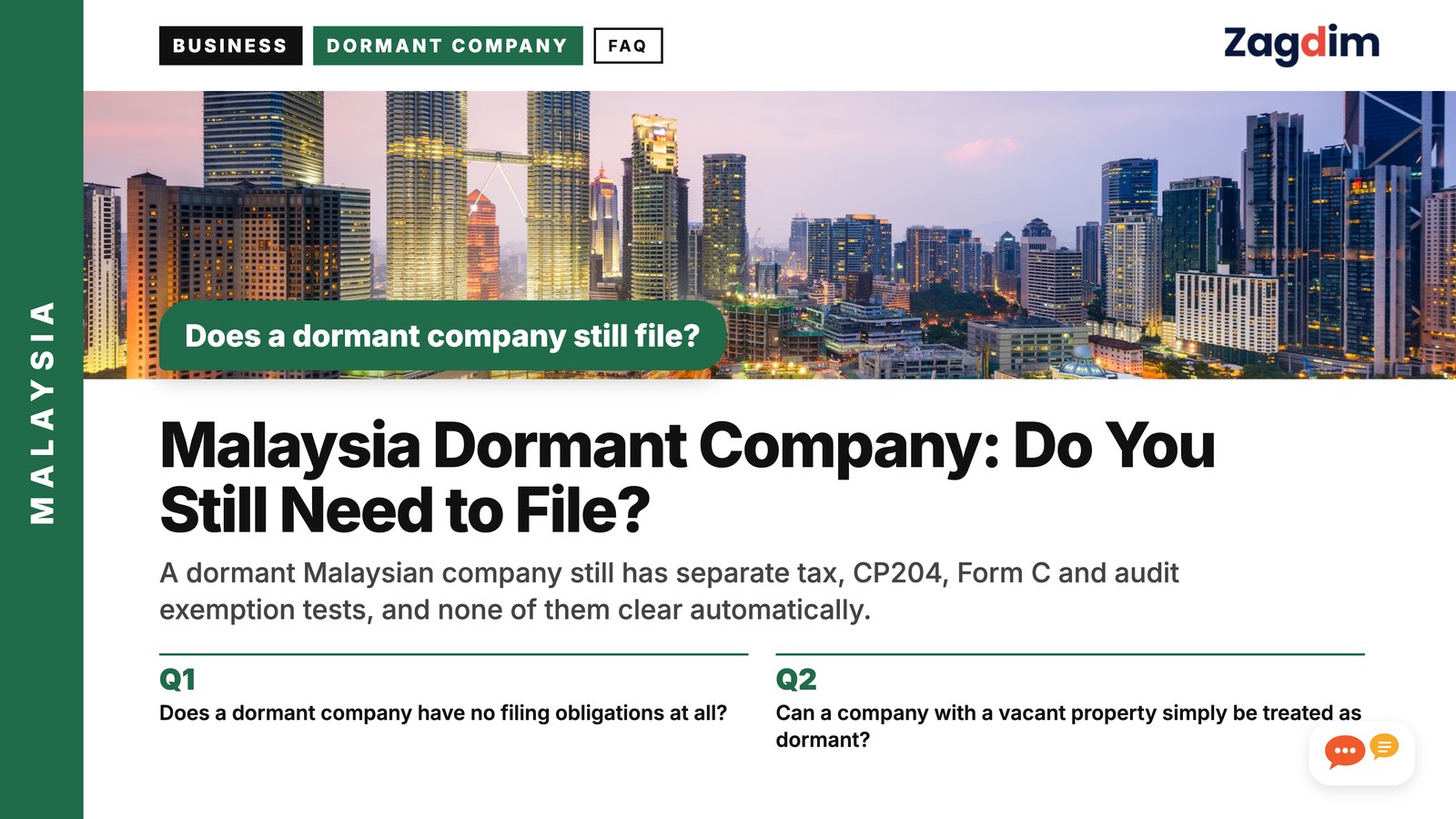
A Malaysian company that never started trading, that has paused taking orders, or that holds nothing but a single asset can look like it is “not doing business.” Legally and for tax purposes, that is not automatically the same thing. Before assuming a company is dormant, it helps to separate out whether it actually has operations, transactions, assets, investments or income, because tax filing, corporate filing and audit requirements are each assessed on their own terms. Ticking a dormant box on an annual form does not mean everything else can be left alone.
Tax Dormancy Is Not Just “No Invoices Issued”
Malaysia’s tax filing guidance treats a company that has never operated, or that operated and then stopped, as a dormant situation. A company holding shares, property, fixed deposits or similar investments should not be treated as dormant under that same guidance.
A company that has bought a property but not yet found a tenant, for example, has no rental income, but that does not mean it has no investment activity. A fixed deposit earning interest cannot be filed as zero income just because there is no customer invoice behind it.
Even where a company does qualify as dormant, it still has to submit the relevant tax forms, including Form E. Where there are no employees, that should be filed to reflect the actual situation rather than skipped.
Not Filing CP204 Does Not Mean You Can Skip Form C
A company that has not yet started operating generally does not need to submit CP204. That form is specifically the tax estimate and installment mechanism, and not filing it cannot be read as a broader exemption from the annual income tax return.
For a company that operated and later stopped, if installment arrangements or tax notices are already in place, the company should confirm with its tax agent and the tax authority how those should be updated. Switching off a bank standing instruction is not the same as resolving the existing tax arrangement behind it.
A company that has stopped taking orders can still collect old receivables, sell equipment or receive other income, and those transactions still need to be recorded.
Audit Dormancy Runs on a Separate Test
The dormancy test used for audit exemption looks at whether the company has been carrying on business and whether it has had any accounting transactions, with specific statutory compliance payments excluded from that test. A company that has been dormant since incorporation, or dormant in both the current and the immediately preceding financial year, can be assessed for exemption under the relevant criteria.
This serves a different purpose from the tax authority’s own classification. Qualifying for one kind of treatment on one side does not mean the other side is automatically exempt as well.
Even where audit exemption applies, the company generally still needs to keep accounting records, maintain a company secretary and registered office, and complete its Annual Return and any applicable financial statement filing.
Keeping the Company Open or Closing It Down
If the pause is only expected to last a few months, it is worth listing out the annual cost of keeping the company and what resuming operations would involve. If there is no intention to use the company again, the applicable striking-off or winding-up procedure should be assessed, covering assets, liabilities, tax and any filings still outstanding.
Stopping secretary fee payments or no longer using a bank account does not automatically close a company. Until a company is formally struck off, its obligations cannot be assumed to have disappeared.
Common Misunderstandings
“A single fixed deposit isn’t a business, so it must be tax-dormant.”
Holding a fixed deposit or similar investment needs to be assessed separately under tax guidance, not assumed into dormant status.
“No employees means no Form E.”
A dormant company’s relevant filing requirement still applies, and should be completed to reflect the actual situation.
What to Check Next
Pull together the last date of operation, bank statements, assets and outstanding liabilities, then have the company secretary and tax agent confirm the annual obligations separately. If the company will be kept, arrange for ongoing filing; if it will not be used again, complete the checks required before formal closure.
Frequently Asked Questions
Does a dormant company have no filing obligations at all?
No. The relevant annual tax returns and corporate filings still need to be submitted as required.
Can a company with a vacant property simply be treated as dormant?
No. A company holding property as an investment needs to be confirmed against the applicable tax rules.
Does stopping company-related payments mean the company has already closed?
No. Formal striking-off or winding-up has its own separate conditions and procedure.
Note
This article is based on information accessible as of October 8, 2026, for general reference only, and does not constitute legal, tax or employment advice. The general time limits listed here should be checked against individual exemptions, approved extensions and the filing arrangements in effect for the relevant year.
Sources
LHDN — Dormant Companies and Other Situations; SSM — Practice Directive 10/2024: Qualifying Criteria for Audit Exemption for Certain Categories of Private Companies; SSM — Companies Act 2016 (read together with its amendments); LHDN — Corporate Tax Estimates (CP204)
Have a question about this guide? Leave a comment below, or ask Zagdim directly.
Your first stop for international property and global living.
Research and insights. Know what’s changing. Understand what matters.