
































Zagdim Overseas
Subscribe
  • Home
  • Real Estate & Economic News
    • All
    • Japan Market News
    • Other Market News
    • Thailand Market News
    • UK Market News
    • Vietnam Market News
    Prime London Rental Values Jump 67% as Supply Contracts

    Prime London Rental Values Rise 67% as Supply Contracts

    Portugal's One-Bed Rent Now Tops the Minimum Wage

    One-Bedroom Flat Rent in Portugal Now Costs More Than Minimum Wage

    Dubai Rents Fall Up to 15% as Tenants Switch to New Leases

    Dubai Tenants Switch Homes as New-Lease Rents Fall Up to 15%

    Ras Al Khaimah waterfront apartments and palm promenade aerial view

    Ras Al Khaimah Apartment Prices Rise 18% in H1 2026 as Record Hotel Guest Numbers Land

    Halifax Harbour sunset skyline

    Canada Sets 90-Day Deadline for Atlantic Immigration Applicants Facing Employment Changes

    Sydney CBD night skyline

    Australia’s Capital Gains Tax Reform Takes Effect July 2027 — Why a Valuation Now Could Matter

    Trending Tags

  • Zagdim Insights
    • All
    • Market Trends Overview
    • Policy Interpretation
    • Zagdim Insights
    Automated immigration gates at Suvarnabhumi Airport

    Thailand’s Suvarnabhumi Auto Gates Expand to 33 Nationalities: Full List, Eligibility and TDAC Guide

    1960 archive photo of Queen Sirikit at a gala concert in The Hague, with Bank of Thailand specimens of the THB100 and THB500 commemorative notes

    Thailand’s commemorative banknotes return in October: where to exchange the THB100 and THB500 notes

    A document-style cover showing the Thai Revenue Department’s 15 September 2026 GloBE MCAA announcement with the subject line highlighted.

    Thailand joins the global minimum tax information exchange: which businesses need to pay attention, and are individuals affected?

    A 2025 file photo of Australian Home Affairs Minister Tony Burke at a meeting, alongside Zagdim’s analysis title on Australia’s migration reforms.

    Australia announces migration reforms targeting student families, visa switching and longer stays

    China’s Entry-Exit Agency Rules: What Your Business Needs to Prepare. Paper folders labelled Deadlines, Documents and Partners, with a calendar, Chinese gateway and flight route. AI-generated illustration.

    China’s New Entry-Exit Agency Rules: What Your Business Needs to Prepare

    Three UK New-Build Thresholds for 2026: The Building Safety Levy, Second Staircases and the New EPC

    Zagdim Research cover: investigator setting up cameras in an empty Japanese apartment - Japan Prices Death Into Its Housing Market, and Buyers Have Begun to Bite

    Japan Prices Death Into Its Housing Market — and Buyers Have Begun to Bite

    Thailand to Cancel 60-Day Visa Exemption: What Long-Stay Options Are Available for Foreigners?

    Thailand to Cancel 60-Day Visa Exemption: What Long-Stay Options Are Available for Foreigners?

    Thailand Cabinet Approves Cancellation of 60-Day Visa Exemption for 93 Countries; Official Effective Date Still Pending Royal Gazette Publication

    Thailand Cabinet Approves Cancellation of 60-Day Visa Exemption for 93 Countries; Official Effective Date Still Pending Royal Gazette Publication

    • Zagdim Insights
    • Market Trends Overview
    • Policy Interpretation
  • Global Reports
    Zagdim Featured CBRE Thailand Mid-Year Outlook 2026

    CBRE Thailand Mid-Year Outlook: What Is Changing Across Six Real Estate Sectors?

    More Firms, a Busier First Half, a Softer Q2: What Vietnam’s Property Data Show, and Where ‘Repositioning’ Is a Reading

    More Firms, a Busier First Half, a Softer Q2: What Vietnam’s Property Data Show, and Where ‘Repositioning’ Is a Reading

    The Headline Number and the Real One: Reading UK Home Values After Inflation

    The Headline Number and the Real One: Reading UK Home Values After Inflation

    Tokyo’s Property Boom: How to Read AMRO’s ‘Warning, Not a Crisis’

    Tokyo’s Property Boom: How to Read AMRO’s ‘Warning, Not a Crisis’

    A Soft Summer for US Housing: What the Data Show, and Where ‘Hurting’ Is CNBC’s Word

    A Soft Summer for US Housing: What the Data Show, and Where ‘Hurting’ Is CNBC’s Word

    Malaysia’s Property Market Is Getting Choosier — What \”Selective\” Does and Doesn’t Say

    Malaysia’s Property Market Is Getting Choosier — What \”Selective\” Does and Doesn’t Say

    72% at the Top: What Mainland Buyer-Share Data Say About Hong Kong Property — and What They Don’t

    72% at the Top: What Mainland Buyer-Share Data Say About Hong Kong Property — and What They Don’t

    Hong Kong Home Prices Are Up ~10% This Year — but Can the Rebound Last Without Local Owners?

    Hong Kong Home Prices Are Up ~10% This Year — but Can the Rebound Last Without Local Owners?

    193 Deals in Dubai, 94 in Hong Kong: Reading a Super-Prime Quarter Without Calling It a Cycle

    193 Deals in Dubai, 94 in Hong Kong: Reading a Super-Prime Quarter Without Calling It a Cycle

  • Buying & Immigration Guide
    • All
    • Expat Lifestyle Guide
    • International Property Buying Guide
    • Overseas Leasing & Long-Term Stay
    • Real Estate Law & Taxation
    • Relocation, Immigration & Visa
    Five things a first-time overseas buyer must settle before buying in London: entry (SDLT and the two surcharges), financing (interest relief capped at 20%), holding (NRLS and letting compliance), title (leasehold and building safety), exit (NRCGT and your treaty position)

    Is London property worth buying? Five things a first-time overseas buyer must settle first

    Japan’s Revised Condominium Ownership Act (2026): What Overseas Owners Need to Know About Voting Rights, Resolutions, and the New Domestic Manager Requirement

    Japan’s Revised Condominium Ownership Act (2026): What Overseas Owners Need to Know About Voting Rights, Resolutions, and the New Domestic Manager Requirement

    Before You Buy Property in Vietnam: Eligible Assets, Prohibited Categories, and How Land Rights Actually Work for Overseas Buyers

    Before You Buy Property in Vietnam: Eligible Assets, Prohibited Categories, and How Land Rights Actually Work for Overseas Buyers

    Buying Property in London: Key Risks to Check Before You Exchange — Leasehold, Service Charges, Off-Plan Deposits, and Contracts

    Buying Property in London: Key Risks to Check Before You Exchange — Leasehold, Service Charges, Off-Plan Deposits, and Contracts

    Opening a UK Bank Account as an Overseas Resident: Identity, Address, and What to Check Before You Apply

    Opening a UK Bank Account as an Overseas Resident: Identity, Address, and What to Check Before You Apply

    UK Residential Mortgage Readiness for Overseas Buyers: What Lenders Check on Income, Status, and Deposit

    UK Residential Mortgage Readiness for Overseas Buyers: What Lenders Check on Income, Status, and Deposit

    How should overseas owners manage and rent out property in Japan after purchase?

    How should overseas owners manage and rent out property in Japan after purchase?

    The retirees who no longer want to renew their Thai visa every year

    The retirees who no longer want to renew their Thai visa every year

    Same retirement age, different Thailand residence choices: Retirement O, LTR, and Thailand Privilege

    Same retirement age, different Thailand residence choices: Retirement O, LTR, and Thailand Privilege

    Trending Tags

  • About
    • Ask Questions
    • Zagdim Research
    • Contact Us — LINE / WhatsApp
  • 中文 EN
No Result
View All Result
Zagdim
  • Home
  • Real Estate & Economic News
    • All
    • Japan Market News
    • Other Market News
    • Thailand Market News
    • UK Market News
    • Vietnam Market News
    Prime London Rental Values Jump 67% as Supply Contracts

    Prime London Rental Values Rise 67% as Supply Contracts

    Portugal's One-Bed Rent Now Tops the Minimum Wage

    One-Bedroom Flat Rent in Portugal Now Costs More Than Minimum Wage

    Dubai Rents Fall Up to 15% as Tenants Switch to New Leases

    Dubai Tenants Switch Homes as New-Lease Rents Fall Up to 15%

    Ras Al Khaimah waterfront apartments and palm promenade aerial view

    Ras Al Khaimah Apartment Prices Rise 18% in H1 2026 as Record Hotel Guest Numbers Land

    Halifax Harbour sunset skyline

    Canada Sets 90-Day Deadline for Atlantic Immigration Applicants Facing Employment Changes

    Sydney CBD night skyline

    Australia’s Capital Gains Tax Reform Takes Effect July 2027 — Why a Valuation Now Could Matter

    Trending Tags

  • Zagdim Insights
    • All
    • Market Trends Overview
    • Policy Interpretation
    • Zagdim Insights
    Automated immigration gates at Suvarnabhumi Airport

    Thailand’s Suvarnabhumi Auto Gates Expand to 33 Nationalities: Full List, Eligibility and TDAC Guide

    1960 archive photo of Queen Sirikit at a gala concert in The Hague, with Bank of Thailand specimens of the THB100 and THB500 commemorative notes

    Thailand’s commemorative banknotes return in October: where to exchange the THB100 and THB500 notes

    A document-style cover showing the Thai Revenue Department’s 15 September 2026 GloBE MCAA announcement with the subject line highlighted.

    Thailand joins the global minimum tax information exchange: which businesses need to pay attention, and are individuals affected?

    A 2025 file photo of Australian Home Affairs Minister Tony Burke at a meeting, alongside Zagdim’s analysis title on Australia’s migration reforms.

    Australia announces migration reforms targeting student families, visa switching and longer stays

    China’s Entry-Exit Agency Rules: What Your Business Needs to Prepare. Paper folders labelled Deadlines, Documents and Partners, with a calendar, Chinese gateway and flight route. AI-generated illustration.

    China’s New Entry-Exit Agency Rules: What Your Business Needs to Prepare

    Three UK New-Build Thresholds for 2026: The Building Safety Levy, Second Staircases and the New EPC

    Zagdim Research cover: investigator setting up cameras in an empty Japanese apartment - Japan Prices Death Into Its Housing Market, and Buyers Have Begun to Bite

    Japan Prices Death Into Its Housing Market — and Buyers Have Begun to Bite

    Thailand to Cancel 60-Day Visa Exemption: What Long-Stay Options Are Available for Foreigners?

    Thailand to Cancel 60-Day Visa Exemption: What Long-Stay Options Are Available for Foreigners?

    Thailand Cabinet Approves Cancellation of 60-Day Visa Exemption for 93 Countries; Official Effective Date Still Pending Royal Gazette Publication

    Thailand Cabinet Approves Cancellation of 60-Day Visa Exemption for 93 Countries; Official Effective Date Still Pending Royal Gazette Publication

    • Zagdim Insights
    • Market Trends Overview
    • Policy Interpretation
  • Global Reports
    Zagdim Featured CBRE Thailand Mid-Year Outlook 2026

    CBRE Thailand Mid-Year Outlook: What Is Changing Across Six Real Estate Sectors?

    More Firms, a Busier First Half, a Softer Q2: What Vietnam’s Property Data Show, and Where ‘Repositioning’ Is a Reading

    More Firms, a Busier First Half, a Softer Q2: What Vietnam’s Property Data Show, and Where ‘Repositioning’ Is a Reading

    The Headline Number and the Real One: Reading UK Home Values After Inflation

    The Headline Number and the Real One: Reading UK Home Values After Inflation

    Tokyo’s Property Boom: How to Read AMRO’s ‘Warning, Not a Crisis’

    Tokyo’s Property Boom: How to Read AMRO’s ‘Warning, Not a Crisis’

    A Soft Summer for US Housing: What the Data Show, and Where ‘Hurting’ Is CNBC’s Word

    A Soft Summer for US Housing: What the Data Show, and Where ‘Hurting’ Is CNBC’s Word

    Malaysia’s Property Market Is Getting Choosier — What \”Selective\” Does and Doesn’t Say

    Malaysia’s Property Market Is Getting Choosier — What \”Selective\” Does and Doesn’t Say

    72% at the Top: What Mainland Buyer-Share Data Say About Hong Kong Property — and What They Don’t

    72% at the Top: What Mainland Buyer-Share Data Say About Hong Kong Property — and What They Don’t

    Hong Kong Home Prices Are Up ~10% This Year — but Can the Rebound Last Without Local Owners?

    Hong Kong Home Prices Are Up ~10% This Year — but Can the Rebound Last Without Local Owners?

    193 Deals in Dubai, 94 in Hong Kong: Reading a Super-Prime Quarter Without Calling It a Cycle

    193 Deals in Dubai, 94 in Hong Kong: Reading a Super-Prime Quarter Without Calling It a Cycle

  • Buying & Immigration Guide
    • All
    • Expat Lifestyle Guide
    • International Property Buying Guide
    • Overseas Leasing & Long-Term Stay
    • Real Estate Law & Taxation
    • Relocation, Immigration & Visa
    Five things a first-time overseas buyer must settle before buying in London: entry (SDLT and the two surcharges), financing (interest relief capped at 20%), holding (NRLS and letting compliance), title (leasehold and building safety), exit (NRCGT and your treaty position)

    Is London property worth buying? Five things a first-time overseas buyer must settle first

    Japan’s Revised Condominium Ownership Act (2026): What Overseas Owners Need to Know About Voting Rights, Resolutions, and the New Domestic Manager Requirement

    Japan’s Revised Condominium Ownership Act (2026): What Overseas Owners Need to Know About Voting Rights, Resolutions, and the New Domestic Manager Requirement

    Before You Buy Property in Vietnam: Eligible Assets, Prohibited Categories, and How Land Rights Actually Work for Overseas Buyers

    Before You Buy Property in Vietnam: Eligible Assets, Prohibited Categories, and How Land Rights Actually Work for Overseas Buyers

    Buying Property in London: Key Risks to Check Before You Exchange — Leasehold, Service Charges, Off-Plan Deposits, and Contracts

    Buying Property in London: Key Risks to Check Before You Exchange — Leasehold, Service Charges, Off-Plan Deposits, and Contracts

    Opening a UK Bank Account as an Overseas Resident: Identity, Address, and What to Check Before You Apply

    Opening a UK Bank Account as an Overseas Resident: Identity, Address, and What to Check Before You Apply

    UK Residential Mortgage Readiness for Overseas Buyers: What Lenders Check on Income, Status, and Deposit

    UK Residential Mortgage Readiness for Overseas Buyers: What Lenders Check on Income, Status, and Deposit

    How should overseas owners manage and rent out property in Japan after purchase?

    How should overseas owners manage and rent out property in Japan after purchase?

    The retirees who no longer want to renew their Thai visa every year

    The retirees who no longer want to renew their Thai visa every year

    Same retirement age, different Thailand residence choices: Retirement O, LTR, and Thailand Privilege

    Same retirement age, different Thailand residence choices: Retirement O, LTR, and Thailand Privilege

    Trending Tags

  • About
    • Ask Questions
    • Zagdim Research
    • Contact Us — LINE / WhatsApp
  • 中文 EN
No Result
View All Result
Zagdim
No Result
View All Result

Risks of Renting to Foreigners in Malaysia: A Screening Guide

Home Living Abroad
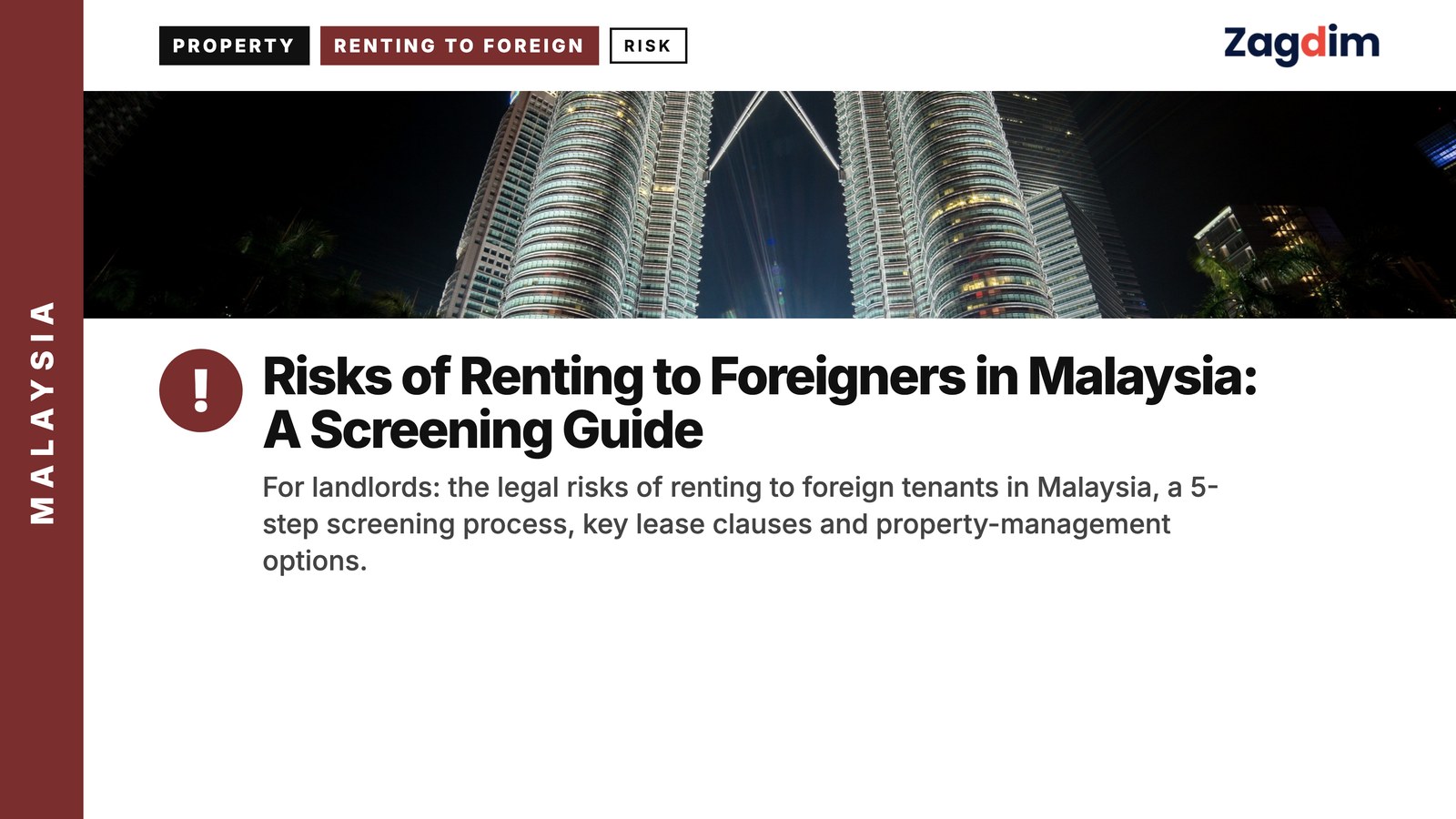
Night — Petronas Towers at night with fountain show, illustrating Risks of Renting to Foreigners in Malaysia: A Screening Guide

Image: Zagdim

September 24, 2026
in Living Abroad, Malaysia, Property
Reading Time: 12 mins read

Introduction

In recent years, driven by Malaysia’s economic development and policies that attract international investment and migration, more and more foreigners have chosen to rent and work there. As a fast-developing country, Malaysia offers rich business opportunities and has drawn a large number of foreign tenants, particularly in Kuala Lumpur, Penang and Johor. For many landlords, renting to foreign tenants is an obvious way to expand into the rental market, especially against the backdrop of growing numbers of international students, posted executives and immigrants.

That said, this choice also brings certain risks and challenges. Foreign tenants may face differences from local law, culture and economic conditions, while landlords need to weigh considerations such as rent payment, lease terms and financial risk. Understanding the potential risks foreign tenants can bring, and setting appropriate screening standards and management strategies, therefore matters a great deal to landlords. This article looks in depth at the potential risks of renting to foreigners, and offers landlords practical screening and management advice to help avoid common pitfalls and keep the rental process smooth and secure.

Who This Is For

Before deciding to rent to foreign tenants, landlords need some analysis and screening of who the target group actually is. Here are several key considerations to help landlords decide whether to rent to foreign tenants, and how to choose the right one.

Identity Breakdown: Who Can Rent Property in Malaysia?

Rental eligibility for foreign tenants in Malaysia varies by the type of status they hold. Common foreign tenant groups include:

  • International students: Malaysia has many international schools and universities that draw students from around the world. These tenants typically need convenient transport and living facilities, and often rent for a semester or a longer period. Landlords can offer more flexible lease terms for students, while making sure the contract clearly defines the student’s responsibilities.
  • Posted executives and corporate staff: as Malaysia becomes a regional business hub, many multinational companies post senior managers or professionals to work there. These tenants typically have higher, more stable incomes and are considered relatively reliable. Landlords might consider offering higher-end housing or short-term rental services suited to their needs.
  • Immigrants: those who choose Malaysia as their place of residence, particularly those relying on long-term residency programs (such as MM2H), tend to have stable, long-term rental needs. These tenants generally have stronger financial backing, and suit long-term lease arrangements.

Regional and Purpose Breakdown: Where Is Demand From Foreign Tenants Highest?

Rental demand across regions is shaped by geography, cost of living and local development, and some areas draw more foreign tenants than others:

  • Kuala Lumpur: as Malaysia’s capital, KL is the main hub for foreign tenants. With large numbers of international businesses and schools and a well-developed public transport network, along with comparatively reasonable rents, it draws large numbers of international students, posted executives and professionals.
  • Penang: Penang’s particular appeal lies in its high-quality living environment, medical facilities and scenic coastline, making it a top choice for many foreign retirees and immigrants. It also draws some foreign corporate staff and tourists.
  • Johor: because it borders Singapore, Johor also sees substantial demand from foreign tenants, especially those from Singapore. These tenants typically have higher housing expectations and tend to sign longer leases.

What Landlords Should Consider: Traits of a Suitable Landlord

Beyond understanding tenant groups, a landlord’s own circumstances and management ability matter greatly too, particularly when dealing with foreign tenants. Landlords should consider the following:

  • Management ability: if a landlord is able to personally manage rental matters — signing the lease, collecting rent, maintaining the property — they can choose to rent directly to a foreign tenant. This requires the landlord to have some legal knowledge and understand local rental regulations and cultural differences.
  • Property management service: if a landlord lacks the time or experience to handle day-to-day management, they can consider a professional property management company. These firms can handle tenant screening, contract enforcement and rent collection, offering more efficient, professional service and reducing management risk. This is particularly important for landlords who don’t live in Malaysia.

In short, when deciding whether to rent to a foreign tenant, landlords should weigh tenant identity, geographic demand and their own management capacity. Reasonable screening and preparation can effectively lower risk during the rental process and protect the interests of both sides.

Process Steps

Before renting to a foreign tenant, landlords should follow a series of steps to make sure the process goes smoothly and risk is minimized. Here are five key recommended steps to help landlords build a clear rental strategy and make sure their cooperation with a foreign tenant is lawful and efficient.

Step 1: Understand the Legal Rules Around Renting to Foreigners

  • Laws to comply with (such as lease restrictions and tax matters) Malaysia’s rental market is governed by several laws, such as the Contracts Act 1950 and the Civil Law Act 1956. These laws set out how a lease is legally formed, rent payment rules, and the rights and obligations between landlord and tenant. However, since the legal framework still lacks a unified residential tenancy law (a Residential Tenancy Act is still in draft), rental protections and rules remain incomplete. Landlords should pay particular attention to the written-contract requirement and avoid relying on verbal agreements, which can lead to legal disputes. Landlords should also understand the relevant tax rules — rental income from foreign tenants may be subject to income tax and stamp duty, and the lease should be formally stamped.
  • The importance of screening a tenant’s identity Before a foreign tenant moves in, they should provide valid identification (such as a passport, work pass or student visa), and undergo a detailed background check. Landlords need to confirm the visa is valid and check the tenant’s work or study status, as well as verify their financial situation, to avoid legal risk arising from unclear status or unlawful residence.

The legal rules around renting to foreigners can be fairly complex, and landlords should understand the relevant legal provisions to avoid risk. If you have questions about how to comply with local law or how to draft a lease, feel free to contact Zagdim for professional advice and support.

Step 2: Basic Requirements for Screening a Tenant

  • Verifying the tenant’s background (such as proof of employment and source of funds) When screening a foreign tenant, landlords should ask for complete background documentation, including a valid proof of employment or student status and proof of the source of funds. For foreign tenants, verifying income source, employer information and other financial documentation is particularly important.
  • Necessary credit reports and rental history Since foreign tenants may lack a local rental history, landlords should check a credit report to assess the tenant’s payment history and creditworthiness. Landlords may also ask the tenant for their rental history elsewhere, to understand their track record and avoid selecting a tenant with a history of default.

Step 3: Set Clear Lease Terms

  • Rent payment method and schedule Landlords should clearly agree the payment method and schedule with a foreign tenant. Common payment methods include monthly, quarterly or annual payment, and landlords should set a reasonable schedule based on the tenant’s circumstances. The lease should also clearly state the penalty clause for late payment, to protect the landlord’s interests.
  • Responsibility for maintaining and repairing common areas If the rental unit is in an apartment or residential complex, the landlord needs to agree with the tenant on responsibility for maintaining shared areas. The contract should clearly state the landlord’s responsibility for maintaining shared facilities, and set out behavior expectations for the tenant’s use of shared spaces. This helps avoid disputes arising from maintenance issues.

Step 4: Choose a Suitable Lease Agreement and Set the Deposit

  • Recommended lease templates Landlords should use a standard lease that has been reviewed by a professional lawyer, to make sure the terms are clear. The agreement should include core content such as the lease term, rent, payment method, maintenance responsibility and termination clauses. Landlords can reference a local lease template, or adjust it based on the actual situation, adding necessary clauses to protect their own interests.
  • Deposit amount and refund conditions A standard Malaysian lease agreement typically requires the tenant to pay a deposit equal to three months’ rent, comprising two months’ rent as a security deposit and one month’s rent as an advance for utilities. Landlords should clearly set the deposit refund conditions, and after the lease ends, decide whether to refund the full deposit based on whether there is property damage or unpaid fees.

Step 5: Decide Whether to Use Property Management

  • Pros and cons of property management services Landlords can choose to manage the property themselves, or hire a professional management company to handle rental matters. The advantage of a management service is that a professional company can effectively handle tenant screening, rent collection, and maintenance, reducing the landlord’s day-to-day management burden. The downside is the cost of the management fee, and somewhat reduced control for the landlord.
  • How to choose a suitable management company If choosing a management service, landlords should select a properly licensed professional management company, and understand its scope of service, fee structure and track record. Choosing a company with a good reputation and proven track record can effectively reduce risk during the rental process.

Through these steps, landlords can rent to foreign tenants with more confidence, while making sure the process is legally compliant, risk is controlled, and finances are protected.

For landlords without the time or experience to manage a rental property themselves, a management service is an ideal way to improve efficiency. If you’d like to learn more about the benefits of property management or how to choose the right management company, feel free to contact Zagdim at any time.

FAQ

Question 1: What legal risks come with renting to foreigners?

When renting to a foreigner, landlords must comply with Malaysia’s rental laws, including but not limited to the Contracts Act 1950 and the Civil Law Act 1956. However, Malaysia’s rental regulations aren’t fully unified, and there is no dedicated residential tenancy law. This fragmentation makes disputes harder to resolve, particularly around rent payment, property damage or contract termination, and landlords may face insufficient legal protection. Landlords should sign a written lease with clear terms and avoid verbal agreements.

Question 2: How do I assess whether a tenant is reliable?

Assessing a tenant’s reliability requires carefully checking their background information, including proof of employment, proof of income, rental history and a credit report. For foreign tenants, landlords should ask for a passport, valid visa and bank statements, and can also contact the tenant’s employer or school to confirm the information is genuine. Landlords can also ask the tenant for references from a previous rental to understand their payment habits and rental history.

Question 3: What key clauses should a lease include to protect a landlord?

The lease is the legal document protecting a landlord’s interests. Key clauses should include:

  • Lease term and renewal terms: clearly set the lease period and renewal options, to avoid unannounced termination.
  • Rent payment terms: set out the payment method, payment date and late-payment penalty clause.
  • Maintenance responsibility: clearly set out landlord and tenant responsibility for repairs, especially for shared areas.
  • Prohibited items: including a ban on illegal activity (such as gambling or drug manufacturing) and unauthorized subletting.
  • Termination clause: the conditions under which either party may terminate the lease in specific circumstances.

Question 4: What are foreign tenants’ payment habits like?

A foreign tenant’s payment discipline can vary due to cultural differences and background. Some foreign tenants, particularly those from higher-income countries, tend to have good credit records and payment ability; but some tenants may be unfamiliar with the local rental system, or face cash-flow difficulties, leading to irregular payment. Landlords should carefully review a foreign tenant’s financial situation and include strict payment clauses in the lease to protect their own interests.

Question 5: What should I do if a tenant is unable to pay rent?

If a tenant cannot pay rent, the landlord should first issue a formal payment demand under the terms of the lease. If the tenant still fails to meet the obligation, the landlord can consider legal action, filing suit under the Civil Law Act and the Contracts Act, or enforcing the lease’s terms. If the lease already includes a clause for forcibly reclaiming the property, the landlord can reclaim it within the legal framework. To avoid this situation, landlords should conduct thorough tenant screening in advance and require a reasonable deposit.

Question 6: What are the benefits of a property management service?

A property management service offers landlords several benefits. First, a management company can effectively handle rental matters, including tenant screening, rent collection and maintenance, reducing the landlord’s day-to-day management pressure. Second, a professional management company is familiar with local law and regulation, helping ensure the rental process is compliant and reducing legal risk. Finally, a management service can also provide regular property inspections, catching and resolving potential issues promptly to protect the property’s value.

Question 7: How do market shifts affect a landlord’s decisions?

Shifts in Malaysia’s rental market, particularly fluctuations in demand from foreign tenants, directly affect a landlord’s rental strategy. When demand rises, landlords may choose to raise rent or shorten the lease term to increase income; when demand falls, they may need to adjust rent levels or offer more flexible lease options to attract tenants. In addition, changes in Malaysian government policy toward foreign tenants (such as tax policy or immigration policy) also affect foreign tenants’ willingness to move in, which in turn affects a landlord’s rental decisions. Landlords therefore need to keep tracking market trends and adjust their rental strategy flexibly.

Points to Note

When renting to foreign tenants, landlords may make certain common mistakes due to lack of experience or unfamiliarity with local law. Below are some common misconceptions that, once understood, can help landlords effectively avoid risk and keep the rental process running smoothly.

Common Misconceptions and Misunderstandings

  1. Ignoring the misunderstandings and management difficulties that cultural differences can bring Many landlords don’t fully consider the challenges that cultural differences can create when working with foreign tenants. For example, a foreign tenant may not be very familiar with local law or everyday customs, which can lead to misunderstandings and communication difficulties. Landlords should stay open and patient, provide appropriate cultural guidance when needed, and make sure lease terms clearly reflect both sides’ responsibilities and rights. Landlords should also understand a foreign tenant’s specific needs, such as providing more language support and practical guidance, to avoid cultural conflict and misunderstanding.
  2. Relying too heavily on verbal agreements, and neglecting the importance of a written contract Another common mistake is relying too heavily on a verbal agreement instead of signing a formal written lease. A verbal agreement does carry some weight under Malaysia’s legal framework, but it doesn’t offer enough legal protection. In a dispute, a verbal agreement is hard to use as effective evidence. Landlords should make sure every rental arrangement is backed by a formal written contract, clearly listing rent, payment schedule, division of responsibility, lease term and termination clause, with the tenant’s signature confirming agreement. This protects both sides’ interests and provides legal protection when needed.
  3. Setting the deposit or rent payment method incorrectly Many landlords set the deposit amount or rent payment method without properly adjusting for local law or market conditions, which can create financial risk. Generally, landlords should require a deposit equal to three months’ rent, comprising two months as a security deposit and one month as an advance for utilities. Landlords should also clearly agree the rent payment method (monthly, quarterly or annual) and set out a late-payment penalty clause in the lease in detail. An incorrect deposit setup or unreasonable payment arrangement can lead to losses for the landlord, particularly if the tenant fails to pay on time or damages the property.

These common misconceptions and misunderstandings often create unnecessary trouble and loss for landlords. To reduce risk, landlords should improve their understanding of rental regulations and make the necessary adjustments and plans based on their specific situation.

Summary

Renting to foreigners is not only a potential source of income, it is also an investment that requires careful management and screening. As Malaysia becomes an increasingly international market, it has attracted a growing number of foreign tenants. As a landlord, understanding local legal conditions, setting clear lease terms, and choosing an appropriate management approach are the keys to a smooth rental process. Correct screening and management measures can effectively lower risk and protect a landlord’s property and income. If you have any questions about how to select a suitable foreign tenant, or want to know how to manage a rental property more effectively, feel free to contact us at any time — a professional advisor will help you make the best decision, ensuring the rental process is smooth, lawful, and delivers a stable return.

Related in this series:

  • Do Foreign Tenants Have Legal Protection in Malaysia?
  • Where to Rent in Kuala Lumpur: A Neighborhood Guide for Foreigners
  • Where to Rent in Johor Bahru: A Neighborhood Guide for Foreigners
  • Where to Rent in Penang: A Neighborhood Guide for Foreigners
  • Renting in Malaysia as a Foreigner: Leases, Deposits and the Law
  • Legal Rights and Complaint Channels for Foreigners in Malaysia
  • Evicting a Non-Paying or Damaging Tenant in Malaysia
  • How to Verify a Malaysian Property Can Be Legally Rented Out

Have a question about this guide? Leave a comment below, or ask Zagdim directly.

Life abroad? Ask Zagdim.

Your first stop for international property and global living.

Research and insights. Know what’s changing. Understand what matters.

Sources

  • Maybank2u – Tenancy Agreement Malaysia
  • The Star – Urgent Need for Long-Awaited Residential Tenancy Law
  • Speedhome – Background Check Documents
  • Propertygenie – Rent Out Your Property: 13 Mistakes Landlords Should Avoid
  • PropertyGuru – Exploring Tenant Rights and Tenancy Agreement in Malaysia
  • LHLU – Complete Guide to Foreigners Renting in Malaysia

Zagdim AI
All content is researched, written, or authorized for publication by the @Zagdim Overseas team. Sharing and reposting are welcome, but please make sure to credit the source and include the original article link from this website. Any plagiarism or unauthorized use may result in legal action. For article submissions, please contact us via Facebook. Thank you for your support!

For article submissions, press release publication, or interview notices, please contact [email protected]. 

Zagdim Ask

Have a specific question about overseas living, property, visa, or practical arrangements?

Fill in your situation and key concerns through Zagdim Ask. Our team will review your message and get back to you by email where appropriate.

Submit your enquiry →

Similar Topics

Skyline — Osaka skyline with tower at sunset, illustrating Japan Residence Essentials: How to Apply for the Residence Card, Juminhyo, and My Number Card
Japan

Japan Residence Essentials: How to Apply for the Residence Card, Juminhyo, and My Number Card

September 24, 2026
Architecture — curved modern building with garden terraces, illustrating How to Set Up a Company in Japan as a Foreigner: Requirements and Process
Japan

How to Set Up a Company in Japan as a Foreigner: Requirements and Process

September 24, 2026
Street — shopping street exterior with billboards in Osaka, illustrating How to Find a Job in Japan: 7 Methods for Foreigners
Japan

How to Find a Job in Japan: 7 Methods for Foreigners

September 24, 2026
Next Post
Festival — woman hanging red lanterns at temple, illustrating Malaysian Income Tax on Rental Income for Overseas Landlords

Malaysian Income Tax on Rental Income for Overseas Landlords

Skyline — Petronas Towers viewed from KLCC Park, illustrating How to Verify a Malaysian Property Can Be Legally Rented Out

How to Verify a Malaysian Property Can Be Legally Rented Out

Landmark — domed mosque framed by archway Kuala Lumpur, illustrating Does Malaysia Have Rent Control or Tenant Protection Laws?

Does Malaysia Have Rent Control or Tenant Protection Laws?

Facebook Twitter Youtube

About Us

Zagdim is a global knowledge platform focused on cross-border property, relocation, lifestyle, and location-based decision-making.

We provide insights on overseas real estate, market trends, regional analysis, economic developments, and practical relocation information. Through continuous market observation and on-the-ground research, Zagdim helps readers better understand a place before deciding where to live, invest, buy property, or establish a base abroad.

We currently follow markets including the UK, Japan, Thailand, Malaysia, Germany, Australia, the UAE, Greece, Portugal, and Spain, while continuing to track emerging lifestyle, relocation, and property trends worldwide.

Category

  • Australia
  • Buying & Immigration Guide
  • Canada
  • Costa Rica
  • Dubai
  • Encyclopedia
  • Europe
  • Expat Lifestyle Guide
  • Global Reports Analysis
  • Hong Kong
  • Human-Picked
  • International Property Buying Guide
  • Japan
  • Japan Market News
  • Kenya
  • Living Abroad
  • Malaysia
  • Mallorca
  • Market Trends Overview
  • News
  • Other Market News
  • Overseas Leasing & Long-Term Stay
  • Philippines
  • Policy Interpretation
  • Portugal
  • Property
  • Property Law & Tax
  • Real Estate & Economic News
  • Real Estate Law & Taxation
  • Relocation, Immigration & Visa
  • Singapore
  • South Korea
  • Spain
  • Switzerland
  • Thailand
  • Thailand Market News
  • UK Market News
  • United Kingdom
  • United States
  • Vietnam Market News
  • Visa & Immigration
  • Zagdim Insights
  • Zagdim Property Insights

Email:[email protected]


Add Friends


WhatsApp
Contact Us


Wechat:Zagdim

Work with Zagdim

Put your brand inside the overseas property research process — in English and in Chinese. Reaching buyers, expats and investors across 19 markets.

View partnership packages →

©2026 Zagdim Overseas All Right Reserved

No Result
View All Result
  • Home
  • Zagdim Property Insights
    • Market Trends Overview
    • Policy Interpretation
    • Forest
    • PLACEHOLDER sub-cate for Zagdim Property Insights
  • Global Reports Analysis
    • In-Depth Project Analysis
  • Real Estate & Economic News
    • Thailand Market News
    • UK Market News
    • Germany Market News
    • Japan Market News
  • Buying & Immigration Guide
    • Expat Lifestyle Guide
    • Real Estate Law & Taxation
    • Overseas Leasing & Long-Term Stay
    • Starting a Business & Company Setup
  • Zagdim Ask
  • 中文 EN

©2026 Zagdim Overseas All Right Reserved