






























Payment, Title Registration, and Key Handover May Not Happen on the Same Day
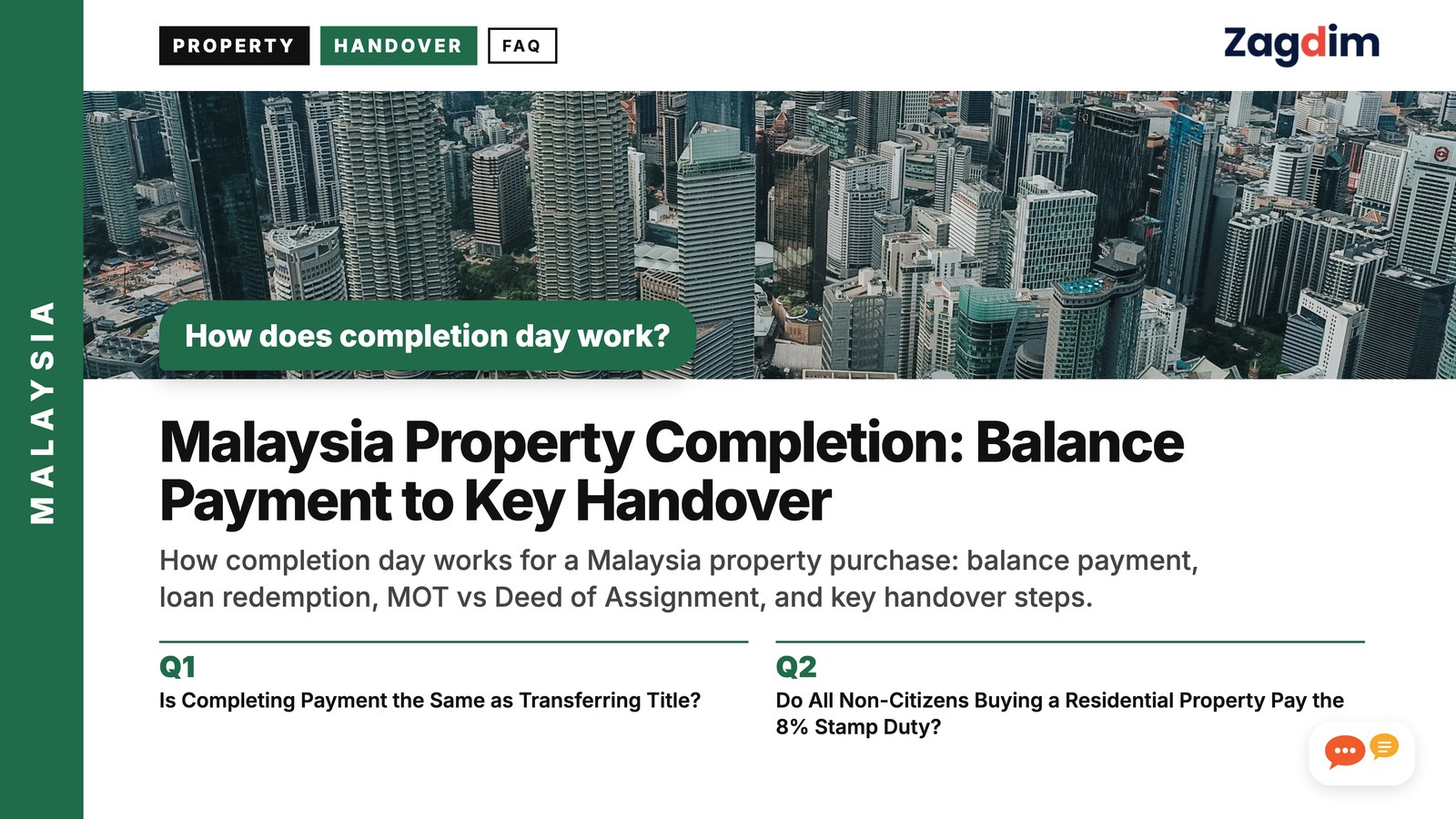
The completion stage of a Malaysia property purchase typically involves paying the balance of the purchase price, redeeming the seller’s existing loan, stamping the transfer documents, registering title, and handing over the property. These steps depend on each other in sequence. It is a mistake to assume that because both parties sign documents on one day, everything else is completed at the same time.
For the buyer, a more useful approach is to ask the conveyancing lawyer to list out each task, its payment deadline, and its current status. This matters especially for buyers based overseas, since witnessing signatures, sending documents, and transferring funds all need to be arranged well in advance.
This article covers the completion of a typical secondary-market residential purchase in Peninsular Malaysia. Purchases with staged payments during construction follow a different schedule, and transactions where an individual title has not yet been issued use different documents, which are discussed below.
When the Completion Period Starts Depends on the SPA’s Wording
Secondary-market transactions often use a structure of “three months to completion, plus one month of extension.” This is a common contractual arrangement, not a nationwide statutory deadline.
Some transactions count the completion period from the date of the Sale and Purchase Agreement (SPA); others require state consent or other conditions to be satisfied first. Whether an extension applies automatically, how extension interest is calculated, and which party’s delay allows for a time adjustment all depend on the specific clauses in the contract.
After signing, it is worth asking the lawyer to confirm four dates: when the formal completion period starts counting, the final payment deadline, the available extension period, and the expected key handover date. This is more useful than simply remembering “three plus one.”
Different Documents Apply With and Without an Issued Title
Where a transferable individual or strata title has already been issued, registration is usually handled through a Memorandum of Transfer (MOT; Form 14A is commonly used under the relevant land system). If the seller still has an outstanding loan, redemption and discharge of charge also need to be arranged.
Where an individual or strata title has not yet been issued, the transaction may first use a document such as a Deed of Assignment to transfer the buyer’s rights under the sale and purchase agreement, with the formal transfer of title completed later once the title becomes available for registration. Not every transaction can be described as “sign the MOT and the land office immediately registers the buyer as owner.”
A signed transfer document, a stamped document, a submitted registration, and a completed registration are four different stages. If you need to confirm whether title has actually been transferred, ask for the registration outcome or an updated title search, not just a copy of the signed document.
The Balance Payment and Documents Usually Need to Line Up With These Tasks
| Task | What Buyers Should Check |
|---|---|
| Bank loan disbursement | Whether loan documents, conditions precedent, and required approvals are all in place |
| Buyer’s own balance funds | Whether the portion of the price not covered by the bank loan arrives on schedule |
| Seller’s loan redemption | How the redemption amount, document handover, and discharge of charge are coordinated |
| Stamp duty and registration | Who is responsible for filing, the payment deadline, and registration progress |
| Apportionment of costs | How maintenance fees, quit rent, and assessment rates are apportioned by date |
| Property handover | Whether the unit is delivered vacant or with an existing tenancy, and how keys, access cards, and items are handed over |
If the property is bought with an existing tenancy in place, the tenancy, deposit, rent apportionment, and tenant notification also need to be handled separately. Receiving the keys alone should not be treated as completion of the handover.
Stamp Duty Is Charged by Document, Not Something to Leave Until Key Handover
Loan documents and property transfer documents attract different stamp duties. The main loan instrument for an ordinary residential loan is commonly calculated at 0.5% of the loan amount, though the document type, ancillary documents, and any applicable exemptions still need to be checked.
Malaysia’s Finance Act 2025 added a provision to the stamp duty schedule covering residential property: from January 1, 2026, the sale of a residential property to an individual who is neither a citizen nor a Malaysian permanent resident, or to a foreign company as defined under the legislation, is subject to stamp duty of RM8 for every RM100, or part thereof, calculated on whichever is higher between the consideration and the market value.
This 8% rate cannot be simplified to “every foreigner buying any property pays the same rate.” Permanent residents, non-residential property, the definition of a company, and documents that straddle the effective date should each be checked against the applicable provisions and how LHDN (Malaysia’s Inland Revenue Board) treats them.
For example, assuming a buyer and a residential transaction meet the 8% rule above, with a chargeable value of RM1,000,000, the transfer stamp duty would be RM80,000. If a RM700,000 loan is taxed at the standard 0.5% rate, the main loan instrument duty would be RM3,500. Together that is RM83,500, not including legal fees, registration fees, and other costs.
Documents signed in Malaysia, or signed abroad and then brought into Malaysia, each have their own stamping deadlines. Ask the lawyer to confirm the deadlines against the actual documents and assessment notices, rather than assuming every tax or fee can wait until the completion date.
Check the Handover Conditions Again Before Collecting the Keys
The timing of key handover follows the delivery conditions set out in the SPA. It may be coordinated with payment and registration progress, but it does not necessarily have to wait until all registration paperwork is finished.
When collecting the keys, it is worth checking the condition of the unit, furniture and appliances, keys and access cards, utility meter readings, and any outstanding bills against what was agreed. For buyers overseas, it helps to arrange in advance who will receive the property on your behalf, which documents they are authorized to sign, and whether photos and a handover checklist are needed.
Common Misunderstandings
“Completion Is Guaranteed Three Months After Signing the SPA.”
Check when the completion period starts counting, the conditions precedent, and the extension clauses first. Do not calculate it yourself based only on the signing date.
“Once the MOT Is Stamped, You Are Already the Registered Owner.”
Stamping and title registration are not the same thing. The outcome of land registration should be checked separately.
“Apart From the Down Payment, Other Costs Can Wait Until Key Handover.”
Stamp duty, legal fees, and the buyer’s own balance payment may fall due earlier. They should be scheduled according to payment notices and the formal timetable.
What to Check Next
Buyers approaching completion should ask their lawyer for a settlement statement and an outstanding-items list, and confirm whether funds, approvals, redemption documents, and loan disbursement conditions are all in place.
Buyers who need to sign documents or remit funds from overseas should ask in advance about witnessing requirements, original documents, and fund-arrival requirements, and allow enough processing time. Buyers preparing to take possession should separately confirm the handover conditions, how costs are apportioned, and whether an existing tenancy will be taken over.
Frequently Asked Questions
Is Completing Payment the Same as Transferring Title?
No. Payment, registration, and handover are separate matters, and each should be confirmed separately.
If There Is No Strata Title Yet, Does That Mean the Property Cannot Be Transacted?
Not necessarily. It may be handled through an assignment of contractual rights, but the documents, approvals, and the later transfer of title still need to be checked by a lawyer.
Do All Non-Citizens Buying a Residential Property Pay the 8% Stamp Duty?
It depends on whether the buyer is also a non-permanent-resident, whether the transaction and the documents fall under the provisions effective in 2026, and whether any special arrangement applies.
Disclaimer
This article provides general information about the transaction and tax aspects of completion. It is not legal or tax advice. The worked example is for illustration only. Actual tax amounts, payment deadlines, and completion conditions are determined by the applicable law, the formal documents, and the assessment issued. Information verified as of October 6, 2026.
Have a question about this guide? Leave a comment below, or ask Zagdim directly.
Your first stop for international property and global living.
Research and insights. Know what’s changing. Understand what matters.
References
- LHDN — Finance Act 2025 (Act 874), Sections 25–29 and the stamp duty schedule amendments for residential transfers: https://www.hasil.gov.my/wp-content/uploads/Akta-Kewangan-2025-Akta-874.pdf
- LHDN — Stamp duty stamping deadlines and penalties for late stamping: https://www.hasil.gov.my/en/duti-setem/penalti-duti-setem/
- Maybank — Property Stamp Duty (the 0.5% loan-document portion): https://www.maybank2u.com.my/maybank2u/malaysia/en/articles/properties/sale-and-purchase/property-stamp-duty.page
- JKPTG — Pemilik Tanah: land transfer and registration: https://www.jkptg.gov.my/my/pemilik-tanah
- Kuek, Ong & Associates — Title, financing, and completion conditions for secondary-market transactions: https://www.kuekong.com/?p=3880