






























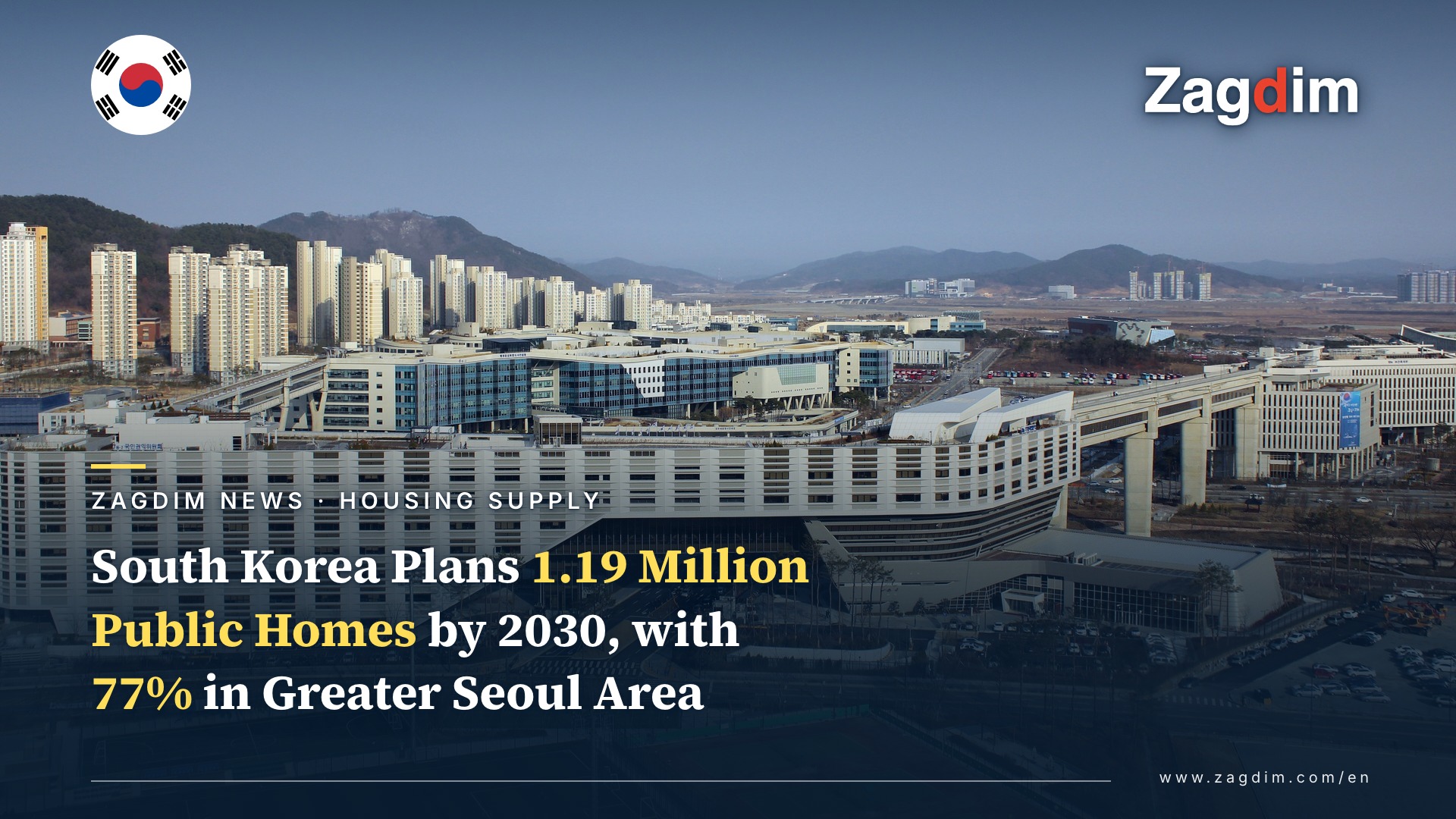
South Korea’s Ministry of Land, Infrastructure and Transport (MOLIT) unveiled a “Housing Stability Plan” on September 21 that aims to supply about 1.19 million public homes through 2030, an average of about 240,000 a year, with 77% of them — about 920,000 units — allocated to the Seoul metropolitan area, where housing demand is highest. According to SBS, the total equals about 13.6% of the country’s 8.717 million renter households as of 2024. The Korea Times reported that the plan targets low-income households, young people and newlyweds amid rising home prices in the greater Seoul area.
The count is not limited to newly built homes. In the SBS breakdown, rental supply comes from 350,000 construction-type units on public land and other sites, 313,000 purchase-type units, 230,000 jeonse-type units utilizing existing private housing and 52,000 publicly supported private rental units, while 243,000 public for-sale units (211,000 in the metropolitan area) will be supplied in third new towns and other areas. Hankook Ilbo put the exact total at 1.188 million, following a national policy target of at least 1.1 million public homes, and defined public housing as homes given public character through government finance or funds. The plan also creates a new “universal public rental” category of about 190,000 units, covering 175,000 construction-type and 18,000 purchase-type homes, with income and asset criteria relaxed to reach middle-income households and sizes up to 84 square meters.
By life stage, SBS reported 243,000 units for unmarried youths, 328,000 for newlyweds and child-rearing households, and 54,000 for elderly households. The youth monthly rent subsidy, up to 200,000 won a month for 24 months, will have its income ceiling raised to 2.74 million won from 1.54 million won (the earlier figure is from Seoul Economic Daily) and its age range widened to 18 to 34, including 18-year-olds. For private landlords, MOLIT plans a long-term rental model of 20 years or more, and told Hankook Ilbo it is preparing a dedicated mortgage product with a 4–5% rate that can be repaid from 20 years of rental income; the initial rent ratio has not been set.
On timing, SBS said about 150,000 units nationwide, about 100,000 of them in the metropolitan area, are expected to be ready for move-in from the fourth quarter of 2026 through the end of 2027. Seoul Economic Daily reported that MOLIT will also designate two public housing districts, Daejang-dong in Goyang (9,400 units) and Ojeon-dong in Uiwang (14,000 units), aiming for district plan approval in the second half of 2027 and the first housing project in 2029. Hankook Ilbo said the plan overlaps by about 650,000 to 700,000 units with the August 13 rapid supply measures, whose Greater Seoul target of 1.491 million homes is counted on a construction-start basis and includes private redevelopment.
Seoul Economic Daily noted that critics point to the large share of homes the government buys or leases from the existing market, and that construction on the new district sites cannot begin until late 2029, limiting short-term market impact. Ham Young-jin, head of the Woori Bank real estate research lab, told Hankook Ilbo that securing urban land for universal rentals is costly and requires negotiation with residents and local governments, that reconstruction of aging public rentals takes years because of relocation, and that actual construction starts and move-ins should be disclosed each year rather than planned volumes. SBS reported that the government expects the near-term move-in volume to help stabilize the lease and rental market in the metropolitan area.
References
SBS News – 1.19 Million Public Housing Units to Be Supplied by 2030, with 920,000 in Seoul Metropolitan Area / Seoul Economic Daily – Korea to Supply 1.19 Million Public Homes by 2030 / The Korea Times – Gov’t plans 1.19 mil. public sale, rental homes amid housing price pressures / Hankook Ilbo – 2030년까지 공적주택 119만 가구… 92만 가구 수도권에 공급 / Newsworks – 국토부 “2030년까지 공적주택 119만가구 공급”…수도권에 92만