































Search “Camden London” on social media and you’ll see a very split picture.
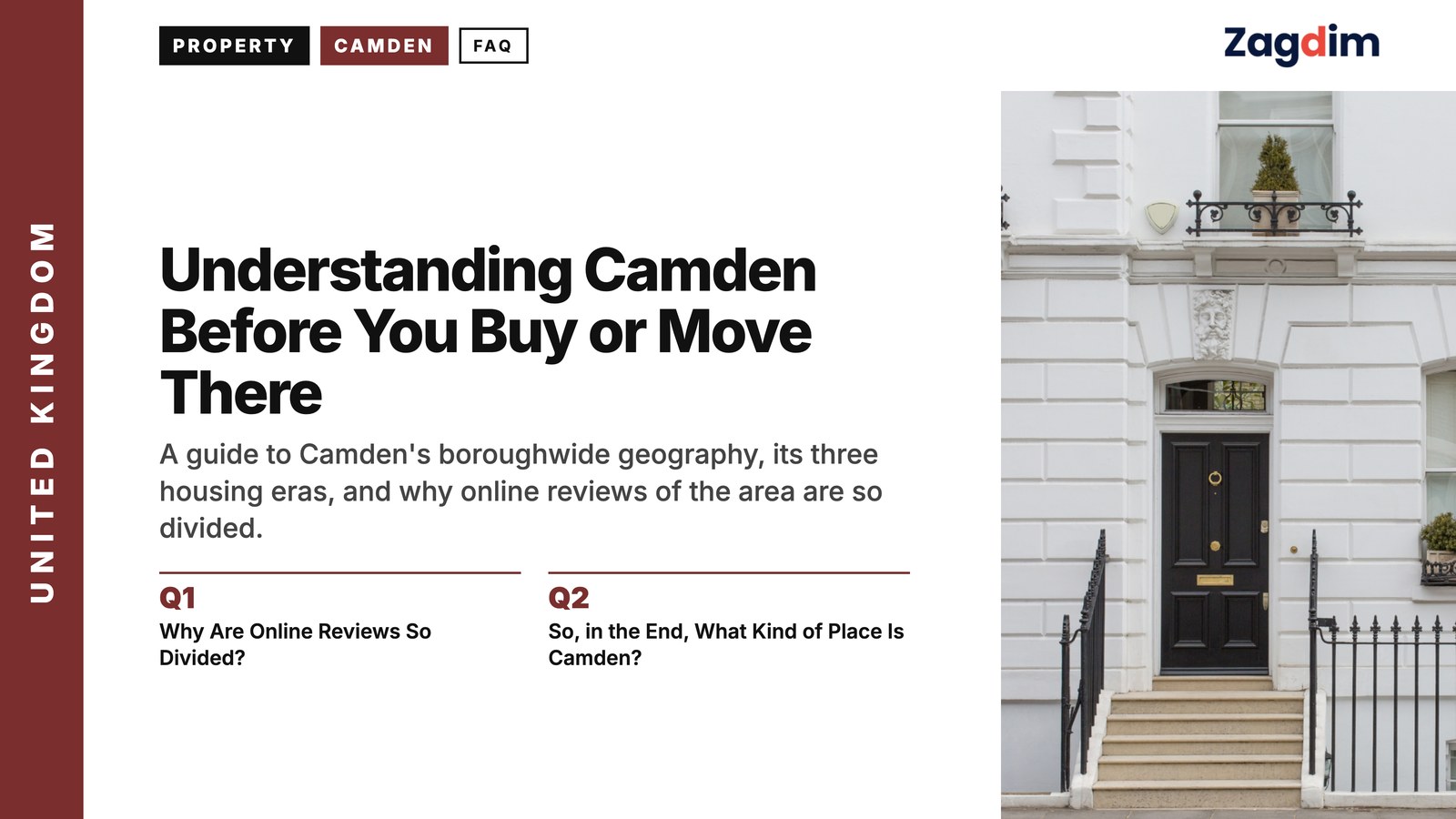
There are videos of Camden Market’s colorful rooftops, street musicians and arches packed with tourists, captioned as the most characterful place in all of London; there are photos of a whole row of neat Georgian terraces in Bloomsbury, with white façades and small front gardens, looking quiet and refined; and there are all kinds of one-line comments — some people say it’s a lovely place to live, others tell you to “think twice.”
The more you look, the easier it is to get confused: why does the same name seem to mean such different things to different people? And if you’re considering making your home here, the first thing to understand is this confusion itself — most of the time, when people say “Camden,” they’re not actually talking about the same area.
First, Get the Map Right: Camden Has Two Meanings
The first is Camden in the borough sense — the London Borough of Camden. Its area is much bigger than most people imagine: to the south it starts at Bloomsbury, home to UCL and the British Museum, and sits in Zone 1; it extends north across Primrose Hill and Belsize Park, all the way to the green edge of Hampstead, with most of the northern part falling in Zone 2. The whole borough spans Zone 1 and Zone 2 and contains a dozen or so neighborhoods with completely different characters: Bloomsbury, Fitzrovia, Somers Town, Camden Town, Primrose Hill, Belsize Park, Hampstead, Kentish Town, Swiss Cottage and the Mornington Crescent area are all included.
In other words, when someone casually says “Camden is lively,” they may only mean the few streets around the Camden Town market; when someone says “Camden is quiet,” they might mean the lanes of Hampstead, or a terrace facing a square in Bloomsbury. Both places sit within the same borough, yet it’s over half an hour’s walk between them, with almost no similarity in atmosphere, prices or resident makeup.
The second meaning is the Camden Town neighborhood most tourists and passers-by know — the small core area with the market, the canal, and music playing the moment you step out of the tube station. It genuinely is the most recognizable landmark in the whole borough, but it’s also the one most easily blown up into “the whole of Camden.”
In Zagdim’s research, this distinction is almost always the starting point of every discussion. The single most upvoted comment we found wasn’t a recommendation or a warning — it was someone carefully separating “the Camden borough” from “the Camden Town neighborhood,” telling everyone not to generalize the whole borough from the impression of one street. The fact that a “map-drawing” comment was the most agreed-with says something in itself: once you get the map right, more than half the arguments simply disappear.
From now on, whenever you hear anyone draw a conclusion about Camden, your first reaction can be: which neighborhood of the borough are they actually talking about?
The Housing Here Roughly Falls Into Three Worlds
Once you’ve sorted out the area, the natural next question is: if I look for a home here, what options will I run into, and roughly what price bracket do they fall in?
Camden’s housing supply isn’t complicated — it can be broadly split into three categories, coming from three completely different eras and spread across different neighborhoods. Once you understand these three, you won’t compare against the wrong benchmark when looking at any given property.
Category One: 19th-Century Terraces — Camden’s Foundational Character
The most prized housing in the whole borough, and the one long favored by buy-and-hold buyers, is the Georgian and Victorian terraces built in the 19th century by large estate families under a unified plan. The most representative example is the Bedford Estate, where an entire street block was designed and built together, with everything from façade proportions and door and window styles down to the placement of street trees and squares considered as a whole.
Harrington Square, which we often mention, is one such estate, built in 1843, with the terraces on the northeast side of the square now listed as Grade II. The character of these homes is clear: terraced housing, uniform façades, many arranged around a square garden. They are not scattered old houses, but an environment built almost two hundred years ago around the concept of “a single community” — which is also why these street blocks are still able to maintain very stable living quality today. Owning one of these also means accepting the alteration and upkeep requirements that come with conservation rules.
This type of property is concentrated mainly around Bloomsbury, Fitzrovia, Primrose Hill, Belsize Park, Hampstead and the Mornington Crescent area, with a fairly wide price gap between different neighborhoods. Hampstead and Primrose Hill have long been among London’s most established traditional residential districts, occupying their own market position and buyer base; areas such as Bloomsbury or around Mornington Crescent have more terraces already split into flats, giving a more varied range of budget entry points. (Individual sub-areas lack comparable published price data, so any specific viewing should be checked against recent sold prices in that street or block.)
Category Two: Postwar Council Housing — the Real Streetscape Standing Beside the Terraces
From the postwar period through the 1970s, a large amount of council housing was built across the UK, and Camden was no exception. These estates are mostly medium- to high-rise blocks, planned under the modernist thinking of the time, with a large number of units and ample public space, originally intended to provide affordable homes for the general public.
A very representative example is the Ampthill Square Estate, completed in the 1960s with a total of 366 units, right on the south side of Harrington Square. This type of estate exists in significant numbers across the borough, spread widely — and a very common scene is turning a corner to find a 19th-century terrace on one side and a 1960s residential block on the other.
Many people viewing a property for the first time find this “old and new side by side” a bit jarring. But for long-term residents, this is simply Camden’s true face — two eras, two different visions of “good housing,” standing side by side, with neither having fully replaced the other. Understanding this means you won’t keep applying an “everything matches” standard as you walk the streets — and it’s exactly this existing stock that makes Camden’s population far more diverse than a purely luxury district would be.
Category Three: New Developments — Scarce Supply, Priced in a Category of Their Own
Compared with the terraces and postwar estates, brand-new supply in Camden has never been plentiful. Land in the core area is scarce and planning restrictions are significant, so the number of sites available for ground-up development is very limited — which is exactly why any new scheme tends to draw plenty of attention when it launches.
Currently visible examples on the market include large schemes such as Camden Goods Yard, which integrates former railway land and rebuilds it with a larger unit count and integrated amenities; based on Zagdim’s sample of agent listings observed at the end of July 2026, unit prices there run roughly £1,240–£2,061 per square foot, clearly split by unit type and floor (these are listing prices observed, not confirmed sale prices). Another category is boutique small-scale schemes, such as Duke’s Row, with only 11 units in total, where one-bedroom units start from £845,000 — working out, based on the published starting price and floor area, to about £1,447 per square foot (a calculated estimate).
For reference, according to Land Registry transaction records, the median resale price for flats in the NW1 7 postcode over the past 24 months has been about £995 per square foot, with the middle 50% of transactions falling between £837 and £1,155 per square foot. Putting these figures side by side, it’s clear there is a real gap between new-build asking prices and the recent second-hand transaction midpoint — and what a new-build home trades that gap for is a brand-new structure, warranty cover and current energy standards. The two pricing logics simply shouldn’t be compared directly. Whether any particular new scheme is worth considering is covered in [our separate article on Duke’s Row]; this article does not go into that individual assessment.
Worth noting is one concrete example that ties the map together: Harrington Square, where Duke’s Row sits, brings all three categories of housing into the same square — the northeast side is the Grade II-listed terrace from 1843, the south side is the 1960s council estate, and the newly built Duke’s Row fills in the remaining corner of the square. One square is, in effect, a snapshot of Camden’s entire housing history.
Simply put: when you look for a home in Camden, you’re really choosing between three different “living options” — nearly two centuries of streetscape and craftsmanship, the plain, spacious layout of the postwar era, or a brand-new property with current specifications. The three logics are completely different, and each has its own price range. Once you’re clear on which category you’re actually looking at, you won’t end up comparing the wrong things.
Put the People and Institutions on the Map Too
Housing is static; what really makes an area run is people and institutions. A set of official figures can make Camden’s “level of activity” clear:
- Population: According to the 2021 Census, Camden borough has a resident population of about 210,000 (ONS).
- Employment and institutions: The Knowledge Quarter innovation district, centered on King’s Cross within about a one-mile radius, has member organizations employing over 30,000 people and serving more than 8 million visitors a year (Knowledge Quarter’s own figures) — Google’s UK headquarters, Meta, DeepMind, Universal Music Group and the Francis Crick Institute are all within it.
- Education: UCL is one of the UK’s largest universities by international-student numbers; at the basic-education level, Camden Council oversees about 38 state primary schools and 10 state secondary schools, plus a fair number of private schools (Camden Council).
- Culture and green space: The British Museum and the British Library sit at the borough’s southern end; in the middle is Camden Market, running since 1974 with millions of annual visitors (Camden BID’s estimate); to the north lies the large expanse of Hampstead Heath.
Read together, these figures show that Camden has a rather unusual economic structure: academia, technology, biomedicine, music/culture and market tourism all operate within a single borough at once. For a buyer considering a long-term hold, this means residential demand in the area comes from several independent sources — the academic calendar, corporate employment and family settlement each run on their own rhythm, not dependent on a single industry.
Why Are Online Reviews So Divided?
Now that the housing types are clear, the next hurdle most people struggle with is: why does the same place feel comfortable to some and completely unacceptable to others? Whose account is actually true?
To answer this, Zagdim carried out its own research: we collected public discussion about Camden from Chinese-language communities, logged each post’s topic and sentiment direction, and did an in-depth reading of the comments on the highest-engagement posts about living there. A few findings are worth handing over exactly as we found them.
Let’s look first at what people are actually talking about. The most-discussed topics, in order, are: how it feels to live there, market culture, transport and commuting, schools and studying abroad, food, and housing prices/rent; the two categories with the highest engagement are how it feels to live there and housing prices/rent. In other words, what really drives the discussion isn’t tourism content — it’s “what is it actually like to live there, and how much does it cost” — which is exactly why this article opened with the map and the housing composition.
Next, look at who is doing the talking. This is the clearest dividing line in the whole research round: among the reviews we logged, residents who self-reported living there for more than a year were almost uniformly positive; the more reserved opinions came overwhelmingly from users who had never actually lived there and were only passing on a secondhand impression. In other words, the polarization of opinion often isn’t really about “is this place good or not” — it’s about “have you actually lived here or not.”
Why is the gap so large? A resident of three years offered what turned out to be the most widely agreed-with explanation — call it the “five-minute rule”: Camden Town’s high street really is busy, with heavy foot traffic and a fast pace, especially lively in the evenings and on weekends; but walk just five minutes off the high street, turn into any of the residential side streets, and the noise drops away — more trees, fewer cars, a perfectly standard quiet London residential street.
These few sentences actually resolve most of the debate. Much of the strong impression people form of Camden comes from “riding the tube in and looking around for an afternoon” — what you see is always the busiest, most crowded side. But the people who actually live there don’t center their lives on the high street: they walk five minutes home from the station, pop to the corner shop, stroll in the nearby park — a daily radius really no different from most London residential areas. One user who had lived there for only three months left a simple but persuasive line: “Three months in, and honestly, it’s been really lovely.”
Some residents also specifically point to the Mornington Crescent area as a livable pocket: just the right distance from the buzz of Camden Town, itself an old Northern line station that opened back in 1907, with Chinese restaurants nearby, long-running Thai restaurants, and well-stocked Asian supermarkets within walking distance — for overseas Chinese buyers, these everyday shopping options often matter more in practice than any statistic.
As for why the more reserved comments online tend to sound so loud, one resident who has lived there for ten years offered her own personal view (this is her own opinion, not a verified conclusion): she thinks some of the more heavily weighted area reviews are often, in her view, tied to accounts connected to letting or sales interests; while genuinely long-term resident families, mostly busy with work, school runs and their own lives, rarely have the time to post publicly on forums — so over time, the voices in these discussion spaces naturally tend to skew toward certain interests. We can’t say whether this is a general pattern, but as a reader, simply knowing this observation exists is itself part of forming your own judgment.
Put these observations together with the official figures above, and the conclusion holds either way: Camden was never a “highly homogeneous, purely residential district” to begin with. Students and researchers, commuting professionals, local families, creative workers and tourists — all of these people move through the same borough every day. For someone who enjoys diversity and a different view every time they step outside, this is exactly what makes Camden so appealing; for someone used to a highly uniform streetscape, it may take a little time to adjust at first. There’s no right or wrong here — only “does this place’s rhythm match the daily life you actually want.”
So, in the End, What Kind of Place Is Camden?
Having come full circle, we can now properly answer the question we started with.
Camden isn’t the two opposing extremes you see on social media — it’s neither purely a tourist hotspot of colorful markets and punk legend, nor a single neighborhood reduced to a handful of labels. It’s a large, richly layered area: the academic and employment resources of Zone 1 sit to the south, the green space and traditional housing of Zone 2 sit to the north, and in between are a lively commercial core, a nearly two-hundred-year-old terraced community, postwar housing estates, and a small but always closely watched number of new developments.
If you keep researching this area in future — whether you come across a new development, read a new post, or a friend sends you a street photo — you can use this article’s framework and ask yourself three questions: First, which neighborhood of the borough is it actually in? Don’t use the single name “Camden” to sum up the whole area. Second, which of the three housing types does it belong to — terrace, postwar estate, or new build? Each has its own standard. Third, is the person saying this someone who has lived there for more than six months, or just someone with a half-day passing impression?
Once you can place any piece of information into these three questions, you’ll no longer be a bystander swept along by whatever voice is loudest. You’ll start to see the real Camden — it has its own rhythm, its own layers, and an everyday groundedness that only someone who has actually moved in ever comes to understand.
As for how it physically feels to live at a specific address, or the century-long backstory of a street block like Harrington Square, we cover those separately in our companion pieces on living beside Harrington Square and on Harrington Square’s hundred-year history — worth reading next if you’re interested.
Want Zagdim to help break down a specific London area or project for you? You can ask Zagdim — we pull together information, compare options, and flag anything that needs further verification. Zagdim does not provide tax, mortgage or legal advice; where those questions come up, we point you toward the relevant professional resource.
Further reading: Is Duke’s Row, a new development in London, worth considering? | A Complete Guide to a UK Property Project · Living Beside Harrington Square: Two Sides of Camden NW1 · Harrington Square’s Hundred-Year Story — the Corner Where Duke’s Row Was Born
*Data notes: resale data is from the Land Registry, aggregated by Housemetric, using a 24-month window, with the sample drawn from registered flat transactions in the NW1 7 postcode; the Duke’s Row price-per-square-foot figure is a calculated estimate based on the developer’s published starting price and unit floor area — actual pricing follows the seller’s latest price list; the Camden Goods Yard price-per-square-foot figure is drawn from a sample of agent listings that Zagdim checked at the end of July 2026 (including listings later removed), representing asking prices rather than sold prices; because Hampstead, Primrose Hill and other sub-areas lack verified, unified data, this article gives only a qualitative description for them and does not cite price figures; the community-observation material comes from Zagdim’s 2026 sampling study of public discussion in Chinese-language communities (not a random sample, prioritizing high engagement, with no claim of statistical representativeness; topics and sentiment direction were logged post by post and are archived in Zagdim’s research library); population is from the 2021 Census (ONS); employment and visitor figures are Knowledge Quarter’s own published figures; school counts are from official Camden Council data; Camden Market footfall is an estimate cited by Camden BID.*
*Sources: Land Registry (aggregated by Housemetric) / ONS (2021 Census) / Camden Council / Knowledge Quarter / Historic England / Camden BID / Zagdim community research (2026) / developer-published starting prices*
*Disclaimer: This article is for general information and area-analysis reference only and does not constitute investment or purchase advice. Please verify the latest information before making any decision, and consult a licensed professional.*
Have a question about this guide? Leave a comment below, or ask Zagdim directly.
Your first stop for international property and global living.
Research and insights. Know what’s changing. Understand what matters.