





























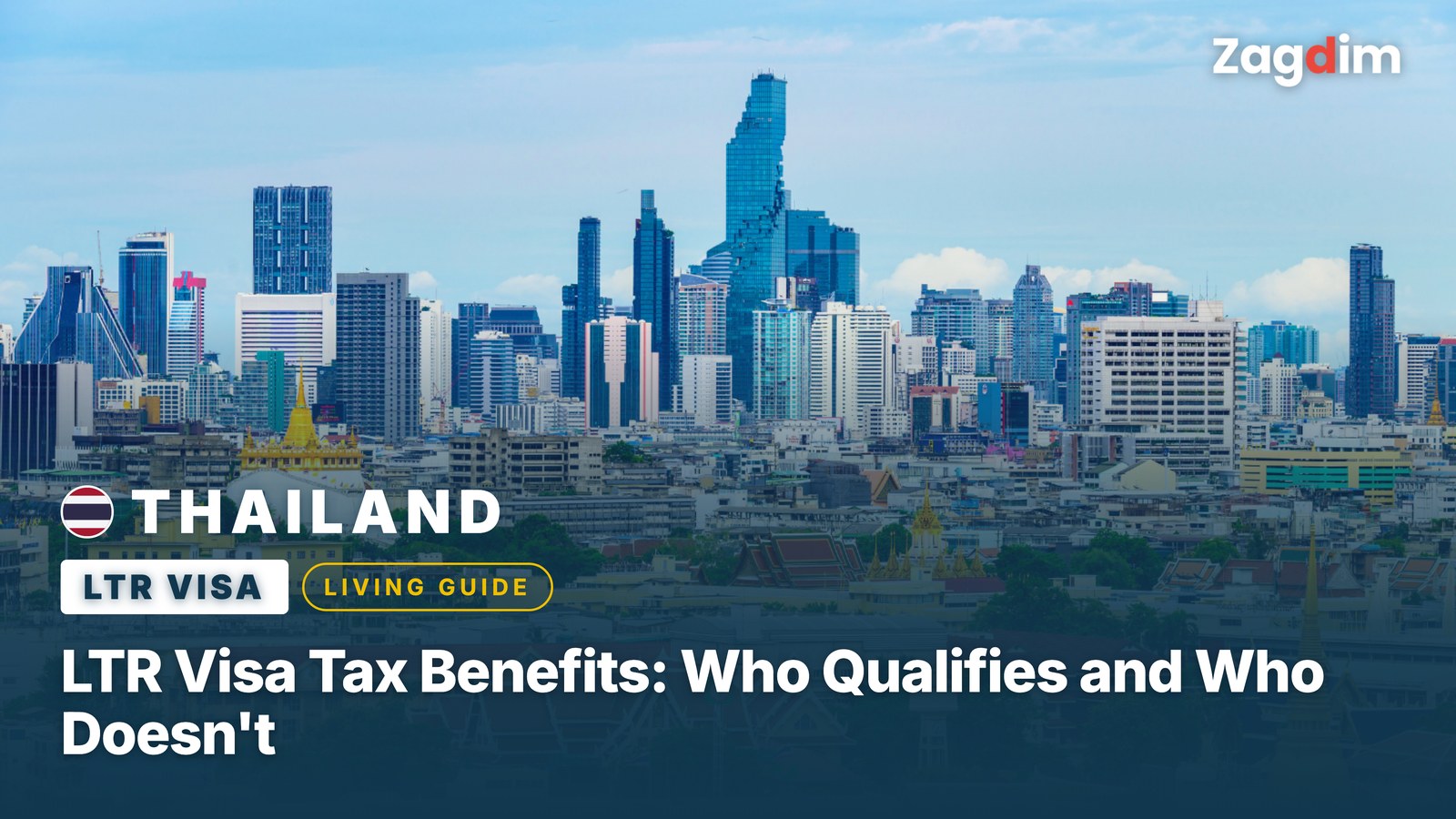
Thailand’s LTR (Long-Term Resident) Visa is often summarized simply as “having tax benefits,” but that description is easy to misread.
The LTR’s two main tax treatments are in fact not shared by all categories: the 17% personal income tax benefit applies only to specific employment income earned by Highly-Skilled Professionals (HSP); the foreign-sourced income exemption applies to Wealthy Global Citizens (WGC), Wealthy Pensioners (WP) and Work-from-Thailand Professionals (WFTP). BOI’s current benefits comparison table also lists these two treatments under different categories.
In addition, holding an LTR visa does not automatically determine whether you are a Thai tax resident. Visa status and tax residency status are two separate determinations.
So when looking at LTR tax benefits, you need to be clear on at least three things:
Which LTR category you hold, where your income comes from, and how you arrange your stay and income in Thailand.
17% Personal Income Tax: Only for Highly-Skilled Professionals
The 17% personal income tax benefit is not shared by all LTR holders.
Royal Decree No. 743 explicitly places this treatment with Highly-Skilled Professionals (HSP): an eligible HSP may apply a 17% personal income tax rate to relevant employment income earned from employment with a company or juristic entity in a targeted industry.
So Wealthy Global Citizens, Wealthy Pensioners and Work-from-Thailand Professionals cannot use this 17% rate simply because they also hold an LTR visa.
And even if you are an HSP, “17%” should not be read as meaning all personal income is taxed uniformly at 17%.
This benefit applies to qualifying employment income, and is tied to employment with a targeted-industry employer and to procedures set by the Revenue Department.
The 17% Rate Doesn’t Start Automatically Once You Get HSP Status
In practice, the employer must submit information on qualifying employees to the local Area Revenue Office.
According to the Revenue Department’s 2026 LTR tax guidance, the 17% withholding rate can apply once the tax authority has confirmed the relevant notification; eligible HSPs must also use the designated personal income tax return form P.N.D.95. If the 17% withholding is chosen as the final tax on that income, that income does not need to be included again in the general annual income calculation — but no refund or credit can then be claimed for that withholding.
So a more accurate statement is not:
“Once you get HSP status, all income is taxed at just 17%.”
But rather:
**Designated employment income that meets the HSP tax benefit conditions may be taxed at 17% personal income tax under the applicable law and procedures.**
If 17% Is Your Main Goal, First Check Whether You Qualify as HSP
HSP itself has category eligibility requirements. BOI’s current conditions include personal income requirements and employment with a company, institution or government agency in a targeted industry or a specified professional field.
The general personal income threshold is an average of at least USD 80,000/year over the past two years; if the average income is at least USD 40,000 but below USD 80,000, additional BOI-listed qualifications must be met, such as holding a master’s degree or higher in a science or technology field.
So if one of the main reasons for applying for LTR is the 17% tax rate, the order should be:
First confirm HSP category eligibility → then confirm whether your actual employer and income meet the 17% tax treatment → finally handle the procedures required by the Revenue Department.
You cannot see “17%” on a benefits table and simply assume it applies to you.
Foreign-Sourced Income Exemption: Not All LTR Categories, and Not “All Remitted Overseas Income Is Tax-Exempt”
This is the part of LTR tax benefits most easily oversimplified into a single line.
BOI’s benefits list does include Tax Exemption for Overseas Income, but who actually qualifies depends on Royal Decree No. 743 and Revenue Department regulations.
Under current law, this foreign-sourced income exemption is granted to three categories of LTR holders:
Wealthy Global Citizens (WGC), Wealthy Pensioners (WP) and Work-from-Thailand Professionals (WFTP).
Highly-Skilled Professionals are not among the categories eligible for this benefit; HSP instead corresponds to the 17% employment income tax treatment described above. BOI’s current benefits comparison table also marks the foreign income exemption only in the WGC, WP and WFTP columns, with no such benefit in the HSP column.
So the simplest way to remember the two tax treatments is:
| LTR Category | 17% Personal Income Tax | Foreign-Sourced Income Exemption |
|---|---|---|
| Highly-Skilled Professionals | **Yes, for qualifying employment income** | — |
| Work-from-Thailand Professionals | — | **Yes** |
| Wealthy Global Citizens | — | **Yes** |
| Wealthy Pensioners | — | **Yes** |
Both are LTR tax benefits, but they do not apply to the same people, and they are not the same set of tax rules.
What Exactly Does the Foreign Income Exemption Exempt?
Section 5 of Royal Decree No. 743 does not say “any money remitted from overseas into Thailand is tax-exempt.”
The regulation instead points to assessable income under Section 40 of the Revenue Code, which includes income from employment abroad, business conducted abroad, or property located abroad, in connection with remitting that income into Thailand.
So the question to analyze is not:
“Was the money transferred from an overseas bank?”
But rather:
**”What kind of income is this under Thai tax law, and where does it originate?”**
These are two completely different questions.
For example, a person receiving a salary into an overseas bank account does not automatically mean that salary is “foreign-sourced income.” If the actual work was performed in Thailand, the source of that income must still be determined under the Revenue Code’s source rules.
Similarly, transferring your own funds from an overseas account into Thailand does not, simply because the bank transfer originated abroad, automatically mean “this money qualifies for the LTR foreign income exemption.”
The order to consider is:
Nature of the income → source of the income → year it arose → how it is remitted → which LTR category you hold → whether it meets the corresponding exemption conditions.
Why Does This Benefit Matter More After 2024?
For general Thai tax residents, current Revenue Department rules state that if foreign-sourced income arises in a tax year from January 1, 2024 onward, and the taxpayer was a Thai tax resident in that year, then when that income is remitted into Thailand in the same year or a later year, it may fall within the scope of Thai personal income tax.
So the LTR foreign income exemption is not just an empty marketing benefit.
For WGC, WP and WFTP, it is a statutory tax treatment that stands apart from the general foreign-sourced income rule. The Revenue Department’s own materials confirm that Royal Decree No. 743 provides a personal income tax exemption on foreign-sourced income for these three LTR categories. (Revenue Department)
But precisely because it is a statutory exception, it should not be generalized the other way into:
“As long as you have an LTR, all overseas income is tax-free.”
Category, source of income and the scope of the relevant regulation still need to be checked item by item.
Does This Exemption Need a Separate Application to BOI?
According to tax guidance the Revenue Department provided to LTR holders in 2026, the Foreign-Sourced Income Exemption itself does not require a separate advance application or approval.
That guidance also distinguishes between filing situations:
If an LTR holder who qualifies for the foreign income exemption has no other Thailand-sourced income, and only has exempt foreign-sourced income remitted into Thailand, Revenue Department guidance indicates there is no need to file a personal income tax return solely because of that.
If there is also Thailand-sourced income, a personal income tax return must still be filed for that income.
This matters because:
Whether income is exempt, whether a tax return is required, and whether there is any tax liability on other income, are three separate questions.
Foreign Income Exemption Does Not Mean Thailand-Sourced Income Is Also Exempt
This line matters a great deal.
The Revenue Code has its own rules for determining the source of income. Thailand-sourced income — for example, income from work performed in Thailand, business conducted in Thailand, or property located in Thailand — may still be Thailand-sourced income even if payment is actually made overseas. (Revenue Department)
So for WFTP holders, owners of overseas companies, and employees of multinational companies, the question should not simply be:
Is the company an overseas company? Is the salary paid into an overseas bank account? Was it ultimately remitted into Thailand from somewhere else?
The real tax question is:
Under the Revenue Code, is this income treated as Thailand-sourced or foreign-sourced?
If it is, in substance, Thailand-sourced income, you cannot apply the “Tax Exemption for Overseas Income” to it simply because the payment route passed through an overseas account.
The LTR Foreign Income Exemption Also Doesn’t Mean Every Fund Flow Gets the Same Treatment
Here it’s also necessary to distinguish between “income” and “funds.”
For example, a single bank transfer may contain: principal, past savings, dividends, interest, rental income, pension payments, capital transaction proceeds, corporate dividends, or even funds accumulated across different years.
Their nature under tax law may be entirely different.
So if an LTR applicant’s financial structure is relatively complex — for example: shareholder in an overseas company, multi-country investment portfolio, overseas rental property, pension, dividends and interest, proceeds from asset sales —
genuine tax planning should not lump all of this together as “overseas income.”
Each type of income needs to be separated first, then assessed for its source and how the LTR exemption applies.
Visa Status ≠ Tax Resident Status
LTR is an immigration and residence scheme; Thai tax residency is determined separately under the Revenue Code.
The two statuses do not determine each other.
So: holding an LTR does not automatically make you a Thai tax resident, nor does it automatically mean you are not one.
There is a commonly seen phrasing here that also needs special attention.
Under Revenue Code Section 41 and the Revenue Department’s current personal income tax filing guidance, staying in Thailand for a total of 180 days or more within a tax year makes you a tax resident; the days are counted cumulatively within the year and do not need to be consecutive. (Revenue Department)
So if an LTR holder stays 60 days in January, another 60 days in May, and another 60 days in October, that totals 180 days.
What matters is the cumulative total across the calendar year, not whether any single stay exceeds six months.
What Generally Matters Once You Become a Tax Resident?
As a general rule, Thailand-sourced income must be treated under the Revenue Code.
As for foreign-sourced income, current Revenue Department guidance states that if the income arose from January 1, 2024 onward, the taxpayer was a Thai tax resident in the year the income arose, and that income is subsequently remitted into Thailand, it may fall within the scope of Thai personal income tax.
But for WGC, WP and WFTP, there is a further step: the LTR foreign income exemption under Royal Decree No. 743.
So it is not enough to conclude only:
“I stayed 180 days, so all my overseas income is taxable.”
Nor is it enough to conclude only:
“I have an LTR, so all my overseas income is tax-free.”
The correct order is:
First determine tax residency status → then determine the source of the income → then determine the type of income → and finally check whether an LTR-specific exemption or other tax treatment applies.
Other Non-Tax Benefits of LTR
Besides tax treatment, LTR itself also comes with a set of immigration and administrative conveniences.
These include changing the general 90-day reporting requirement for foreigners to once a year, multiple-entry arrangements, exemption from the general re-entry permit requirement, and a Digital Work Permit for those who qualify.
But Work-from-Thailand Professionals are an exception. BOI explicitly states that WFTP is a category for people in Thailand working remotely for an overseas employer, and therefore a Thai Digital Work Permit is not issued for this category. (LTR Visa Thailand)
So even though they all hold LTR visas, the different categories still have real differences in work rights and tax benefits.
One Table: The Main Tax Differences Across the Four LTR Categories
| LTR Category | Foreign Income Exemption | 17% HSP Tax Rate | Digital Work Permit |
|---|---|---|---|
| Wealthy Global Citizens | **Yes** | — | Depends on work arrangement in Thailand |
| Wealthy Pensioners | **Yes** | — | Depends on work arrangement in Thailand |
| Work-from-Thailand Professionals | **Yes** | — | **Not issued** |
| Highly-Skilled Professionals | — | **For qualifying employment income** | **Yes** |
The most important point of this table isn’t which category has “the most benefits” — it’s the reminder that the four LTR categories differ not only in application thresholds; the tax and work treatment after the visa is granted is not identical either.
A Few Common Misunderstandings
Misunderstanding One: “Once you get LTR, the whole family gets the 17% tax rate.”
Not true. The 17% tax treatment applies to Highly-Skilled Professionals, and only to designated qualifying employment income.
WGC, WP, WFTP holders, and family members who are simply LTR dependents, cannot apply the HSP 17% rate just because they hold LTR status.
Misunderstanding Two: “All of an HSP’s income is taxed at 17%.”
Also not true. The 17% arrangement under Royal Decree No. 743 applies to qualifying employment income, tied to a targeted-industry employer and Revenue Department filing procedures. Other income cannot be taxed at a flat 17% simply because the holder is an HSP.
Misunderstanding Three: “Since there’s a foreign income exemption, none of the four LTR categories pay tax on overseas income.”
Not true. The current foreign-sourced income exemption applies to WGC, WP and WFTP; HSP is not among the categories eligible for this exemption.
Misunderstanding Four: “Any money remitted from an overseas bank is ‘foreign income.'”
That cannot be assumed. The bank transfer route is not the sole test of the source of income. What matters is the actual nature of the income and factors such as where the work, business or property is located.
Misunderstanding Five: “Getting an LTR automatically makes you, or automatically keeps you from being, a Thai tax resident.”
The two systems are determined separately. LTR is a visa status; tax residency is determined under the Revenue Code. The Revenue Department’s current filing guidance uses a total of 180 days or more of stay in Thailand within a tax year as the residency test.
Misunderstanding Six: “If you stay less than 180 days, Thai personal income tax has nothing to do with you.”
Also not true. The 180-day rule is mainly used to determine residency status, but Thailand-sourced income itself can still create a Thai personal income tax liability. The Revenue Department has made clear that Thailand-sourced employment or business income may still fall within Thailand’s tax scope even if payment is made overseas.
Not sure which category and tax treatment applies to your situation? ask Zagdim to work through it based on your income, assets, work and family structure.
FAQ
Q1: What are the main LTR tax benefits?
Currently there are two main ones: qualifying employment income for Highly-Skilled Professionals can be taxed at 17%; WGC, WP and WFTP have a personal income tax exemption on foreign-sourced income.
Neither is a shared benefit across all LTR categories.
Q2: I’m a Wealthy Pensioner. Can I use the 17% rate?
No, WP status alone does not let you use the HSP 17% rate.
The main LTR tax benefit for Wealthy Pensioners is the qualifying foreign-sourced income exemption.
Q3: Is a WFTP’s overseas salary automatically tax-exempt?
You cannot conclude that just because the employer is overseas.
WFTP is a category eligible for the foreign income exemption, but you must still determine whether that income counts as foreign-sourced under Thai tax law, and whether it meets the conditions of Royal Decree No. 743.
Q4: Does the foreign income exemption need a separate application to the Revenue Department?
The Revenue Department’s 2026 LTR Tax Essentials guidance states that the Foreign-Sourced Income Exemption does not require advance application or approval.
Q5: Do I still need to file taxes after the foreign income exemption applies?
It depends on whether you have other income.
Revenue Department LTR guidance states that if you only have exempt foreign-sourced income remitted into Thailand and no other Thailand-sourced income, you do not need to file a PIT return solely for that reason; if you also have Thailand-sourced income, you must still file as required.
Q6: When do you become a Thai tax resident?
Under the Revenue Code and current Revenue Department filing guidance, staying in Thailand for a total of 180 days or more within a calendar year makes you a Thai tax resident; the stay does not need to be consecutive.
Q7: Do an LTR holder’s spouse or dependents automatically get the foreign income exemption too?
BOI’s current benefits comparison table lists the foreign income exemption under the WFTP, WGC and WP principal-applicant categories; it is not listed in the Dependent column.
So a family member holding an LTR dependent visa cannot automatically apply the principal applicant’s foreign income exemption.
Disclaimer
This article is general information and does not constitute immigration, legal, accounting or tax advice.
LTR visa categories and benefits are subject to the Thailand Board of Investment’s (BOI) current official LTR materials; the 17% personal income tax treatment and the foreign-sourced income exemption are subject to Royal Decree No. 743, Revenue Department Notification No. 427, and current regulations from Thailand’s tax authorities.
Source of income, tax residency status, remittance of foreign income, double taxation agreements, foreign tax credits, and the treatment of individual income types can all vary by case. If tax planning is a major consideration for your LTR application, confirm your actual income structure with Thailand’s tax authorities or a qualified tax professional.
Information current as of September 2026.
Have a question about this guide? Leave a comment below, or ask Zagdim directly.
Your first stop for international property and global living.
Research and insights. Know what’s changing. Understand what matters.
Sources
- Thailand BOI LTR official website and the 2025 LTR Benefits Comparison — the four LTR categories, foreign income exemption, 17% personal income tax and Digital Work Permit eligibility.
- Thailand Revenue Department / BOI, “Tax Essentials for LTR Visa Holders” — foreign income exemption for WGC, WP and WFTP; the HSP 17% employment income tax rate and related filing procedures.
- Royal Decree No. 743 B.E. 2565 — the legal basis for the HSP 17% tax treatment and the WGC, WP and WFTP foreign-sourced income exemption.
- Notification of the Director-General of the Revenue Department No. 427 — eligibility, procedures and conditions for LTR tax treatment.
- Thailand Revenue Department — general rules on tax residency, Thailand-sourced income, and the taxation of foreign-sourced income remitted from 2024 onward.
Further Reading
1. Highly-Skilled Professional LTR: application conditions, process, fees and FAQ
2. Wealthy Global Citizen LTR: application conditions, process, asset requirements and FAQ
3. Work-from-Thailand Professional LTR: application conditions, income standards and FAQ
4. Wealthy Pensioner LTR: application conditions, process, fees and FAQ