































Many foreign nationals planning to settle in Vietnam long-term get confused by the terms “Temporary Residence Card,” “long-term residence” and “Permanent Residence Card.” They’re all called some kind of “residence card,” but their legal status is fundamentally different. The most common misunderstanding is: “once you’ve lived here long enough, you can apply for permanent residence,” or “getting a 10-year long-term residence card is the same as permanent residence.” In fact, both of these ideas are inaccurate.
This guide is for readers planning to settle in Vietnam long-term, who want to understand the legal footing of the three main residency paths before they start applying: what each one is, who it suits, and how it relates to owning property. It focuses on where each status sits legally — what it is, how it differs, and which one you might qualify for — rather than being a complete step-by-step operating manual, though a general application process and document checklist are included below.
Who should read this:
- Foreign nationals planning to work, start a business, or retire long-term in Vietnam, who want to understand their residency options and how they actually differ
- Readers considering buying property in Vietnam who are unsure whether they need residency status first
- Foreign spouses or family members of Vietnamese citizens who want to understand the specific conditions for applying for permanent residence as a family member
The Core Framework: Three Legal Statuses
Temporary Residence Card (TRC): The Main Route to Long-Term Residence
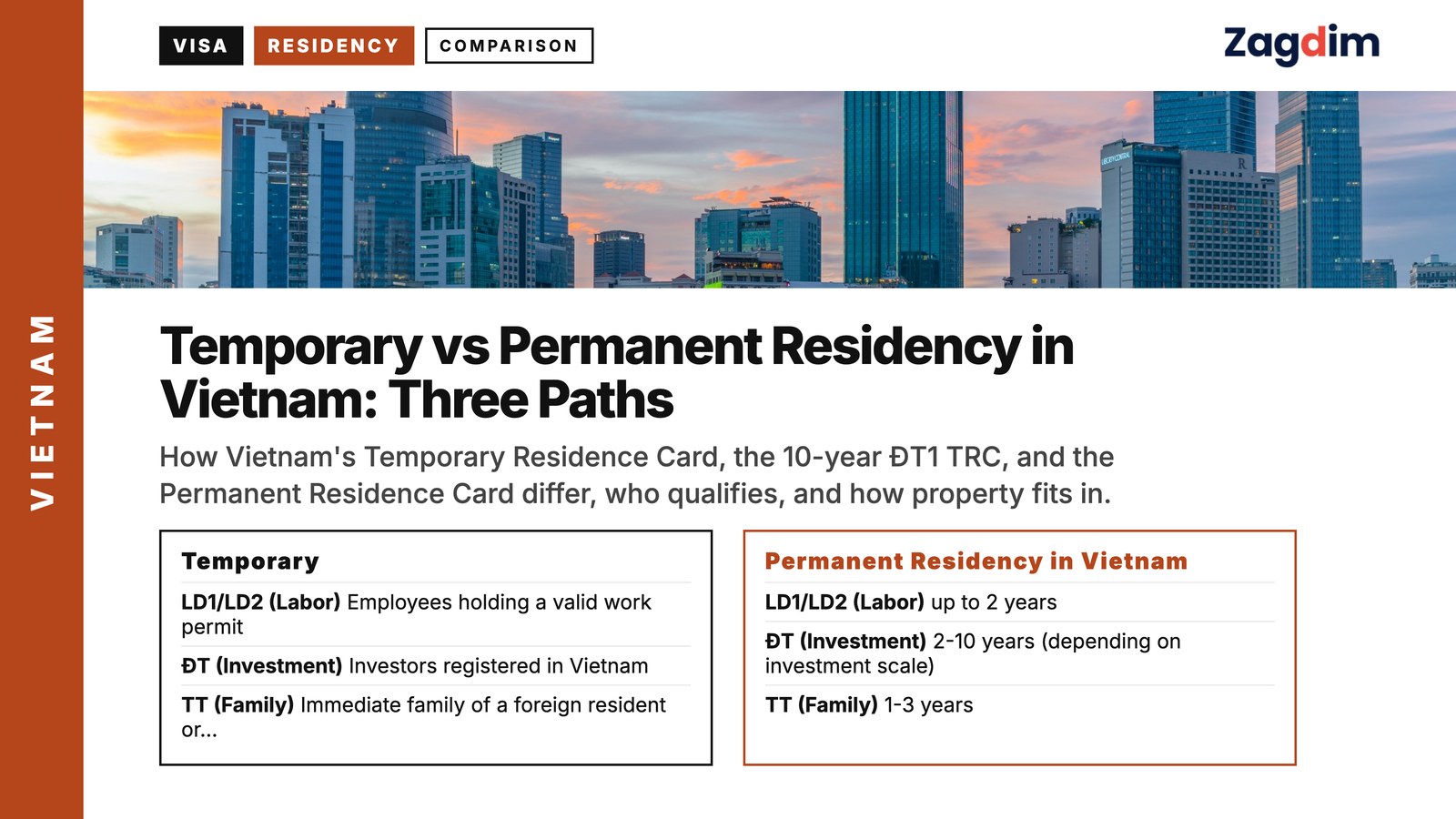
The Temporary Residence Card (TRC) is the identity document held by most foreign nationals living in Vietnam long-term. It lets the holder reside legally without needing a separate visa during that period, but it has a fixed term and must be renewed on expiry.
TRC validity depends on the application category:
| Category | Who It’s For | Typical Validity |
|---|---|---|
| LD1/LD2 (Labor) | Employees holding a valid work permit | up to 2 years |
| ĐT (Investment) | Investors registered in Vietnam | 2-10 years (depending on investment scale) |
| TT (Family) | Immediate family of a foreign resident or Vietnamese citizen | 1-3 years |
| DH (Student) | Students enrolled at a recognized Vietnamese institution | 1 year per academic year |
| NG/NN (Diplomatic/Official) | Based on an intergovernmental agreement framework | 2-5 years |
*Specific categories and durations follow Law 47/2014 (as amended in 2023); confirm with Vietnam’s Ministry of Public Security immigration authority before applying.*
A TRC must be renewed periodically. Renewal depends on the underlying condition for that category still being valid — for example, a labor-category TRC requires a still-valid employment contract; an investment-category TRC requires the investment registration to still be in force.
Long-Term TRC (ĐT1, 10 Years): Still a TRC, Despite the Name
Within the TRC categories, large investors (ĐT1) can apply for a TRC valid for up to 10 years — the longest term available. Ten years sounds close to “permanent residence,” but the ĐT1 10-year TRC is still a Temporary Residence Card, with the same legal status as any other TRC category: it must be renewed on expiry, and there is no mechanism for it to automatically upgrade into a Permanent Residence Card (PRC).
This is one of the most common misunderstandings in Vietnam’s residency system. A 10-year ĐT1 TRC differs from a PRC in these fundamental ways:
- Validity calculation: an ĐT1 TRC must be reapplied for on expiry; a PRC is valid for 10 years and renewable, with a more stable long-term status
- Entry convenience: outside its validity, a TRC still requires a separate visa to enter; a PRC itself functions as an entry document
- Upgrade mechanism: the two are parallel, separate legal categories — there is no automatic TRC-to-PRC upgrade path
Permanent Residence Card (PRC): Four Eligibility Categories, Strictly Applied
The Permanent Residence Card (PRC) is the highest residency status a foreign national can hold in Vietnam. Holders may reside without a time limit, and the PRC itself functions as an entry document (valid for 10 years, renewable).
However, PRC eligibility is strict, and not every foreign national who has lived in Vietnam for a period of time can apply. Under Law 47/2014 (as amended in 2023), a PRC application must meet one of the following four categories:
Category 1: Recipients of a Vietnamese state medal or honorary title for contributions to Vietnam’s development and defense
This category is granted at the initiative of the Vietnamese government; receiving the honor is itself the triggering condition, rather than something actively applied for.
Category 2: Scientists or experts currently holding a TRC
Anyone currently holding a valid TRC who is recognized as a “scientist or expert” may apply for a PRC. However, there is currently no unified, publicly available definition of what qualifies as a “scientist or expert” — this is assessed case by case by the relevant authority. Anyone considering this category is advised to confirm the current review standard directly with Vietnam’s Ministry of Public Security Immigration Department (xuatnhapcanh.gov.vn) before applying.
Category 3: Parents, spouses or children of a Vietnamese citizen who holds permanent residence
Applicants in this category must have resided continuously and lawfully in Vietnam for at least 3 years before applying. This is a continuous-residence requirement, not a cumulative one — a longer break in residence during that period may affect whether it counts as continuous, and it’s advisable to confirm the specific calculation method with the immigration authority.
Category 4: Stateless persons who have resided continuously in Vietnam since 2000 or earlier
This applies to a specific historical circumstance; anyone in this situation should consult the immigration authority directly.
Important: the number of years you have lived in Vietnam is not, by itself, sufficient grounds to apply for a PRC. No matter how many years someone has resided in Vietnam, if they don’t meet one of the four categories above, they cannot apply for a PRC. The idea that “you can apply once you’ve lived here long enough” is the most common misreading of the rules.
Background Requirements That Generally Apply
Separately from the specific eligibility category, foreign nationals applying for either a TRC or a PRC are generally expected to meet the following baseline requirements:
- Nationality: applicants of almost any nationality can apply, though certain nationalities may face additional review
- Age: there is no explicit hard age limit, but the applicant generally needs full civil capacity (typically 18 or older)
- Financial proof: applicants need to show sufficient means or assets to support themselves during their stay
- Criminal record: applicants must provide a criminal record certificate confirming no major criminal history
Who Each Status Suits — and Who It Doesn’t
TRC suits you if:
- You hold a valid work permit, an investment registration, or are residing long-term as a student or family member
- You want lawful long-term residence but don’t meet PRC eligibility
- You plan to live in Vietnam for a period of years, without necessarily settling permanently
PRC suits you if:
- You are the foreign immediate family member of a Vietnamese citizen and have already resided continuously in Vietnam for at least 3 years
- You hold a TRC as a scientist or expert who meets the immigration authority’s recognition standard
- You have received a Vietnamese state medal or honorary title
PRC is not a good fit if:
- You have simply lived in Vietnam for many years without meeting one of the four categories above
- You are applying on the basis of “having lived here long enough” — years of residence is a necessary but not sufficient condition
- You are hoping that buying property will get you residency status — property ownership does not grant either a TRC or a PRC
TRC vs. PRC: Practical Rights Compared
| Dimension | TRC | PRC |
|---|---|---|
| Legal status | Temporary residence for a foreign national | Permanent residence for a foreign national |
| Validity | 1-10 years (depending on category), renewal required on expiry | 10 years, renewable |
| Entering Vietnam | Requires a valid entry visa alongside it | PRC substitutes for an entry visa (direct entry) |
| Automatically upgrades to PRC? | No | — |
| Equivalent to Vietnamese citizenship? | No | No |
| Voting rights | No (foreign national) | No (foreign national) |
| Precondition for buying property | Not required | Not required |
PRC holders remain foreign nationals — they do not have the political rights of Vietnamese citizens (including voting rights), and cannot hold specific public offices that Vietnamese law reserves for citizens. A PRC is not equivalent to Vietnamese nationality.
Where Vietnam Fits Among Regional Long-Stay Options
Compared with Thailand and Malaysia, Vietnam’s approach to permanent residence is fundamentally different: it is not simply available after buying property, investing, or living there long enough — the threshold is high, and it’s limited to a small number of specific situations.
| Item | Vietnam | Malaysia (MM2H) | Thailand (Elite Visa) |
|---|---|---|---|
| Long-term residence route | TRC / 5-year visa exemption / company investment | MM2H long-term visa (10-year validity) | Elite Visa (5-20 years) |
| Financial requirement | Roughly USD 20,000 annual income or equivalent asset proof | Roughly USD 30,000 annual income plus a fixed deposit | Varies by tier; packages start from roughly USD 20,000 |
| Criminal record | No major criminal record required | No major criminal record required | No major criminal record required |
| Feasibility of permanent residence | Very difficult, requires special contribution or family reunion | No direct permanent residence, but long-term renewal is possible | No direct permanent residence; remains a long-term visa |
Property and Residency Are Two Separate Legal Systems
Under Vietnam’s Housing Law 2023 (effective from August 2024), foreign nationals only need a valid passport and a lawful entry visa (including a tourist visa) to complete a property purchase in Vietnam. Neither a TRC nor a PRC is a legal precondition for buying property.
Buying property does not grant any residency status: once a purchase is complete, if the buyer’s entry visa expires, they must still leave the country or apply for a visa extension according to their existing visa arrangement. Property ownership and residency are two entirely separate legal systems, and owning property does not automatically confer any residency right.
Foreign nationals cannot own land in Vietnam: land in Vietnam is state-owned, so foreign nationals can only acquire a Land Use Right (LUR) over a property, not ownership of the land itself.
Cap on apartment ownership by foreign nationals: under Housing Law 2023, the total number of units held by foreign nationals (individuals and organizations combined) in any single residential building is capped at 30% of that building’s total units. Before buying, it’s worth confirming whether the building you’re interested in has already reached this cap. This 30% cap is calculated per building, not as a nationwide total — different buildings may be at different levels, so it’s best to confirm the current foreign-ownership ratio with the developer or a lawyer before purchasing a specific unit.
How to Apply: A General Process
Applying for a TRC or a PRC needs to be planned precisely around your individual circumstances, following the correct legal procedure. Here is a general outline of the application steps:
Step 1: Choose the Appropriate Base Visa Category
Applicants first need to hold a suitable visa category, such as:
- Work visa (LĐ category): suited to foreign employees and technical specialists
- Investment visa (ĐT category): suited to those setting up a company or an investment project as a foreign investor
- Family reunion visa (TT category): suited to those forming a family relationship with a Vietnamese citizen or a TRC holder
The base visa chosen has a direct effect on which later residency category and term length you’ll be eligible for, so this initial choice matters.
Step 2: Accumulate Lawful Residence and Maintain Visa Continuity
Under current rules, applying for permanent residence generally requires at least 3 years of continuous lawful residence in Vietnam, without any major legal violation. During that period, the visa must remain valid and be renewed continuously, with no lapse or overstay.
Step 3: Submit the TRC or PRC Application
Once the basic residence period and conditions are met, the application can formally be submitted to the provincial public security bureau (immigration department) where you reside. This is generally submitted with an employer, investment enterprise, or family member acting as sponsor.
- TRC applications: generally for those already holding a work, investment or family visa
- PRC applications: for those with a special contribution, an immediate-family relationship, or accumulated years of residence under one of the eligible categories
Step 4: Submit Background Checks and Financial Proof
Application materials typically include:
- A criminal record certificate (issued by the home country or current place of residence)
- Proof of lawful residence history (such as past visas or a TRC copy)
- Proof of financial means (bank deposit certificates, stable income sources, etc.)
- Health insurance (required in some provinces)
All documents must be notarized, authenticated, and translated into Vietnamese.
Step 5: Await Immigration Approval and Collect Identity Documents
Once a complete application is submitted, it proceeds to review. Depending on the case type and location:
- A standard TRC application: review generally takes about 5-15 business days
- A PRC application: requires initial provincial-level review followed by central-level approval, averaging 12-18 months, and can take longer for individual cases
Once approved, the applicant must go to the designated location to collect their residence card or other documents, and complete local temporary-residence registration.
Estimated timeline:
| Process Step | Estimated Time |
|---|---|
| Base visa application and approval | About 1-2 months |
| Accumulating continuous lawful residence | At least 3 years |
| Preparing and submitting the TRC/PRC application | About 1-2 months |
| Background review and document verification | About 1-2 months |
| Final approval and collecting identity documents | TRC: about 5-15 business days; PRC: averaging 12-18 months |
Required Documents
Successfully applying for temporary or permanent residence in Vietnam depends heavily on document preparation. The immigration department’s document requirements are detailed, and different provinces may add extra local requirements, so it’s best to start organizing documents early and leave time for authentication and translation.
Here is the main standard checklist:
Passport and visa copies
- Original passport and copy, valid for more than 13 months
- A copy of your current lawful visa or Temporary Residence Card (if any)
Proof of lawful residence address
- A residence registration certificate issued by the local police (Giấy xác nhận tạm trú)
- A lease agreement or proof of property ownership (if you own property)
Financial proof documents
- Bank deposit certificates (generally recommended to exceed the standard needed to support your living costs)
- Tax statements, salary certificates, or other proof of stable income
Criminal record certificate
- A criminal record certificate from your home country (notarized and consular-authenticated)
- A local Vietnamese criminal record certificate issued by Vietnamese public security (Phiếu lý lịch tư pháp)
Medical/health certificate (in certain cases)
- Certain visa categories (such as investment or highly skilled work visas) may require a health check certificate
- This must be completed and certified at a Vietnam-recognized medical institution
Application forms and recent photographs
- TRC/PRC application form (form NA6, NA8 or NA7)
- Two recent white-background passport photos (2cm×3cm), taken within the last 6 months
Document checklist:
| Category | Required Documents |
|---|---|
| Identity documents | Valid passport copy, valid visa or residence card copy |
| Proof of residence | Local police residence registration, lease agreement or property title |
| Financial proof | Bank deposit certificate, tax statements, income documents |
| Background record | Home-country criminal record certificate + local Vietnamese criminal record |
| Health certificate (if applicable) | Health check certificate from a Vietnamese medical institution |
| Application form and photos | Prescribed form (NA6, NA7, NA8) + white-background passport photos |
| Other (province-dependent) | Company documents, property title, additional proof of funds, etc. |
If you’re not sure which visa or residence path fits your situation, ask Zagdim and tell us your situation.
Golden Visa: Status Still Awaiting Official Confirmation
Vietnam has previously announced a golden-visa pilot concept aimed at investors and high-net-worth individuals. As of the most recent update to this article, the specific launch status, eligibility, quota and details are still awaiting formal confirmation from an official primary source, and no precise official reference can currently be provided.
A few important points:
- Until an official primary document (naming the authority, the announcement title, a direct URL and a publication date) is available to verify it, the golden visa should not be treated as a currently available application route
- Specific figures reported in the media (launch date, term length, quota) are secondary sources and may be inaccurate or out of date
- The current TRC and PRC system (Law 47/2014, as amended in 2023) remains the applicable framework for most foreign nationals
Anyone following the golden visa’s progress should check directly with Vietnam’s Ministry of Public Security Immigration Department (xuatnhapcanh.gov.vn) and official announcements to confirm whether a formally applicable arrangement is in place before making plans around it.
Common Misunderstandings
Misunderstanding 1: A 10-year ĐT1 long-term TRC is the same as permanent residence
ĐT1 is the longest-validity category within the TRC system, but it remains a Temporary Residence Card that must be renewed on expiry, with a fundamentally different legal status from a Permanent Residence Card. A TRC does not automatically “upgrade” into a PRC just because its term is long.
Misunderstanding 2: Living in Vietnam long enough automatically qualifies you for permanent residence
PRC eligibility is based on four specific categories (recipients of a state honor, scientists/experts, immediate family of a Vietnamese citizen, or stateless persons resident since 2000 or earlier) — not simply years of residence. Years of residence is a necessary condition for some categories, but not a sufficient one on its own.
Misunderstanding 3: You need a residence card before you can buy property in Vietnam
Under Housing Law 2023, foreign nationals only need a valid passport and a lawful entry visa to buy property in Vietnam — neither a TRC nor a PRC is a precondition. But buying property does not grant residency status either; the two belong to separate legal systems.
Misunderstanding 4: A PRC is equivalent to Vietnamese citizenship
PRC holders remain foreign nationals, without voting rights, and cannot hold certain public offices. Vietnamese nationality has its own separate requirements under nationality law, and Vietnam does not generally recognize dual nationality — becoming a Vietnamese citizen usually requires giving up one’s existing nationality.
Misunderstanding 5: Vietnam’s golden visa is already fully open
Vietnam has previously announced a golden-visa pilot concept, but its launch status, eligibility and quota are still awaiting confirmation from an official primary source. Until a formally applicable arrangement is officially confirmed, it should not be treated as a current investment-migration route.
Additional application pitfalls to watch for
- Assuming property ownership itself qualifies you for PR: buying property can support a longer stay (for example, by helping justify a visa extension or a TRC application), but it cannot by itself serve as grounds for a PRC application.
- Overlooking the importance of continuity in lawful residence: some applicants assume any accumulated number of years in Vietnam will do, but Vietnam requires clear continuity — a visa lapsing, switching to the wrong visa category, or an overstay followed by a late return can all be treated as a break in residence, affecting eligibility for permanent residence.
- Choosing the wrong visa category, breaking residency eligibility: different visa categories affect residency rights very differently. A business visa (DN), for example, can be used for short-term work or a business trip, but does not count toward the residence years needed to apply for a PRC; only ĐT-category investment visas or LĐ-category work visas meet the long-term residence accumulation standard. Choosing the wrong category can invalidate years of accumulated residence record, requiring the count to restart. On first entering Vietnam, choose the correct visa category for your intended plan and stay consistent with it.
- Incomplete documents or non-compliant translations: even meeting the residence period and conditions, incomplete documents or translations that don’t meet official formatting requirements often lead to rejection or delay — for example, a criminal record certificate, financial proof, or birth certificate needing both home-country notarization and consular authentication, then translation into Vietnamese. Requirements can vary slightly by province, so it’s best to check the official checklist carefully, or consult a professional agent, before submitting.
FAQ
Q: I’m the foreign spouse of a Vietnamese citizen — can I apply for a PRC? What are the conditions?
A foreign spouse falls under the “immediate family of a Vietnamese citizen” category among the four PRC eligibility categories. You must have resided continuously and lawfully in Vietnam for at least 3 years before applying. “Continuous” means no lengthy interruption from leaving the country during that period; the exact standard is best confirmed with Vietnam’s Ministry of Public Security Immigration Department (xuatnhapcanh.gov.vn). Application materials generally include marriage documentation and records covering the residence period; confirm the exact checklist directly with the immigration authority.
Q: I’ve already held a TRC through work for many years — can I convert directly to a PRC?
No, you cannot directly “convert.” TRC and PRC are separate, independent application processes, with no automatic upgrade mechanism. Holding a TRC only confirms that you are currently residing lawfully in Vietnam; to apply for a PRC, you need to meet one of the four eligibility categories. If you don’t meet any of them, holding a TRC for a long time does not by itself qualify you to apply for a PRC.
Q: Can foreign nationals apply directly for Vietnam’s permanent residence?
Not directly. Vietnam’s PRC is open only to specific categories — for example, someone who has made a major economic or scientific contribution to Vietnam, a professional recognized by the Vietnamese government, or someone with an immediate-family relationship to a Vietnamese citizen. Ordinary foreign nationals, even with a long-term visa or an investment, cannot obtain a PRC directly on that basis alone.
Q: After how many years of residence can I apply for long-term residence (TRC)?
Generally, you need to have accumulated at least 3 consecutive years of residence, holding a lawful and valid Temporary Residence Card or visa throughout, and you also need to show a stable lawful income and residential address, with no criminal record.
Q: Can owning property count toward a permanent residence application?
Currently, owning property cannot, by itself, be grounds for a permanent residence application. Buying property in Vietnam can support a longer stay — for example, by helping with a visa extension or a TRC application — but it cannot serve as the primary condition for a PRC application.
Q: Are applicants of certain nationalities more likely to be approved for PR?
The Vietnamese government has not explicitly stated that any particular nationality is given preference, but in practice, citizens of countries with close economic and cultural ties to Vietnam (such as Japan, South Korea, France and the United States) tend to see a higher approval rate if they meet the economic or scientific contribution conditions. Overseas Vietnamese also enjoy certain policy benefits.
Q: What’s the difference in rights between temporary residence and permanent residence?
- Temporary Residence Card (TRC): generally valid for 1 to 10 years and requires renewal. Holders may work, run a business and reside in Vietnam, but retain foreign-national status.
- Permanent Residence Card (PRC): a status closer to that of a local resident, allowing continuous living, employment or business activity in Vietnam without needing to renew frequently. However, the residence card’s information must still be updated every three years.
Q: Vietnam’s 30% foreign-ownership cap on apartments — is that a nationwide total, or calculated per building?
Under Housing Law 2023, the 30% cap is calculated per residential building, not as a nationwide total. Different buildings may have different foreign-ownership ratios — some may already be close to or at the cap, while others are not. Before buying a specific unit, it’s advisable to confirm the building’s current foreign-ownership ratio with the developer or a lawyer.
Q: Can I appeal if my PR application is rejected?
Yes. If an applicant is rejected, they may, within 60 days of receiving formal notice, file an administrative appeal or administrative litigation with Vietnam’s immigration authority or public security department. However, supplementary documents meeting the requirements must be provided, and processing often takes a long time.
Q: Can holding a PRC let me work in Vietnam without restriction?
No. Working in Vietnam still requires a separate, valid Work Permit — a PRC does not automatically grant a work permit. A PRC confers residency status, while the right to work is governed by a separate labor-permit system. If you plan to work or start a business in Vietnam, you need to separately confirm the relevant work-permit requirements.
Q: Are there alternatives if I don’t meet the conditions for PR, such as a long-term business visa?
Yes. If your PR conditions aren’t sufficient, you can consider continuing to use a long-term business visa (ĐT visa) or a Temporary Residence Card (TRC), particularly suited to investors, company shareholders and technical specialists. These are typically renewable every two to five years, are relatively flexible, and have clear procedures.
Q: Can I use a property I own in Vietnam to obtain residency status?
No. Buying property and obtaining residency status in Vietnam are two entirely independent legal systems. Owning Vietnamese property does not grant any TRC or PRC; once the purchase is complete, your entry visa continues to be managed under its existing arrangement. If you want lawful long-term residence, you need to separately apply for a qualifying TRC category.
Q: How does Vietnam’s golden-visa pilot relate to PRC? Can I consider both at once?
The two are currently separate arrangements. The PRC system operates under the current Law 47/2014 (as amended in 2023), with four mature eligibility categories and an established procedure. The golden visa’s specific launch status, eligibility and relationship to the existing residency system are still awaiting formal confirmation from Vietnam’s authorities. It’s advisable to first understand the current TRC/PRC framework, and keep watching official announcements from Vietnam’s immigration authority for golden-visa developments.
Summary
Vietnam’s approach to long-term and permanent residence is clearly different from the common assumption that “buying property is enough to relocate.” Whether you’re planning to retire, take up a work posting, or build a new base for your family, choosing the right visa category and accumulating a stable, lawful period of residence is the real key to a lawful long-term stay. The Temporary Residence Card (TRC) and the Permanent Residence Card (PRC) each carry strict conditions and procedures, and applicants with different goals and backgrounds need a tailored strategy suited to their own situation. Clarifying your eligibility and mapping out your path early can save time and cost, while reducing the risk of a failed application or a break in your residence record.
If you have an individual question, ask Zagdim and tell us about your situation — we’ll help clarify the details of Vietnam’s residency system for you.
Have a question about this guide? Leave a comment below, or ask Zagdim directly.
Your first stop for international property and global living.
Research and insights. Know what’s changing. Understand what matters.
Sources
- Vietnam Immigration Department — *Vietnam Migration Profile 2023*
- International Organization for Migration (IOM) — *Migration Profile Report*
- Knight Frank — *Asia-Pacific Horizon Report 2024*
- Internations — *Expat Insider 2024*
- LuatVietnam — *Circular No. 22/2023/TT-BCA on Immigration Procedures*
- Vietnam Briefing — *Updates on Vietnam Immigration Law 2024*
- Savills Vietnam — *Foreign Property Ownership Guide 2024*
- Law No. 47/2014/QH13 (as amended by Law No. 23/2023/QH15)
- Vietnam Housing Law 2023 (Law No. 27/2023/QH15)
- Vietnam Ministry of Public Security, Immigration Department
Disclaimer: This article draws on public statistics, regulatory updates and authoritative research published between 2023 and 2026, including material from Vietnam’s immigration authority, the International Organization for Migration (IOM), Internations, Knight Frank, Vietnam Briefing, and several Vietnam-based law firms and professional publications, current as of July 2026. Vietnam’s residency regulations may be adjusted over time, and the golden visa’s specific launch status and eligibility remain pending official confirmation. This article is for informational purposes only and does not constitute legal, immigration or financial advice. For your own circumstances, please consult a qualified Vietnamese legal adviser or Vietnam’s Ministry of Public Security Immigration Department directly for the latest official announcements.