





























I. Introduction
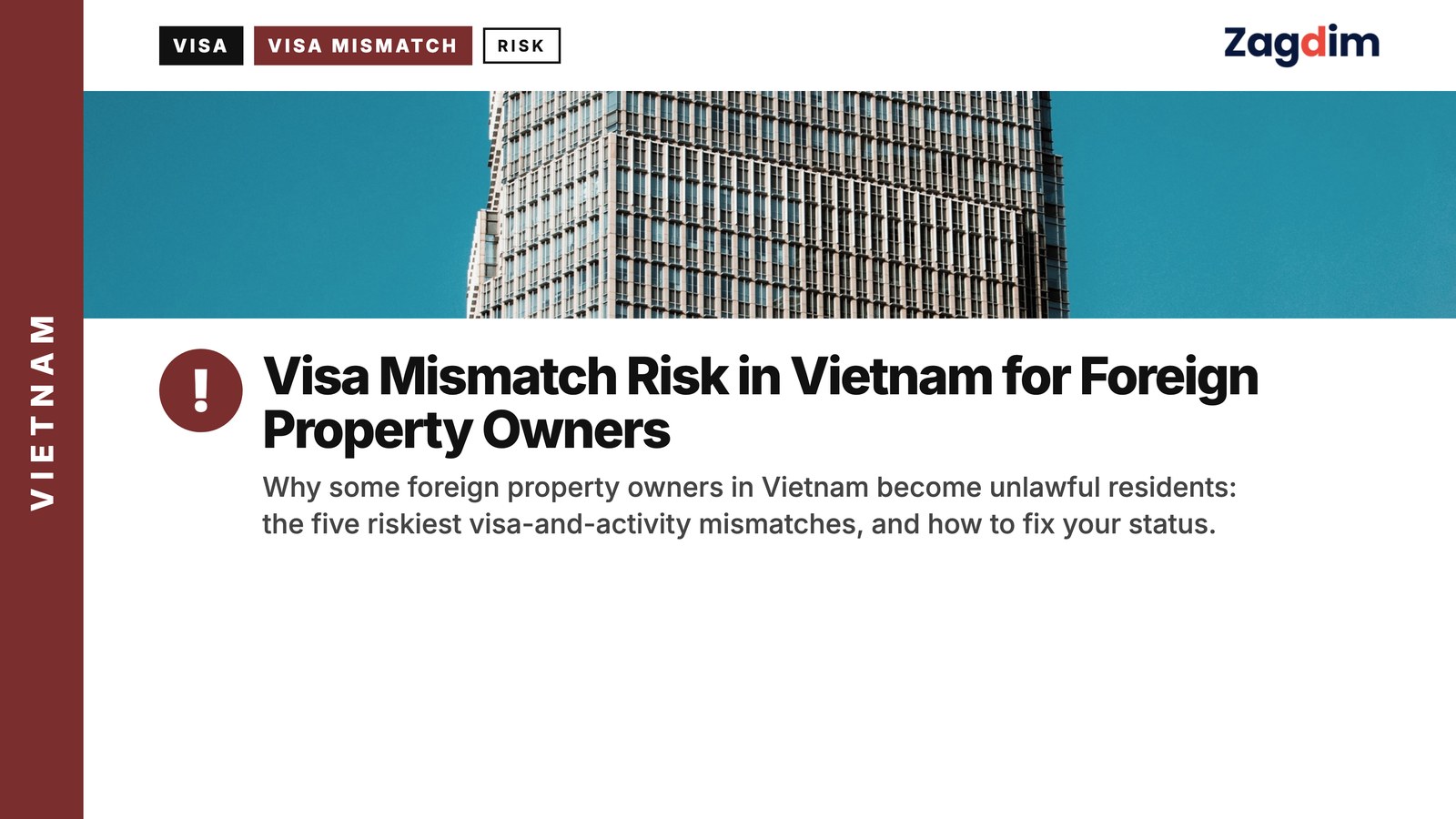
Vietnam’s real estate market has become increasingly open to foreign buyers in recent years, drawing buyers from Hong Kong, Singapore, South Korea and Europe. But alongside the freedom to buy property, many foreign owners have unknowingly stepped into an increasingly sensitive gray area — a mismatch between what your visa permits and what you actually do. This kind of “identity mismatch” is becoming a focus of enforcement and fines, and it is usually triggered by the same pattern: you assumed “it’s fine to stay here temporarily and collect rent,” but under the law, that can actually amount to unlawful residence or even tax evasion.
The most common scenarios include: buying a property on a tourist visa and then actually living there long-term, or holding property, leasing units and collecting cash rent — even filing taxes in a personal capacity — under a student visa or business visa without a registered company. Once discovered, these actions can carry a fine of up to VND 20,000,000 (about USD 885), and can also lead to deportation or being placed on an immigration blacklist, preventing future entry.
Under current Vietnamese law, foreigners may buy apartments and some categories of property, but land-use rights remain state-owned, and because leasing activity involves business and tax registration, failing to convert your status through the proper channel makes it easy to be found in a “mismatch between residence status and activity.” Several recent cases have already surfaced of foreign landlords being heavily fined or even deported over unauthorized leasing, overstaying, or short-term Airbnb rentals — with enforcement clearly intensifying, especially in Ho Chi Minh City and Hanoi.
II. Who Is Most Likely to Fall Into These Mismatches
The bar to buy property in Vietnam is not especially high, but the real risk was never in the right to buy — it’s in what status you hold when you “own the property, collect the income, and live your life” there. Whenever there’s a gap between your visa category and what you actually do, you can fall into an unlawful gray zone. The following five profiles are the “high-risk mismatch combinations” that show up most often in recent penalty notices and blacklists:
1. Entering and leaving on a tourist visa, but actually residing for more than 90 days
This is most common among “pre-retirees” or “semi-relocating buyers”: each DL visa stay is 30-90 days, but they actually live there continuously for six months or more, which amounts to unlawful residence — and is especially likely to trigger scrutiny during bank transfers or tax filing.
2. Using a business visa (DN) without an actual registered company
Many people use an agent to obtain a DN1 or DN2 visa to extend their stay, but if they have no company or partner organization actually registered in their name, this is treated as “fraudulent sponsorship.” Ho Chi Minh City has already seen multiple penalty cases of people applying for a business visa under a fake company while actually living there or leasing property.
3. Holding a student visa (DH) while actually owning a rental property
If a visa was obtained under the pretext of “accompanying a student” or attending language school, but the holder owns property and collects rent, this easily violates the intended purpose of a student visa through profit-making activity. This kind of activity is easily detected when school reporting is cross-checked against landlord information.
4. Setting up a company under an investor visa (DT) with no substantive operations
Some buyers register a shell company purely to qualify for long-term residence, without conducting real business, opening tax records, or hiring staff. This kind of “nominal investment” is treated as an abuse of the visa system, and can lead to visa revocation and fines.
5. Running a short-term rental platform (such as Airbnb) while holding a retirement visa
Even with lawful residence, using a property for unregistered commercial activity — particularly short-term, subdivided or daily rentals — can still be a violation. Vietnam’s current Law on Tourism Services and Decree 79 set clear rules for “rentals under 30 days,” and anyone without a hospitality operating license is treated as operating illegally.
If you’ve stayed in Vietnam on a tourist or student visa and are unsure whether your status is safe, ask Zagdim and tell us your situation.
III. Step-by-Step: How to Fix Your Status
If you already own property in Vietnam but find that your current visa doesn’t support how you’re actually using it (such as long-term residence or rental income), you should start the process of converting your status and regularizing your tax position as soon as possible. This not only helps you avoid fines, deportation or blacklist risk, but is also a key step for any future asset disposal or repatriation of rental income.
Below are the recommended five steps toward regularizing status, for foreign nationals holding Vietnamese property in a personal capacity:
Step 1 | Check Whether Your Current Visa Legally Supports “Holding Property + Collecting Rent”
First, confirm whether your visa allows long-term stays and financial activity such as leasing. For example, a DL (tourist), DN (business visitor) or DH (student) visa does not support long-term property holding and leasing, and you will need to consider converting to a different category.
Step 2 | Assess Converting to a Suitable Visa Category (Company Formation / Long-Term Residence)
If you plan to hold property and reside legally on a long-term basis, consider converting to one of the following:
- Investor visa (DT1-DT4): by setting up a company and registering an investment amount
- Spouse visa (TT) + Temporary Residence Card (TRC): for those married to a Vietnamese citizen. A tourist visa can be converted to a business or spouse-sponsored category without leaving the country.
Step 3 | Pay Back Taxes Owed and Declare Property Income
If you have already been leasing your property, proactively paying the outstanding personal income tax and value-added tax (10% combined) will help reduce your legal risk. The tax declaration should cover: historical rental income, transaction contracts, remittance proof and bank deposit records.
Step 4 | Update Your Tax Residency Status and Register a Valid Address
A lawful status needs to be paired with the proper tax procedures:
- Apply for a Vietnamese Tax Identification Number (TIN)
- Register a lawful residential address (reported by the landlord or the individual); if the TIN and residential address are not aligned, this will still be treated as a status-activity mismatch.
Step 5 | Where Necessary, Engage a Lawyer to Help File a Status Conversion or Appeal
Professional help is strongly recommended in the following situations:
- Facing an overstay penalty, an immigration interview, or being asked to leave the country
Where a company’s investment amount needs to be reviewed, or legal documents need to be translated, a professional lawyer or immigration consultant can help prepare the NA5 visa conversion application form, an explanatory letter and supporting documents, effectively reducing the risk of rejection.
Handling status conversion and back taxes on rental income varies from person to person; if you have a similar concern, tell us your situation.
IV. FAQ
Q1: Can I buy property on a tourist visa?
Yes, but only for holding title — not for long-term residence or renting it out. If you actually reside long-term or run a rental business on a tourist visa, that involves unlawful residence and tax evasion risk.
Q2: I have a student visa, and if my parents buy a property in my name and rent it out, is that a problem?
There’s a risk. If the income record is attributed to the student, and taxes are not properly declared or there is no valid status behind it, it may be treated as unlawful business activity, and is especially likely to be discovered when the source of funds and rental income flow are checked.
Q3: Is buying under a company name safer?
Relatively safer, provided the company genuinely operates and files taxes as required, and is not a shell company. Even setting up a company purely to obtain an investor visa can still risk having the company shut down or the visa revoked.
Q4: Does Vietnam check whether I really live at the property?
Yes. Immigration and local public security have recently been conducting on-the-ground checks on people staying long-term on a tourist visa, and key apartment communities in Ho Chi Minh City and Hanoi have already started spot checks and cross-referencing of records.
Q5: What happens if I don’t file taxes?
It depends on the severity. The lightest outcome is a fine (based on the amount and duration), while the most severe can lead to visa revocation, an entry ban, asset freezing, or administrative deportation — which can also affect your entry record elsewhere in Southeast Asia in future.
Q6: How do I fix this?
It’s recommended to consult a professional lawyer and tax advisor immediately, review your own status, and complete the necessary remedial steps — including converting to the appropriate visa, paying back taxes, and applying for a tax ID and residence registration. The earlier you correct it, the lower the risk.
V. Common Mistakes
Owning property in Vietnam is not itself illegal, but once residency length, cash flow and profit-making activity are involved, a mismatch between status and taxes can create real risk. The following combinations of mistakes have repeatedly shown up in recent enforcement, and deserve particular caution:
Entering on a tourist visa, then living there or renting out the property for six months or more
This kind of situation is very likely to be treated as unlawful residence, especially when rental income flows into a local account, or entry/exit records show a long continuous stay, which raises the likelihood of a check. Multiple cases have already occurred in Ho Chi Minh City and Da Nang of fines or deportation over long-term residence on a tourist visa.
Conducting property transactions and money transfers under a spouse’s or relative’s visa, while the person actually acting is someone else
For example, a parent enters and leaves Vietnam on a spouse visa, while an adult child actually handles the property transaction and rent collection. If the distinction between identities and accounts isn’t clear, this can be treated as nominal tax avoidance or a violation of the visa’s intended purpose, potentially affecting the whole family’s visa renewal.
Starting a leasing business without applying for a tax ID, while still using a home-country bank account to collect rent
Vietnam’s tax authority is particularly sensitive to foreigners collecting local rent through an unregistered account; without a Tax Identification Number (TIN) and business declaration, even a modest amount can be treated as unauthorized business activity, and can affect future fund repatriation and property transfers.
Vietnam’s on-the-ground enforcement is already under way; if you’ve had a similar situation, ask Zagdim and tell us about it.
VI. Summary
Do your visa category, your actual living situation, and how you use your property in Vietnam contradict each other? If your status and your activity are mismatched, you could be treated as an unlawful resident or as evading tax without any warning. This isn’t just about fines and deportation risk — it can also lead to your property being frozen, your funds unable to be repatriated, or future entry being restricted.
Rather than waiting for something to go wrong before fixing it, it’s better to act now. Start by clarifying whether your “identity combination” is compliant — does your visa legally support your current lifestyle? Are you leasing without being registered to do so? Does your money flow comply with tax declaration requirements?
Feel free to fill in the form below; a professional will help you assess your risk, regularize your tax position, and plan a status-conversion path, so that in this era of tightening enforcement, you can still hold your property and live with peace of mind.
Have a question about this guide? Leave a comment below, or ask Zagdim directly.
Your first stop for international property and global living.
Research and insights. Know what’s changing. Understand what matters.
Sources
- Vietnam Immigration Department — *Explanatory notes on 2023-2024 amendments to Vietnam’s law on entry and residence for foreigners*
- KPMG — *Vietnam Tax Highlights 2024*
- Vietnam Briefing — *Rental Property Obligations for Foreign Owners in Vietnam*
- Deloitte — *Global Mobility: Vietnam Individual Tax Guide 2024*
- Vietnam Ministry of Construction — *Explanatory draft on new rules for foreign property ownership and land use*
- Baker McKenzie — *Vietnam Real Estate Compliance Overview 2024*
- ASEAN Briefing — *Tax Obligations for Non-Resident Property Owners*
- VN Immigration & Visa Portal — *Overstaying and Visa Conversion Guidelines (2023-2024)*
- ICE — *U.S.-Vietnam Deportation & Visa Misuse Cases Update 2025*
Disclaimer: This article is compiled from publicly available regulations, professional reports and news coverage from 2023 to 2025, including Vietnam’s national regulatory database, international accounting firms, professional legal platforms and local immigration websites. If policy changes, please confirm current official information separately.