































Recently, many people have said they have looked into some Cambodian projects informally. So what exactly is the buying and selling process, and what should you watch out for? Here is an overview.
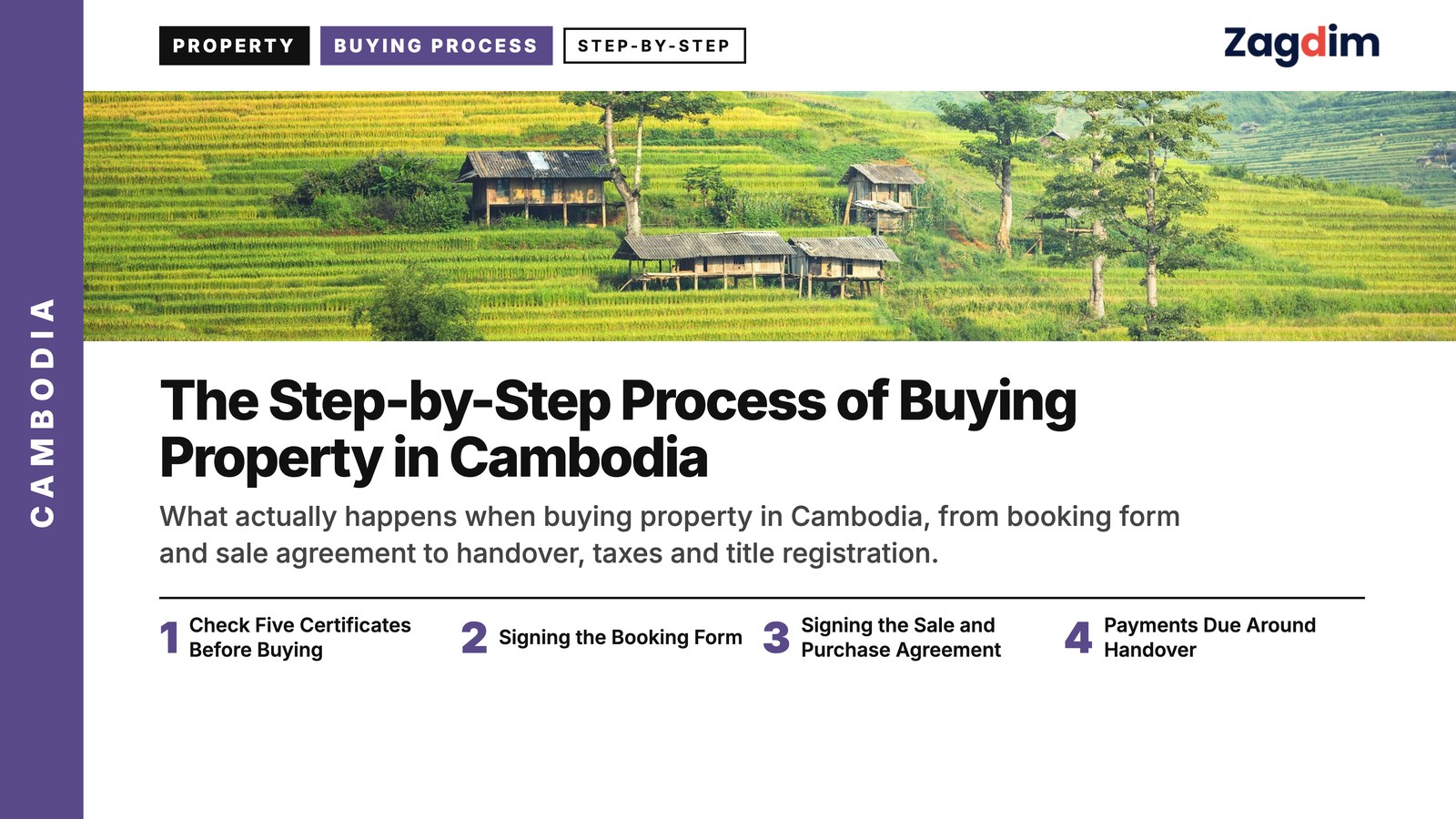
Check Five Certificates Before Buying
Different Cambodian project developers have slightly different sales processes, but they are broadly similar. To protect buyers, before purchasing a unit it is worth checking whether the developer has already obtained the five certificates for that project: a construction commencement permit, a tax registration certificate, a business registration certificate, a construction permit, and a land certificate.
Signing the Booking Form
The first step is finding the unit in the project you want to buy. You then provide the buyer’s passport, personal details and contact information, and pay a deposit of US$2,000 to US$3,000, at which point a developer staff member signs a Booking Form with you. The Booking Form records the buyer, the unit purchased, the price, the size, the payment method, and whether furniture is included, among other details.
Signing the Sale and Purchase Agreement
Next, the buyer generally needs to complete the Sale & Purchase Agreement within about one to two weeks and pay a down payment of roughly 10% to 30%, depending on the buyer’s chosen payment method. This can include paying the full amount in one go (mandatory when buying a completed, ready unit), interest-free instalments paid quarterly or annually, or in some cases a mortgage offered by the developer, which can run for up to more than 20 years, at a typical Cambodian bank mortgage interest rate of around 8% to 9.5%. Compared with a Hong Kong residential mortgage rate of about 2.3–2.5%, or HIBOR plus about 1%, many buyers choose to borrow from a Hong Kong bank to fund the purchase of a Phnom Penh unit, as this can work out cheaper — and taking out a mortgage in Cambodia does not affect the buyer’s credit record in Hong Kong.
The Sale & Purchase Agreement is signed in triplicate. Note that the contract must be in Khmer at minimum, with a Chinese or English version alongside it for reference, so the buyer can also understand the contract; signatures must be accompanied by a blue ink thumbprint (right thumb). The agreement is then returned to the developer for signature and countersigned by the developer’s representative lawyer — generally, the developer covers the legal fee — after which one fully signed and countersigned copy of the agreement is returned to the buyer. This process typically takes around 1.5 to 2 months to complete.
Regardless of who is buying or renting out property in Phnom Penh, Cambodia, all settlement must be made in US dollars. Buyers should pay into the developer’s account according to their chosen payment method, and some developers even hold bank accounts in Hong Kong or mainland China; when making a payment, check carefully that the account name matches the developer’s name before transferring funds. If the buyer chooses a mortgage, after paying the down payment they will need to provide the required mortgage documents and information to the developer to help with the mortgage application, which typically takes around 1.5 to 2 months to process.
Payments Due Around Handover
- If a Hard Title needs to be processed, a registration tax must be paid (4% of the purchase price under the sale contract, or as set by the Cambodian government at the time)
- An annual property tax of 0.1% (calculated according to Cambodian government regulations)
Finally, the Procedures Required at Handover
- Sign and thumbprint the handover documents
- Sign a power of attorney (authorising a company to lease or sell the unit on the owner’s behalf)
- Open a bank account / provide bank details (used by the property management company to collect rent on the owner’s behalf)
- Pay the balance in full at handover
- Pay a deposit equivalent to about three to four months of management fees, to cover management fees and a maintenance/renovation fund
- Sign the residents’ covenant and the property management rules
- After the handover procedures are complete, once the required documents and fees have been prepared, the buyer can process the Hard Title. Registration is handled by the developer, who is responsible for obtaining the property document from the district or sub-district government (Soft Title) or the title registration (Hard Title) and providing it to the buyer. Separately, the developer also pays a 10% VAT (value-added tax).
Having covered the buying and selling process for Cambodian property, readers may have noticed the earlier mentions of Soft Title and Hard Title, or wondered what land ownership actually means — for more detail, see the earlier article on Cambodia’s property titles: Hard Title, Soft Title and Strata Title.
Have a question about this guide? Leave a comment below, or ask Zagdim directly.
Your first stop for international property and global living.
Research and insights. Know what’s changing. Understand what matters.