





























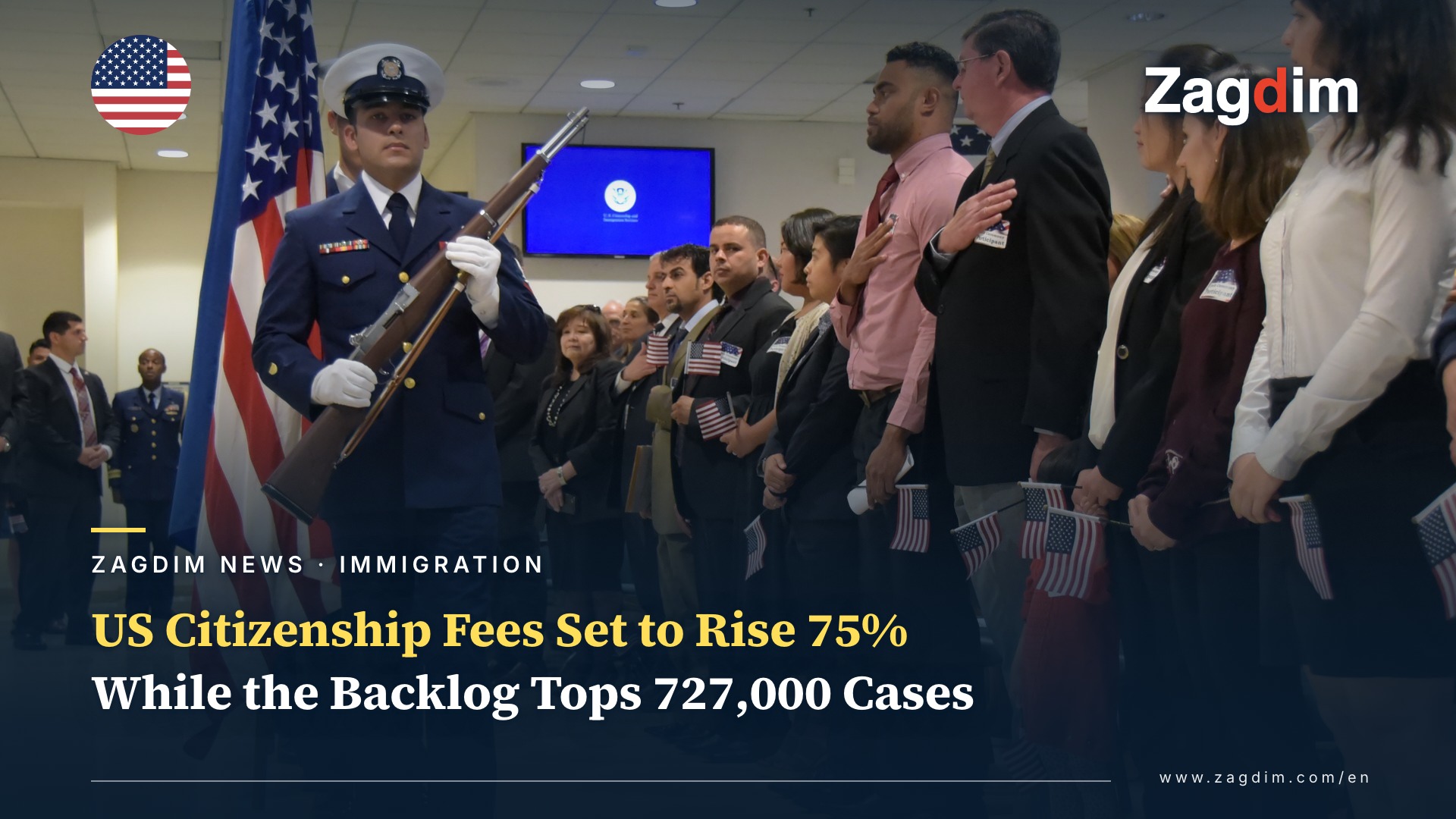
US citizenship is becoming costlier and slower in the same stretch of 2026: the Department of Homeland Security has proposed raising the main naturalization filing fee by 75%, from $760 to $1,330, while US Citizenship and Immigration Services’ own figures show 727,371 citizenship applications (Form N-400) still pending and an average wait of 9.5 months for non-military cases, as of the end of the third quarter of fiscal year 2026. Read separately, a fee proposal and a processing backlog look like two unrelated news items. Read together, they describe one shift in how naturalization works in the United States right now.
This analysis sets out exactly what has changed, who is affected now versus later, and why the same policy direction is driving both the higher price tag and the longer wait.
Event and data status as of 4 October 2026.
A 75 Percent Fee Increase Is Still Just a Proposal
DHS posted the proposed rule to the Federal Register on Monday, 22 June 2026. It would raise the standard paper-filing fee for naturalization from $760 to $1,330 — an increase of $570, or 75%. The fee to request reconsideration of a denied application before an appeals board would rise even more sharply, from $830 to $1,475, a $645 increase, or 77.7%. The rule would also eliminate most existing fee waivers, though current and former members of the US armed forces would remain exempt. Under standard federal rulemaking procedure, the rule cannot take effect until at least 60 days after posting and only after a public comment period — so, as of this writing, applicants still pay the current fees of $760 for a paper N-400 filing, $710 online, or a reduced $380 fee for those who qualify.
DHS’s stated reason for the increase is that current fees do not fully cover the cost “of thoroughly adjudicating applications for naturalization, including necessary screening and vetting checks, which USCIS is continuously enhancing consistent with the President’s Executive Orders.” USCIS funds itself almost entirely from filing fees rather than general tax revenue, so a rise in vetting costs flows directly into the fee schedule. Immigration lawyer Rosanna Berardi, who practices in Buffalo, New York, told ABC News the pattern fits a broader direction: “When you simultaneously raise fees, eliminate waivers, and add new vetting layers like neighborhood checks and expanded ‘good moral character’ scrutiny, you are not streamlining a system. You are building walls inside it.”
The Backlog Is Already Real for Applicants Now in Line
Whatever happens to the fee proposal, the queue itself is already the bigger practical problem for anyone who has already filed. USCIS data covering the third quarter of fiscal year 2026 (April through June 2026) show the agency received about 146,000 new N-400 applications but completed only about 70,500 of them — roughly half the incoming volume. Of the applications it did complete, 57,697 were approved and 12,842 were denied. As Boundless Immigration put it in a weekly summary of the data, “applications are coming in much faster than USCIS is completing them.”
The gap widened further over the summer. In July 2026 alone, USCIS completed 20,674 naturalizations, down 74% from the 80,077 it completed in July 2025. By that point, total pending N-400 cases had climbed further still, to roughly 778,000, with about 485,000 of those unresolved for more than six months. For a reader currently waiting on a decision, the 9.5-month average is already the more concrete number to plan around than a fee that has not been finalized.
The Same Vetting Push Is Behind Both the Cost and the Delay
The fee increase and the backlog are not two separate stories that happen to be competing for attention this year — they trace back to the same decision to expand vetting. DHS’s proposed fee increase is explicitly framed around funding “screening and vetting checks” that USCIS is “continuously enhancing” under presidential executive orders. At the end of April 2026, USCIS acted on that same direction operationally: it activated the FBI’s Next Generation Identification (NGI) background-check system, which required archived fingerprints to be resubmitted for millions of applicants and temporarily halted case adjudications. That step traces to a February 2026 executive order.
The American Immigration Lawyers Association estimates the fingerprint-resubmission requirement alone could lengthen naturalization processing nationwide by 46%. In other words, the policy that DHS says justifies charging applicants more is the same policy USCIS says is making applicants wait longer. A reader who successfully budgets for the new fee once it is finalized is not thereby buying a faster decision — the vetting expansion sits on both sides of the ledger.
A Specific Wave of Applicants Is Adding to the Queue
Supply-side slowdown is not the only force at work; demand has also surged from an identifiable group. Cubans who arrived during the 2022–2023 migration wave — many through the CHNV humanitarian parole program, which admitted about 110,240 Cuban entrants — obtained permanent residency quickly under the Cuban Adjustment Act, which requires only one year and one day of physical presence. Those who adjusted status in 2022 or 2023 are now reaching the five-year permanent-residency mark that makes them eligible to apply for citizenship, adding a wave of new filings on top of the existing queue. Motivation is sharpened by the same uncertainty driving the vetting changes: with CHNV parole cancelled and status reviews under way, citizenship offers legal protection that permanent residency does not guarantee.
A separate, earlier disruption compounds the picture for this group specifically: in December 2025 the administration paused citizenship and residency processing for nationals of 19 countries, including Cuba, and did not lift the final adjudication suspension for Cuban and Venezuelan applicants until July 2026 — months in which no cases from those countries moved forward at all. One further date is worth separating out clearly: a different set of new USCIS fees, unrelated to the N-400 naturalization fee discussed here, is scheduled to take effect on 16 October 2026 for other immigration filings. Applicants whose wait already exceeds USCIS’s published processing time for their office can file an online service request; attorneys note that a federal mandamus lawsuit is a further option in cases of unreasonable delay, though that step should be discussed with an immigration attorney rather than attempted alone.
Zagdim’s View — For someone currently mid-process, the backlog is the number to plan around, not the proposed fee: the 9.5-month average wait is already in effect, while the 75% fee increase still needs to clear a public comment period and cannot take effect for at least 60 days after its June 2026 posting. For someone who has not yet filed, both figures matter together — a higher fee is being proposed at the same time the queue it would help fund is at its most backed up in recent memory, so the practical planning question is less “can I file before the fee rises” and more “what will my realistic wait be regardless of which fee applies.”
References
ABC7 Los Angeles / ABC News – DHS Proposes 75% Increase in Fees for US Citizenship Paperwork / CubaHeadlines – Citizenship Applications Stuck at USCIS Surge Past 727,000: Naturalization Wait Times Now Near 10 Months