





























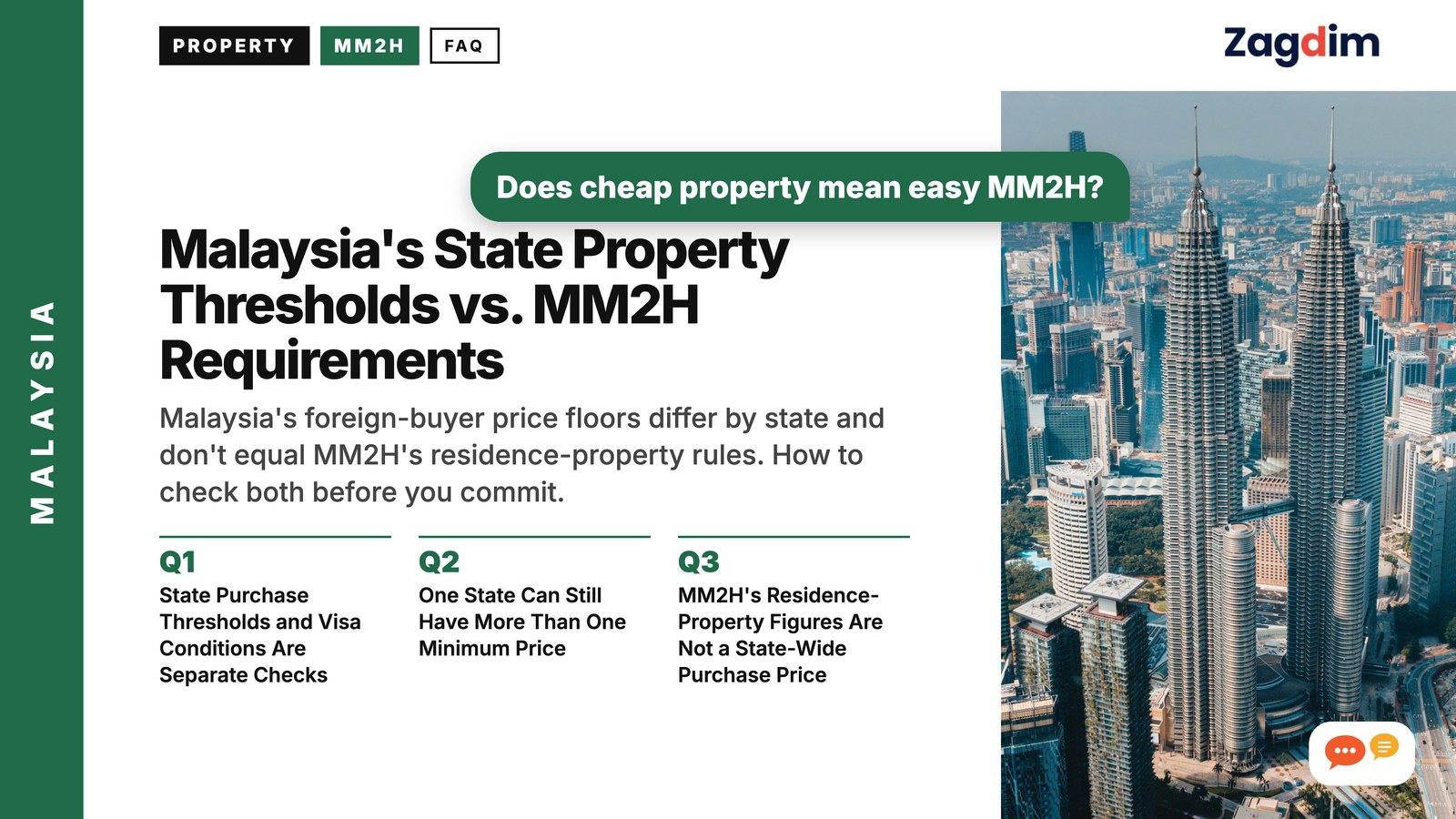
Foreign buyers comparing property in different Malaysian states often ask what the “minimum price” is before they can buy. That number only answers one part of the question. A state’s purchase policy decides which properties a given category of foreign buyer may buy at all; a long-stay visa program such as Malaysia My Second Home (MM2H) has its own separate eligibility, funds and sometimes residence-property requirements. This article sets out why the two have to be checked separately, and together, before a buyer commits to a unit.
State Purchase Thresholds and Visa Conditions Are Separate Checks
A lower purchase threshold in one state does not mean a long-stay visa in that state will be easier to approve. At the same time, some MM2H categories carry their own location and purchase conditions, so it isn’t accurate to say that “which state you buy in makes no difference to any long-stay program” either. Both statements can be partly true depending on the specific program and property, which is why they need to be checked as separate questions rather than inferred from one another.
One State Can Still Have More Than One Minimum Price
Malaysia’s foreign-ownership rules can vary by district, by the property’s intended use, by whether it is landed or strata housing, by the buyer’s own status, and by specific programs the property may be tied to. Title restrictions, Bumiputera quotas and other limits do not disappear just because a unit’s price clears the stated threshold for that state.
When making an enquiry, it helps to give the specific address, project name, unit type, transaction price, title details and buyer status, so a lawyer can verify directly with the land authority. Asking only “what’s the minimum foreigners can buy for in this state” often produces an answer that doesn’t apply to the actual unit in question.
Under the National Land Code, a foreigner acquiring an interest in land or property generally requires approval from the relevant state authority. Sabah and Sarawak each run their own land systems, so a procedure that applies in Peninsular Malaysia should not be assumed to apply nationwide.
MM2H’s Residence-Property Figures Are Not a State-Wide Purchase Price
The current federal MM2H application categories set out the following minimum figures for the residence-property requirement. Applicants approved under earlier terms should confirm the figures that applied to their own approval instead:
| Category | Minimum Residence-Property Value Stated by the Program |
|---|---|
| Silver | RM600,000 |
| Gold | RM1,000,000 |
| Platinum | RM2,000,000 |
These are program requirements, not a foreign-buyer purchase threshold for every state or every unit. A buyer still needs to confirm separately whether the relevant state has specific arrangements for that MM2H category, whether the property qualifies, and what approvals are needed.
For example, the Silver category’s RM600,000 figure does not by itself turn a unit that a given state would otherwise not permit a foreign buyer to purchase into an eligible property. The reverse also holds: a state allowing purchases at a particular price point does not automatically mean that price satisfies the residence-property requirement of whichever MM2H category the applicant has chosen.
Designated-Zone Categories Need Their Own Check on Source and Scope
The federal MM2H program’s Special Economic Zone / Special Financial Zone (SEZ/SFZ) category carries conditions tied to property policy in Johor, and requires buying directly from a developer rather than from an existing owner. The property’s location, the method of purchase, and which categories the arrangement applies to are therefore all things that need to be verified in practice.
This does not mean “buying any new development in Johor automatically qualifies.” A buyer still needs to confirm that the specific project is within the accepted scope, that the applicant meets the full program conditions, and how approval and payment are sequenced.
Sarawak and other states run their own separate long-stay programs, each with its own current guidelines. Figures or property obligations from the federal Silver category should not be carried over to a different state program.
Three Documents to Cross-Check Before Placing a Deposit
| Document | Question It Needs to Answer |
|---|---|
| State purchase policy and the unit’s title records | Can this buyer purchase this unit, and what consents are needed? |
| The chosen long-stay program’s conditions | Does this property’s value, location and purchase method meet the requirement? |
| Sale-and-purchase and application-service documents | If approval, financing or program steps don’t go through, how are the payment and service fees handled? |
Holding and resale restrictions also need checking. If a property was bought specifically to satisfy an MM2H condition, selling or switching it later may not follow the same timeline as an ordinary investment property.
Common Misreadings
“A lower state threshold means the long-stay visa is easier to get.”
A purchase threshold cannot be used to estimate how hard a visa approval will be; that still depends on the applicant’s full set of qualifications.
“Silver lists RM600,000, so any state allows buying at that price.”
The buyer still has to meet the purchase policy that applies to them and to that property in that location, and confirm whether any special arrangement applies.
“A more expensive property gives a stronger guarantee of approval.”
A higher property price cannot substitute for the fixed-deposit, income, background or other program requirements, and does not guarantee approval.
What to Check Next
If you haven’t settled on a location yet, start by narrowing it down based on where you actually want to live, then check the purchase and visa conditions for that area. This avoids buying into a lower threshold that turns out to be a property unsuited for living in or renting out.
If you already have a target unit, bring the property details and the name of the program you plan to apply under to your lawyer and the relevant authority (or a qualified service provider) for confirmation, and keep the response in writing.
FAQ
Q1: Is the foreign-buyer property threshold the same across every Malaysian state?
No. It can also vary within the same state by district, property type or buyer category, so the specific unit needs to be checked.
Q2: Should I check the state purchase threshold or the MM2H residence-property requirement?
Both need to be satisfied, and you should also confirm whether the state has any special arrangement for the relevant program.
Q3: If I buy in a designated zone, does that automatically meet the SEZ/SFZ category?
No. The project, purchase method, applicant eligibility and other conditions still need to be confirmed; the location alone is not enough.
Disclaimer: This article compares general property-purchase and program conditions and is not legal or immigration advice. The figures cited are the residence-property requirements for the stated federal MM2H categories, not a nationwide purchase-threshold table. Actual transactions must be confirmed against the applicable local policy and formal approval. Information verified as of October 6, 2026.
Sources
- MOTAC / MM2H — Official Guidelines and Category Residence-Property Amounts
- MOTAC — SEZ/SFZ Special Conditions: Johor Property Policy and Purchase Method
- JKPTG — Land Transfer and Foreign Buyer Approval Requirements
- Selangor Land and Mines Office — Foreigner Property Acquisition Procedure (State Example)
- Sarawak Ministry of Tourism, Creative Industry and Performing Arts — S-MM2H Application Guidelines 2025
Have a question about this guide? Leave a comment below, or ask Zagdim directly.
Your first stop for international property and global living.
Research and insights. Know what’s changing. Understand what matters.