































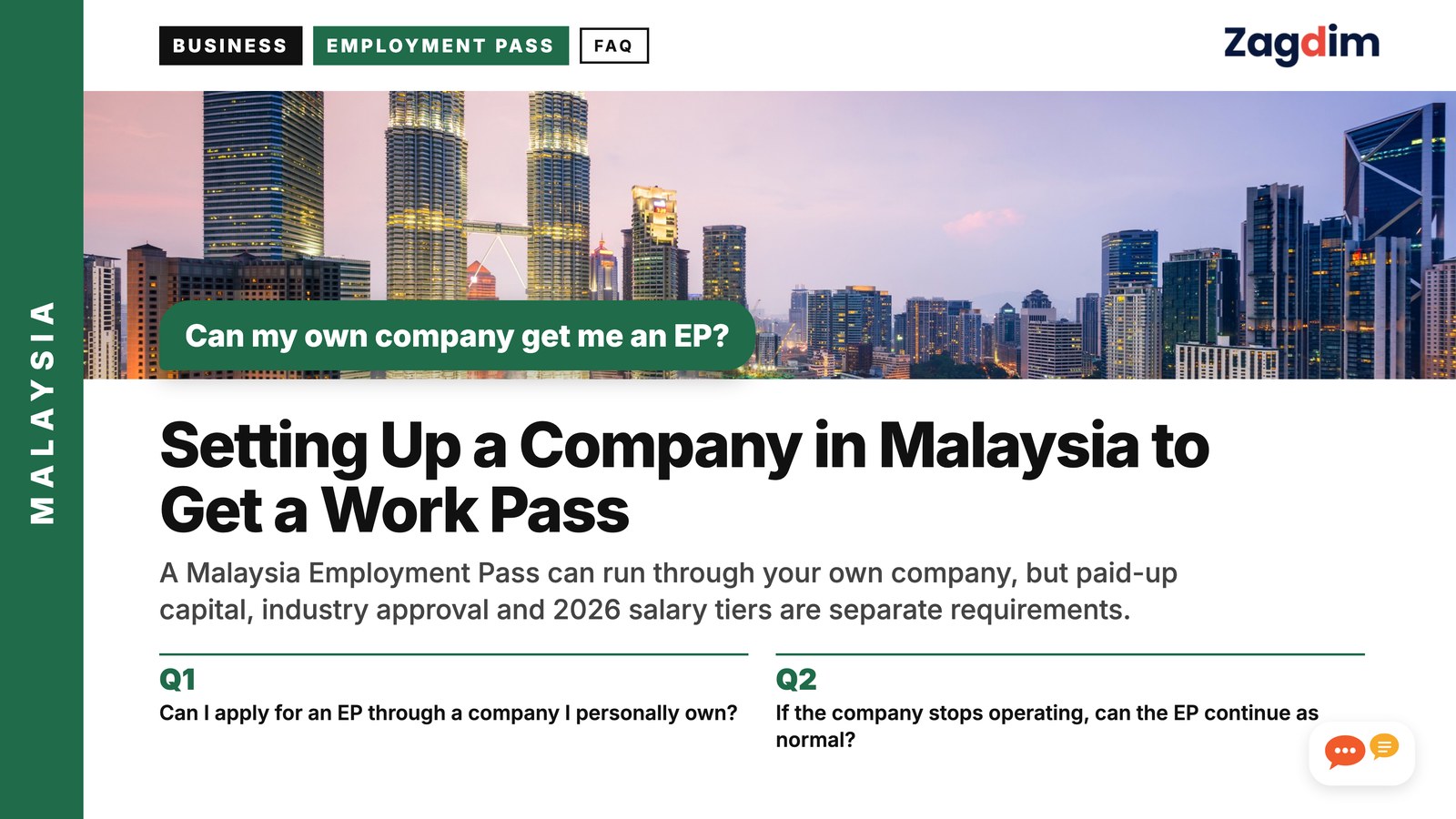
Foreigners who incorporate a company in Malaysia sometimes assume the company itself will clear the way for them to live and work there. It does not work that way. A company you set up and own can sponsor your Employment Pass (EP), but the company and the individual applicant each have to meet separate requirements, and neither one substitutes for the other.
You Can Apply Through Your Own Company, But Both the Company and You Must Qualify
A foreigner can incorporate a company in Malaysia. If that company meets the requirements for hiring foreign staff, and the applicant will hold a suitable position in it, the company can submit an Employment Pass application on the applicant’s behalf.
An Employment Pass is not an automatic add-on once the company is registered. Shareholding status, company incorporation, industry approval, and the individual applicant’s work qualifications are several distinct requirements. Being both a shareholder and a director of the same company does not let you skip any of the approvals.
If the real goal is simply a long-term place to live, with no actual business plan behind it, it is worth comparing other residence options first. Once a company is incorporated, it carries ongoing operating, filing and administrative costs.
Before You Incorporate, Check Shareholding, Directors and Industry Limits
A private company must have at least one director who ordinarily resides in Malaysia and has a principal residence there. A foreigner can be a shareholder, but if they want to be the sole director as well, they still need to meet the relevant residency requirement.
Company law allowing you to incorporate a business does not mean every industry accepts the same level of foreign ownership, or requires no further approval. Confirm the business type, any foreign-ownership limits, premises requirements and industry licensing before settling on a company structure.
A company secretary can help with incorporation and statutory filings, but company registration services cannot substitute for Employment Pass approval.
Paid-Up Capital Is an Application Threshold, Not a Rough Market Figure
Malaysia’s Expatriate Services Division (ESD) public guidebook lists paid-up capital requirements for company registration. These have a defined administrative scope and should not be treated as approximate figures circulating in the market.
| Company Situation | Paid-Up Capital Requirement Listed in the Guidebook |
|---|---|
| Joint-venture company | RM350,000; the guidebook also notes a minimum 30% foreign shareholding |
| 100% foreign-owned company, general category | RM500,000 |
| 51% or more foreign shareholding, involved in wholesale and retail trade (WRT) or designated non-regulated service subsectors | RM1,000,000, and check applicable industry approval |
These are not minimum capital figures that apply to every company at incorporation, and meeting the capital figure does not by itself guarantee EP approval. Individual industries, company types and approving authorities may carry additional requirements, so check against the actual business classification.
Where WRT is involved, confirm whether the related approvals and restrictions apply. Not every trading business can be reduced to “just file one license.”
EP Salary Thresholds Changed in June 2026
New applications and renewals submitted from June 1, 2026 must meet the revised requirements:
| EP Category | Monthly Salary Threshold | Term Listed in the Policy |
|---|---|---|
| Category I | RM20,000 or above | Up to 10 years |
| Category II | RM10,000-19,999 | Up to 10 years, with succession-planning requirement |
| Category III | RM5,000-9,999 | Up to 5 years, with succession-planning requirement |
The maximum term is not the term every application receives. The company still has to justify the need for the position, the applicant’s qualifications and the employment arrangement, and the actual approval can also be affected by the contract and other conditions.
“Setting your own salary” still requires a genuine employment and payment arrangement behind it. Filling in a number on the application form that happens to clear the threshold does not, by itself, satisfy the requirement.
After Approval, Your Work Pass Stays Tied to the Company and Role
An EP holder must work within the arrangement approved for that employer. If the company changes, the role changes, or the company stops operating, check promptly whether the pass needs to be reapplied for, amended or cancelled.
The company’s statutory filings, accounting, tax obligations and applicable licenses also need ongoing attention. Budgeting should cover salary, office space, staff and professional fees, not just the one-time paid-up capital figure.
Common Misunderstandings
“I own the company, so I don’t need a work pass.”
Holding equity does not equal permission to work in Malaysia. Whether you are actually performing work, and which type of pass that requires, needs to be confirmed against the specific arrangement.
“A foreign-owned company just needs RM500,000 ready and that covers it.”
The general category and arrangements like WRT or designated service industries are not the same. You cannot judge this by the word “foreign-owned” alone.
“If the salary reaches Category I, a 10-year approval is guaranteed.”
Ten years is a policy ceiling, not a commitment for any individual application. Other approval conditions still apply.
What to Check Next
Start by setting out clearly what the company will actually do, where its customers are, and who will run operations. Then confirm shareholding, paid-up capital and industry approval. After that, check the position, salary, qualifications and the EP procedure itself. Only at the end should you estimate the full operating budget and the household’s living costs.
Frequently Asked Questions
Can I apply for an EP through a company I personally own?
Yes, provided both the company and the individual applicant meet the requirements. Registering the company does not automatically result in approval.
Is the paid-up capital requirement the same as the minimum capital for incorporating a company?
No. These are different concepts. ESD registration, industry approval and company incorporation each carry their own applicable requirements.
If the company stops operating, can the EP continue as normal?
Do not assume it can. Follow the correct procedure for the actual change and the pass’s conditions, since this can also affect renewal.
Note
This article is based on official information accessible as of October 8, 2026, and does not constitute company formation, legal, tax or immigration advice. The 2025 ESD guidebook is used here only for the company registration requirements; the salary figures and terms reflect the policy that took effect in 2026. Individual cases should still be checked against subsequent announcements and approval conditions.
Sources
SSM — Starting a Company; SSM — Companies Act 2016 FAQ, Part C; ESD — Online Guidebook V6 (2025, company registration and capital requirements); ESD — Revised Employment Pass Salary Policy, Effective 1 June 2026; ESD — Employment Pass
Have a question about this guide? Leave a comment below, or ask Zagdim directly.
Your first stop for international property and global living.
Research and insights. Know what’s changing. Understand what matters.