






























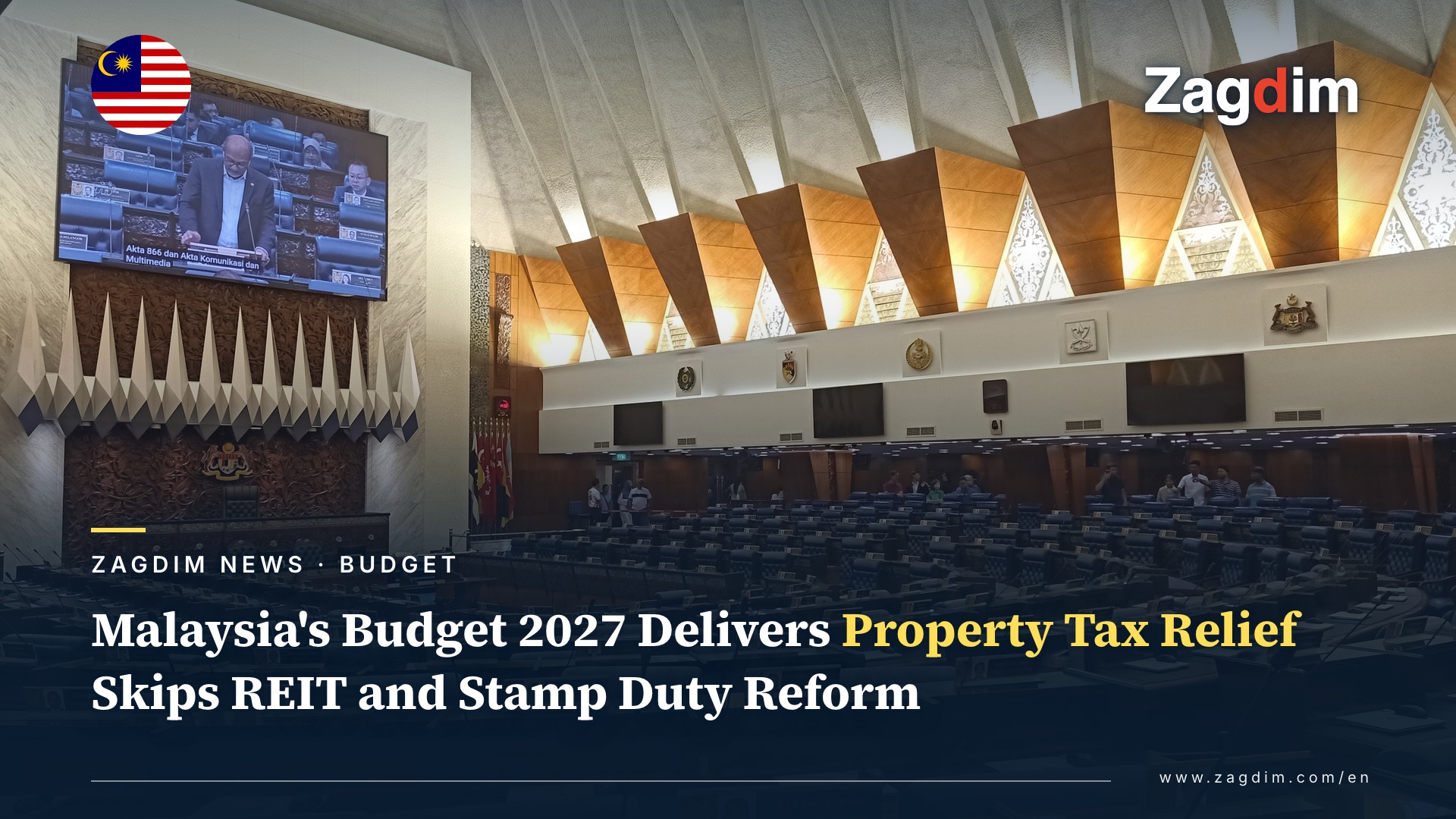
Malaysia’s Budget 2027, tabled by Prime Minister and Finance Minister Anwar Ibrahim in the Dewan Rakyat on October 9, 2026, extends and widens stamp duty exemptions for first-time homebuyers and troubled housing projects through December 31, 2030, but the tabled measures do not include the two structural reforms the property and real estate investment trust (REIT) industry had specifically asked for going into this budget: a simplification of the Stamp Act 1949’s duty schedule, and restoration of a lapsed REIT withholding-tax concession.
What Budget 2027 Actually Changes for Property Buyers
The measures that were tabled are targeted exemptions, not a rewrite of how stamp duty works. For first-time buyers of homes priced up to RM500,000, Budget 2027 provides a full stamp duty exemption on both the loan agreement and the instrument of transfer. For first homes priced between RM500,000 and RM750,000, buyers get a full exemption on the first RM500,000 and a 50% exemption on the remaining amount. Both tiers apply to sale and purchase agreements executed from January 1, 2027 to December 31, 2030.
A separate measure targets a long-running problem rather than new buyers: rescue contractors or developers, and the original purchasers, of abandoned housing projects get a full stamp duty exemption on loan agreements and transfer instruments over the same 2027-2030 window. Anwar framed this as part of a push toward “zero abandoned housing projects by 2030.” For overseas Malaysians and foreign buyers tracking the market, these are relief measures layered on top of the existing stamp duty regime — they lower the cost of a specific transaction type and a specific buyer problem, within specific price bands and dates, rather than changing the underlying rules that determine how any property transaction is taxed.
The Stamp Duty Simplification That Didn’t Come
Before the budget, Soh Lian Seng, head of tax at KPMG in Malaysia, wrote in The Star (August 19, 2026) that Budget 2027 was the opportunity to advance a different kind of reform: simplifying the First Schedule of the Stamp Act 1949 itself. His argument was that the schedule’s complexity — not the exemption amounts — is what creates uncertainty, since taxpayers “generally do not object to paying the right amount of tax” but want “clarity, consistency and predictability” in how documents are classified and taxed in the first place. He credited the Inland Revenue Board with digitalising stamp duty processing and introducing self-assessment, but said documents that already qualify for exemption still get held up by administrative endorsement steps that add compliance cost without changing the tax outcome.
That specific ask — schedule simplification, as distinct from targeted exemptions — does not appear in the measures Anwar announced on October 9, and it is also absent from the post-budget tax commentary available as of this writing, including an October 12 Edge Malaysia roundup of tax advisers’ reactions to the budget (featuring PwC Malaysia’s Steve Chia) that covers the first-home and abandoned-project stamp duty exemptions in detail without mentioning the First Schedule. For a reader trying to judge how Malaysia’s property-transaction costs will behave beyond the specific bands and dates named in this budget, the practical read is that the underlying duty structure KPMG flagged as a source of “interpretational disputes” going into Budget 2027 is, on the public record so far, unchanged by it.
M-REITs: A Specific Ask Met With Budget Silence
The REIT sector went into Budget 2027 with a narrower, more quantified ask than the stamp duty debate. According to The Edge Malaysia (via EdgeProp.my, September 22, 2026), the Malaysian REIT Managers Association (MRMA) asked the government to restore the preferential 10% withholding tax that applied to REIT distributions to non-corporate unit holders from 2016 to 2025 before lapsing; AmFIRST REIT’s deputy CEO, Zuhairy Md Isa, said MRMA separately proposed raising the statutory gearing limit for REITs from 50% to 60% of total asset value to give REITs more flexibility to invest. Zuhairy argued the lapsed concession leaves Malaysian REITs at a disadvantage: “without the withholding tax, we actually lost out to Singapore, Hong Kong and all the other REIT jurisdictions,” he told the paper. CGS International Research, cited in the same reporting, estimated that restoring the withholding tax would remove a 50-100 basis point drag on post-tax yields for the sector — a named analyst’s own estimate, not a Zagdim projection.
Government officials had already signalled before the budget that the concession’s return was not guaranteed: a Finance Ministry deputy minister said earlier this year that, for what is now a “mature and viable” REIT sector, the government “may need to reconsider” whether the support is still necessary. Neither the withholding-tax restoration nor the gearing-limit increase appears among the measures Anwar announced on October 9, and — as with the stamp duty schedule — neither surfaces in the post-budget tax-adviser commentary reviewed for this piece. That is an absence across the sources checked, not a confirmed rejection; Zagdim has not seen an explicit government statement saying the REIT asks were declined, and MRMA had not, as of this writing, published a reaction to the tabled budget specifically. Readers holding or weighing M-REIT exposure should treat the withholding-tax treatment introduced under the Inland Revenue Board’s 2026 practice note as the standing position until MRMA, the Securities Commission, or the Finance Ministry says otherwise.
Zagdim’s View — The property measures in Budget 2027 are real and dated: if a first-time buyer’s sale and purchase agreement is signed between January 1, 2027 and December 31, 2030 and the home is priced at or under RM750,000, the stamp duty exemption applies as described above. What the budget does not do is change the two things the property and REIT industry had been asking for since well before October 9 — a simpler stamp duty schedule, and a restored REIT tax concession. Both remain open questions rather than settled ones, and readers with a specific transaction or holding at stake should confirm current treatment with a tax adviser or the relevant REIT manager rather than relying on budget-day headlines alone.
References
The Star – Budget 2027: Govt Proposes Stamp Duty Exemptions for First-Time Homebuyers / EdgeProp.my (The Edge Malaysia) – Malaysian REIT Managers Call for Return of Withholding Tax Relief in Budget 2027 / The Star Insight – Tax Wish List for a More Competitive Malaysia / The Edge Malaysia – Tax Experts See Targeted Relief for Middle-Income Taxpayers in Budget 2027