

































How Much Can a UK Landlord Raise the Rent? In England, Once a Year With Two Months’ Notice, and No Legal Percentage Cap
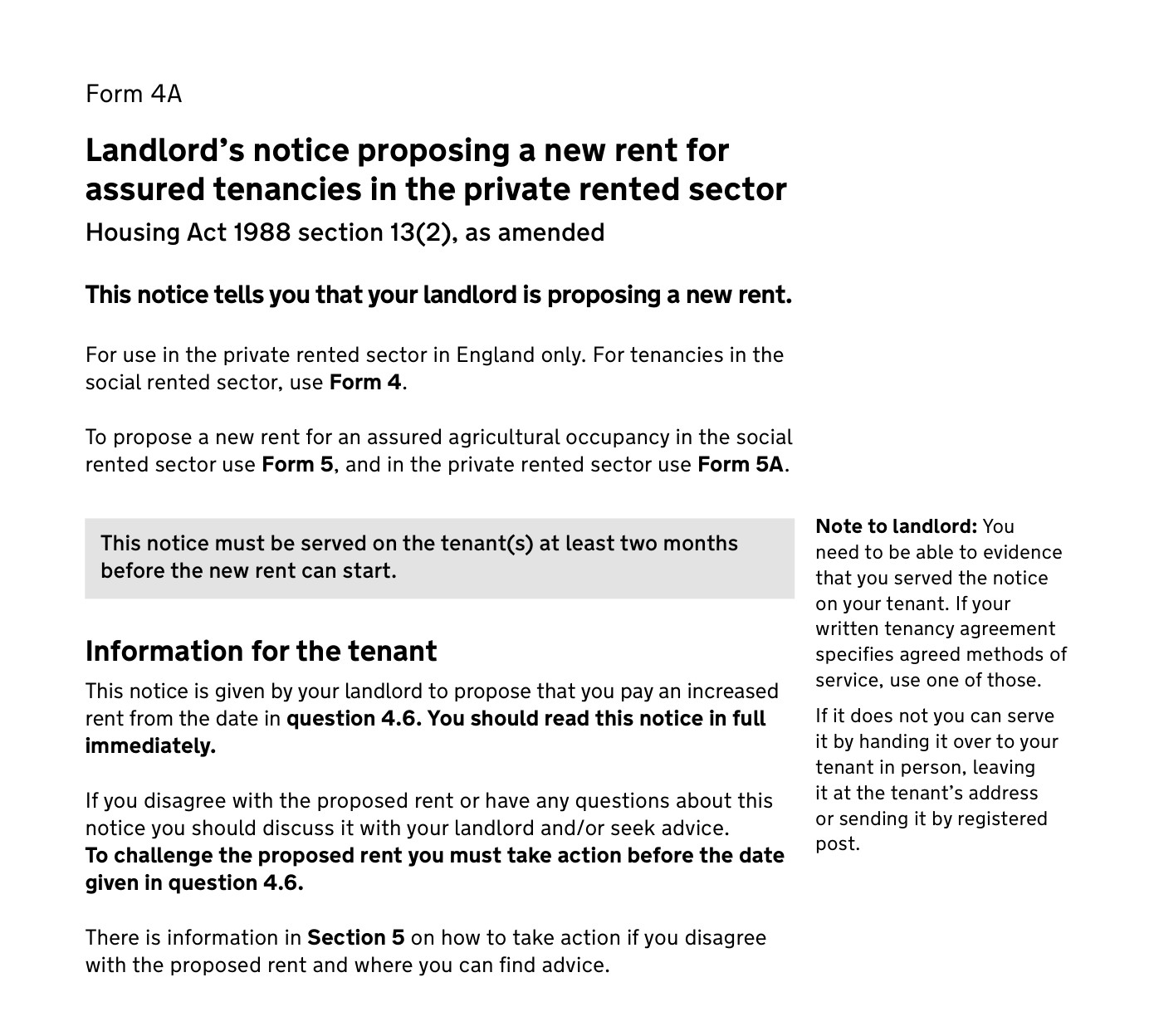
UK rent increase rules in England changed on 1 May 2026: under section 13 of the Housing Act 1988, as amended by the Renters’ Rights Act 2025, a private landlord can raise the rent only by serving a Form 4A notice at least 2 months before the new rent starts, and no earlier than 52 weeks after the tenancy began or the last increase. The legislation sets no percentage cap, but a tenant can apply to the First-tier Tribunal before the new rent starts to have the market rent decided, and the tribunal cannot set the new rent above what the landlord proposed.
On 19 October 2026, MyLondon reported that, according to the Hamptons rent index, the average new-let rent in Great Britain was £1,433 a month in September, 2.7% higher than a year earlier, and that tenants renewing faced an average increase of 5.6% (as relayed by the media).
This guide uses that report as a starting point. It explains how rent increases work in England after 1 May 2026, how much a landlord can ask for, and what a tenant can do on receiving a notice. It also separates the rules that are already in force from those announced but not yet in force and those still only planned, and shows that Wales, Scotland and Northern Ireland have their own rules.
Key Points
- Who should pay attention: international residents and newly arrived families in England (including BN(O) visa holders), students, anyone about to sign a new tenancy, and overseas owners who let out property in the UK.
- From 1 May 2026, fixed terms no longer exist in England. Existing tenancies became rolling periodic tenancies, so there is no “renewal”; there is only a rent increase notice from the landlord.
- A landlord has one route: Form 4A, at least 2 months’ notice and at least 52 weeks between increases. Rent review clauses in the tenancy agreement no longer work. The legislation sets no percentage cap; the safeguard is that a tenant can ask the tribunal to decide the market rent, for a £47 fee.
- A tenant must apply before the new rent start date and tell the landlord. If nothing is done, the new rent starts on the date in the notice.
- Rent disputes are due to move to HMRC’s Valuation Office, announced on 9 September 2026, but no start date has been published; until the new service opens, applications still go to the First-tier Tribunal.
How UK Rent Increase Rules Work in England: Form 4A, 2 Months’ Notice and 52 Weeks Between Increases
Everything below comes from section 13 of the Housing Act 1988 (as amended by section 6 of the Renters’ Rights Act 2025) and the government’s Form 4A guidance. It applies to private assured tenancies in England (not social housing):
| Item | Rule | In practice |
|---|---|---|
| How to raise the rent | The landlord serves a Form 4A notice stating the new rent and the date it starts | A verbal request, a message or a clause in the tenancy agreement cannot replace the notice |
| Notice period | At least 2 months from the day the notice is served | The new rent starts at the beginning of a rental period, for example the 1st of the month |
| First increase | Not before 52 weeks after the tenancy began | No increase in the first 12 months |
| Later increases | The new rent cannot start earlier than 52 weeks after the last increase took effect | At most once a year |
| Rent review clauses in the agreement | The legislation states that, apart from a notice, an agreement or a tribunal decision, any term saying the rent will or may rise has no effect | Since 1 May 2026, a rent review clause cannot be used to raise the rent |
| How the notice is delivered | In person, by post, or by email where the tenancy agreement allows it | The landlord must be able to prove it was served |
There is a transitional rule for tenancies where the landlord raised the rent under a rent review clause before 1 May 2026: a later Form 4A rent cannot start within 52 weeks of that increase. Notices served before 1 May 2026 follow the old rules.
How Much Can a UK Landlord Raise the Rent? There Is No Percentage Cap, but the Market Rent Test Applies
The rules set no limit such as “a maximum of X% a year”. A landlord can propose any amount, but a tenant who thinks it is above the open market rent can challenge it. The open market rent is the rent the landlord could reasonably expect to receive if the property were let on the open market. The rent the tribunal decides can be lower than, or equal to, the amount the landlord proposed.
So an index figure such as Hamptons’ new-let rent or renewal increase describes the market. It is not a legal ceiling on what a landlord can ask. The tribunal looks at what the same property, on the same terms, would let for.
What to Do When You Get a UK Rent Increase Notice: Accept, Negotiate, Apply to the Tribunal or Move Out
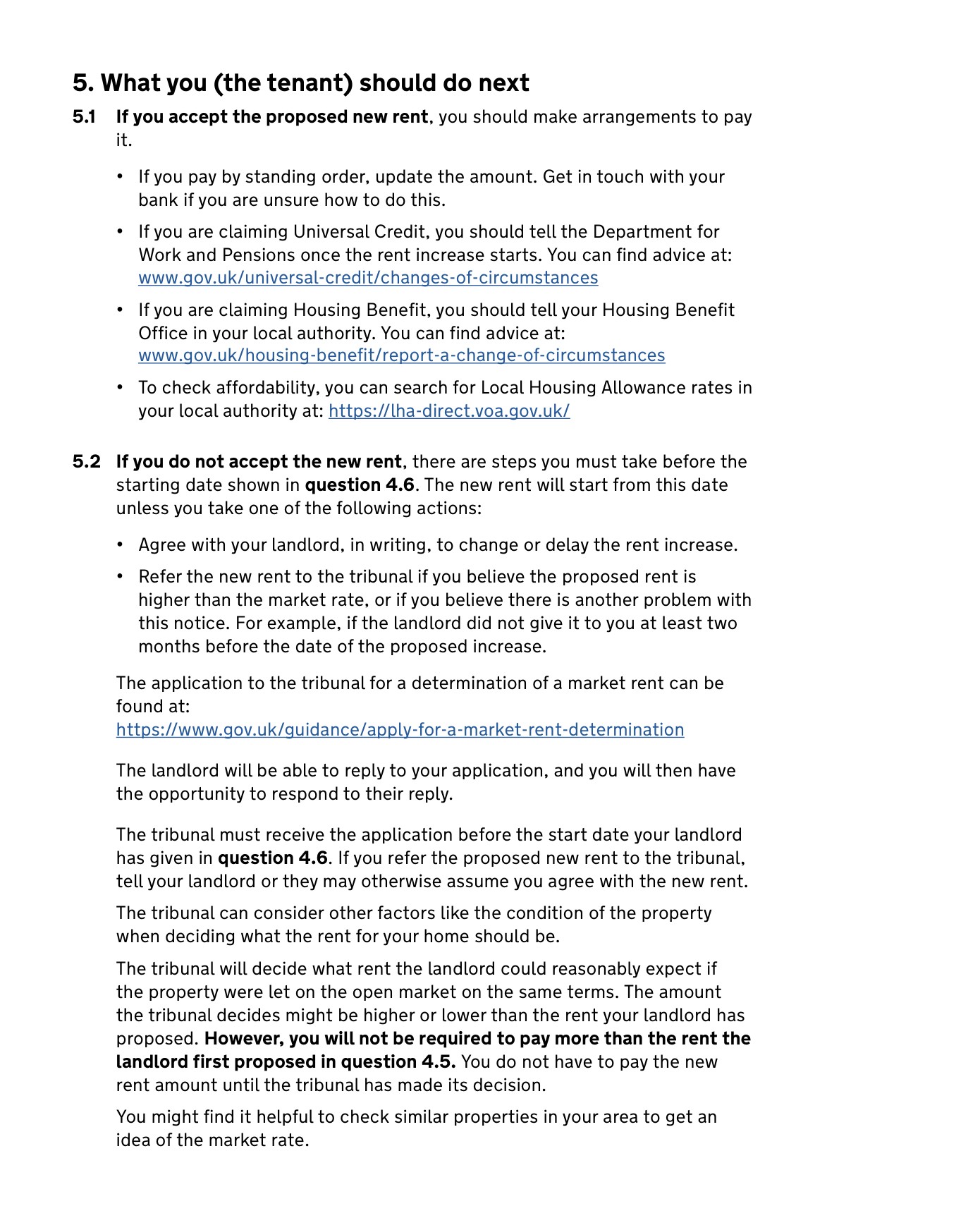
Before the new rent start date, a tenant who receives a Form 4A has several options. The table follows the government’s Form 4A guidance, the MR1 form notes and the tenant overview:
| Option | What to do | Result |
|---|---|---|
| Accept | Pay the new rent from the start date; if you receive Universal Credit or Housing Benefit, report the change | The new rent applies |
| Negotiate | Agree a lower amount, or a later start date, with the landlord in writing | The written agreement applies |
| Apply to the tribunal | Before the start date, apply on form MR1 for a market rent decision, and tell the landlord | You do not have to pay the new rent until the tribunal has decided |
| End the tenancy | Give 2 months’ written notice, ending on the rent due day or the day before | You still pay rent during the notice period |
If you do nothing, the new rent starts on the date in the notice. If the notice itself is flawed (for example, too little notice), you can also ask the tribunal to decide whether the notice is valid.
Applying to the Tribunal for a Market Rent: Form MR1, a £47 Fee and the Start-Date Deadline
According to the government’s application guidance and the MR1 form (August 2026 version):
- You apply to the First-tier Tribunal Property Chamber, online or on form MR1 by post or email.
- The fee is £47. It is waived if the landlord’s notice was served before 1 May 2026 or if you live in social housing, and people with little savings or on a low income can apply for help with fees.
- The tribunal must receive your application before the new rent start date shown in the notice, even if you are still gathering evidence. Tell your landlord too, or they may assume you agree.
- Include details of the property (size, equipment, photographs, repairs) and the rents of similar nearby properties. The guidance says evidence from actual agreed lettings is stronger than advertised asking rents.
- If you argue that paying the new rent from the start date would cause hardship, you must set out your finances in the application; the tribunal can set a later start date, which must fall within 2 months of its decision.
The new rent normally starts on the date in the notice if that date is on or after the tribunal’s decision. If the decision comes after that date, the new rent normally starts from the next payment date after the decision, and is not normally collected back to the notice date.
How the Tribunal Decides a Market Rent: A Decision From 17 July 2026
A published First-tier Tribunal decision (case CAM/26UH/MRA/2026/0004, dated 17 July 2026) shows the approach. It concerned a third-floor, two-bedroom build-to-rent flat in Stevenage, Hertfordshire. The landlord served a notice on 20 May 2026 proposing to raise the monthly rent from £1,282 to £1,675 from 1 August 2026, and the tenant applied on 5 June 2026.
Using the comparable properties offered by both sides and its own expertise, the tribunal put the market rent for the flat in good condition and including parking at about £1,625. Because parking was charged separately at £75 for this flat, it deducted that amount and set the rent at £1,550, effective 1 August 2026. The increase fell from the £393 the landlord proposed to £268. The tribunal also noted that the tenant’s comparables lacked the development’s roof terrace, gym and members’ lounge, so they could not be compared directly, and it gave little weight to the tenant’s evidence of financial difficulty because the document was more than a year old, so it did not delay the start date.
The decision shows that comparables must resemble your own home, that items included in or charged on top of the rent are compared separately, and that evidence of hardship needs to be up to date.
UK Rent Increase Rules Timeline: What Is in Force, What Is Announced and What Is Planned
The table below is accurate as of 19 October 2026. The source differs for each row:
| Item | Status | Date | Source |
|---|---|---|---|
| End of fixed terms and section 21, Form 4A rent increases, market rent challenges, ban on rental bidding, limits on rent in advance | In force (assured tenancies other than social housing) | 1 May 2026 | Commencement Regulations SI 2026/421, regulations 2 and 3 |
| Landlords to give existing tenants with written tenancies the government Information Sheet | Deadline has passed | 31 May 2026 | Government tenant overview and roadmap |
| Landlord registration service (Register your rental property) | Date announced, not yet started | From 15 December 2026, starting in the West Midlands and rolling out by region; all let properties to be registered by 14 November 2027 | Government press release, 9 September 2026 |
| Rent disputes decided by HMRC’s Valuation Office | Direction announced, start date not yet published | Not yet published; until then applications go to the First-tier Tribunal | Government press release, 9 September 2026 |
| New tenancy system for social housing assured tenancies (private registered providers) | Not yet in force | Not yet published | SI 2026/421, regulation 2, and the roadmap |
| Private rented sector Landlord Ombudsman | Planned | Mandatory membership expected in 2028; no firm date | Government roadmap (13 November 2025) |
| Decent Homes Standard and Awaab’s Law for private renting | Planned | Timing depends on consultation, marked “TBC” | Government roadmap |
The Renters’ Rights Act 2025 received Royal Assent on 27 October 2025, but its provisions are switched on in stages by commencement regulations. Check legislation.gov.uk and GOV.UK for the latest dates; where no date has been published, this guide does not guess one.
Rent Increase Rules in Wales, Scotland and Northern Ireland Are Different
UK rent increase rules are not one national system. The first phase of the Renters’ Rights Act covers England only. The other three nations have their own laws, and the source differs for each row:
| Nation | Frequency and notice | Form and challenge route | Source |
|---|---|---|---|
| Wales | At least 2 months between notice and the new rent; the first notice can specify any date, and later new rents must start at least 1 year after the last new rent took effect | Form RHW12; this guide does not cover the challenge route, so check Welsh Government guidance | Renting Homes (Wales) Act 2016, section 123; gov.wales form RHW12 |
| Scotland (private residential tenancy) | Only once in 12 months; at least 3 months’ written notice; no cap on the amount | Prescribed notice form; a tenant who disagrees can apply to Rent Service Scotland within 21 days of getting the notice; the rent officer’s figure can be higher or lower than the landlord’s; there is a review and then an appeal to the First-tier Tribunal for Scotland, which is free | mygov.scot tenant guidance |
| Northern Ireland | From 1 April 2025, no increase within 12 months of the tenancy starting or the last increase; at least 3 months’ written notice (electronic notice allowed) | A second increase within 12 months has no effect on the tenant | Department for Communities and nidirect |
Scotland also has rent control areas under the Housing (Scotland) Act 2025. From 1 April 2026, local authorities must assess rent conditions, with first reports due by 31 May 2027. Once ministers designate a rent control area, increases are capped at the Consumer Price Index (CPI) plus 1%, up to a maximum of 6%. The government’s page does not list any designated area or designation date.
Common Misconceptions About UK Rent Increase Rules
- Misconception: the UK has a “maximum X% a year” cap. The English legislation sets no percentage cap; the real safeguard is the tribunal’s market rent decision. The CPI plus 1%, maximum 6%, cap in Scotland applies only to areas designated in future. Tip: check which nation you live in before applying any rule.
- Misconception: if the agreement says rent rises every year, the landlord can simply apply it. In England, from 1 May 2026, automatic rent increase clauses have no effect; the only route is Form 4A. Tip: a clause in the agreement does not remove the need for a notice.
- Misconception: if I disagree, I can simply not pay the new rent. The new rent starts on the date in the notice unless the tenant agrees something in writing with the landlord, or applies to the tribunal before that date and tells the landlord. Tip: unpaid rent becomes arrears, and rent arrears are among the grounds a landlord can use to seek possession.
- Misconception: applying to the tribunal could make the rent even higher. The legislation and the Form 4A guidance both say a tenant will not be required to pay more than the rent the landlord first proposed. Tip: still prepare comparables, because the tribunal may decide that the landlord’s figure is the market rent.
- Misconception: rent can only go up when the tenancy is renewed. Fixed terms have gone in England and tenancies simply roll on, so a landlord can serve Form 4A at any time as long as the notice period and the 52-week gap are met. Tip: count the 2 months and the 52 weeks, then check the start date.
Scenarios: UK Rent Increase Rules for Three Kinds of Readers
Scenario 1: an English tenant whose rent last rose on 1 February 2026 and who receives a Form 4A on 20 November 2026. The notice asks for the monthly rent to rise from £1,200 to £1,350 from 1 February 2027 (a hypothetical example). Two months after the notice is 20 January 2027, and 52 weeks after the last increase is 31 January 2027, so 1 February meets both conditions. A tenant who thinks £1,350 is above the market must apply to the tribunal before 1 February 2027 and tell the landlord; if the notice has a procedural flaw, they can also ask the tribunal to decide whether it is valid.
Scenario 2: a newly arrived family about to sign a new tenancy. Since 1 May 2026, a written advert must state a specific rent, and landlords and agents may not invite or accept offers above the advertised rent. No rent may be taken before signing, and after signing, up to one month’s rent can usually be taken before move-in. Within 6 months of the tenancy starting, a tenant who thinks the agreed rent was excessive can also apply to the tribunal.
Scenario 3: an overseas owner who lets out UK property and wants to raise the rent next month. First check the tenancy start date and the date of the last increase, then work out the earliest start date: at least 2 months after the notice is served and at least 52 weeks after the last increase, on Form 4A, keeping proof of service. In practice, a proposed rent is usually based on the achieved rents of similar properties nearby, because the tenant can challenge it and the tribunal decides by market rent.
UK Rent Increase Rules: Frequently Asked Questions
How often can a landlord raise the rent under the UK rent increase rules?
In England, the new rent cannot start earlier than 52 weeks after the tenancy began or after the last increase, so in practice once a year, on a Form 4A with at least 2 months’ notice. Scotland allows one increase in 12 months with 3 months’ notice, Northern Ireland also allows one in 12 months with 3 months’ notice, and Wales requires 2 months’ notice and at least a year between new rents.
Is there a cap on rent increases under the UK rent increase rules?
The English legislation sets no percentage or amount cap. A landlord can propose any figure, but a tenant can ask the tribunal to decide the market rent, and the tribunal’s decision cannot be higher than the landlord’s proposal. The Scottish cap of CPI plus 1%, up to 6%, applies only to rent control areas to be designated in future; the government’s page lists no designation date.
By when must a tenant act after receiving a rent increase notice?
Before the new rent start date shown in the notice. To go to the First-tier Tribunal, the tribunal must receive form MR1 before that date and you should tell your landlord; to negotiate, agree the change in writing before that date. In Scotland, the application to Rent Service Scotland must arrive within 21 days of receiving the notice.
Does challenging a UK rent increase at the tribunal cost anything?
In England the fee is £47. It is waived where the landlord’s notice was served before 1 May 2026, and people on a low income can apply for help with fees. Attach the tenancy agreement, the landlord’s notice, property details and photos, and the achieved rents of similar properties; signed tenancy agreements carry more weight than advertised rents. Appeals to the tribunal in Scotland are free.
Can a fixed-term tenancy still end and renew under the UK rent increase rules?
In England, fixed terms were abolished on 1 May 2026. Existing tenancies became periodic, as did new ones, and any end date in an agreement no longer applies. A landlord cannot use section 21 no-fault possession, and a tenant can leave by giving 2 months’ written notice. Wales, Scotland and Northern Ireland have their own tenancy systems.
Who will decide UK rent increase disputes in future?
The government announced on 9 September 2026 that HMRC’s Valuation Office will decide challenges to rent increases in England in place of the First-tier Tribunal. No start date has been published. Until the new service opens, tenants must still apply to the First-tier Tribunal, and applying means they do not have to pay the higher rent until the tribunal has made its final decision.
Renting or Signing a Tenancy in the UK? Ask Zagdim
If you want to understand renting, signing a tenancy and living in the UK, or compare tenancy conditions in different cities, Ask Zagdim.
Life abroad? Ask Zagdim.
Your first stop for international property and global living.
Research and insights. Know what’s changing. Understand what matters.
Newsletter for overseas updatesSubscribe →
Important Disclaimer
This article is general information only and is not legal advice. It is based on material published in 2025 and 2026 by legislation.gov.uk, the UK government (GOV.UK), the Welsh Government, the Scottish Government and the Northern Ireland Department for Communities. Later phases of the Renters’ Rights Act, the new rent determination body and the rules in each nation may change, and the type of tenancy (for example social housing, a resident landlord or student halls) affects which rules apply. The latest official notices prevail, and for any dispute you should consult a qualified UK legal professional or an advice service such as Shelter or Citizens Advice.
Information is current as of 19 October 2026; please check the latest official notices from legislation.gov.uk and GOV.UK.
References
legislation.gov.uk – Renters’ Rights Act 2025, section 6 (Statutory procedure for increases of rent) / legislation.gov.uk – Renters’ Rights Act 2025, section 7 (Challenging amount or increase of rent) / legislation.gov.uk – The Renters’ Rights Act 2025 (Commencement No. 2 and Transitional and Saving Provisions) Regulations 2026 / legislation.gov.uk – Housing Act 1988, section 13 / UK Government – Renters’ Rights Act overview for tenants / UK Government – Assured periodic tenancies: a guide for tenants (Rent increases) / UK Government – Apply for an open market rent determination (updated 10 August 2026) / UK Government – Form MR1: Apply for a determination of an open market rent (08.26) / UK Government – Form 4A: Landlord’s notice proposing a new rent (05.26) / UK Government – Guide to the Renters’ Rights Act / UK Government – Implementing the Renters’ Rights Act 2025: our roadmap (13 November 2025) / UK Government – Stronger protections and greater confidence for renters (9 September 2026) / First-tier Tribunal Property Chamber – Decision CAM/26UH/MRA/2026/0004 (17 July 2026) / legislation.gov.uk – Renting Homes (Wales) Act 2016, section 123 / Welsh Government – Notice of variation of rent: form RHW12 / Scottish Government (mygov.scot) – Rent increases if you have a private residential tenancy / Scottish Government – Rent controls (Private renting) / Northern Ireland Department for Communities – Sections 7 & 12 of Private Tenancies Act (Northern Ireland) 2022 / nidirect – Private rent and tenancies / MyLondon – Newly agreed rent price rising at fastest rate in years – how much you will pay (19 October 2026, relaying the Hamptons rent index) / Zagdim – Renters’ Rights Act comes into force: What tenants and landlords in England need to know / Zagdim – UK Landlords Lose 73% of Rent Tribunal Cases, Data Shows / Zagdim – UK Landlords Lean Harder on Tenant Referencing After Advance-Rent Ban